The word anticipate means to expect something before it happens. Imagine a student waiting for exam results. The student checks the website again and again, thinking about the possible outcome. In this moment, the student anticipates the result.
This word is common in daily conversations, academic writing, and professional communication. People use it when they talk about planning, predicting, or preparing for something in the future.
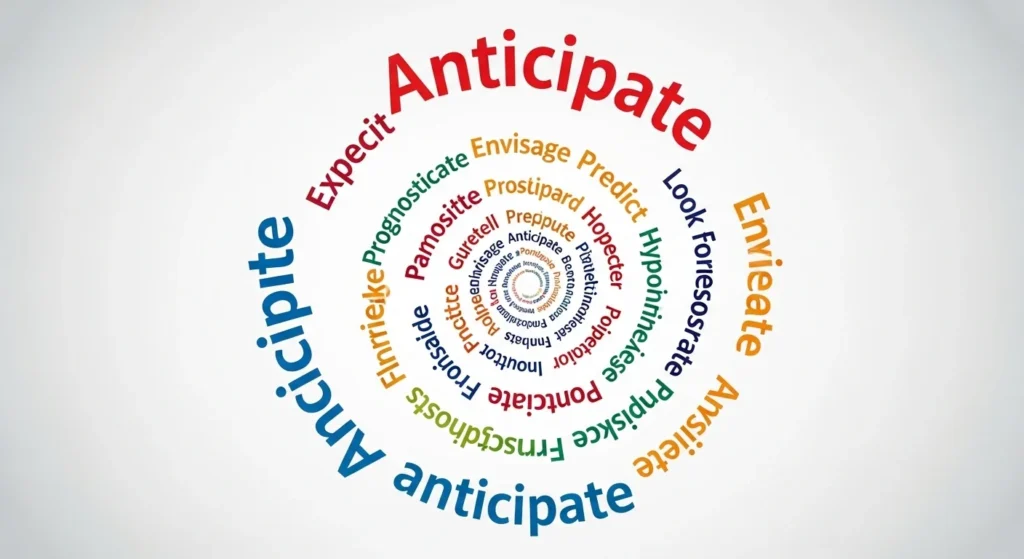
Learning synonyms of anticipate helps English learners and content writers express ideas in many different ways. It also prevents repetition and improves clarity in writing and speaking.
In this article, you will learn the meaning of anticipate and explore its synonyms with examples.
You will also discover its pronunciation, grammar, history, semantic categories, and related vocabulary to strengthen your English skills.
Meaning of Anticipate
Anticipate (verb):
To expect or predict that something will happen in the future and often prepare for it.
Examples
- She anticipates good news from the company.
- We anticipate heavy traffic during the holiday.
Connotative Meaning
(Connotation means the emotional or cultural feeling connected to a word beyond its dictionary meaning.)
- Positive tone: expecting something good, such as success or happiness.
- Negative tone: expecting problems or danger.
- Neutral tone: simply predicting or preparing for an event.
Etymology
- Origin: From Latin anticipare meaning “to take care of beforehand” or “to act before.”
Short History
- Old English (450–1100): The exact word did not exist, but ideas of expectation were expressed with other verbs.
- Middle English (1100–1500): The word began appearing through Latin influence in scholarly language.
- Modern English (1500–Present): The word anticipate became common in writing, science, and everyday communication.
Pronunciation (US & UK – IPA)
US: /ænˈtɪs.ə.peɪt/
UK: /ænˈtɪs.ɪ.peɪt/
Syllables
an-tic-i-pate
Affixation Pattern of Anticipate
Root: anticip (before)
Prefix: anti- (before)
Suffix: -ate (verb-forming suffix)
Word Formation
- anticipation (noun)
- anticipatory (adjective)
- anticipated (verb – past form)
- anticipating (verb – present participle)
- anticipator (noun)
A List of 30 Synonyms for Anticipate
1. Expect (Verb)
US /ɪkˈspɛkt/ | UK /ɪkˈspɛkt/
Meaning: To believe that something will happen.
Examples:
- She expects good news tomorrow.
- We expect rain this evening.
2. Predict (Verb)
US /prɪˈdɪkt/ | UK /prɪˈdɪkt/
Meaning: To say that something will happen in the future.
Examples:
- Scientists predict climate changes.
- He predicts a victory for the team.
3. Foresee (Verb)
US /fɔrˈsiː/ | UK /fɔːˈsiː/
Meaning: To know or imagine something before it happens.
Examples:
- She foresees problems in the plan.
- Experts foresee economic growth.
4. Envision (Verb)
US /ɪnˈvɪʒən/ | UK /ɪnˈvɪʒən/
Meaning: To imagine something happening in the future.
Examples:
- He envisions a successful career.
- They envision a better future.
5. Forecast (Verb)
US /ˈfɔrkæst/ | UK /ˈfɔːkɑːst/
Meaning: To predict future events, especially weather.
Examples:
- Meteorologists forecast heavy rain.
- The report forecasts economic growth.
6. Project (Verb)
US /prəˈdʒɛkt/ | UK /prəˈdʒekt/
Meaning: To estimate future results.
Examples:
- Analysts project rising prices.
- The study projects population growth.
7. Await (Verb)
US /əˈweɪt/ | UK /əˈweɪt/
Meaning: To wait for something expected.
Examples:
- They await the final decision.
- Students await exam results.
8. Look Forward To (Verb phrase)
US /lʊk ˈfɔrwərd tuː/ | UK /lʊk ˈfɔːwəd tuː/
Meaning: To feel happy about something that will happen.
Examples:
- I look forward to meeting you.
- She looks forward to the holiday.
9. Presume (Verb)
US /prɪˈzuːm/ | UK /prɪˈzjuːm/
Meaning: To suppose something is true.
Examples:
- I presume he will come.
- She presumes success.
10. Assume (Verb)
US /əˈsuːm/ | UK /əˈsjuːm/
Meaning: To believe something without proof.
Examples:
- They assume the meeting will happen.
- I assume you agree.
11. Estimate (Verb)
US /ˈɛstəˌmeɪt/ | UK /ˈestɪmeɪt/
Meaning: To roughly calculate or guess.
Examples:
- Engineers estimate the cost.
- Experts estimate future demand.
12. Imagine (Verb)
US /ɪˈmædʒɪn/ | UK /ɪˈmædʒɪn/
Meaning: To form a picture of something in the mind.
Examples:
- She imagines a bright future.
- We imagine success.
13. Expectation (Noun)
US /ˌɛkspɛkˈteɪʃən/ | UK /ˌekspekˈteɪʃən/
Meaning: A belief that something will happen.
Examples:
- The team has high expectations.
- There is an expectation of success.
14. Count On (Verb phrase)
US /kaʊnt ɑn/ | UK /kaʊnt ɒn/
Meaning: To rely on something happening.
Examples:
- You can count on his help.
- We count on success.
15. Hope (Verb)
US /hoʊp/ | UK /həʊp/
Meaning: To want something good to happen.
Examples:
- She hopes for good results.
- We hope for peace.
16. Prepare For (Verb phrase)
US /prɪˈpɛr fɔr/ | UK /prɪˈpeə fɔː/
Meaning: To get ready for something expected.
Examples:
- They prepare for the storm.
- Students prepare for exams.
17. Expectation (Verb sense / anticipate outcome)
US /ˌɛkspɛkˈteɪʃən/ | UK /ˌekspekˈteɪʃən/
Meaning: To feel certain about future results.
Examples:
- There is an expectation of improvement.
- Fans have high expectations.
18. Contemplate (Verb)
US /ˈkɑntəmˌpleɪt/ | UK /ˈkɒntəmpleɪt/
Meaning: To think deeply about future possibilities.
Examples:
- She contemplates the next step.
- They contemplate change.
19. Plan (Verb)
US /plæn/ | UK /plæn/
Meaning: To arrange something for the future.
Examples:
- We plan the event carefully.
- They plan a trip.
20. Speculate (Verb)
US /ˈspɛkjəˌleɪt/ | UK /ˈspekjʊleɪt/
Meaning: To guess about future possibilities.
Examples:
- Experts speculate about the market.
- People speculate about the outcome.
21. Prophesy (Verb)
US /ˈprɑfəsaɪ/ | UK /ˈprɒfɪsaɪ/
Meaning: To predict future events.
Examples:
- The priest prophesies change.
- Ancient texts prophesy events.
22. Calculate (Verb)
US /ˈkælkjəˌleɪt/ | UK /ˈkælkjʊleɪt/
Meaning: To determine something by reasoning.
Examples:
- They calculate future costs.
- She calculates risks.
23. Sense (Verb)
US /sɛns/ | UK /sens/
Meaning: To feel that something will happen.
Examples:
- He senses trouble ahead.
- She senses opportunity.
24. Suspect (Verb)
US /səˈspɛkt/ | UK /səˈspekt/
Meaning: To think something is likely.
Examples:
- I suspect delays.
- They suspect changes.
25. Think Ahead (Verb phrase)
US /θɪŋk əˈhɛd/ | UK /θɪŋk əˈhed/
Meaning: To consider future outcomes.
Examples:
- Good leaders think ahead.
- She thinks ahead before planning.
26. Expectancy (Noun)
US /ɪkˈspɛktənsi/ | UK /ɪkˈspektənsi/
Meaning: A feeling that something will happen.
Examples:
- The crowd waits with expectancy.
- There is great expectancy.
27. Predictability (Noun)
US /prɪˌdɪktəˈbɪləti/ | UK /prɪˌdɪktəˈbɪlɪti/
Meaning: The quality of being easy to predict.
Examples:
- The pattern shows predictability.
- Markets lack predictability.
28. Look Ahead (Verb phrase)
US /lʊk əˈhɛd/ | UK /lʊk əˈhed/
Meaning: To think about future plans.
Examples:
- We must look ahead.
- She looks ahead confidently.
29. Anticipatory (Adjective)
US /ænˈtɪsɪpəˌtɔri/ | UK /ænˈtɪsɪpətəri/
Meaning: Related to expecting something.
Examples:
- He felt anticipatory excitement.
- There was an anticipatory silence.
30. Await Expectantly (Verb phrase)
US /əˈweɪt ɪkˈspɛktəntli/ | UK /əˈweɪt ɪkˈspektəntli/
Meaning: To wait while expecting something.
Examples:
- Fans await expectantly.
- Students await expectantly for results.
Prototype Meaning
The typical meaning of anticipate is expecting something to happen before it actually occurs. People often imagine preparing mentally or physically for a future event when they hear this word.
Prototype Categorization
Grouping synonyms helps writers choose the most suitable word.
- Prediction words: predict, forecast, foresee, project
- Expectation words: expect, presume, assume
- Planning words: prepare, plan, calculate
- Imagination words: envision, imagine, contemplate
This categorization helps writers use precise words depending on whether they are predicting, hoping, planning, or imagining.
Antonyms of Anticipate
- Ignore (verb): to pay no attention to something.
- Doubt (verb): to feel uncertain about something.
- Forget (verb): to fail to remember something expected.
- Overlook (verb): to miss noticing something important.
Short Questions and Answers
- What does anticipate mean?
It means to expect or predict something before it happens. - When should anticipate be used?
Use it when talking about expecting or preparing for future events. - Is anticipate positive or negative?
It can be positive, negative, or neutral depending on the situation. - How is it different from similar words?
Unlike simple prediction words, anticipate often includes preparation or emotional expectation.
Conclusion
Learning the word anticipate and its synonyms can greatly improve English vocabulary. It helps writers and speakers describe future expectations with clarity and variety. Using different synonyms prevents repetition and makes communication more engaging.
Understanding pronunciation, history, and semantic categories also deepens language knowledge. When learners practice these words daily, they gain confidence in both writing and speaking. Over time, a strong vocabulary allows people to express thoughts more clearly and creatively.
To become fluent in English, it is helpful to learn new words every day and practice using them in real sentences.

I am a linguist with 17 years of experience in English language teaching, including postgraduate-level instruction. My expertise includes English grammar, and I contribute as a content and blog writer, producing scholarly and educational language resources.