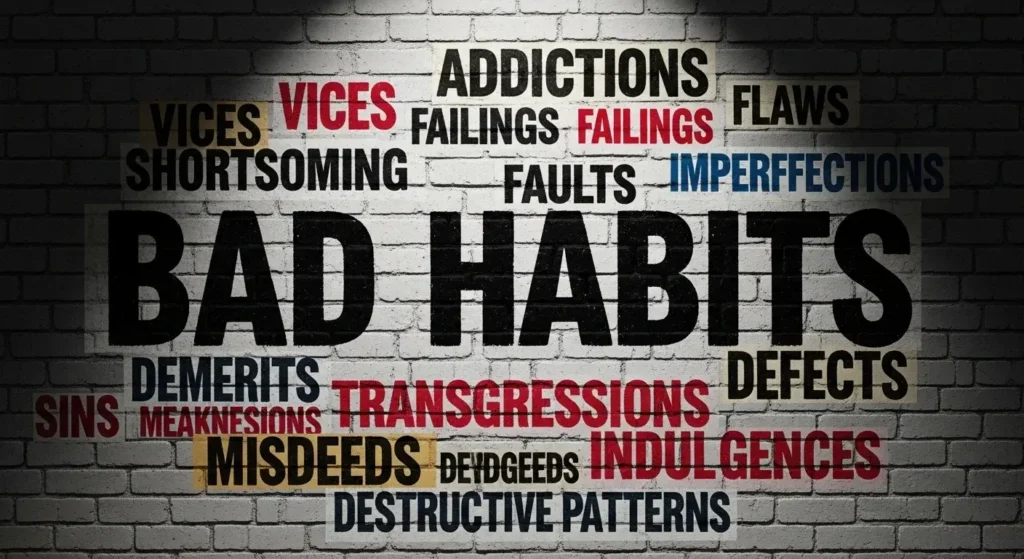
Bad habits are actions we repeat that harm us or others. Think of a student who bites his nails during exams. At first, it seems small. But over time, it becomes hard to stop. This is a bad habit.
The phrase bad habits is common in daily life. People use it when talking about health, behavior, manners, or lifestyle. English learners often hear this term in school, books, and conversations.
Learning synonyms of bad habits is important. It helps students, writers, and bloggers avoid repeating the same words. It also makes speaking and writing more powerful and clear.
In this article, you will learn the meaning of bad habits and its synonyms with examples, grammar, history, pronunciation, word formation, and semantic categories in simple English.
Meaning of Bad Habits
Definition
Bad habits (Noun, plural): repeated actions or behaviors that are harmful, unhealthy, or morally wrong.
Examples
He is trying to quit his bad habits.
Staying up late every night is one of her bad habits.
Connotative Meaning
(Connotation means the emotional feeling or idea connected to a word.)
- Positive tone: Rarely positive, sometimes used lightly or jokingly.
- Negative tone: Usually negative because it suggests harm or wrong behavior.
- Neutral tone: Can be neutral when talking about small everyday behaviors.
Etymology
- Bad comes from Old English bæddel, meaning weak or undesirable.
- Habit comes from Latin habitus, meaning condition or character.
Short History
- Old English (450–1100): Words like “bad” described weakness or moral fault.
- Middle English (1100–1500): “Habit” entered English from French and Latin.
- Modern English (1500–Present): The phrase “bad habits” became common to describe repeated harmful behavior.
Pronunciation (US & UK – IPA)
US: /bæd ˈhæbɪts/
UK: /bæd ˈhæbɪts/
Syllables
bad hab-its
Affixation Pattern of Bad Habits
- Root: habit
- Prefix: none
- Suffix: -s (plural marker)
Word Formation
- Habit (noun)
- Habits (noun plural)
- Habitual (adjective)
- Habitually (adverb)
- Unhabitual (adjective)
- Habit-forming (adjective)
A List of 30 Synonyms for Bad Habits
1. Vice (Noun) — US /vaɪs/ | UK /vaɪs/
Meaning: A harmful or immoral habit.
Examples:
Smoking is a common vice.
He gave up his gambling vice.
2. Flaw (Noun) — US /flɔː/ | UK /flɔː/
Meaning: A weakness or fault.
Examples:
Everyone has a flaw.
Impatience is his biggest flaw.
3. Fault (Noun) — US /fɔːlt/ | UK /fɔːlt/
Meaning: A mistake or bad quality.
Examples:
Anger is her main fault.
We all have faults.
4. Weakness (Noun) — US /ˈwiːknəs/ | UK /ˈwiːknəs/
Meaning: A lack of strength or control.
Examples:
Chocolate is my weakness.
His weakness is laziness.
5. Addiction (Noun) — US /əˈdɪkʃən/ | UK /əˈdɪkʃən/
Meaning: Strong dependence on something harmful.
Examples:
He fought his addiction.
Phone addiction is common today.
6. Compulsion (Noun) — US /kəmˈpʌlʃən/ | UK /kəmˈpʌlʃən/
Meaning: Strong urge to repeat an action.
Examples:
She felt a compulsion to check her phone.
Cleaning became a compulsion.
7. Obsession (Noun) — US /əbˈseʃən/ | UK /əbˈseʃən/
Meaning: Unhealthy focus on something.
Examples:
His obsession with money is unhealthy.
Fitness became her obsession.
8. Shortcoming (Noun) — US /ˈʃɔːrtˌkʌmɪŋ/ | UK /ˈʃɔːtkʌmɪŋ/
Meaning: A weakness or failure.
Examples:
Lack of focus is a shortcoming.
We must improve our shortcomings.
9. Defect (Noun) — US /ˈdiːfekt/ | UK /ˈdiːfekt/
Meaning: A fault or imperfection.
Examples:
Greed is a character defect.
The plan has a defect.
10. Failing (Noun) — US /ˈfeɪlɪŋ/ | UK /ˈfeɪlɪŋ/
Meaning: A weakness in character.
Examples:
Pride is his failing.
We all have failings.
11. Sin (Noun) — US /sɪn/ | UK /sɪn/
Meaning: An immoral act.
Examples:
Lying is considered a sin.
Greed is a deadly sin.
12. Misconduct (Noun) — US /ˌmɪsˈkɑːndʌkt/ | UK /ˌmɪsˈkɒndʌkt/
Meaning: Wrong or improper behavior.
Examples:
The worker was fired for misconduct.
School misconduct is punished.
13. Indulgence (Noun) — US /ɪnˈdʌldʒəns/ | UK /ɪnˈdʌldʒəns/
Meaning: Allowing oneself too much pleasure.
Examples:
Too much sugar is an indulgence.
Shopping became her indulgence.
14. Dependency (Noun) — US /dɪˈpendənsi/ | UK /dɪˈpendənsi/
Meaning: Need for something harmful.
Examples:
Drug dependency is dangerous.
He developed alcohol dependency.
15. Toxicity (Noun) — US /tɑːkˈsɪsɪti/ | UK /tɒkˈsɪsɪti/
Meaning: Harmful quality.
Examples:
The toxicity of his behavior hurt others.
Social media can create toxicity.
16. Corruption (Noun) — US /kəˈrʌpʃən/ | UK /kəˈrʌpʃən/
Meaning: Moral decay or dishonesty.
Examples:
Corruption destroys trust.
Power led to corruption.
17. Immorality (Noun) — US /ˌɪməˈræləti/ | UK /ˌɪməˈræləti/
Meaning: Lack of moral behavior.
Examples:
The story shows immorality.
Immorality harms society.
18. Negligence (Noun) — US /ˈneɡlɪdʒəns/ | UK /ˈneɡlɪdʒəns/
Meaning: Careless behavior.
Examples:
Negligence caused the accident.
His negligence hurt the team.
19. Carelessness (Noun) — US /ˈkerləsnəs/ | UK /ˈkeələsnəs/
Meaning: Lack of attention.
Examples:
Carelessness leads to mistakes.
Her carelessness broke the glass.
20. Laziness (Noun) — US /ˈleɪzinəs/ | UK /ˈleɪzinəs/
Meaning: Unwillingness to work.
Examples:
Laziness affects success.
He fights his laziness daily.
21. Sloppiness (Noun) — US /ˈslɑːpinəs/ | UK /ˈslɒpinəs/
Meaning: Careless or messy behavior.
Examples:
Sloppiness caused errors.
His sloppiness annoys others.
22. Procrastination (Noun) — US /proʊˌkræstɪˈneɪʃən/ | UK /prəʊˌkræstɪˈneɪʃən/
Meaning: Delaying tasks.
Examples:
Procrastination wastes time.
She struggles with procrastination.
23. Impulsiveness (Noun) — US /ɪmˈpʌlsɪvnəs/ | UK /ɪmˈpʌlsɪvnəs/
Meaning: Acting without thinking.
Examples:
Impulsiveness leads to regret.
His impulsiveness caused trouble.
24. Recklessness (Noun) — US /ˈrekləsnəs/ | UK /ˈrekləsnəs/
Meaning: Careless and risky behavior.
Examples:
Recklessness can be dangerous.
Driving fast shows recklessness.
25. Gluttony (Noun) — US /ˈɡlʌtəni/ | UK /ˈɡlʌtəni/
Meaning: Eating too much.
Examples:
Gluttony harms health.
He avoids gluttony now.
26. Greed (Noun) — US /ɡriːd/ | UK /ɡriːd/
Meaning: Strong desire for more.
Examples:
Greed causes problems.
Greed ruined the deal.
27. Envy (Noun) — US /ˈenvi/ | UK /ˈenvi/
Meaning: Jealous feeling toward others.
Examples:
Envy destroys friendship.
He felt envy of his friend.
28. Arrogance (Noun) — US /ˈerəɡəns/ | UK /ˈærəɡəns/
Meaning: Proud and rude attitude.
Examples:
Arrogance pushes people away.
His arrogance cost him respect.
29. Habitual Error (Noun) — US /həˈbɪtʃuəl ˈerər/ | UK /həˈbɪtʃuəl ˈerə/
Meaning: A repeated mistake.
Examples:
Spelling mistakes are his habitual error.
She corrected her habitual errors.
30. Self-Destruction (Noun) — US /ˌself dɪˈstrʌkʃən/ | UK /ˌself dɪˈstrʌkʃən/
Meaning: Behavior that harms oneself.
Examples:
Drugs lead to self-destruction.
He stopped his self-destruction.
Prototype Meaning
When people hear bad habits, they usually think of small daily actions like smoking, biting nails, overeating, or wasting time. These are repeated behaviors that are hard to stop and cause harm.
Prototype Categorization
Synonyms can be grouped into categories:
- Moral faults: sin, immorality, corruption
- Personal weaknesses: flaw, failing, shortcoming
- Addictive behaviors: addiction, dependency, compulsion
- Careless actions: negligence, recklessness, carelessness
Categorization helps writers choose the right word. For moral topics, use “sin.” For health issues, use “addiction.” For small daily behavior, use “flaw” or “weakness.”
Antonyms of Bad Habits
- Good habits
- Virtue
- Strength
- Discipline
- Self-control
- Responsibility
Short Questions and Answers
- What does bad habits mean?
Repeated harmful behaviors. - When should bad habits be used?
When talking about repeated negative actions. - Is bad habits positive or negative?
Mostly negative, sometimes neutral in casual talk. - How is it different from similar words?
It focuses on repeated behavior, not one-time mistakes.
CONCLUSION
Learning the word bad habits and its synonyms improves vocabulary. It helps writers avoid repetition and choose better words. It strengthens speaking and writing skills. It also builds confidence in English communication.
When you understand tone, pronunciation, and word history, your language becomes richer. Practice using one new synonym daily. Small steps lead to strong vocabulary growth.

I am a linguist with 17 years of experience in English language teaching, including postgraduate-level instruction. My expertise includes English grammar, and I contribute as a content and blog writer, producing scholarly and educational language resources.