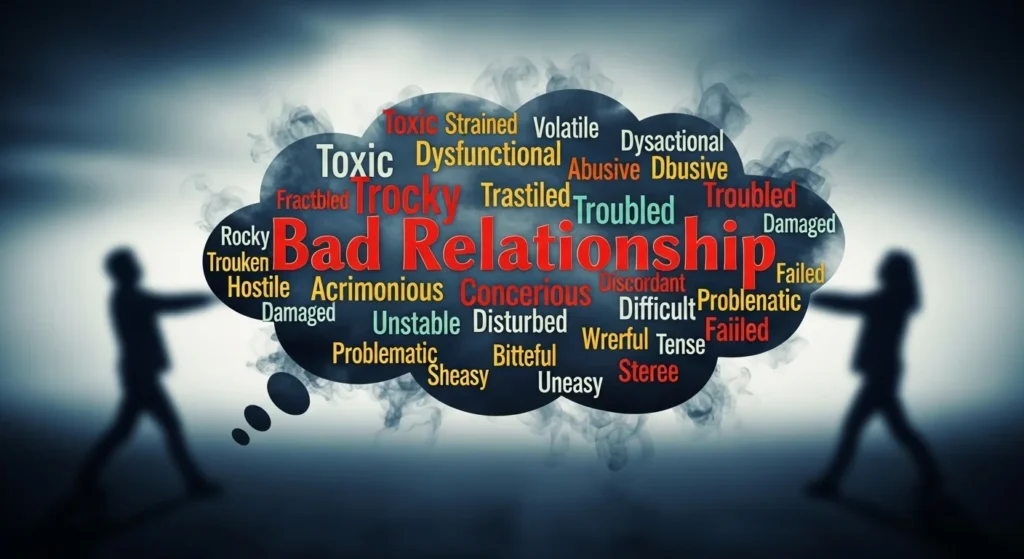
A bad relationship means a connection between people that brings stress, pain, or unhappiness. Imagine two friends who argue every day and never feel safe sharing their thoughts. That is a bad relationship. This phrase is very common because people often talk about love, friendship, family, and work.
Learning synonyms of “bad relationship” helps English learners and writers avoid repeating the same words again and again. It also makes speaking and writing more clear and powerful.
In this article, you will learn the meaning of “bad relationship” and its synonyms with examples, grammar, history, pronunciation, and categories.
Everything is explained in easy English to help you build strong vocabulary step by step.
Meaning of Bad Relationship
Bad relationship (noun):
A connection between people that is unhealthy, unhappy, or full of problems.
Examples:
- They stayed in a bad relationship for many years.
- A bad relationship can affect your mental health.
Connotative Meaning
(Connotation = the emotional feeling a word gives beyond its basic meaning)
- Positive tone: Rarely used in a positive sense
- Negative tone: Stress, pain, conflict, toxicity
- Neutral tone: Can describe a situation without strong emotion
Etymology
- Bad: Old English bæddel (uncertain origin, meaning “inferior”)
- Relationship: From Latin relatio meaning “connection”
History:
- Old English (450–1100): “Bad” used for poor quality
- Middle English (1100–1500): “Relationship” ideas began forming
- Modern English (1500–Present): Full phrase used widely for personal connections
Pronunciation (US & UK – IPA)
- US: /bæd rɪˈleɪʃənʃɪp/
- UK: /bæd rɪˈleɪʃənʃɪp/
Syllables
bad-re-la-tion-ship
Affixation Pattern of Bad Relationship
- Root: relate
- Prefix: re-
- Suffix: -ship
Word Formation:
- relation (noun)
- relate (verb)
- relational (adjective)
- relationship (noun)
A List of Synonyms for Bad Relationship
1. Toxic Relationship (noun)
US: /ˈtɑːksɪk/ | UK: /ˈtɒksɪk/
Meaning: A harmful and unhealthy relationship
Examples:
- They are in a toxic relationship.
- Toxic relationships damage confidence.
2. Unhealthy Relationship (noun)
US: /ʌnˈhɛlθi/ | UK: /ʌnˈhɛlθi/
Meaning: A relationship that harms well-being
- This is an unhealthy relationship.
- He left the unhealthy bond.
3. Strained Relationship (noun)
US: /streɪnd/ | UK: /streɪnd/
Meaning: A tense and stressed connection
- Their relationship is strained.
- Talks made it more strained.
4. Broken Relationship (noun)
US: /ˈbroʊkən/ | UK: /ˈbrəʊkən/
Meaning: A relationship that no longer works
- They have a broken relationship.
- Trust caused a broken bond.
5. Troubled Relationship (noun)
US: /ˈtrʌbəld/ | UK: /ˈtrʌbəld/
Meaning: Full of problems
- It is a troubled relationship.
- Their past made it troubled.
6. Dysfunctional Relationship (noun)
US: /dɪsˈfʌŋkʃənl/ | UK: /dɪsˈfʌŋkʃənl/
Meaning: Not working properly
- They live in a dysfunctional relationship.
- It affects their family.
7. Conflict-Ridden Relationship (noun)
US: /ˈkɒnflɪkt/ | UK: /ˈkɒnflɪkt/
Meaning: Full of fights
- Their bond is conflict-ridden.
- They argue daily.
8. Rocky Relationship (noun)
US: /ˈrɑːki/ | UK: /ˈrɒki/
Meaning: Unstable and uncertain
- They have a rocky relationship.
- It goes up and down.
9. Abusive Relationship (noun)
US: /əˈbjuːsɪv/ | UK: /əˈbjuːsɪv/
Meaning: Involving harm or violence
- She escaped an abusive relationship.
- Abuse destroys trust.
10. Unstable Relationship (noun)
US: /ʌnˈsteɪbəl/ | UK: /ʌnˈsteɪbəl/
Meaning: Not steady
- It is an unstable relationship.
- Emotions change quickly.
11. Bitter Relationship (noun)
US: /ˈbɪtər/ | UK: /ˈbɪtə/
Meaning: Full of anger
- They share a bitter relationship.
- Old issues remain.
12. Hostile Relationship (noun)
US: /ˈhɑːstaɪl/ | UK: /ˈhɒstaɪl/
Meaning: Full of hate
- It is a hostile relationship.
- They avoid each other.
13. Fractured Relationship (noun)
US: /ˈfræktʃərd/ | UK: /ˈfræktʃəd/
Meaning: Damaged connection
- Their relationship is fractured.
- Trust is broken.
14. Complicated Relationship (noun)
US: /ˈkɑːmplɪkeɪtɪd/ | UK: /ˈkɒmplɪkeɪtɪd/
Meaning: Hard to understand
- It is a complicated relationship.
- Feelings are mixed.
15. Cold Relationship (noun)
US: /koʊld/ | UK: /kəʊld/
Meaning: No warmth or love
- They have a cold relationship.
- They rarely talk.
16. Distant Relationship (noun)
US: /ˈdɪstənt/ | UK: /ˈdɪstənt/
Meaning: Emotionally far
- Their bond is distant.
- They feel disconnected.
17. Failing Relationship (noun)
US: /ˈfeɪlɪŋ/ | UK: /ˈfeɪlɪŋ/
Meaning: Slowly ending
- It is a failing relationship.
- They try to fix it.
18. Unhappy Relationship (noun)
US: /ʌnˈhæpi/ | UK: /ʌnˈhæpi/
Meaning: Without joy
- She is in an unhappy relationship.
- He feels sad daily.
19. Toxic Bond (noun)
US: /bɑːnd/ | UK: /bɒnd/
Meaning: Harmful connection
- They share a toxic bond.
- It drains energy.
20. Broken Bond (noun)
US: /broʊkən/ | UK: /brəʊkən/
Meaning: Connection lost
- Their bond is broken.
- Trust is gone.
21. Negative Relationship (noun)
US: /ˈneɡətɪv/ | UK: /ˈneɡətɪv/
Meaning: Produces bad feelings
- It is a negative relationship.
- It affects mood.
22. Painful Relationship (noun)
US: /ˈpeɪnfəl/ | UK: /ˈpeɪnfəl/
Meaning: Causes emotional pain
- She left a painful relationship.
- It hurt deeply.
23. Stressful Relationship (noun)
US: /ˈstrɛsfəl/ | UK: /ˈstrɛsfəl/
Meaning: Causes stress
- It is a stressful relationship.
- He feels tired.
24. One-Sided Relationship (noun)
US: /ˈwʌn saɪdɪd/ | UK: /ˈwʌn saɪdɪd/
Meaning: Only one person cares
- It is one-sided.
- She gives more effort.
25. Loveless Relationship (noun)
US: /ˈlʌvləs/ | UK: /ˈlʌvləs/
Meaning: Without love
- They have a loveless relationship.
- There is no care.
26. Weak Relationship (noun)
US: /wiːk/ | UK: /wiːk/
Meaning: Not strong
- Their bond is weak.
- It breaks easily.
27. Fragile Relationship (noun)
US: /ˈfrædʒaɪl/ | UK: /ˈfrædʒaɪl/
Meaning: Easily damaged
- It is fragile.
- Small issues hurt it.
28. Damaged Relationship (noun)
US: /ˈdæmɪdʒd/ | UK: /ˈdæmɪdʒd/
Meaning: Harmed over time
- Their relationship is damaged.
- Past fights matter.
29. Tense Relationship (noun)
US: /tɛns/ | UK: /tɛns/
Meaning: Full of pressure
- It is tense.
- Silence feels heavy.
30. Failing Bond (noun)
US: /ˈfeɪlɪŋ/ | UK: /ˈfeɪlɪŋ/
Meaning: Losing strength
- Their bond is failing.
- They feel distant.
Prototype Meaning
The most typical meaning of “bad relationship” is a connection where people feel unhappy, unsafe, or stressed. People often imagine constant fights, lack of trust, and emotional pain.
Prototype Categorization
- Emotional harm: toxic, painful, stressful
- Lack of love: cold, distant, loveless
- Instability: rocky, unstable, fragile
- Conflict: hostile, tense, conflict-ridden
These categories help writers choose the right word for the exact situation.
Antonyms of Bad Relationship
- Healthy relationship (noun): Good and supportive connection
- Strong relationship (noun): Stable and lasting bond
- Loving relationship (noun): Full of care and affection
- Positive relationship (noun): Brings happiness
Short Questions and Answers
- What does bad relationship mean?
A connection that causes stress, pain, or unhappiness. - When should it be used?
When describing unhealthy or harmful human connections. - Is it positive or negative?
Usually negative. - How is it different from similar words?
It is general, while synonyms give specific meanings like stress or conflict.
CONCLUSION
Learning the word “bad relationship” and its synonyms helps you grow your vocabulary in a smart way. It improves both writing and speaking by giving you many choices instead of repeating one word. It also helps you express feelings clearly and correctly. When you know different synonyms, you can match the right word with the right situation. This builds confidence in English communication. Try to learn a few words daily and use them in sentences. Over time, your English will become stronger, clearer, and more natural.

I am a linguist with 17 years of experience in English language teaching, including postgraduate-level instruction. My expertise includes English grammar, and I contribute as a content and blog writer, producing scholarly and educational language resources.