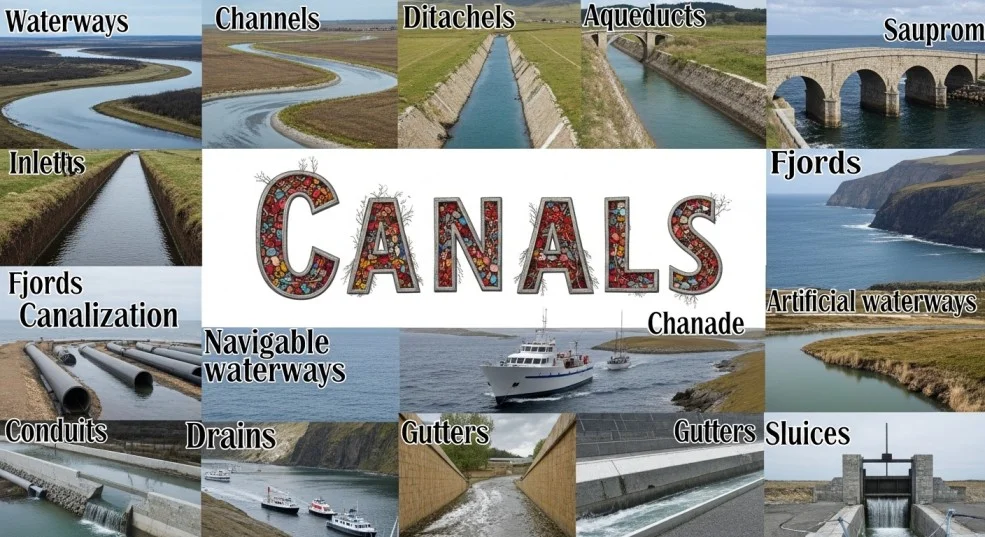
The word canals refers to long, narrow waterways made by people to move water, ships, or irrigation. Imagine a farmer whose crops are dry during summer. A new canal brings water from a nearby river to his fields. Soon, the land becomes green again. This simple water path changes lives.
The word canal is commonly used in geography, engineering, farming, and city planning. It appears in textbooks, news, and everyday conversations about water systems.
Learning synonyms of canal is very useful for English learners and content writers. It helps avoid repeating the same word again and again. It also makes writing richer and clearer.
In this article, we will explore the meaning of canal and its synonyms with examples. We will also discuss pronunciation, grammar, word history, and semantic categories to help you understand the word deeply.
Meaning of Canal
Definition
Canal (Noun):
Canal is a water channel built by govt. or people to carry water, ships, or irrigation.
Examples
- The canal carries water to the village farms.
- Boats travel slowly through the old canal.
Connotative Meaning
(Connotation means the emotional or cultural feeling connected to a word beyond its basic meaning.)
- Positive tone: progress, irrigation, transportation, development
- Negative tone: flooding, water pollution, blocked waterways
- Neutral tone: infrastructure, water channel, engineering structure
Etymology
- Origin: From Latin canalis meaning “pipe” or “water channel”.
- Entered English through Old French canal.
Short History
- Old English (450–1100): The concept existed but the word was rare. Water paths were called streams or ditches.
- Middle English (1100–1500): The term canal appeared through French influence.
- Modern English (1500–Present): The word became common during the canal-building era in Europe and North America.
Pronunciation (US & UK – IPA)
US: /kəˈnæl/
UK: /kəˈnæl/
Syllables
ca-nal
Affixation Pattern of Canal
Root: canal
Prefix: none
Suffix: none
Word Formation from Canal
- canalize (verb) – to build canals or make something like a canal
- canalization (noun) – the process of building canals
- canalized (adjective) – shaped or controlled like a canal
A List of 30 Synonyms for Canal
1. Channel (Noun)
US /ˈtʃænəl/ | UK /ˈtʃænəl/
Meaning: A natural or artificial water passage.
Examples:
- Boats moved through the narrow channel.
- The river formed a deep channel in the valley.
2. Waterway (Noun)
US /ˈwɔːtərweɪ/ | UK /ˈwɔːtəweɪ/
Meaning: A route for boats or ships through water.
Examples:
- The waterway connects two large rivers.
- Traders used this waterway for centuries.
3. Aqueduct (Noun)
US /ˈækwɪdʌkt/ | UK /ˈækwɪdʌkt/
Meaning: A structure that carries water over long distances.
Examples:
- The Romans built strong aqueducts.
- The aqueduct supplies water to the city.
4. Ditch (Noun)
US /dɪtʃ/ | UK /dɪtʃ/
Meaning: A narrow channel dug in the ground for water.
Examples:
- Water flowed into the ditch beside the road.
- Farmers dug a ditch for irrigation.
5. Trench (Noun)
US /trentʃ/ | UK /trentʃ/
Meaning: A long narrow hole dug in the ground.
Examples:
- Workers dug a trench for water pipes.
- Rainwater filled the trench quickly.
6. Drain (Noun)
US /dreɪn/ | UK /dreɪn/
Meaning: A passage that carries away water.
Examples:
- The drain removed excess water.
- Leaves blocked the drain.
7. Streamway (Noun)
US /ˈstriːmweɪ/ | UK /ˈstriːmweɪ/
Meaning: A route used by flowing water.
Examples:
- The streamway guided water to the lake.
- Engineers improved the streamway.
8. Conduit (Noun)
US /ˈkɒnduɪt/ | UK /ˈkɒndjuɪt/
Meaning: A channel that carries water or fluid.
Examples:
- The conduit supplies fresh water.
- Water moves through the underground conduit.
9. Passage (Noun)
US /ˈpæsɪdʒ/ | UK /ˈpæsɪdʒ/
Meaning: A path that allows movement through something.
Examples:
- The canal forms a passage for boats.
- The passage links two lakes.
10. Watercourse (Noun)
US /ˈwɔːtərkɔːrs/ | UK /ˈwɔːtəkɔːs/
Meaning: A natural or artificial channel for water.
Examples:
- The watercourse flows to the sea.
- Engineers cleaned the watercourse.
11. Irrigation Channel (Noun)
US /ˌɪrɪˈɡeɪʃən ˈtʃænəl/ | UK /ˌɪrɪˈɡeɪʃən ˈtʃænəl/
Meaning: A channel used to supply water to farms.
Examples:
- The irrigation channel waters the crops.
- Farmers maintain the irrigation channel.
12. Water Channel (Noun)
US /ˈwɔːtər ˈtʃænəl/ | UK /ˈwɔːtə ˈtʃænəl/
Meaning: A path where water flows.
Examples:
- The water channel leads to the fields.
- Fish swim in the water channel.
13. Runway (Noun)
US /ˈrʌnweɪ/ | UK /ˈrʌnweɪ/
Meaning: A path where water flows or runs.
Examples:
- Rainwater followed the runway.
- The runway drained the floodwater.
14. Furrow (Noun)
US /ˈfɜːroʊ/ | UK /ˈfʌrəʊ/
Meaning: A long narrow trench in soil.
Examples:
- The farmer made furrows in the field.
- Water filled the furrow quickly.
15. Pipeline (Noun)
US /ˈpaɪplaɪn/ | UK /ˈpaɪplaɪn/
Meaning: A system that carries liquids through pipes.
Examples:
- The pipeline transports water.
- Engineers repaired the pipeline.
16. Culvert (Noun)
US /ˈkʌlvərt/ | UK /ˈkʌlvət/
Meaning: A tunnel that allows water to flow under a road.
Examples:
- Water flows through the culvert.
- The culvert prevents flooding.
17. Gutter (Noun)
US /ˈɡʌtər/ | UK /ˈɡʌtə/
Meaning: A small channel that collects rainwater.
Examples:
- Rain ran through the gutter.
- The gutter carried water away.
18. Flume (Noun)
US /fluːm/ | UK /fluːm/
Meaning: A narrow channel used to move water.
Examples:
- Water rushed through the flume.
- The mill used a wooden flume.
19. Spillway (Noun)
US /ˈspɪlweɪ/ | UK /ˈspɪlweɪ/
Meaning: A channel for releasing extra water from a dam.
Examples:
- Water flowed down the spillway.
- The spillway prevented flooding.
20. Raceway (Noun)
US /ˈreɪsweɪ/ | UK /ˈreɪsweɪ/
Meaning: A narrow water channel for mills or fish farms.
Examples:
- Water moved quickly in the raceway.
- Fish swam in the raceway.
21. Water Path (Noun)
US /ˈwɔːtər pæθ/ | UK /ˈwɔːtə pɑːθ/
Meaning: A route where water flows.
Examples:
- The water path leads to the river.
- Engineers designed a new water path.
22. Flow Channel (Noun)
US /floʊ ˈtʃænəl/ | UK /fləʊ ˈtʃænəl/
Meaning: A passage where liquid flows.
Examples:
- The flow channel directs water.
- The dam has a large flow channel.
23. Water Passage (Noun)
US /ˈwɔːtər ˈpæsɪdʒ/ | UK /ˈwɔːtə ˈpæsɪdʒ/
Meaning: A route used for water movement.
Examples:
- Boats move through the water passage.
- The water passage connects two lakes.
24. Runnel (Noun)
US /ˈrʌnəl/ | UK /ˈrʌnəl/
Meaning: A small stream or channel.
Examples:
- A runnel formed after rain.
- Water flowed through the runnel.
25. Drainage Channel (Noun)
US /ˈdreɪnɪdʒ ˈtʃænəl/ | UK /ˈdreɪnɪdʒ ˈtʃænəl/
Meaning: A channel that removes excess water.
Examples:
- The drainage channel prevents floods.
- Workers cleaned the drainage channel.
26. Stream Channel (Noun)
US /striːm ˈtʃænəl/ | UK /striːm ˈtʃænəl/
Meaning: The path a stream follows.
Examples:
- The stream channel widened after rain.
- Rocks lined the stream channel.
27. Water Route (Noun)
US /ˈwɔːtər ruːt/ | UK /ˈwɔːtə ruːt/
Meaning: A path used for travel through water.
Examples:
- The canal served as a water route.
- Ships followed the water route.
28. Water Line (Noun)
US /ˈwɔːtər laɪn/ | UK /ˈwɔːtə laɪn/
Meaning: A path where water travels.
Examples:
- The water line reached the fields.
- Engineers repaired the water line.
29. Irrigation Ditch (Noun)
US /ˌɪrɪˈɡeɪʃən dɪtʃ/ | UK /ˌɪrɪˈɡeɪʃən dɪtʃ/
Meaning: A ditch used to water crops.
Examples:
- Water flowed through the irrigation ditch.
- Farmers dug an irrigation ditch.
30. Water Trench (Noun)
US /ˈwɔːtər trentʃ/ | UK /ˈwɔːtə trentʃ/
Meaning: A trench made to guide water.
Examples:
- Rainwater filled the water trench.
- The water trench protected the road.
Prototype Meaning
The typical meaning of canal is a water channel built by govt. or people used for transport or irrigation. When people hear the word, they often imagine a long, straight water path with boats slowly moving through it or water flowing to farms.
Prototype Categorization
Synonyms can be grouped into useful categories:
- Water transport terms: channel, waterway, passage, water route
- Engineering structures: aqueduct, conduit, pipeline, culvert
- Agricultural water paths: ditch, furrow, irrigation channel
- Drainage systems: drain, drainage channel, gutter
Categorizing synonyms helps writers choose the most accurate word for a specific context, such as farming, city engineering, or water transport.
Antonyms of Canal
- Blockage (noun): something that stops water flow
- Barrier (noun): a structure that prevents movement
- Dam (noun): a wall that stops or stores water
- Obstruction (noun): something that blocks a path
Short Questions and Answers
- What does canal mean?
A canal is a water channel built by govt. or people used for transport or irrigation. - When should canal be used?
Use it when talking about artificial waterways built for ships, irrigation, or water supply. - Is canal positive or negative?
It is usually neutral, but it can have positive meanings when discussing development and farming. - How is it different from similar words?
A canal is a water channel built by govt. or people, while words like river or stream usually describe natural water bodies.
Conclusion
Learning the word canal and its synonyms helps improve vocabulary and writing skills. Instead of repeating the same word, you can choose from many alternatives like channel, waterway, or conduit. This makes writing more interesting and clear.
Understanding synonyms also strengthens speaking skills. It allows learners to explain ideas in different ways. Writers, students, and English learners benefit from knowing several related words.
Studying pronunciation, meaning, and history also deepens language knowledge. The more words you learn, the more confident you become in English.
Try to practice new vocabulary every day. Over time, your language will become richer, clearer, and more powerful.

I am a linguist with 17 years of experience in English language teaching, including postgraduate-level instruction. My expertise includes English grammar, and I contribute as a content and blog writer, producing scholarly and educational language resources.