
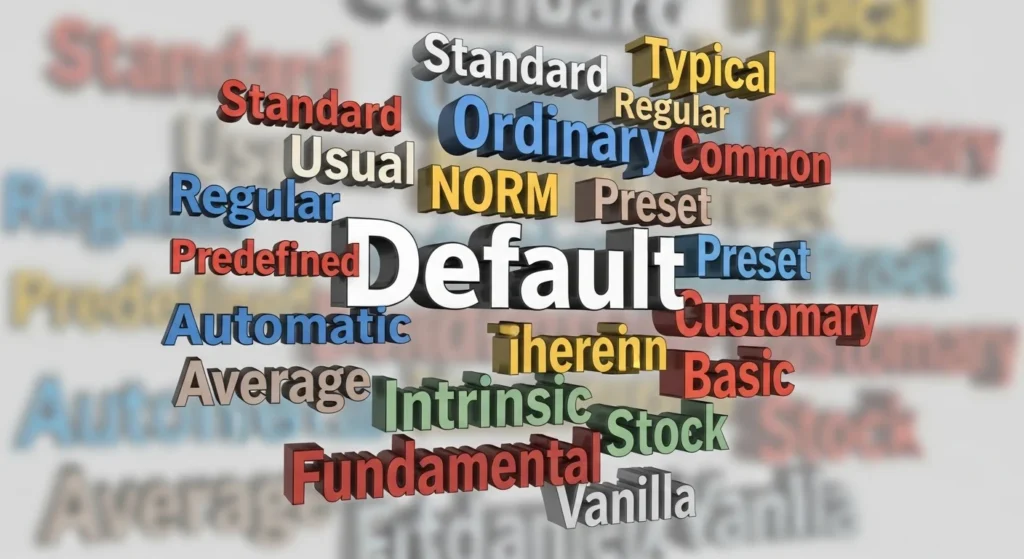
The word default means a pre-set option or a failure to act when needed. Imagine you open your phone, and it shows the same wallpaper every time because you never changed it. That is the default setting. Or think of a student who does not submit homework; that is also a default in action. This word is very common in daily life, especially in technology, finance, and general communication.
Learning synonyms of “default” helps English learners and writers use more exact words. It improves writing style and avoids repeating the same word again and again.
In this article, you will learn the meaning of “default” and its synonyms with examples, grammar, history, pronunciation, and categories.
Everything is explained in simple English to help you grow your vocabulary step by step.
Meaning of Default
Default (noun/verb):
A pre-set choice or a failure to do something required.
Examples:
- The system uses default settings.
- He defaulted on his loan.
Connotative Meaning
(Connotation = the emotional feeling a word gives beyond its basic meaning)
- Positive tone: Simple, easy, automatic
- Negative tone: Failure, neglect, carelessness
- Neutral tone: Standard or normal option
Etymology
- From Old French defaut meaning “lack” or “failure”
- From Latin defectus meaning “to fail”
History:
- Old English (450–1100): Not used directly
- Middle English (1100–1500): Entered as “defaut”
- Modern English (1500–Present): Used for failure and preset options
Pronunciation (US & UK – IPA)
- US: /dɪˈfɔːlt/
- UK: /dɪˈfɒlt/
Syllables
de-fault
Affixation Pattern of Default
- Root: fault
- Prefix: de-
- Suffix: none
Word Formation:
- default (noun/verb)
- defaulted (verb)
- defaulting (verb)
- defaulter (noun)
A List of 30 Synonyms for Default
1. Standard (noun/adjective)
US: /ˈstændərd/ | UK: /ˈstændəd/
Meaning: A usual or accepted level
Examples:
- This is the standard setting.
- They follow standard rules.
2. Preset (adjective)
US: /ˌpriːˈsɛt/ | UK: /ˌpriːˈsɛt/
Meaning: Set in advance
- The phone has preset options.
- Use preset values.
3. Automatic Option (noun)
US: /ˌɔːtəˈmætɪk/ | UK: /ˌɔːtəˈmætɪk/
Meaning: Selected without change
- It runs as an automatic option.
- The system chooses it.
4. Preselected (adjective)
US: /ˌpriːsɪˈlɛktɪd/ | UK: /ˌpriːsɪˈlɛktɪd/
Meaning: Chosen before use
- The value is preselected.
- Users can change it.
5. Norm (noun)
US: /nɔːrm/ | UK: /nɔːm/
Meaning: A usual rule
- This is the norm.
- People follow it.
6. Usual (adjective)
US: /ˈjuːʒuəl/ | UK: /ˈjuːʒuəl/
Meaning: Common or typical
- It is the usual option.
- He took the usual path.
7. Routine (noun)
US: /ruːˈtiːn/ | UK: /ruːˈtiːn/
Meaning: Regular practice
- This is routine.
- They follow routine steps.
8. Baseline (noun)
US: /ˈbeɪslaɪn/ | UK: /ˈbeɪslaɪn/
Meaning: Starting point
- It sets a baseline.
- Compare with baseline.
9. Prototype (noun)
US: /ˈproʊtətaɪp/ | UK: /ˈprəʊtətaɪp/
Meaning: First model
- This is the prototype.
- It shows the basic idea.
10. Original Setting (noun)
US: /əˈrɪdʒɪnəl/ | UK: /əˈrɪdʒɪnəl/
Meaning: First setup
- Use original settings.
- Reset to original.
11. Failure (noun)
US: /ˈfeɪljər/ | UK: /ˈfeɪljə/
Meaning: Not succeeding
- It was a failure.
- He faced failure.
12. Neglect (noun)
US: /nɪˈɡlɛkt/ | UK: /nɪˈɡlɛkt/
Meaning: Not giving care
- It shows neglect.
- The task was ignored.
13. Omission (noun)
US: /oʊˈmɪʃən/ | UK: /əʊˈmɪʃən/
Meaning: Leaving something out
- It was an omission.
- He forgot it.
14. Nonpayment (noun)
US: /ˌnɑːnˈpeɪmənt/ | UK: /ˌnɒnˈpeɪmənt/
Meaning: Not paying money
- Nonpayment caused issues.
- He faced fines.
15. Breach (noun)
US: /briːtʃ/ | UK: /briːtʃ/
Meaning: Breaking a rule
- It is a breach.
- Rules were broken.
16. Lapse (noun)
US: /læps/ | UK: /læps/
Meaning: A small failure
- It was a lapse.
- He forgot once.
17. Oversight (noun)
US: /ˈoʊvərsaɪt/ | UK: /ˈəʊvəsaɪt/
Meaning: Small mistake
- It was an oversight.
- No one noticed.
18. Dereliction (noun)
US: /ˌdɛrəˈlɪkʃən/ | UK: /ˌdɛrɪˈlɪkʃən/
Meaning: Serious neglect
- It shows dereliction.
- Duty was ignored.
19. Abandonment (noun)
US: /əˈbændənmənt/ | UK: /əˈbændənmənt/
Meaning: Leaving something
- It was abandonment.
- He gave up duty.
20. Customary Option (noun)
US: /ˈkʌstəˌmɛri/ | UK: /ˈkʌstəməri/
Meaning: Usual choice
- It is customary.
- People follow it.
21. Typical Choice (noun)
US: /ˈtɪpɪkəl/ | UK: /ˈtɪpɪkəl/
Meaning: Common option
- It is typical.
- Many choose it.
22. Fixed Setting (noun)
US: /fɪkst/ | UK: /fɪkst/
Meaning: Not changeable
- It is fixed.
- It cannot change.
23. Prearranged (adjective)
US: /ˌpriːəˈreɪndʒd/ | UK: /ˌpriːəˈreɪndʒd/
Meaning: Planned before
- It is prearranged.
- Steps are fixed.
24. Built-in Option (noun)
US: /ˈbɪlt ɪn/ | UK: /ˈbɪlt ɪn/
Meaning: Already included
- It is built-in.
- No change needed.
25. Starting Point (noun)
US: /ˈstɑːrtɪŋ/ | UK: /ˈstɑːtɪŋ/
Meaning: Beginning level
- It is the starting point.
- Begin from here.
26. Template (noun)
US: /ˈtɛmplɪt/ | UK: /ˈtɛmpleɪt/
Meaning: Ready model
- Use a template.
- It saves time.
27. Model (noun)
US: /ˈmɑːdəl/ | UK: /ˈmɒdəl/
Meaning: Example pattern
- It is a model.
- Follow it.
28. Framework (noun)
US: /ˈfreɪmwɜːrk/ | UK: /ˈfreɪmwɜːk/
Meaning: Basic structure
- It gives a framework.
- Build on it.
29. Base Setting (noun)
US: /beɪs/ | UK: /beɪs/
Meaning: Main setting
- It is base setting.
- Start from it.
30. Primary Option (noun)
US: /ˈpraɪˌmɛri/ | UK: /ˈpraɪməri/
Meaning: First choice
- It is primary.
- Used first.
Prototype Meaning
The most common meaning of “default” is a pre-set option that works automatically unless changed. People often think of phone settings, apps, or systems that run on their own without user action.
Prototype Categorization
- Preset options: preset, preselected, built-in
- Normal choices: standard, usual, norm
- Failure meaning: neglect, breach, failure
- Starting point: baseline, template, model
These groups help writers choose the best word for the right context.
Antonyms of Default
- Custom (adjective): Made to fit personal needs
- Manual (adjective): Done by hand
- Active (adjective): In action
- Success (noun): Achieving a goal
Short Questions and Answers
- What does default mean?
A preset option or failure to act. - When should it be used?
When talking about settings or missed duties. - Is it positive or negative?
It can be both, depending on context. - How is it different from similar words?
It has two meanings: preset and failure.
CONCLUSION
Learning the word “default” and its synonyms helps improve your English vocabulary in a clear way. It makes your writing and speaking more natural and strong. You can avoid repeating the same word and choose better words for each situation. This also helps you express ideas more clearly. When you practice daily, you build confidence and fluency. Try using new words in simple sentences every day. Over time, your English will become more powerful and easy to understand.

I am a linguist with 17 years of experience in English language teaching, including postgraduate-level instruction. My expertise includes English grammar, and I contribute as a content and blog writer, producing scholarly and educational language resources.