
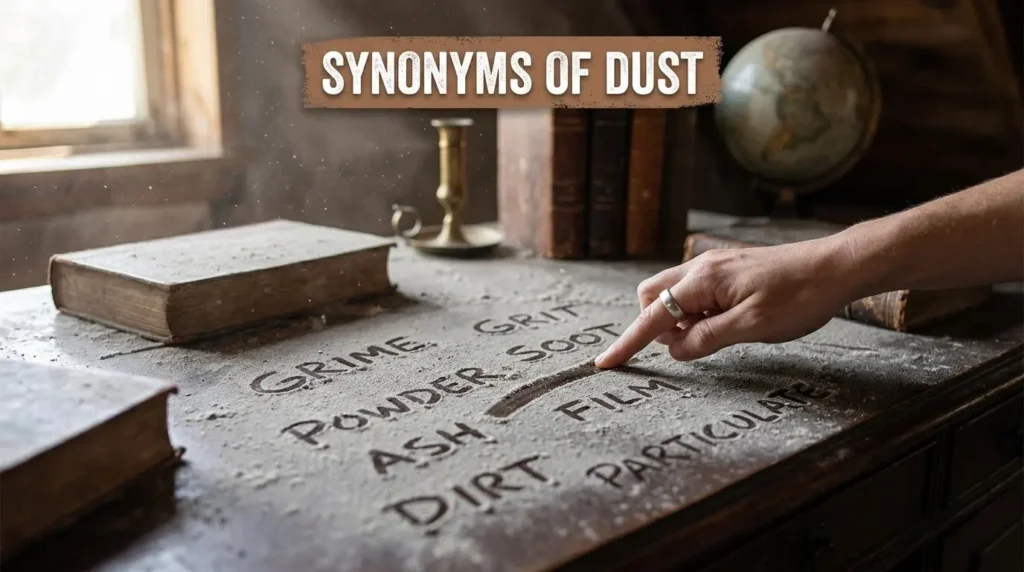
Dust is a common word in English. We see dust on shelves, roads, and old books. Imagine cleaning your room after many days. You wipe the table, and a thin gray layer covers your cloth. That is dust. It is tiny, dry particles that settle everywhere.
The word “dust” is simple, but it appears often in daily speech, stories, science, and even poetry. English learners and writers use it a lot. Learning synonyms of dust helps you avoid repeating the same word. It also makes your speaking and writing more colorful and clear.
In this article, you will learn the meaning of dust and its synonyms with examples. You will also learn its grammar, pronunciation, word history, and categories in easy language.
Meaning of Dust
Dust (noun / verb):
Dust means very small, dry particles of dirt or powder that float in the air or settle on surfaces.
Examples:
- The table was covered with dust.
- She dusted the shelves before guests arrived.
Connotative Meaning
(Connotation means the emotional feeling or idea connected to a word, beyond its basic meaning.)
- Positive tone: Soft golden dust in sunlight.
- Negative tone: Dirty dust causing allergies.
- Neutral tone: Dust on a road or shelf.
Etymology
- From Old English dūst meaning “fine dry powder.”
- Related to German Dunst (mist, vapor).
Short History:
- Old English (450–1100): Used as dūst for dry earth particles.
- Middle English (1100–1500): Spelled as dust or douste.
- Modern English (1500–Present): Used for dirt, powder, and even metaphorically (e.g., “bite the dust”).
Pronunciation (US & UK – IPA)
- US: /dʌst/
- UK: /dʌst/
Syllables
- dust
Affixation Pattern of Dust
- Root: dust
- Prefix: none
- Suffix: none
Word Formation:
- dust (noun)
- dust (verb)
- dusty (adjective)
- dusting (noun/verb)
- dustless (adjective)
A List 30 Synonyms for Dust
1. Dirt (noun)
US: /dɝːt/ | UK: /dɜːt/
Meaning: Soil or unclean matter.
Examples:
- His shoes were covered in dirt.
- The floor was full of dirt after the storm.
2. Powder (noun)
US: /ˈpaʊdər/ | UK: /ˈpaʊdə/
Meaning: Fine, dry particles.
Examples:
- The sugar turned into powder.
- She applied face powder.
3. Sand (noun)
US: /sænd/ | UK: /sænd/
Meaning: Tiny grains of rock.
Examples:
- The beach was full of sand.
- Sand blew into my eyes.
4. Ash (noun)
US: /æʃ/ | UK: /æʃ/
Meaning: Powder left after burning.
Examples:
- Ash covered the ground.
- The fire turned wood into ash.
5. Soot (noun)
US: /sʊt/ | UK: /sʊt/
Meaning: Black powder from smoke.
Examples:
- Soot stained the wall.
- The chimney was full of soot.
6. Grime (noun)
US: /ɡraɪm/ | UK: /ɡraɪm/
Meaning: Thick dirt.
Examples:
- Grime covered the windows.
- He washed away the grime.
7. Debris (noun)
US: /dəˈbriː/ | UK: /ˈdeɪbriː/
Meaning: Scattered remains.
Examples:
- Debris lay after the storm.
- Workers cleared the debris.
8. Residue (noun)
US: /ˈrɛzɪduː/ | UK: /ˈrɛzɪdjuː/
Meaning: Material left behind.
Examples:
- Sticky residue remained.
- The soap left residue.
9. Particles (noun)
US: /ˈpɑːrtɪkəlz/ | UK: /ˈpɑːtɪkəlz/
Meaning: Very small pieces.
Examples:
- Dust particles floated in air.
- Tiny particles sparkled.
10. Speck (noun)
US: /spɛk/ | UK: /spɛk/
Meaning: A very small spot.
Examples:
- A speck of dust sat there.
- I saw a speck on my shirt.
11. Grain (noun)
US: /ɡreɪn/ | UK: /ɡreɪn/
Meaning: A tiny hard particle.
Examples:
- A grain of sand stuck to me.
- Each grain felt rough.
12. Lint (noun)
US: /lɪnt/ | UK: /lɪnt/
Meaning: Small fibers from cloth.
Examples:
- Lint covered the sweater.
- She removed lint carefully.
13. Fluff (noun)
US: /flʌf/ | UK: /flʌf/
Meaning: Light soft fibers.
Examples:
- Fluff floated in air.
- The pillow released fluff.
14. Powderiness (noun)
US: /ˈpaʊdərɪnəs/ | UK: /ˈpaʊdərɪnəs/
Meaning: The quality of being powdery.
Examples:
- The soil had powderiness.
- Powderiness covered the surface.
15. Sediment (noun)
US: /ˈsɛdɪmənt/ | UK: /ˈsɛdɪmənt/
Meaning: Material settled at bottom.
Examples:
- Sediment lay in the river.
- The jar had sediment.
16. Earth (noun)
US: /ɝːθ/ | UK: /ɜːθ/
Meaning: Soil or ground.
Examples:
- Earth stuck to boots.
- The earth felt dry.
17. Soil (noun)
US: /sɔɪl/ | UK: /sɔɪl/
Meaning: Upper layer of ground.
Examples:
- Soil blew in wind.
- The soil was dry and dusty.
18. Talc (noun)
US: /tælk/ | UK: /tælk/
Meaning: Soft mineral powder.
Examples:
- She used talc on skin.
- Talc felt smooth.
19. Chalk (noun)
US: /tʃɔːk/ | UK: /tʃɔːk/
Meaning: Soft white stone powder.
Examples:
- Chalk dust filled air.
- The board had chalk marks.
20. Smudge (noun)
US: /smʌdʒ/ | UK: /smʌdʒ/
Meaning: Dirty mark.
Examples:
- A smudge was on glass.
- She wiped the smudge away.
21. Film (noun)
US: /fɪlm/ | UK: /fɪlm/
Meaning: Thin layer on surface.
Examples:
- A film of dust formed.
- The mirror had a film.
22. Layer (noun)
US: /ˈleɪər/ | UK: /ˈleɪə/
Meaning: One level covering another.
Examples:
- A layer of dust settled.
- The table had a thin layer.
23. Crumbs (noun)
US: /krʌmz/ | UK: /krʌmz/
Meaning: Small bits of food.
Examples:
- Crumbs fell on floor.
- She brushed crumbs away.
24. Dustiness (noun)
US: /ˈdʌstinəs/ | UK: /ˈdʌstinəs/
Meaning: The state of being dusty.
Examples:
- The room had dustiness.
- Dustiness caused sneezing.
25. Shavings (noun)
US: /ˈʃeɪvɪŋz/ | UK: /ˈʃeɪvɪŋz/
Meaning: Thin small slices.
Examples:
- Wood shavings lay around.
- Shavings covered floor.
26. Pulverulence (noun)
US: /ˌpʌlvəˈruːləns/ | UK: /ˌpʌlvəˈruːləns/
Meaning: The state of being dusty.
Examples:
- The air had pulverulence.
- Pulverulence filled the cave.
27. Grit (noun)
US: /ɡrɪt/ | UK: /ɡrɪt/
Meaning: Small rough particles.
Examples:
- Grit blew into eyes.
- The road had grit.
28. Fleck (noun)
US: /flɛk/ | UK: /flɛk/
Meaning: Small spot or particle.
Examples:
- A fleck of dust sparkled.
- Flecks covered the coat.
29. Haze (noun)
US: /heɪz/ | UK: /heɪz/
Meaning: Light mist of particles.
Examples:
- A haze of dust rose.
- The air looked hazy.
30. Cloud (noun)
US: /klaʊd/ | UK: /klaʊd/
Meaning: A mass of particles in air.
Examples:
- A cloud of dust formed.
- The car left a cloud behind.
Prototype Meaning
The most typical meaning of dust is a fine, dry layer of dirt that settles on surfaces like tables, books, and floors. People often imagine sunlight coming through a window and tiny particles floating in the air.
Prototype Categorization
Synonyms can be grouped by meaning:
- Natural ground particles: sand, soil, earth, grit.
- Burned material: ash, soot.
- Tiny spots: speck, fleck, grain.
- Layers and marks: film, layer, smudge.
- Air particles: haze, cloud, particles.
Categorization helps writers choose the best word. For example, use “ash” after fire, but “grit” for rough roads.
Antonyms of Dust
- Cleanliness (noun): State of being clean.
- Purity (noun): Freedom from dirt.
- Clarity (noun): Clearness without particles.
- Spotlessness (noun): Complete cleanliness.
Short Questions and Answers
- What does dust mean?
Dust means very fine, dry particles of dirt or powder. - When should dust be used?
Use it when talking about tiny dry particles on surfaces or in air. - Is dust positive or negative?
It is usually neutral, but it can feel negative when linked to dirt. - How is it different from similar words?
Dust is general. Words like soot or ash are specific types.
Conclusion
Learning the word dust and its synonyms improves your English vocabulary. It helps you speak and write with more detail. You avoid repeating the same simple word again and again. Strong vocabulary makes your sentences clear and interesting. It also builds your confidence in English.
Practice one new synonym each day. Use it in a sentence. Over time, your vocabulary will grow naturally and powerfully.

I am a linguist with 17 years of experience in English language teaching, including postgraduate-level instruction. My expertise includes English grammar, and I contribute as a content and blog writer, producing scholarly and educational language resources.