
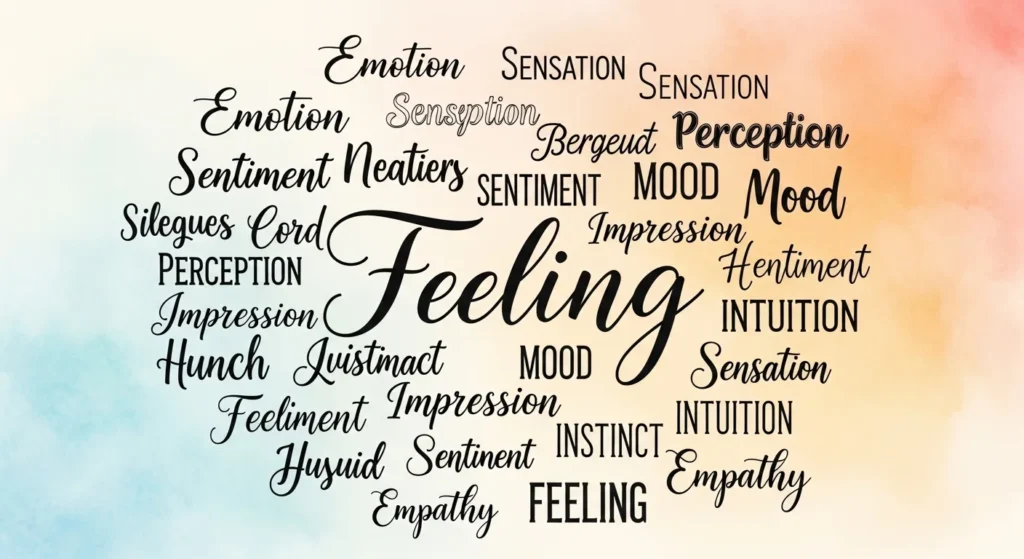
Feeling is a word we use every day. You may say, “I have a strange feeling,” or “I feel happy today.” Imagine you are waiting for exam results. Your heart beats fast. That deep emotion inside you is a feeling.
The word is common in daily talk, books, and social media. It helps us share emotions, thoughts, and physical sensations. But using the same word again and again can make writing dull.
Learning synonyms of feeling helps English learners and content writers grow their vocabulary. It makes speech clear and rich. In this article, you will learn the meaning of feeling, its synonyms, pronunciation, tone, grammar, history, and categories in a simple and easy way.
Meaning of Feeling
Definition
Feeling (Noun):
An emotion, thought, or physical sensation that you experience inside your body or mind.
Examples
- I have a good feeling about this job interview.
- She shared her feelings with her best friend.
Connotative Meaning
(Connotation means the emotional tone or feeling a word suggests beyond its basic meaning.)
- Positive tone: love, joy, hope
- Negative tone: fear, anger, sadness
- Neutral tone: sensation, awareness
Etymology
- From Old English “fēlan” meaning “to touch or perceive.”
- Related to German “fühlen.”
- Originally meant physical touch, later included emotions.
Short History
- Old English (450–1100): Used for physical touch.
- Middle English (1100–1500): Included emotional sense.
- Modern English (1500–Present): Used for emotions and intuition.
Pronunciation (US & UK – IPA)
- US: /ˈfiːlɪŋ/
- UK: /ˈfiːlɪŋ/
Syllables
feel-ing
Affixation Pattern of Feeling
- Root: feel
- Prefix: none
- Suffix: -ing
Word Formation
- Feel (verb)
- Feeling (noun)
- Feelings (plural noun)
- Feeler (noun)
- Feelingly (adverb)
A List of 30 Synonyms for Feeling
1. Emotion (Noun)
US /ɪˈmoʊʃən/ | UK /ɪˈməʊʃən/
Meaning: A strong human feeling like love or anger.
Examples:
- She spoke with deep emotion.
- His voice showed emotion.
2. Sensation (Noun)
US /senˈseɪʃən/ | UK /senˈseɪʃən/
Meaning: A physical feeling in the body.
Examples:
- I felt a cold sensation.
- The pain created a sharp sensation.
3. Sentiment (Noun)
US /ˈsentɪmənt/ | UK /ˈsentɪmənt/
Meaning: A thought or feeling based on emotion.
Examples:
- Public sentiment was strong.
- She expressed her true sentiment.
4. Passion (Noun)
US /ˈpæʃən/ | UK /ˈpæʃən/
Meaning: A powerful feeling of love or excitement.
Examples:
- He spoke with passion.
- Music is her passion.
5. Affection (Noun)
US /əˈfekʃən/ | UK /əˈfekʃən/
Meaning: A gentle feeling of love.
Examples:
- She showed affection to her child.
- His affection was clear.
6. Mood (Noun)
US /muːd/ | UK /muːd/
Meaning: A temporary emotional state.
Examples:
- I am in a good mood.
- His mood changed quickly.
7. Spirit (Noun)
US /ˈspɪrɪt/ | UK /ˈspɪrɪt/
Meaning: Inner feeling or attitude.
Examples:
- She has a happy spirit.
- Team spirit is strong.
8. Perception (Noun)
US /pərˈsepʃən/ | UK /pəˈsepʃən/
Meaning: The way you understand something.
Examples:
- His perception was wrong.
- Perception shapes opinion.
9. Intuition (Noun)
US /ˌɪntuˈɪʃən/ | UK /ˌɪntjuˈɪʃən/
Meaning: A feeling that guides you without logic.
Examples:
- Trust your intuition.
- She had an intuition about danger.
10. Impression (Noun)
US /ɪmˈpreʃən/ | UK /ɪmˈpreʃən/
Meaning: A belief or feeling about something.
Examples:
- I got a good impression.
- His impression was positive.
11. Awareness (Noun)
US /əˈwer.nəs/ | UK /əˈweə.nəs/
Meaning: Knowing or sensing something.
Examples:
- She had awareness of risk.
- Awareness helps growth.
12. Sympathy (Noun)
US /ˈsɪmpəθi/ | UK /ˈsɪmpəθi/
Meaning: Sharing someone’s sadness.
Examples:
- He showed sympathy.
- We offer our sympathy.
13. Empathy (Noun)
US /ˈempəθi/ | UK /ˈempəθi/
Meaning: Understanding others’ feelings.
Examples:
- She has empathy.
- Empathy builds trust.
14. Excitement (Noun)
US /ɪkˈsaɪtmənt/ | UK /ɪkˈsaɪtmənt/
Meaning: Strong happiness or thrill.
Examples:
- The news caused excitement.
- I felt excitement.
15. Fear (Noun)
US /fɪr/ | UK /fɪə/
Meaning: A feeling of danger or worry.
Examples:
- Fear stopped him.
- She felt fear.
16. Joy (Noun)
US /dʒɔɪ/ | UK /dʒɔɪ/
Meaning: Great happiness.
Examples:
- The baby brought joy.
- Tears of joy fell.
17. Anger (Noun)
US /ˈæŋɡər/ | UK /ˈæŋɡə/
Meaning: Strong feeling of dislike.
Examples:
- He felt anger.
- Anger can hurt others.
18. Love (Noun)
US /lʌv/ | UK /lʌv/
Meaning: Deep care and affection.
Examples:
- Love heals pain.
- She gave love freely.
19. Sorrow (Noun)
US /ˈsɑːroʊ/ | UK /ˈsɒrəʊ/
Meaning: Deep sadness.
Examples:
- He felt sorrow.
- Sorrow filled her heart.
20. Delight (Noun)
US /dɪˈlaɪt/ | UK /dɪˈlaɪt/
Meaning: Great pleasure.
Examples:
- The gift gave delight.
- She smiled with delight.
21. Discomfort (Noun)
US /dɪsˈkʌmfərt/ | UK /dɪsˈkʌmfət/
Meaning: Slight pain or unease.
Examples:
- He felt discomfort.
- The chair caused discomfort.
22. Anxiety (Noun)
US /æŋˈzaɪəti/ | UK /æŋˈzaɪəti/
Meaning: Nervous worry.
Examples:
- Exams cause anxiety.
- She felt anxiety.
23. Gratitude (Noun)
US /ˈɡrætɪtuːd/ | UK /ˈɡrætɪtjuːd/
Meaning: Thankful feeling.
Examples:
- He showed gratitude.
- Gratitude brings peace.
24. Curiosity (Noun)
US /ˌkjʊriˈɑːsəti/ | UK /ˌkjʊəriˈɒsəti/
Meaning: Desire to know something.
Examples:
- Curiosity led her.
- Children have curiosity.
25. Frustration (Noun)
US /frʌˈstreɪʃən/ | UK /frʌˈstreɪʃən/
Meaning: Feeling of being upset.
Examples:
- He showed frustration.
- Delay caused frustration.
26. Pride (Noun)
US /praɪd/ | UK /praɪd/
Meaning: Feeling of self-respect.
Examples:
- She felt pride.
- Pride filled his heart.
27. Shame (Noun)
US /ʃeɪm/ | UK /ʃeɪm/
Meaning: Feeling of guilt or embarrassment.
Examples:
- He felt shame.
- Shame stopped her.
28. Relief (Noun)
US /rɪˈliːf/ | UK /rɪˈliːf/
Meaning: Feeling of comfort after worry.
Examples:
- She sighed in relief.
- Relief washed over him.
29. Hope (Noun)
US /hoʊp/ | UK /həʊp/
Meaning: Positive feeling about future.
Examples:
- Hope keeps us strong.
- She felt hope.
30. Hurt (Noun)
US /hɜːrt/ | UK /hɜːt/
Meaning: Emotional or physical pain.
Examples:
- He felt hurt.
- Her words caused hurt.
Prototype Meaning
When people hear the word feeling, they usually imagine an emotion inside the heart or mind, such as happiness, sadness, or fear. It often connects with personal experience and inner reaction.
Prototype Categorization
Positive feelings: joy, love, gratitude, hope, delight
Negative feelings: anger, fear, sorrow, shame, frustration
Neutral feelings: sensation, perception, awareness
Categorizing synonyms helps writers choose the right word. For example, “joy” is stronger than “mood,” and “anxiety” is more specific than “fear.”
Antonyms/Opposites of Feeling
- Numbness (Noun): lack of feeling
- Apathy (Noun): lack of interest or emotion
- Indifference (Noun): no care or concern
- Unawareness (Noun): lack of knowledge
Short Questions and Answers
- What does feeling mean?
It means an emotion or sensation you experience inside. - When should feeling be used?
Use it when talking about emotions, thoughts, or body sensations. - Is feeling positive or negative?
It can be positive, negative, or neutral depending on context. - How is it different from emotion?
Emotion is usually stronger and more specific than feeling.
Conclusion
Learning the word feeling and its 30 synonyms improves your vocabulary. It makes writing clear and powerful. It helps you avoid repetition. It strengthens speaking skills. It builds confidence in English communication.
Practice using new synonyms daily. Replace simple words with more exact ones. Over time, your English will sound natural and strong. Keep learning one word each day. Small steps lead to big success.

I am a linguist with 17 years of experience in English language teaching, including postgraduate-level instruction. My expertise includes English grammar, and I contribute as a content and blog writer, producing scholarly and educational language resources.