
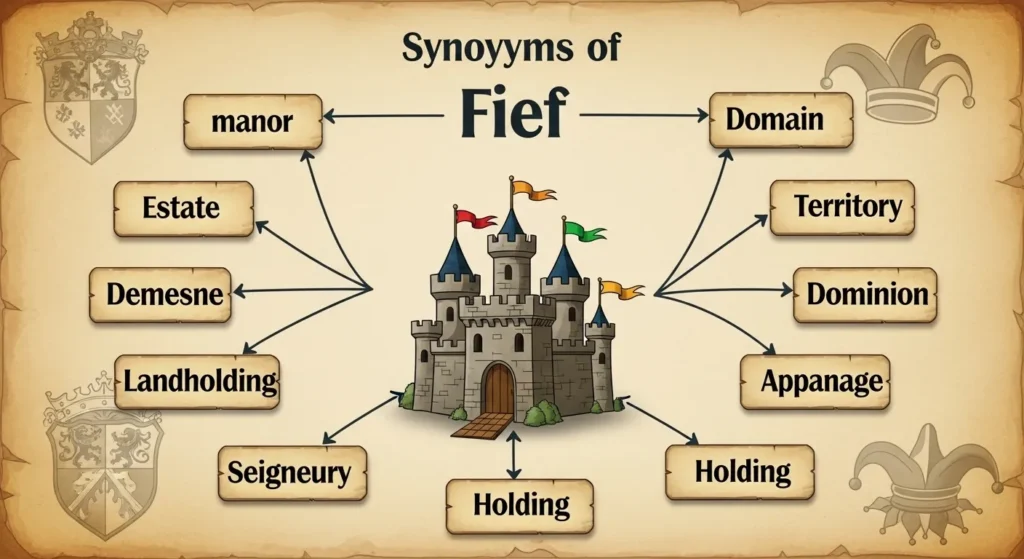
A fief was a piece of land given by a king to a lord in return for loyalty and service. Imagine a medieval knight receiving land from his king. In return, he promises to fight and protect the kingdom. That land is his fief.
The word fief is often used in history books. It also appears in politics and business. Sometimes people use it to describe a place someone controls fully.
Learning synonyms of fief helps English learners and writers avoid repeating the same word. It also makes writing clearer and richer.
In this article, you will learn the meaning of fief, its pronunciation, grammar, tone, history, and word formation. You will also explore 30 useful synonyms with examples and categories to improve your vocabulary step by step.
Meaning of Fief
Definition
Fief (Noun):
Land given by a king or ruler to someone in exchange for loyalty or service.
Examples
- The knight ruled his fief with care.
- The king granted him a large fief.
Connotative Meaning
(Connotation means the emotional feeling or tone a word carries beyond its basic meaning.)
- Positive tone: symbol of honor and trust
- Negative tone: private power or unfair control
- Neutral tone: historical land system
Etymology
- From Old French fief meaning “property or estate.”
- From Medieval Latin feudum meaning “feudal holding.”
Short History:
- Old English (450–1100): The word was not common; feudal ideas existed.
- Middle English (1100–1500): Entered English after the Norman Conquest.
- Modern English (1500–Present): Used in history and figurative speech.
Pronunciation (US & UK – IPA)
US: /fiːf/
UK: /fiːf/
Syllables
fief
Affixation Pattern of Fief
- Root: fief
- Prefix: none
- Suffix: none
Word Formation (3 words formed):
- Fief (noun)
- Feudal (adjective)
- Feudalism (noun)
A List of 30 Synonyms for Fief
1. Estate (Noun)
US: /ɪˈsteɪt/ | UK: /ɪˈsteɪt/
Meaning: A large area of land owned by someone.
Examples:
- He owned a large estate.
- The estate had farms and houses.
2. Manor (Noun)
US: /ˈmæn.ɚ/ | UK: /ˈmæn.ə/
Meaning: A lord’s house and land in feudal times.
Examples:
- The manor stood on a hill.
- Farmers worked on the manor.
3. Domain (Noun)
US: /doʊˈmeɪn/ | UK: /dəˈmeɪn/
Meaning: An area owned or controlled by someone.
Examples:
- This land was his domain.
- She rules her domain wisely.
4. Territory (Noun)
US: /ˈter.ə.tɔːr.i/ | UK: /ˈter.ɪ.tər.i/
Meaning: An area of land under control.
Examples:
- The natives guarded their territory.
- The territory was rich in crops.
5. Holding (Noun)
US: /ˈhoʊl.dɪŋ/ | UK: /ˈhəʊl.dɪŋ/
Meaning: Property owned by someone.
Examples:
- He expanded his land holding.
- The holding included fields.
6. Landholding (Noun)
US: /ˈlændˌhoʊl.dɪŋ/ | UK: /ˈlændˌhəʊl.dɪŋ/
Meaning: Land owned by a person.
Examples:
- His landholding grew larger.
- The landholding supported many workers.
7. Property (Noun)
US: /ˈprɑː.pɚ.ti/ | UK: /ˈprɒp.ə.ti/
Meaning: Land or buildings owned.
Examples:
- The property was valuable.
- She inherited the property.
8. Grant (Noun)
US: /ɡrænt/ | UK: /ɡrɑːnt/
Meaning: Land given officially.
Examples:
- The king gave a land grant.
- The grant rewarded loyalty.
9. Benefice (Noun)
US: /ˈben.ə.fɪs/ | UK: /ˈben.ɪ.fɪs/
Meaning: Church land given for service.
Examples:
- The priest received a benefice.
- The benefice supported his work.
10. Feud (Noun)
US: /fjuːd/ | UK: /fjuːd/
Meaning: A feudal landholding.
Examples:
- He governed his feud.
- The feud passed to his son.
11. Seigniory (Noun)
US: /ˈsiːn.jɔːr.i/ | UK: /ˈseɪn.jɔːr.i/
Meaning: The lord’s land and rights.
Examples:
- The seigniory covered many farms.
- Taxes were paid to the seigniory.
12. Barony (Noun)
US: /ˈber.ə.ni/ | UK: /ˈbær.ə.ni/
Meaning: Land ruled by a baron.
Examples:
- The barony was peaceful.
- He inherited the barony.
13. Principality (Noun)
US: /ˌprɪn.səˈpæl.ə.t̬i/ | UK: /ˌprɪn.sɪˈpæl.ə.ti/
Meaning: Land ruled by a prince.
Examples:
- The principality was small.
- The prince ruled the principality.
14. Kingdom (Noun)
US: /ˈkɪŋ.dəm/ | UK: /ˈkɪŋ.dəm/
Meaning: Land ruled by a king.
Examples:
- The kingdom was vast.
- He defended his kingdom.
15. Duchy (Noun)
US: /ˈdʌtʃ.i/ | UK: /ˈdʌtʃ.i/
Meaning: Land ruled by a duke.
Examples:
- The duchy produced wheat.
- The duke governed the duchy.
16. Realm (Noun)
US: /relm/ | UK: /relm/
Meaning: A kingdom or area of rule.
Examples:
- Peace filled the realm.
- The realm prospered.
17. Province (Noun)
US: /ˈprɑː.vɪns/ | UK: /ˈprɒv.ɪns/
Meaning: A region of a country.
Examples:
- The province was fertile.
- He managed the province.
18. Colony (Noun)
US: /ˈkɑː.lə.ni/ | UK: /ˈkɒl.ə.ni/
Meaning: Land settled and ruled by another country.
Examples:
- The colony grew quickly.
- The colony paid taxes.
19. Possession (Noun)
US: /pəˈzeʃ.ən/ | UK: /pəˈzeʃ.ən/
Meaning: Something owned.
Examples:
- The land was his possession.
- He guarded his possession.
20. Allotment (Noun)
US: /əˈlɑːt.mənt/ | UK: /əˈlɒt.mənt/
Meaning: Land given to someone.
Examples:
- He received an allotment.
- The allotment was small.
21. Patrimony (Noun)
US: /ˈpæ.trə.moʊ.ni/ | UK: /ˈpæt.rɪ.mə.ni/
Meaning: Property inherited from family.
Examples:
- The land was his patrimony.
- He valued his patrimony.
22. Heritage (Noun)
US: /ˈher.ɪ.tɪdʒ/ | UK: /ˈher.ɪ.tɪdʒ/
Meaning: Property passed down.
Examples:
- The castle was family heritage.
- They protected their heritage.
23. Demesne (Noun)
US: /dɪˈmeɪn/ | UK: /dɪˈmiːn/
Meaning: Land kept by a lord.
Examples:
- The demesne fed the manor.
- Workers farmed the demesne.
24. Tenure (Noun)
US: /ˈten.jɚ/ | UK: /ˈten.jə/
Meaning: Holding land by law.
Examples:
- His tenure lasted years.
- Land tenure was strict.
25. Fiefdom (Noun)
US: /ˈfiːf.dəm/ | UK: /ˈfiːf.dəm/
Meaning: An area controlled like a private kingdom.
Examples:
- The office became his fiefdom.
- He ruled it as a fiefdom.
26. Lands (Noun)
US: /lændz/ | UK: /lændz/
Meaning: Areas of ground owned.
Examples:
- The lands were wide.
- He protected his lands.
27. Acreage (Noun)
US: /ˈeɪ.kər.ɪdʒ/ | UK: /ˈeɪ.kər.ɪdʒ/
Meaning: Amount of land area.
Examples:
- The acreage was large.
- They sold the acreage.
28. Territory Holding (Noun)
US: /ˈter.ə.tɔːr.i ˈhoʊl.dɪŋ/ | UK: /ˈter.ɪ.tər.i ˈhəʊl.dɪŋ/
Meaning: Land kept under control.
Examples:
- His territory holding grew.
- The holding was protected.
29. Lordship (Noun)
US: /ˈlɔːrd.ʃɪp/ | UK: /ˈlɔːd.ʃɪp/
Meaning: Power and land of a lord.
Examples:
- The lordship was inherited.
- He defended his lordship.
30. Vassalage (Noun)
US: /ˈvæs.əl.ɪdʒ/ | UK: /ˈvæs.əl.ɪdʒ/
Meaning: The state of holding land under a lord.
Examples:
- He lived in vassalage.
- Vassalage required loyalty.
Prototype Meaning
The most typical meaning of fief is a piece of land given by a king to a lord during feudal times. People imagine castles, knights, and farming land under a ruler’s control.
Prototype Categorization
- Feudal titles: barony, duchy, seigniory
- General land terms: estate, territory, property
- Inherited land: patrimony, heritage
- Control-based meaning: domain, fiefdom
Categorization helps writers choose the right synonym based on history, ownership, or power context.
Antonyms of Fief
- Common land (Noun): Land owned by everyone.
- Public property (Noun): Land owned by the state.
- Independence (Noun): Freedom from control.
- Liberty (Noun): Freedom from rule.
Short Questions and Answers
- What does fief mean?
It means land given by a ruler in return for service. - When should fief be used?
Use it in historical or figurative contexts about control. - Is fief positive or negative?
It depends on context. It can show honor or unfair power. - How is it different from similar words?
“Fief” is specific to feudal systems, while “estate” is more general.
CONCLUSION
Learning the word fief and its synonyms improves vocabulary deeply. It helps you understand history texts better. It strengthens writing by adding variety, and avoids repetition in essays and articles. When you know pronunciation, tone, and history, your English becomes stronger. Practice using one new synonym daily. Over time, your speaking and writing will become clearer and more confident.

I am a linguist with 17 years of experience in English language teaching, including postgraduate-level instruction. My expertise includes English grammar, and I contribute as a content and blog writer, producing scholarly and educational language resources.