A flat character is a simple character in a story who does not grow or change. Imagine a strict school principal in a novel. From the first page to the last page, he is always strict. He never learns a lesson. He never shows new feelings. That is a flat character.
This word is common in literature, school exams, and story writing. Teachers often use it when explaining novels and short stories. For English learners and content writers, knowing synonyms of ‘flat character’ is very important. It improves vocabulary, avoids repetition, and makes writing stronger.
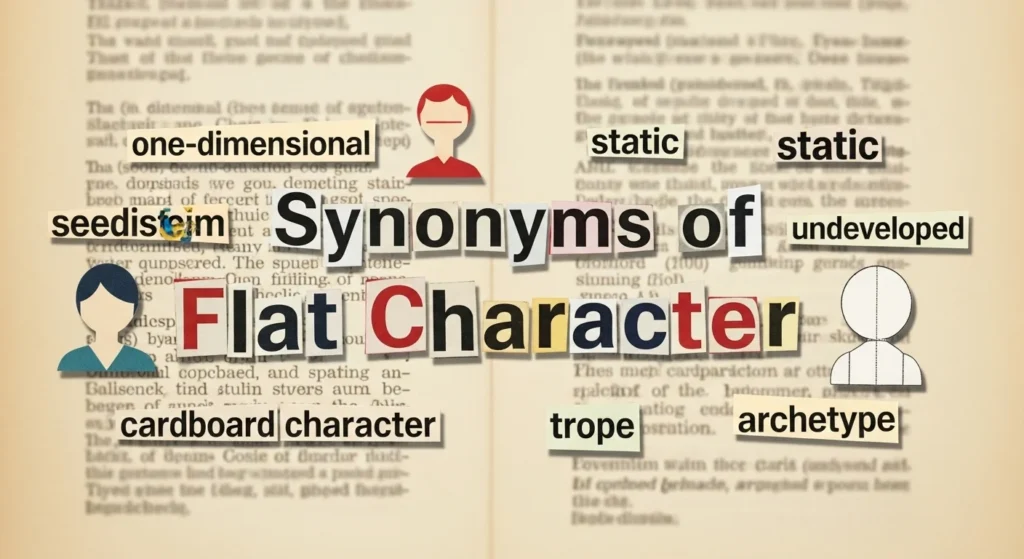
In this article, you will learn the meaning of flat character, its examples, word categorization, pronunciation, word formation, history, and 30 powerful synonyms with meanings and examples. Everything is written in simple and clear English.
Meaning of Flat Character
Definition
Flat Character (Noun):
A character in a story who has only one or two simple traits and does not change during the story.
Examples
- The guard in the story is a flat character who only follows orders.
- The greedy shopkeeper stays selfish from beginning to end.
Connotative Meaning
(Connotation means the emotional feeling or tone a word carries beyond its basic meaning.)
- Positive tone: Sometimes useful in simple stories or comedy.
- Negative tone: Can suggest boring or weak character writing.
- Neutral tone: Often used in academic and literary analysis.
Etymology
- The word flat comes from Old Norse flatr, meaning “level” or “smooth.”
- The word character comes from Greek kharaktēr, meaning “mark” or “distinct sign.”
Short History
- Old English (450–1100): “Flat” meant level or smooth in shape.
- Middle English (1100–1500): The word began to describe personality traits.
- Modern English (1500–Present): Used in literature to describe simple, unchanging characters.
Pronunciation (US & UK – IPA)
US: /flæt ˈkærəktər/
UK: /flæt ˈkærɪktə/
Syllables
flat char-ac-ter
Affixation Pattern of Flat Character
- Root: flat, character
- Prefix: none
- Suffix: -er (in character)
Word Formation
- Flatness (noun)
- Flatten (verb)
- Flatly (adverb)
- Characterize (verb)
- Characterization (noun)
- Characteristic (noun/adjective)
- Characterless (adjective)
A List of 30 Synonyms for Flat Character
1. Static Character (Noun)
US: /ˈstætɪk ˈkærəktər/ | UK: /ˈstætɪk ˈkærɪktə/
Meaning: A character who does not change.
Examples:
- The aunt is a static character in the novel.
- She remains kind throughout the story.
2. One-dimensional Character (Noun)
US: /ˌwʌn dɪˈmenʃənl/ | UK: /ˌwʌn daɪˈmenʃənl/
Meaning: A character with only one main trait.
Examples:
- The villain feels one-dimensional.
- He shows no emotional depth.
3. Stock Character (Noun)
US: /stɑːk ˈkærəktər/ | UK: /stɒk ˈkærɪktə/
Meaning: A common character type used again and again.
Examples:
- The wise old man is a stock character.
- Fairy tales use many stock characters.
4. Stereotype (Noun)
US: /ˈsteriətaɪp/ | UK: /ˈsteriətaɪp/
Meaning: A fixed and simple idea about a person type.
Examples:
- The nerd in the movie is a stereotype.
- She plays a cultural stereotype.
5. Caricature (Noun)
US: /ˈkærɪkətʃər/ | UK: /ˈkærɪkətʃə/
Meaning: An exaggerated and oversimplified character.
Examples:
- The boss feels like a caricature.
- His anger is too exaggerated.
6. Cardboard Character (Noun)
US: /ˈkɑːrdbɔːrd ˈkærəktər/ | UK: /ˈkɑːdbɔːd ˈkærɪktə/
Meaning: A lifeless and unrealistic character.
Examples:
- The hero’s friend is a cardboard character.
- She has no real personality.
7. Shallow Character (Noun)
US: /ˈʃæloʊ/ | UK: /ˈʃæləʊ/
Meaning: A character without deep thoughts or feelings.
Examples:
- The model is a shallow character.
- He lacks emotional depth.
8. Simplistic Character (Noun)
US: /sɪmˈplɪstɪk/ | UK: /sɪmˈplɪstɪk/
Meaning: Too simple and not complex.
Examples:
- The side role feels simplistic.
- She never changes her ideas.
9. Two-dimensional Character (Noun)
US: /ˌtuː dɪˈmenʃənl/ | UK: /ˌtuː daɪˈmenʃənl/
Meaning: A character lacking depth.
Examples:
- The villain is two-dimensional.
- He only shows anger.
10. Underdeveloped Character (Noun)
US: /ˌʌndərdɪˈveləpt/ | UK: /ˌʌndədɪˈveləpt/
Meaning: Not fully explored or explained.
Examples:
- The sister is underdeveloped.
- We know little about her past.
11. Predictable Character (Noun)
US: /prɪˈdɪktəbl/ | UK: /prɪˈdɪktəbl/
Meaning: A character whose actions are easy to guess.
Examples:
- The villain is predictable.
- We know what he will do next.
12. Lifeless Character (Noun)
US: /ˈlaɪfləs/ | UK: /ˈlaɪfləs/
Meaning: A character without energy or realism.
Examples:
- The assistant feels lifeless.
- She adds nothing to the story.
13. Mechanical Character (Noun)
US: /məˈkænɪkl/ | UK: /məˈkænɪkl/
Meaning: Acting in a fixed, robotic way.
Examples:
- His behavior is mechanical.
- He reacts the same every time.
14. Formulaic Character (Noun)
US: /ˌfɔːrmjəˈleɪɪk/ | UK: /ˌfɔːmjʊˈleɪɪk/
Meaning: Created by following a simple pattern.
Examples:
- The hero feels formulaic.
- The story uses a common pattern.
15. Generic Character (Noun)
US: /dʒəˈnerɪk/ | UK: /dʒəˈnerɪk/
Meaning: Not unique or special.
Examples:
- The soldier is generic.
- He has no special traits.
16. Conventional Character (Noun)
US: /kənˈvenʃənl/ | UK: /kənˈvenʃənl/
Meaning: Traditional and common.
Examples:
- The mother is conventional.
- She fits the usual role.
17. Simple Character (Noun)
US: /ˈsɪmpl/ | UK: /ˈsɪmpl/
Meaning: Easy to understand, not complex.
Examples:
- The child is a simple character.
- He has one clear trait.
18. Plain Character (Noun)
US: /pleɪn/ | UK: /pleɪn/
Meaning: Ordinary and not detailed.
Examples:
- The driver is plain.
- He lacks depth.
19. Basic Character (Noun)
US: /ˈbeɪsɪk/ | UK: /ˈbeɪsɪk/
Meaning: Very simple and not detailed.
Examples:
- The neighbor is basic.
- She has no development.
20. Unchanging Character (Noun)
US: /ʌnˈtʃeɪndʒɪŋ/ | UK: /ʌnˈtʃeɪndʒɪŋ/
Meaning: A character who remains the same.
Examples:
- He is unchanging.
- His attitude never shifts.
21. Fixed Character (Noun)
US: /fɪkst/ | UK: /fɪkst/
Meaning: Not flexible or developing.
Examples:
- She is a fixed character.
- Her beliefs stay the same.
22. Linear Character (Noun)
US: /ˈlɪniər/ | UK: /ˈlɪniə/
Meaning: Moving in one straight direction without depth.
Examples:
- The villain is linear.
- He shows only one side.
23. Surface-level Character (Noun)
US: /ˈsɜːrfɪs ˈlevl/ | UK: /ˈsɜːfɪs ˈlevl/
Meaning: Shown only on the outside.
Examples:
- The friend is surface-level.
- We do not know her feelings.
24. Minor Character (Noun)
US: /ˈmaɪnər/ | UK: /ˈmaɪnə/
Meaning: A small role in a story.
Examples:
- The shopkeeper is a minor character.
- He appears only once.
25. Supporting Character (Noun)
US: /səˈpɔːrtɪŋ/ | UK: /səˈpɔːtɪŋ/
Meaning: A character who supports the main hero.
Examples:
- The nurse is a supporting character.
- She helps the main character.
26. Background Character (Noun)
US: /ˈbækɡraʊnd/ | UK: /ˈbækɡraʊnd/
Meaning: A character in the background.
Examples:
- The waiter is a background character.
- He has no major role.
27. Typecast Role (Noun)
US: /ˈtaɪpkæst/ | UK: /ˈtaɪpkɑːst/
Meaning: A fixed and repeated character type.
Examples:
- He always plays the villain typecast role.
- She is known for typecast roles.
28. Standard Character (Noun)
US: /ˈstændərd/ | UK: /ˈstændəd/
Meaning: A usual and common character.
Examples:
- The hero is standard.
- He fits a known pattern.
29. Typical Character (Noun)
US: /ˈtɪpɪkl/ | UK: /ˈtɪpɪkl/
Meaning: Showing normal traits of a type.
Examples:
- The villain is typical.
- He acts as expected.
30. Undynamic Character (Noun)
US: /ʌn daɪˈnæmɪk/ | UK: /ʌn daɪˈnæmɪk/
Meaning: Not active or changing.
Examples:
- The uncle is undynamic.
- He shows no growth.
Prototype Meaning
When people hear “flat character,” they imagine a simple person in a story. This person has one clear trait. The reader can easily guess what the character will do. There is no deep emotion or big change.
Prototype Categorization
Synonyms can be grouped like this:
- No Change: static, fixed, unchanging, undynamic
- No Depth: shallow, surface-level, two-dimensional
- Common Type: stock, stereotype, conventional, standard
- Weak Writing: cardboard, lifeless, mechanical, formulaic
Categorization helps writers choose the best synonym. Academic writing may prefer “static character.” Strong criticism may use “cardboard character.”
Antonyms/Opposites of Flat Character
- Round Character (Noun): A complex and changing character.
- Dynamic Character (Noun): A character who grows or develops.
- Complex Character (Noun): A character with deep personality.
- Multi-dimensional Character (Noun): A character with many traits.
Short Questions and Answers
- What does flat character mean?
A simple character who does not change. - When should flat character be used?
In literary analysis and story discussion. - Is flat character positive or negative?
It depends on context. It is neutral in study but negative in criticism. - How is it different from similar words?
“Static character” focuses on no change. “Stereotype” focuses on fixed social ideas.
CONCLUSION
Learning the word flat character and its synonyms improves vocabulary. It strengthens writing and speaking skills. It helps avoid repetition in essays and stories. When you know many synonyms, you can express ideas more clearly. Strong vocabulary builds English confidence. Read daily, learn new words, and practice using them in sentences. Over time, your writing will become more powerful and natural.

I am a linguist with 17 years of experience in English language teaching, including postgraduate-level instruction. My expertise includes English grammar, and I contribute as a content and blog writer, producing scholarly and educational language resources.