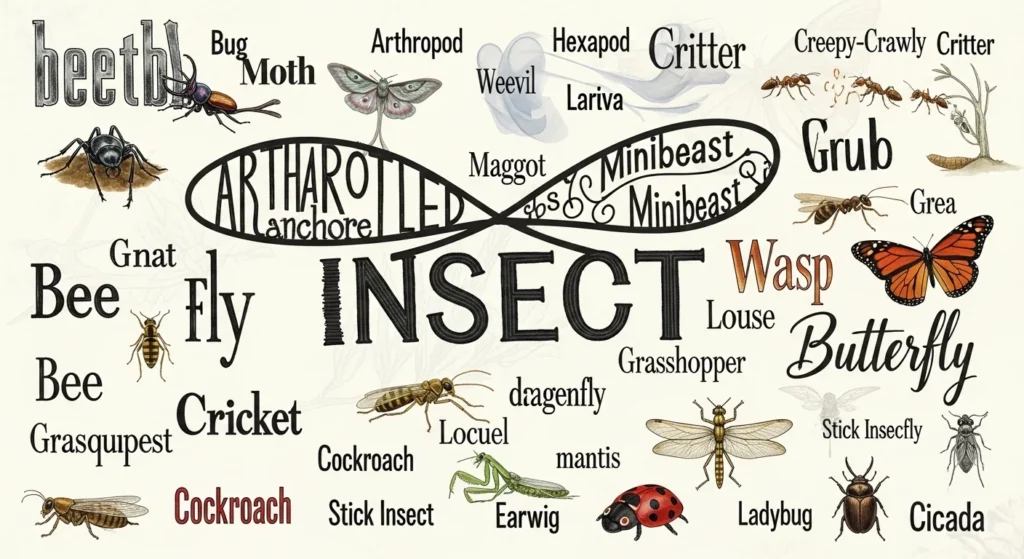
The word insect is very common in daily life. You see insects in your home, garden, or school. Imagine a child watching ants carry food in a line. The child says, “Look at these insects!” This shows how naturally we use this word. It is simple, clear, and easy to understand.
But using the same word again and again can make writing dull. Learning synonyms helps you speak and write better. It gives variety and power to your words. For English learners and writers, synonyms improve vocabulary and expression.
In this article, you will learn the meaning of insect and its synonyms. You will also explore examples, pronunciation, grammar, history, and different categories.
Everything is explained in easy English to help you learn step by step.
Meaning of Insect
Definition
Insect (noun): A small animal with six legs and a body divided into parts, like ants, flies, and bees.
Examples
- I saw an insect crawling on the wall.
- This garden is full of colorful insects.
Connotative Meaning
(Connotation: the feeling or idea a word suggests beyond its basic meaning)
- Positive tone: Useful insect, helpful pollinator
- Negative tone: Dirty insect, harmful pest
- Neutral tone: Small insect, flying insect
Etymology
- From Latin insectum meaning “cut into sections”
History
- Old English (450–1100): No exact word; people used general terms for small creatures
- Middle English (1100–1500): Word forms from Latin began to appear
- Modern English (1500–Present): “Insect” became common in science and daily use
Pronunciation (US & UK – IPA)
- US: /ˈɪn.sekt/
- UK: /ˈɪn.sekt/
Syllables
in-sect
Affixation Pattern of Insect
- Root: sect (cut)
- Prefix: in- (into)
- Suffix: none
Word Formation
- insect (noun)
- insect-like (adjective)
- insecticide (noun)
- insectivorous (adjective)
A List of 30 Synonyms for Insect
1. Bug (noun)
US: /bʌɡ/ | UK: /bʌɡ/
Meaning: A small insect, often used in informal speech
Examples:
- I found a bug in my room.
- The bug is crawling on the table.
2. Pest (noun)
US: /pest/ | UK: /pest/
Meaning: An insect that harms crops or annoys people
Examples:
- Mosquitoes are common pests.
- Farmers fight pests to protect crops.
3. Arthropod (noun)
US: /ˈɑːr.θrə.pɑːd/ | UK: /ˈɑː.θrə.pɒd/
Meaning: A group of animals with jointed legs, including insects
Examples:
- An insect is a type of arthropod.
- Spiders are also arthropods.
4. Creeper (noun)
US: /ˈkriː.pər/ | UK: /ˈkriː.pə/
Meaning: A small creature that crawls
Examples:
- A creeper moved slowly on the ground.
- Children fear tiny creepers.
5. Crawler (noun)
US: /ˈkrɔː.lər/ | UK: /ˈkrɔː.lə/
Meaning: An insect that moves by crawling
Examples:
- The crawler went under the leaf.
- Many crawlers live in soil.
6. Parasite (noun)
US: /ˈper.ə.saɪt/ | UK: /ˈpær.ə.saɪt/
Meaning: An insect that lives on another organism
Examples:
- Fleas are parasites.
- The parasite feeds on blood.
7. Vermin (noun)
US: /ˈvɝː.mɪn/ | UK: /ˈvɜː.mɪn/
Meaning: Harmful small animals or insects
Examples:
- The house had vermin.
- Vermin can spread disease.
8. Beetle (noun)
US: /ˈbiː.t̬əl/ | UK: /ˈbiː.təl/
Meaning: A hard-shelled insect
Examples:
- The beetle is shiny.
- A beetle crawled on the tree.
9. Fly (noun)
US: /flaɪ/ | UK: /flaɪ/
Meaning: A common flying insect
Examples:
- A fly sat on the food.
- Flies are everywhere in summer.
10. Ant (noun)
US: /ænt/ | UK: /ænt/
Meaning: A small social insect
Examples:
- The ant carries food.
- Ants live in groups.
11. Bee (noun)
US: /biː/ | UK: /biː/
Meaning: An insect that makes honey
Examples:
- The bee buzzed loudly.
- Bees help flowers grow.
12. Wasp (noun)
US: /wɑːsp/ | UK: /wɒsp/
Meaning: A stinging insect
Examples:
- A wasp can sting.
- The wasp built a nest.
13. Moth (noun)
US: /mɔːθ/ | UK: /mɒθ/
Meaning: A night-flying insect
Examples:
- The moth flew to the light.
- Moths eat clothes.
14. Butterfly (noun)
US: /ˈbʌt̬.ɚ.flaɪ/ | UK: /ˈbʌt.ə.flaɪ/
Meaning: A colorful flying insect
Examples:
- The butterfly is beautiful.
- A butterfly sat on a flower.
15. Grasshopper (noun)
US: /ˈɡræsˌhɑː.pɚ/ | UK: /ˈɡrɑːsˌhɒp.ə/
Meaning: A jumping insect
Examples:
- The grasshopper jumped high.
- It sat on the grass.
16. Cockroach (noun)
US: /ˈkɑːk.roʊtʃ/ | UK: /ˈkɒk.rəʊtʃ/
Meaning: A dirty household insect
Examples:
- A cockroach ran fast.
- Cockroaches hide in dark places.
17. Mosquito (noun)
US: /məˈskiː.toʊ/ | UK: /məˈskiː.təʊ/
Meaning: A biting insect
Examples:
- A mosquito bit me.
- Mosquitoes spread disease.
18. Termite (noun)
US: /ˈtɝː.maɪt/ | UK: /ˈtɜː.maɪt/
Meaning: An insect that eats wood
Examples:
- Termites damage houses.
- The wood had termites.
19. Larva (noun)
US: /ˈlɑːr.və/ | UK: /ˈlɑː.və/
Meaning: Early stage of an insect
Examples:
- The larva grows into an insect.
- Larvae live in water or soil.
20. Caterpillar (noun)
US: /ˈkæt̬.ɚˌpɪl.ɚ/ | UK: /ˈkæt.ə.pɪl.ə/
Meaning: The larva of a butterfly
Examples:
- The caterpillar eats leaves.
- It becomes a butterfly.
21. Locust (noun)
US: /ˈloʊ.kʌst/ | UK: /ˈləʊ.kʌst/
Meaning: A type of grasshopper that swarms
Examples:
- Locusts destroy crops.
- A swarm covered the sky.
22. Aphid (noun)
US: /ˈeɪ.fɪd/ | UK: /ˈeɪ.fɪd/
Meaning: A small plant-eating insect
Examples:
- Aphids damage plants.
- Farmers remove aphids.
23. Cicada (noun)
US: /sɪˈkeɪ.də/ | UK: /sɪˈkɑː.də/
Meaning: A loud summer insect
Examples:
- The cicada makes noise.
- It sings in trees.
24. Dragonfly (noun)
US: /ˈdræɡ.ən.flaɪ/ | UK: /ˈdræɡ.ən.flaɪ/
Meaning: A long-winged insect
Examples:
- A dragonfly flew fast.
- It hovered over water.
25. Firefly (noun)
US: /ˈfaɪr.flaɪ/ | UK: /ˈfaɪə.flaɪ/
Meaning: A glowing insect
Examples:
- The firefly shines at night.
- Children love fireflies.
26. Gnat (noun)
US: /næt/ | UK: /næt/
Meaning: A tiny flying insect
Examples:
- A gnat flew near me.
- Gnats are very small.
27. Weevil (noun)
US: /ˈwiː.vəl/ | UK: /ˈwiː.vəl/
Meaning: A small beetle that eats grains
Examples:
- Weevils ruin food.
- The bag had weevils.
28. Earwig (noun)
US: /ˈɪr.wɪɡ/ | UK: /ˈɪə.wɪɡ/
Meaning: A small insect with pincers
Examples:
- An earwig hid in the soil.
- It came out at night.
29. Stick insect (noun)
US: /stɪk ˈɪn.sekt/ | UK: /stɪk ˈɪn.sekt/
Meaning: An insect that looks like a stick
Examples:
- The stick insect is hard to see.
- It hides on branches.
30. Mantid (noun)
US: /ˈmæn.tɪd/ | UK: /ˈmæn.tɪd/
Meaning: A praying insect
Examples:
- The mantid sat still.
- It catches prey quickly.
Prototype Meaning
When people hear the word insect, they usually think of a small, six-legged creature like an ant or a fly. It is tiny, moves quickly, and may fly or crawl.
Prototype Categorization
- Common insects: ant, fly, bee
- Harmful insects: pest, termite, mosquito
- Beautiful insects: butterfly, dragonfly
- Scientific terms: arthropod, larva
These categories help writers choose the right word. For example, “pest” shows harm, while “butterfly” shows beauty.
Antonyms of Insect
- Mammal (noun): A warm-blooded animal with fur
- Bird (noun): A feathered flying animal
- Reptile (noun): A cold-blooded animal like a snake
Short Questions and Answers
- What does insect mean?
A small six-legged animal. - When should insect be used?
Use it when talking about small creatures like ants or flies. - Is insect positive or negative?
It can be both, depending on context. - How is it different from similar words?
“Insect” is general; words like “bee” or “ant” are specific.
Conclusion
Learning the word insect and its synonyms helps you grow your vocabulary. It makes your writing more interesting and less repetitive. You can describe things clearly and choose the best word for each situation. This also improves speaking skills and builds confidence in English.
When you practice synonyms daily, your language becomes richer and stronger. Keep learning new words, use them in sentences, and explore their meanings. Over time, you will speak and write English with ease and clarity.

I am a linguist with 17 years of experience in English language teaching, including postgraduate-level instruction. My expertise includes English grammar, and I contribute as a content and blog writer, producing scholarly and educational language resources.