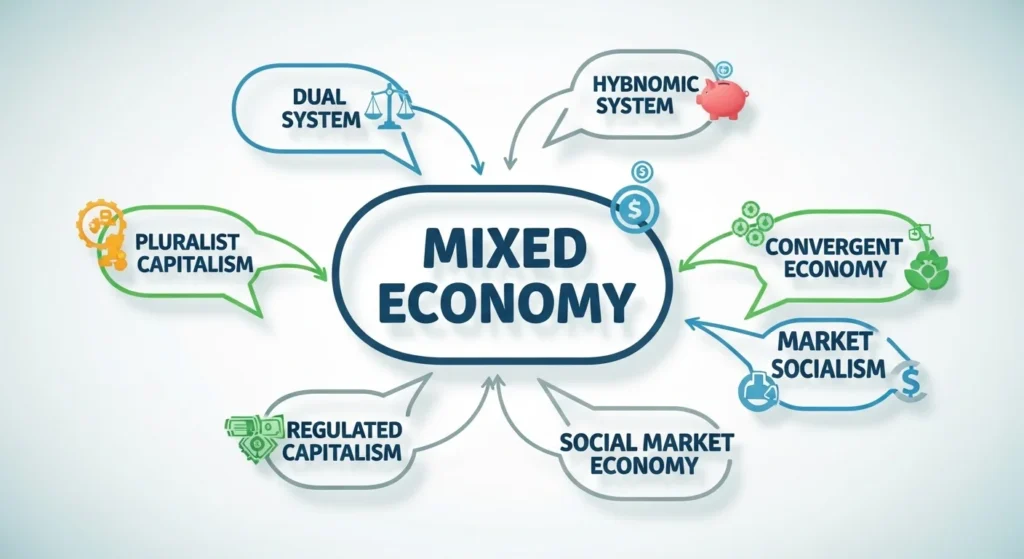
A mixed economy is an economic system where both the government and private businesses take part in managing resources, industries, and services. Imagine a country where people can open their own shops, factories, and companies, but the government also runs public schools, hospitals, roads, and public transport. This balance between private freedom and government support is known as a mixed economy.
Today, many countries use this system because it combines the strengths of capitalism and government planning. The term appears often in economics, politics, news reports, and academic discussions.
For English learners and content writers, learning synonyms of mixed economy is very helpful. It improves vocabulary, avoids repetition in writing, and makes communication clearer and more professional.
In this article, you will learn the meaning of mixed economy, its pronunciation, origin, grammar structure, and 30 useful synonyms with simple meanings and examples. This guide will help you understand and use the word confidently.
Meaning of Mixed Economy
Definition
Mixed economy (noun):
An economic system where both the government and private individuals or businesses share control over resources, industries, and services.
Examples
- Many modern nations operate under a mixed economy.
- In a mixed economy, private companies produce goods while the government provides public services.
Connotative Meaning
(Connotation means the emotional or cultural feeling connected with a word beyond its basic meaning.)
- Positive tone: balance, cooperation between public and private sectors, economic stability
- Negative tone: government interference, complex rules, slow decision-making
- Neutral tone: a practical economic system combining different approaches
Etymology
- Mixed comes from the Latin word miscere, meaning “to combine or blend.”
- Economy comes from the Greek word oikonomia, meaning “management of a household.”
Short History
- Old English (450–1100): The concept of economy referred mainly to household management and resource use.
- Middle English (1100–1500): Trade and markets expanded, and the word began to refer to national wealth and production.
- Modern English (1500–Present): The term mixed economy became widely used in the 20th century as nations combined capitalism with government regulation.
Pronunciation (US & UK – IPA)
US: /ˌmɪkst ɪˈkɑːnəmi/
UK: /ˌmɪkst ɪˈkɒnəmi/
Syllables
mixed – e – con – o – my
Affixation Pattern of Mixed Economy
Root: economy
Prefix: none
Suffix: -y
Word Formation
- Economy (noun) – system of production and distribution
- Economic (adjective) – related to economics
- Economical (adjective) – careful with money or resources
- Economics (noun) – the study of economic systems
- Economist (noun) – a person who studies or works in economics
A List of 30 Synonyms for Mixed Economy
1. Hybrid Economy (noun)
US /ˈhaɪbrɪd ɪˈkɑːnəmi/ | UK /ˈhaɪbrɪd ɪˈkɒnəmi/
Meaning: an economic system created by combining two different economic models.
Examples
- Many European countries operate a hybrid economy.
- A hybrid economy blends government support with private business.
2. Blended Economy (noun)
US /ˈblendɪd ɪˈkɑːnəmi/ | UK /ˈblendɪd ɪˈkɒnəmi/
Meaning: an economy formed by merging different economic systems.
Examples
- The nation built a blended economy after economic reforms.
- A blended economy tries to balance freedom and regulation.
3. Dual Economy (noun)
US /ˈduːəl ɪˈkɑːnəmi/ | UK /ˈdjuːəl ɪˈkɒnəmi/
Meaning: an economy where two major sectors operate together.
Examples
- The country’s dual economy includes agriculture and industry.
- A dual economy often appears in developing countries.
4. Public-Private Economy (noun)
US /ˈpʌblɪk ˈpraɪvət ɪˈkɑːnəmi/ | UK /ˈpʌblɪk ˈpraɪvət ɪˈkɒnəmi/
Meaning: an economy where both government and private sectors work together.
Examples
- Infrastructure projects support the public-private economy.
- The government encourages partnerships in a public-private economy.
5. Regulated Market Economy (noun)
US /ˈreɡjəleɪtɪd ˈmɑːrkɪt ɪˈkɑːnəmi/ | UK /ˈreɡjʊleɪtɪd ˈmɑːkɪt ɪˈkɒnəmi/
Meaning: a market system that operates with government regulation.
Examples
- Germany follows a regulated market economy.
- Labor laws guide the regulated market economy.
6. Welfare Capitalism (noun)
US /ˈwelfer ˈkæpɪtəlɪzəm/ | UK /ˈwelfeə ˈkæpɪtəlɪzəm/
Meaning: capitalism combined with strong social welfare programs.
Examples
- Some European countries practice welfare capitalism.
- Welfare capitalism includes healthcare and social security.
7. Social Market Economy (noun)
US /ˈsoʊʃəl ˈmɑːrkɪt ɪˈkɑːnəmi/ | UK /ˈsəʊʃəl ˈmɑːkɪt ɪˈkɒnəmi/
Meaning: a market system with social protection policies.
Examples
- Germany is known for its social market economy.
- A social market economy protects workers and businesses.
8. Managed Economy (noun)
US /ˈmænɪdʒd ɪˈkɑːnəmi/ | UK /ˈmænɪdʒd ɪˈkɒnəmi/
Meaning: an economy guided partly by government decisions.
Examples
- The state introduced a managed economy.
- Taxes and policies guide the managed economy.
9. Balanced Economy (noun)
US /ˈbælənst ɪˈkɑːnəmi/ | UK /ˈbælənst ɪˈkɒnəmi/
Meaning: an economic system where public and private sectors share influence.
Examples
- Leaders want a balanced economy.
- A balanced economy reduces extreme inequality.
10. Combined Economic System (noun)
US /kəmˈbaɪnd ˌekəˈnɑːmɪk ˈsɪstəm/ | UK /kəmˈbaɪnd ˌiːkəˈnɒmɪk ˈsɪstəm/
Meaning: a system formed by merging several economic approaches.
Examples
- The country uses a combined economic system.
- Policies shape the combined system.
11. Cooperative Economy (noun)
US /koʊˈɑːpərətɪv ɪˈkɑːnəmi/ | UK /kəʊˈɒpərətɪv ɪˈkɒnəmi/
Meaning: an economy where groups and the government share control.
Examples
- Farmers built a cooperative economy.
- Cooperation supports economic growth.
12. Partnership Economy (noun)
US /ˈpɑːrtnərʃɪp ɪˈkɑːnəmi/ | UK /ˈpɑːtnəʃɪp ɪˈkɒnəmi/
Meaning: an economic system based on cooperation between government and business.
Examples
- The nation promotes a partnership economy.
- Businesses and government share responsibility.
13. Shared Economy (noun)
US /ʃerd ɪˈkɑːnəmi/ | UK /ʃeəd ɪˈkɒnəmi/
Meaning: an economy where resources and services are shared.
Examples
- Public transport supports the shared economy.
- A shared economy spreads opportunities.
14. Collaborative Economy (noun)
US /kəˈlæbəreɪtɪv ɪˈkɑːnəmi/ | UK /kəˈlæbəreɪtɪv ɪˈkɒnəmi/
Meaning: an economy built on cooperation among sectors.
Examples
- Cities promote a collaborative economy.
- Collaboration improves economic results.
15. Integrated Economy (noun)
US /ˈɪntɪɡreɪtɪd ɪˈkɑːnəmi/ | UK /ˈɪntɪɡreɪtɪd ɪˈkɒnəmi/
Meaning: an economy where sectors are closely connected.
Examples
- Trade creates an integrated economy.
- Industries support each other in an integrated economy.
16. Composite Economy (noun)
US /kəmˈpɑːzɪt ɪˈkɑːnəmi/ | UK /kəmˈpɒzɪt ɪˈkɒnəmi/
Meaning: an economy formed from multiple systems.
Examples
- The nation runs a composite economy.
- Different policies shape the composite economy.
17. Plural Economy (noun)
US /ˈplʊrəl ɪˈkɑːnəmi/ | UK /ˈplʊərəl ɪˈkɒnəmi/
Meaning: an economy with several economic structures.
Examples
- A plural economy includes many sectors.
- Diversity strengthens the plural economy.
18. Semi-Market Economy (noun)
US /ˈsemi ˈmɑːrkɪt ɪˈkɑːnəmi/ | UK /ˈsemi ˈmɑːkɪt ɪˈkɒnəmi/
Meaning: an economy partly based on market forces.
Examples
- The country moved to a semi-market economy.
- Prices still follow government guidance.
19. Guided Market Economy (noun)
US /ˈɡaɪdɪd ˈmɑːrkɪt ɪˈkɑːnəmi/ | UK /ˈɡaɪdɪd ˈmɑːkɪt ɪˈkɒnəmi/
Meaning: a market system guided by state policies.
Examples
- The government supports a guided market economy.
- Policies guide growth in this system.
20. Public-Mixed System (noun)
US /ˈpʌblɪk mɪkst ˈsɪstəm/ | UK /ˈpʌblɪk mɪkst ˈsɪstəm/
Meaning: a system combining public and private control.
Examples
- Healthcare works under a public-mixed system.
- Many services follow this model.
21. Dual Sector Economy (noun)
US /ˈduːəl ˈsektər ɪˈkɑːnəmi/ | UK /ˈdjuːəl ˈsektə ɪˈkɒnəmi/
Meaning: an economy with two major sectors.
Examples
- Agriculture and industry form a dual sector economy.
- Each sector supports the other.
22. Partly Planned Economy (noun)
US /ˈpɑːrtli plænd ɪˈkɑːnəmi/ | UK /ˈpɑːtli plænd ɪˈkɒnəmi/
Meaning: an economy partly controlled by government plans.
Examples
- The state runs a partly planned economy.
- Some industries follow national plans.
23. State-Supported Market (noun)
US /steɪt səˈpɔːrtɪd ˈmɑːrkɪt/ | UK /steɪt səˈpɔːtɪd ˈmɑːkɪt/
Meaning: a market helped by government support.
Examples
- Subsidies create a state-supported market.
- Farmers benefit from this system.
24. Regulated Capitalism (noun)
US /ˈreɡjəleɪtɪd ˈkæpɪtəlɪzəm/ | UK /ˈreɡjʊleɪtɪd ˈkæpɪtəlɪzəm/
Meaning: capitalism with government control and rules.
Examples
- Many countries practice regulated capitalism.
- Laws protect consumers.
25. Social Capitalism (noun)
US /ˈsoʊʃəl ˈkæpɪtəlɪzəm/ | UK /ˈsəʊʃəl ˈkæpɪtəlɪzəm/
Meaning: capitalism that includes social welfare goals.
Examples
- The nation promotes social capitalism.
- Social programs reduce inequality.
26. Controlled Market System (noun)
US /kənˈtroʊld ˈmɑːrkɪt ˈsɪstəm/ | UK /kənˈtrəʊld ˈmɑːkɪt ˈsɪstəm/
Meaning: a market system under government oversight.
Examples
- The government runs a controlled market system.
- Regulations protect consumers.
27. Government-Market Blend (noun)
US /ˈɡʌvərnmənt ˈmɑːrkɪt blend/ | UK /ˈɡʌvənmənt ˈmɑːkɪt blend/
Meaning: a mix of state control and market activity.
Examples
- The policy created a government-market blend.
- Both sectors influence growth.
28. Economic Hybrid System (noun)
US /ˌekəˈnɑːmɪk ˈhaɪbrɪd ˈsɪstəm/ | UK /ˌiːkəˈnɒmɪk ˈhaɪbrɪd ˈsɪstəm/
Meaning: a combined economic structure.
Examples
- The country developed an economic hybrid system.
- This system mixes two economic ideas.
29. Dual Structure Economy (noun)
US /ˈduːəl ˈstrʌktʃər ɪˈkɑːnəmi/ | UK /ˈdjuːəl ˈstrʌktʃə ɪˈkɒnəmi/
Meaning: an economy with two main structures.
Examples
- Industry and services create a dual structure economy.
- Each structure has a role.
30. Partnership Market System (noun)
US /ˈpɑːrtnərʃɪp ˈmɑːrkɪt ˈsɪstəm/ | UK /ˈpɑːtnəʃɪp ˈmɑːkɪt ˈsɪstəm/
Meaning: a market system based on partnership between sectors.
Examples
- The country runs a partnership market system.
- Government and companies cooperate.
Prototype Meaning
The typical meaning of mixed economy is a national system where private companies run businesses while the government controls important services such as education, defense, transportation, and healthcare. People usually imagine a balanced system that combines capitalism with government regulation.
Prototype Categorization
Synonyms can be grouped into categories to help writers choose the best word.
- Blend-based terms: hybrid economy, blended economy, composite economy
- Government regulation terms: regulated market economy, managed economy, regulated capitalism
- Partnership terms: partnership economy, cooperative economy, collaborative economy
- Dual structure terms: dual economy, dual sector economy, dual structure economy
Categorization helps writers pick the most suitable synonym depending on context, tone, and formality.
Antonyms of Mixed Economy
- Pure Capitalism (noun) – an economy fully controlled by private businesses
- Command Economy (noun) – an economy completely controlled by the government
- Planned Economy (noun) – the government decides production and prices
- Laissez-Faire Economy (noun) – a system with almost no government control
Short Questions and Answers
- What does mixed economy mean?
A mixed economy is a system where both the government and private businesses control economic activities. - When should mixed economy be used?
It is used when describing economic systems that combine free markets with government regulation. - Is mixed economy positive or negative?
It is usually neutral. Some people view it positively because it creates balance, while others think it involves too much government control. - How is it different from similar words?
Mixed economy combines multiple systems, while capitalism or socialism mainly focus on a single economic model.
CONCLUSION
Learning the word mixed economy and its synonyms helps you understand global economic discussions more clearly. Many countries today operate under systems that combine private enterprise with government regulation. By learning different synonyms such as hybrid economy, regulated capitalism, or social market economy, you can expand your vocabulary and avoid repeating the same term in writing.
A strong vocabulary improves both academic and professional communication. It also helps you express ideas more precisely in essays, reports, and conversations. Practicing new words regularly builds confidence and strengthens your English skills. Try using these synonyms in sentences or discussions every day. Over time, your vocabulary will grow richer and your communication will become clearer and more effective.

I am a linguist with 17 years of experience in English language teaching, including postgraduate-level instruction. My expertise includes English grammar, and I contribute as a content and blog writer, producing scholarly and educational language resources.