
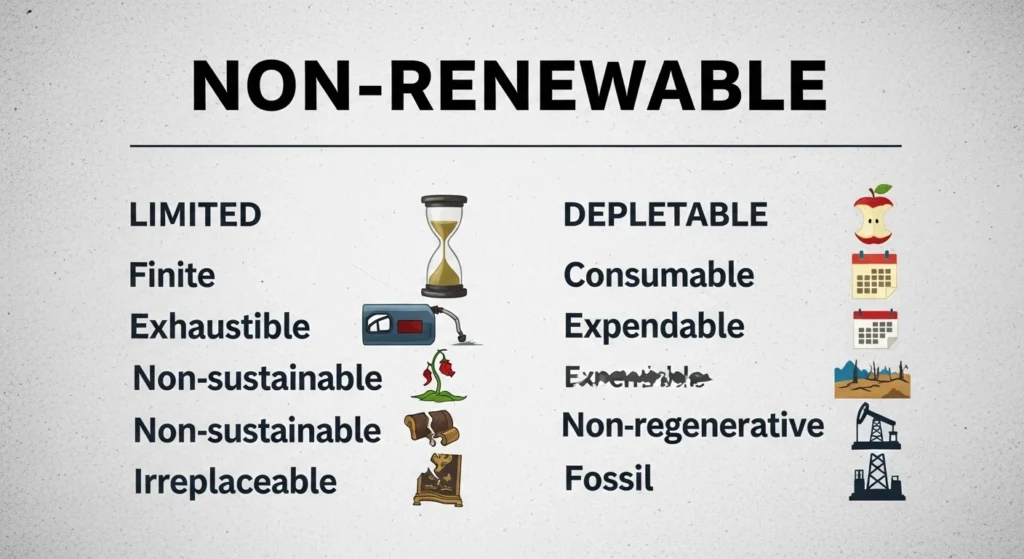
Non-renewable is a common word used when we talk about energy, nature, and resources. It means something that cannot be replaced quickly once it is used. Imagine a village that depends on coal for electricity. Every day the coal is burned to produce power. Over time, the coal supply becomes smaller and smaller. Once it finishes, it may take millions of years for nature to create more. This is a simple example of a non-renewable resource.
This word is widely used in science, environmental studies, and everyday discussions about energy. Learning its synonyms helps English learners express ideas more clearly. Writers and students also use synonyms to avoid repeating the same word again and again.
In this article, you will learn the meaning of non-renewable, its synonyms, pronunciation, grammar, origin, and categories, along with easy examples to improve your vocabulary.
Meaning of Non-Renewable
Non-renewable (Adjective):
Something that cannot be replaced or regenerated in a short time after it is used.
Examples
- Coal is a non-renewable source of energy.
- Oil is a non-renewable resource found deep in the earth.
Connotative Meaning
(Connotation: the emotional or cultural feeling attached to a word beyond its literal meaning.)
- Positive tone: Rarely positive, sometimes used in discussions about valuable limited resources.
- Negative tone: Often linked with environmental problems or resource depletion.
- Neutral tone: Common in scientific or academic discussions.
Etymology
- Source language: Latin and Old French roots.
- Original meaning: “Not able to be made new again.”
History of the Word
- Old English (450–1100): The concept existed but the exact word was not used.
- Middle English (1100–1500): Words like renew began to appear.
- Modern English (1500–Present): The term non-renewable developed with scientific and environmental studies.
Pronunciation (US & UK – IPA)
- US: /ˌnɑːn rɪˈnuːəbl/
- UK: /ˌnɒn rɪˈnjuːəbl/
Syllables
non-re-new-a-ble
Affixation Pattern of Non-Renewable
- Root: renew
- Prefix: non-
- Suffix: -able
Word Formation
- renew (verb)
- renewal (noun)
- renewable (adjective)
- non-renewable (adjective)
A List of 30 Synonyms for Non-Renewable
1. Exhaustible (Adjective)
US /ɪɡˈzɔːstəbəl/ | UK /ɪɡˈzɔːstəbəl/
Meaning: Something that can be used up completely.
Examples:
- Fossil fuels are exhaustible resources.
- Water in a small lake may become exhaustible during drought.
2. Finite (Adjective)
US /ˈfaɪnaɪt/ | UK /ˈfaɪnaɪt/
Meaning: Having limits and not lasting forever.
Examples:
- Oil reserves are finite.
- Earth has finite natural resources.
3. Limited (Adjective)
US /ˈlɪmɪtɪd/ | UK /ˈlɪmɪtɪd/
Meaning: Not unlimited in amount.
Examples:
- Coal supplies are limited.
- The planet has limited minerals.
4. Depletable (Adjective)
US /dɪˈpliːtəbəl/ | UK /dɪˈpliːtəbəl/
Meaning: Capable of being reduced or used up.
Examples:
- Oil is a depletable resource.
- Some forests become depletable with heavy use.
5. Consumable (Adjective)
US /kənˈsuːməbəl/ | UK /kənˈsjuːməbəl/
Meaning: Something that is used and finished.
Examples:
- Fuel is a consumable resource.
- Batteries are consumable energy items.
6. Non-replenishable (Adjective)
US /ˌnɑːn rɪˈplɛnɪʃəbəl/ | UK /ˌnɒn rɪˈplɛnɪʃəbəl/
Meaning: Not able to be replaced after use.
Examples:
- Fossil fuels are non-replenishable.
- Some minerals are non-replenishable.
7. Temporary (Adjective)
US /ˈtɛmpəreri/ | UK /ˈtɛmpərəri/
Meaning: Existing only for a short time.
Examples:
- Some resources provide temporary energy.
- Oil use gives temporary solutions.
8. Scarce (Adjective)
US /skɛrs/ | UK /skeəs/
Meaning: Rare or hard to find.
Examples:
- Clean coal is scarce.
- Some minerals are scarce worldwide.
9. Rare (Adjective)
US /rer/ | UK /reə/
Meaning: Not common or difficult to obtain.
Examples:
- Rare metals are valuable.
- Uranium is a rare resource.
10. Dwindling (Adjective)
US /ˈdwɪndlɪŋ/ | UK /ˈdwɪndlɪŋ/
Meaning: Becoming smaller over time.
Examples:
- Oil supplies are dwindling.
- The fuel stock is dwindling quickly.
11. Vanishing (Adjective)
US /ˈvænɪʃɪŋ/ | UK /ˈvænɪʃɪŋ/
Meaning: Gradually disappearing.
Examples:
- Coal reserves are vanishing.
- Some minerals are vanishing resources.
12. Irreplaceable (Adjective)
US /ˌɪrɪˈpleɪsəbəl/ | UK /ˌɪrɪˈpleɪsəbəl/
Meaning: Impossible to replace.
Examples:
- Oil is an irreplaceable resource in many industries.
- Some metals are irreplaceable for technology.
13. Non-sustainable (Adjective)
US /ˌnɑːn səˈsteɪnəbəl/ | UK /ˌnɒn səˈsteɪnəbəl/
Meaning: Not able to continue for a long time.
Examples:
- Using only fossil fuels is non-sustainable.
- This energy method is non-sustainable.
14. Perishable (Adjective)
US /ˈperɪʃəbəl/ | UK /ˈperɪʃəbəl/
Meaning: Likely to spoil or disappear quickly.
Examples:
- Some fuels are perishable.
- Stored materials can be perishable.
15. Short-lived (Adjective)
US /ˈʃɔːrt lɪvd/ | UK /ˈʃɔːt lɪvd/
Meaning: Lasting for a short time.
Examples:
- Some energy sources are short-lived.
- The supply proved short-lived.
16. Restricted (Adjective)
US /rɪˈstrɪktɪd/ | UK /rɪˈstrɪktɪd/
Meaning: Limited by rules or amount.
Examples:
- Mining areas are restricted.
- The supply is restricted.
17. Decreasing (Adjective)
US /dɪˈkriːsɪŋ/ | UK /dɪˈkriːsɪŋ/
Meaning: Becoming less.
Examples:
- Coal reserves are decreasing.
- Fuel production is decreasing.
18. Shrinking (Adjective)
US /ˈʃrɪŋkɪŋ/ | UK /ˈʃrɪŋkɪŋ/
Meaning: Becoming smaller.
Examples:
- Oil fields are shrinking.
- The supply is shrinking every year.
19. Used-up (Adjective)
US /juːzd ʌp/ | UK /juːzd ʌp/
Meaning: Completely consumed.
Examples:
- The fuel was used-up quickly.
- Old mines are used-up resources.
20. Diminishing (Adjective)
US /dɪˈmɪnɪʃɪŋ/ | UK /dɪˈmɪnɪʃɪŋ/
Meaning: Gradually becoming less.
Examples:
- Oil is a diminishing resource.
- Supplies are diminishing yearly.
21. Non-perpetual (Adjective)
US /ˌnɑːn pərˈpɛtʃuəl/ | UK /ˌnɒn pəˈpetʃuəl/
Meaning: Not lasting forever.
Examples:
- Fossil fuels are non-perpetual.
- These resources are non-perpetual.
22. Non-lasting (Adjective)
US /ˌnɑːn ˈlæstɪŋ/ | UK /ˌnɒn ˈlɑːstɪŋ/
Meaning: Not enduring for long.
Examples:
- Coal energy is non-lasting.
- The solution was non-lasting.
23. Non-regenerative (Adjective)
US /ˌnɑːn rɪˈdʒɛnərətɪv/ | UK /ˌnɒn rɪˈdʒɛnərətɪv/
Meaning: Unable to grow again naturally.
Examples:
- Fossil fuels are non-regenerative.
- Uranium is non-regenerative.
24. Non-recoverable (Adjective)
US /ˌnɑːn rɪˈkʌvərəbəl/ | UK /ˌnɒn rɪˈkʌvərəbl/
Meaning: Impossible to regain after loss.
Examples:
- Some minerals are non-recoverable.
- Energy loss can be non-recoverable.
25. Non-cyclic (Adjective)
US /ˌnɑːn ˈsaɪklɪk/ | UK /ˌnɒn ˈsaɪklɪk/
Meaning: Not repeating in natural cycles.
Examples:
- Fossil fuels are non-cyclic.
- Their formation is non-cyclic.
26. Fixed-supply (Adjective)
US /fɪkst səˈplaɪ/ | UK /fɪkst səˈplaɪ/
Meaning: Existing in a set amount.
Examples:
- Gold has a fixed-supply.
- Uranium is a fixed-supply mineral.
27. Non-recyclable (Adjective)
US /ˌnɑːn riːˈsaɪkləbəl/ | UK /ˌnɒn riːˈsaɪkləbəl/
Meaning: Cannot be recycled or reused.
Examples:
- Some materials are non-recyclable.
- The waste was non-recyclable.
28. Wasting (Adjective)
US /ˈweɪstɪŋ/ | UK /ˈweɪstɪŋ/
Meaning: Being gradually used away.
Examples:
- Natural gas reserves are wasting.
- The resource is wasting slowly.
29. Declining (Adjective)
US /dɪˈklaɪnɪŋ/ | UK /dɪˈklaɪnɪŋ/
Meaning: Falling or reducing over time.
Examples:
- Oil production is declining.
- Coal demand is declining.
30. Exhausted (Adjective)
US /ɪɡˈzɔːstɪd/ | UK /ɪɡˈzɔːstɪd/
Meaning: Completely used up.
Examples:
- The mine became exhausted.
- Fuel reserves are exhausted.
Prototype Meaning
The typical meaning of non-renewable refers to natural resources that cannot quickly replace themselves once used. When people hear this word, they usually think about fossil fuels like coal, oil, and natural gas that take millions of years to form but can be consumed in a short time.
Prototype Categorization
Synonyms can be grouped into meaningful categories:
- Resource limitation: finite, limited, fixed-supply
- Gradual reduction: dwindling, shrinking, declining, diminishing
- Complete depletion: exhausted, used-up, exhaustible
- Environmental sustainability: non-sustainable, non-regenerative
Categorization helps writers choose the best synonym based on the context. For example, a scientific report may use finite, while environmental writing may prefer non-sustainable.
Antonyms of Non-Renewable
- Renewable (Adjective): able to be replaced naturally.
- Sustainable (Adjective): capable of continuing for a long time.
- Replenishable (Adjective): able to be refilled or restored.
- Regenerative (Adjective): capable of natural renewal.
Short Questions and Answers
- What does non-renewable mean?
It refers to resources that cannot be replaced quickly once they are used. - When should non-renewable be used?
Use it when describing limited natural resources like oil, coal, and natural gas. - Is non-renewable positive or negative?
It is usually neutral in science but often negative in environmental discussions. - How is it different from similar words?
Non-renewable specifically describes resources that take a very long time to form again.
Conclusion
Learning the word non-renewable and its synonyms can greatly improve your English vocabulary. When you know many related words, you can express ideas more clearly in writing and speaking. Synonyms also help writers avoid repeating the same word again and again. This makes sentences smoother and more engaging. Understanding the meaning, pronunciation, and categories of these words builds strong language skills. It also helps learners talk about environmental topics more confidently. Try to practice new vocabulary every day by reading, writing, and using synonyms in your sentences. Over time, your English will become richer, clearer, and more powerful.

I am a linguist with 17 years of experience in English language teaching, including postgraduate-level instruction. My expertise includes English grammar, and I contribute as a content and blog writer, producing scholarly and educational language resources.