
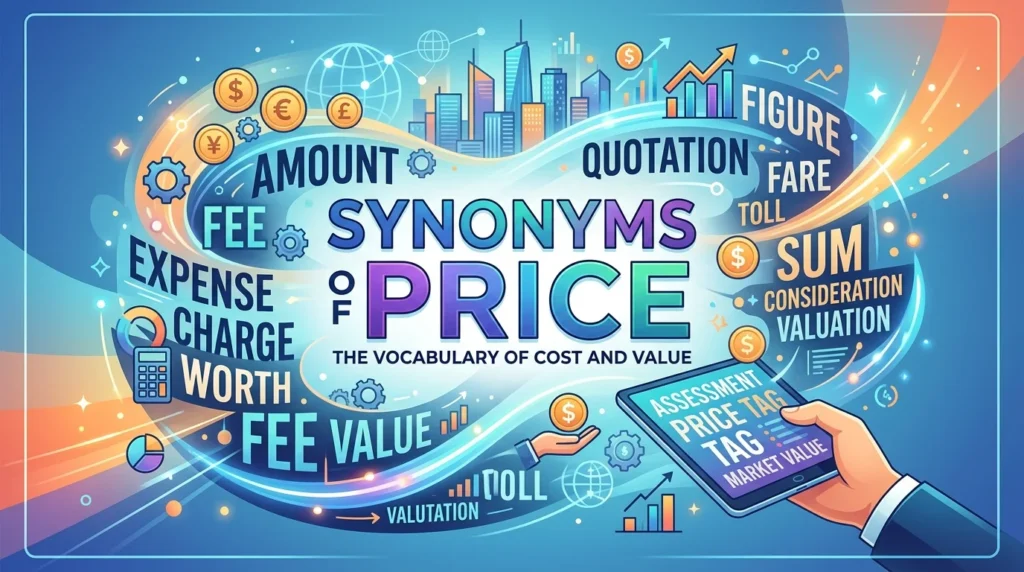
Price means the amount of money you pay for something. Imagine you go to a market in Shahodi Garhi. You see fresh mangoes. Before buying, you ask, “What is the price?” The seller tells you the cost. You decide if it is fair or too high.
The word price is common in daily life. We use it in shops, online stores, business talks, and even in stories. Learning synonyms of price is important for English learners and content writers. It helps you avoid repeating the same word. It makes your writing rich and clear.
In this article, you will learn the meaning of price and its synonyms with examples, grammar, history, pronunciation, and word categories. Everything is explained in simple English.
Meaning of Price
Price (Noun / Verb):
The amount of money needed to buy something; to decide how much something will cost.
Examples:
- The price of rice is rising.
- The shopkeeper priced the shoes at 3,000 rupees.
Connotative Meaning
(Connotation means the emotional feeling a word gives, beyond its basic meaning.)
- Positive tone: fair price, low price, best price
- Negative tone: high price, heavy price, painful price
- Neutral tone: market price, fixed price
Etymology
- From Old French pris meaning “value” or “reward.”
- From Latin pretium meaning “value” or “worth.”
Short History:
- Old English (450–1100): Word came through trade influence.
- Middle English (1100–1500): Spelled as pris or price.
- Modern English (1500–Present): Standard spelling became “price.”
Pronunciation (US & UK – IPA)
US: /praɪs/
UK: /praɪs/
Syllables
price (1 syllable)
Affixation Pattern of Price
- Root: price
- Prefix: none
- Suffix: none
Word Formation (5 words formed):
- Price (noun/verb)
- Priced (adjective/verb)
- Pricing (noun/verb)
- Priceless (adjective)
- Pricey (adjective)
A List of 30 Synonyms for Price
1. Cost (Noun)
US: /kɔːst/ | UK: /kɒst/
Meaning: The money needed to buy something.
Examples:
- The cost of fuel is high.
- We must reduce production costs.
2. Value (Noun)
US: /ˈvæljuː/ | UK: /ˈvæljuː/
Meaning: The worth of something in money or importance.
Examples:
- This ring has great value.
- The value of gold changes daily.
3. Charge (Noun/Verb)
US: /tʃɑːrdʒ/ | UK: /tʃɑːdʒ/
Meaning: The amount asked for a service.
Examples:
- The hotel charge is reasonable.
- They charge extra for delivery.
4. Rate (Noun)
US: /reɪt/ | UK: /reɪt/
Meaning: A fixed amount for something.
Examples:
- The hourly rate is 500 rupees.
- Interest rates are rising.
5. Fee (Noun)
US: /fiː/ | UK: /fiː/
Meaning: Money paid for a service.
Examples:
- The school fee is due.
- He paid a doctor’s fee.
6. Fare (Noun)
US: /fer/ | UK: /feə/
Meaning: Money paid for travel.
Examples:
- The bus fare increased.
- She paid her train fare.
7. Tariff (Noun)
US: /ˈtærɪf/ | UK: /ˈtærɪf/
Meaning: Official price or tax on goods.
Examples:
- The tariff on imports rose.
- New tariffs affect trade.
8. Toll (Noun)
US: /toʊl/ | UK: /təʊl/
Meaning: Money paid to use a road or bridge.
Examples:
- The toll is 100 rupees.
- They paid a road toll.
9. Worth (Noun)
US: /wɜːrθ/ | UK: /wɜːθ/
Meaning: The value of something.
Examples:
- The house is worth millions.
- Know your worth.
10. Expense (Noun)
US: /ɪkˈspens/ | UK: /ɪkˈspens/
Meaning: Money spent on something.
Examples:
- Travel is a big expense.
- We must cut expenses.
11. Payment (Noun)
US: /ˈpeɪmənt/ | UK: /ˈpeɪmənt/
Meaning: Money given for goods or services.
Examples:
- The payment is late.
- Online payment is easy.
12. Premium (Noun)
US: /ˈpriːmiəm/ | UK: /ˈpriːmiəm/
Meaning: Extra cost for better quality or service.
Examples:
- You pay a premium for luxury.
- Insurance premium is high.
13. Valuation (Noun)
US: /ˌvæljuˈeɪʃən/ | UK: /ˌvæljuˈeɪʃən/
Meaning: The act of deciding value.
Examples:
- Property valuation takes time.
- The bank did a valuation.
14. Estimate (Noun)
US: /ˈestɪmət/ | UK: /ˈestɪmət/
Meaning: Rough calculation of cost.
Examples:
- The estimate is 5,000 rupees.
- He gave a repair estimate.
15. Quote (Noun)
US: /kwoʊt/ | UK: /kwəʊt/
Meaning: Stated price for a job.
Examples:
- The company sent a quote.
- Compare price quotes.
16. Appraisal (Noun)
US: /əˈpreɪzəl/ | UK: /əˈpreɪzəl/
Meaning: Official value judgment.
Examples:
- The house needs appraisal.
- She requested an appraisal.
17. Assessment (Noun)
US: /əˈsesmənt/ | UK: /əˈsesmənt/
Meaning: Calculated value or cost.
Examples:
- Tax assessment increased.
- Damage assessment is complete.
18. Figure (Noun)
US: /ˈfɪɡjər/ | UK: /ˈfɪɡə/
Meaning: A number showing cost.
Examples:
- The final figure surprised me.
- Give me the exact figure.
19. Sum (Noun)
US: /sʌm/ | UK: /sʌm/
Meaning: Total amount of money.
Examples:
- He paid a large sum.
- The sum is correct.
20. Total (Noun)
US: /ˈtoʊtəl/ | UK: /ˈtəʊtəl/
Meaning: Full amount.
Examples:
- The total is 10,000 rupees.
- Check the total cost.
21. Outlay (Noun)
US: /ˈaʊtleɪ/ | UK: /ˈaʊtleɪ/
Meaning: Money spent on something.
Examples:
- The outlay was huge.
- Initial outlay is high.
22. Expenditure (Noun)
US: /ɪkˈspendɪtʃər/ | UK: /ɪkˈspendɪtʃə/
Meaning: Spending money.
Examples:
- Government expenditure rose.
- Health expenditure is important.
23. Market Value (Noun)
US: /ˈmɑːrkɪt ˈvæljuː/ | UK: /ˈmɑːkɪt ˈvæljuː/
Meaning: Current selling price.
Examples:
- Market value changes daily.
- Check the market value first.
24. Selling Price (Noun)
US: /ˈselɪŋ praɪs/ | UK: /ˈselɪŋ praɪs/
Meaning: Price at which goods are sold.
Examples:
- The selling price is fair.
- Lower the selling price.
25. Asking Price (Noun)
US: /ˈæskɪŋ praɪs/ | UK: /ˈɑːskɪŋ praɪs/
Meaning: Price requested by seller.
Examples:
- The asking price is high.
- Negotiate the asking price.
26. Retail Price (Noun)
US: /ˈriːteɪl praɪs/ | UK: /ˈriːteɪl praɪs/
Meaning: Price for customers in shops.
Examples:
- Retail price increased.
- Compare retail prices.
27. Wholesale Price (Noun)
US: /ˈhoʊlseɪl praɪs/ | UK: /ˈhəʊlseɪl praɪs/
Meaning: Price for bulk buyers.
Examples:
- Wholesale price is lower.
- Buy at wholesale price.
28. Sticker Price (Noun)
US: /ˈstɪkər praɪs/ | UK: /ˈstɪkə praɪs/
Meaning: Displayed price on product.
Examples:
- The sticker price shocked me.
- Ignore the sticker price.
29. Costing (Noun)
US: /ˈkɔːstɪŋ/ | UK: /ˈkɒstɪŋ/
Meaning: Process of calculating cost.
Examples:
- The costing is complete.
- Accurate costing saves money.
30. Penalty (Noun)
US: /ˈpenəlti/ | UK: /ˈpenəlti/
Meaning: A price paid for a mistake.
Examples:
- He paid a penalty.
- Late fee is a penalty.
Prototype Meaning
The most common meaning of price is the amount of money you pay to buy something. When people hear this word, they imagine a number written on a tag in a shop.
Prototype Categorization
Synonyms can be grouped as:
- General Money Terms: cost, value, sum, total
- Service Payments: fee, charge, fare, toll
- Business & Trade Terms: tariff, retail price, wholesale price
- Calculation Terms: estimate, quote, valuation, appraisal
Categorization helps writers choose the best word for each situation. For example, use fee for services and fare for travel.
Antonyms of Price
- Discount (Noun): Reduced price
- Gift (Noun): Something free
- Freebie (Noun): Free item
- Loss (Noun): Selling below cost
- Reward (Noun): Payment received
Short Questions and Answers
- What does price mean?
It means the amount of money needed to buy something. - When should price be used?
Use it when talking about buying or selling goods. - Is price positive or negative?
It depends on context. A low price is positive. A high price may feel negative. - How is it different from similar words?
Price is general. Fee is for services. Fare is for travel.
Conclusion
Learning the word price and its synonyms improves your vocabulary. It strengthens your writing and speaking. It helps you avoid repeating the same word again and again. When you use the right synonym, your message becomes clear and powerful. This builds English confidence. Practice new words daily. Try using one new synonym in your sentences each day. Soon, your vocabulary will grow naturally and strongly.

I am a linguist with 17 years of experience in English language teaching, including postgraduate-level instruction. My expertise includes English grammar, and I contribute as a content and blog writer, producing scholarly and educational language resources.