
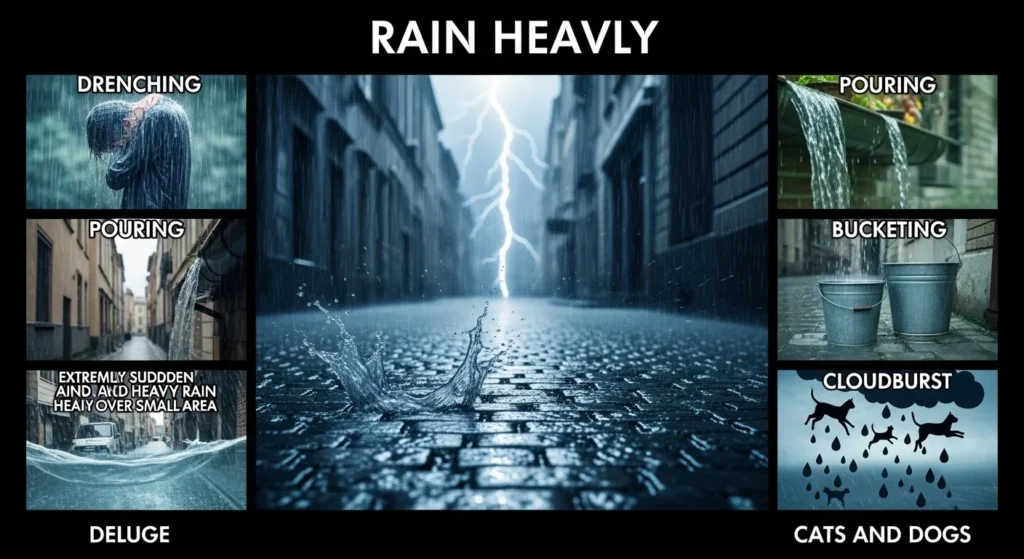
Rain heavily means rain that falls in large amounts and with strong force. Imagine you are walking home. The sky turns dark. Big drops fall fast. In seconds, your clothes are wet. Water fills the road. This is when it rains heavily.
This phrase is common in daily speech, weather reports, and news writing. People use it to describe strong and intense rain.
Learning synonyms of “rain heavily” helps English learners speak clearly and write better. It also helps content writers avoid repeating the same phrase again and again.
In this article, you will learn the meaning of “rain heavily” and its synonyms with simple examples. You will also learn pronunciation, grammar, history, word formation, antonyms, and word groups in clear and easy English.
Meaning of Rain Heavily
Definition
Rain heavily (verb phrase):
To rain in a strong and intense way, with large amounts of water falling quickly.
Examples
- It began to rain heavily before we reached home.
- It rained heavily all night and flooded the streets.
Connotative Meaning
(Connotation means the emotional feeling or tone connected to a word.)
- Positive tone: Good for crops, cool weather, relaxing sound.
- Negative tone: Floods, traffic problems, danger.
- Neutral tone: Simply strong rain with no emotion added.
Etymology
- “Rain” comes from Old English regn.
- It meant “water falling from clouds.”
- “Heavily” comes from “heavy,” from Old English hefig, meaning “weighty.”
Short History
- Old English (450–1100): regn used for rainfall.
- Middle English (1100–1500): Spelling changed to rain.
- Modern English (1500–Present): Phrase “rain heavily” became common in speech and writing.
Pronunciation (US & UK – IPA)
US: /reɪn ˈhɛvɪli/
UK: /reɪn ˈhevɪli/
Syllables
rain – heav – i – ly
Affixation Pattern of Rain Heavily
- Root: rain, heavy
- Prefix: none
- Suffix: -ly (makes adverb “heavily”)
Word Formation
- Rain (Noun/Verb)
- Rainy (Adjective)
- Raining (Verb form)
- Heavy (Adjective)
- Heavily (Adverb)
A List of 30 Synonyms for Rain Heavily
1. Pour (verb) — US /pɔr/ | UK /pɔː/
Meaning: To rain very hard.
Examples:
It started to pour after noon.
Rain poured for hours.
2. Downpour (noun) — US /ˈdaʊnˌpɔr/ | UK /ˈdaʊnpɔː/
Meaning: A short period of heavy rain.
Examples:
A sudden downpour soaked us.
The downpour caused traffic jams.
3. Deluge (noun/verb) — US /ˈdɛluːdʒ/ | UK /ˈdeljuːdʒ/
Meaning: A great flood of rain.
Examples:
The deluge lasted two hours.
Rain deluged the city.
4. Cloudburst (noun) — US /ˈklaʊdˌbɝst/ | UK /ˈklaʊdbɜːst/
Meaning: Sudden very heavy rain.
Examples:
A cloudburst hit the village.
The cloudburst flooded fields.
5. Torrent (noun) — US /ˈtɔrənt/ | UK /ˈtɒrənt/
Meaning: Fast and strong flow of rain.
Examples:
Rain fell in torrents.
A torrent washed away mud.
6. Shower (noun) — US /ˈʃaʊər/ | UK /ˈʃaʊə/
Meaning: Short period of rain.
Examples:
A heavy shower began suddenly.
We waited for the shower to stop.
7. Storm (noun/verb) — US /stɔrm/ | UK /stɔːm/
Meaning: Violent weather with heavy rain.
Examples:
The storm lasted all night.
It stormed fiercely.
8. Squall (noun) — US /skwɔl/ | UK /skwɔːl/
Meaning: Sudden strong wind and rain.
Examples:
A squall hit the coast.
Rain came with a loud squall.
9. Monsoon (noun) — US /mɑnˈsuːn/ | UK /mɒnˈsuːn/
Meaning: Seasonal heavy rain.
Examples:
The monsoon flooded roads.
Monsoon rains lasted weeks.
10. Cloudbreak (noun) — US /ˈklaʊdˌbreɪk/ | UK /ˈklaʊdbreɪk/
Meaning: Break in clouds with heavy rain.
Examples:
A cloudbreak brought sudden rain.
The cloudbreak cooled the air.
11. Flood (verb) — US /flʌd/ | UK /flʌd/
Meaning: To cover with too much rainwater.
Examples:
Rain flooded the streets.
The river flooded after rain.
12. Drizzle (verb) — US /ˈdrɪzəl/ | UK /ˈdrɪzəl/
Meaning: Light rain.
Examples:
It began to drizzle.
Cold drizzle fell all day.
13. Pelting (verb) — US /ˈpɛltɪŋ/ | UK /ˈpeltɪŋ/
Meaning: Falling fast and hard.
Examples:
Rain was pelting the roof.
Pelting rain reduced vision.
14. Bucketing (verb) — US /ˈbʌkɪtɪŋ/ | UK /ˈbʌkɪtɪŋ/
Meaning: Raining very heavily.
Examples:
It was bucketing down.
Rain kept bucketing all night.
15. Teeming (verb) — US /ˈtiːmɪŋ/ | UK /ˈtiːmɪŋ/
Meaning: Falling in large amounts.
Examples:
Rain was teeming down.
Teeming rain filled drains.
16. Lashing (verb) — US /ˈlæʃɪŋ/ | UK /ˈlæʃɪŋ/
Meaning: Falling strongly with wind.
Examples:
Rain was lashing windows.
Lashing rain hit hard.
17. Beating (verb) — US /ˈbiːtɪŋ/ | UK /ˈbiːtɪŋ/
Meaning: Falling hard on surfaces.
Examples:
Rain was beating the roof.
Beating rain scared children.
18. Soaking (verb) — US /ˈsoʊkɪŋ/ | UK /ˈsəʊkɪŋ/
Meaning: Making completely wet.
Examples:
Rain soaked our clothes.
Soaking rain ruined plans.
19. Gushing (verb) — US /ˈɡʌʃɪŋ/ | UK /ˈɡʌʃɪŋ/
Meaning: Flowing out strongly.
Examples:
Water was gushing down streets.
Gushing rain blocked roads.
20. Spattering (verb) — US /ˈspætərɪŋ/ | UK /ˈspætərɪŋ/
Meaning: Splashing drops of rain.
Examples:
Rain was spattering the glass.
Spattering rain sounded loud.
21. Pounding (verb) — US /ˈpaʊndɪŋ/ | UK /ˈpaʊndɪŋ/
Meaning: Hitting strongly and repeatedly.
Examples:
Rain was pounding roofs.
Pounding rain flooded fields.
22. Drenching (verb) — US /ˈdrɛntʃɪŋ/ | UK /ˈdrentʃɪŋ/
Meaning: Making very wet.
Examples:
Drenching rain soaked us.
The drenching rain lasted hours.
23. Inundating (verb) — US /ɪˈnʌndeɪtɪŋ/ | UK /ɪˈnʌndeɪtɪŋ/
Meaning: Flooding with large amounts of water.
Examples:
Rain inundated farms.
Inundating rain damaged homes.
24. Cataclysm (noun) — US /ˈkætəˌklɪzəm/ | UK /ˈkætəklɪzəm/
Meaning: Violent natural event.
Examples:
The rain felt like a cataclysm.
A weather cataclysm struck town.
25. Tempest (noun) — US /ˈtɛmpɪst/ | UK /ˈtempɪst/
Meaning: Strong storm with rain.
Examples:
A fierce tempest hit.
The tempest damaged trees.
26. Waterlog (verb) — US /ˈwɔtərˌlɔɡ/ | UK /ˈwɔːtəlɒɡ/
Meaning: Fill with too much water.
Examples:
Rain waterlogged fields.
Crops were waterlogged.
27. Sheet (verb) — US /ʃiːt/ | UK /ʃiːt/
Meaning: Rain falling like sheets.
Examples:
Rain was sheeting down.
Water sheeted off roofs.
28. Cascade (verb) — US /kæˈskeɪd/ | UK /kæˈskeɪd/
Meaning: Fall in large amounts.
Examples:
Rain cascaded from hills.
Water cascaded down walls.
29. Plummet (verb) — US /ˈplʌmɪt/ | UK /ˈplʌmɪt/
Meaning: Fall quickly and heavily.
Examples:
Rain plummeted suddenly.
Drops plummeted from clouds.
30. Rain Cats and Dogs (idiom) — US /reɪn kæts ænd dɔɡz/ | UK /reɪn kæts ænd dɒɡz/
Meaning: To rain very heavily.
Examples:
It is raining cats and dogs.
Yesterday it rained cats and dogs.
Prototype Meaning
The most common image of “rain heavily” is thick, fast drops falling from dark clouds. Streets become wet. People run for shelter. Umbrellas turn inside out. Water flows quickly.
Read more about 30 Synonyms of Naive with Examples and Explanation for 2026
Prototype Categorization
Synonyms can be grouped like this:
- Sudden heavy rain: cloudburst, downpour, squall
- Long seasonal rain: monsoon
- Violent storm rain: tempest, storm, cataclysm
- Descriptive action words: pounding, lashing, pelting
- Flood-related words: inundating, flooding, waterlogging
Categorizing words helps writers choose the right word for weather reports, stories, or daily speech.
Antonyms of Rain Heavily
- Drizzle lightly (Verb phrase): Rain softly
- Clear up (Verb): Stop raining
- Dry (Verb/Adjective): Become free from rain
- Brighten (Verb): Weather becomes sunny
- Cease (Verb): Stop completely
Short Questions and Answers
- What does rain heavily mean?
It means rain falling strongly and in large amounts. - When should rain heavily be used?
Use it when describing strong or intense rainfall. - Is rain heavily positive or negative?
It depends on context. It can help crops but cause floods. - How is it different from similar words?
Some words show short rain (shower), others show violent storms (tempest).
CONCLUSION
Learning “rain heavily” and its synonyms improves your English vocabulary. It helps you speak clearly and write better. Using different words avoids repetition in essays, blogs, and stories. It also builds your confidence in English.
Weather words are common in daily life. When you know many synonyms, you can describe situations more clearly and creatively. Practice a few new words each day. Over time, your vocabulary will grow strong and powerful.

I am a linguist with 17 years of experience in English language teaching, including postgraduate-level instruction. My expertise includes English grammar, and I contribute as a content and blog writer, producing scholarly and educational language resources.