
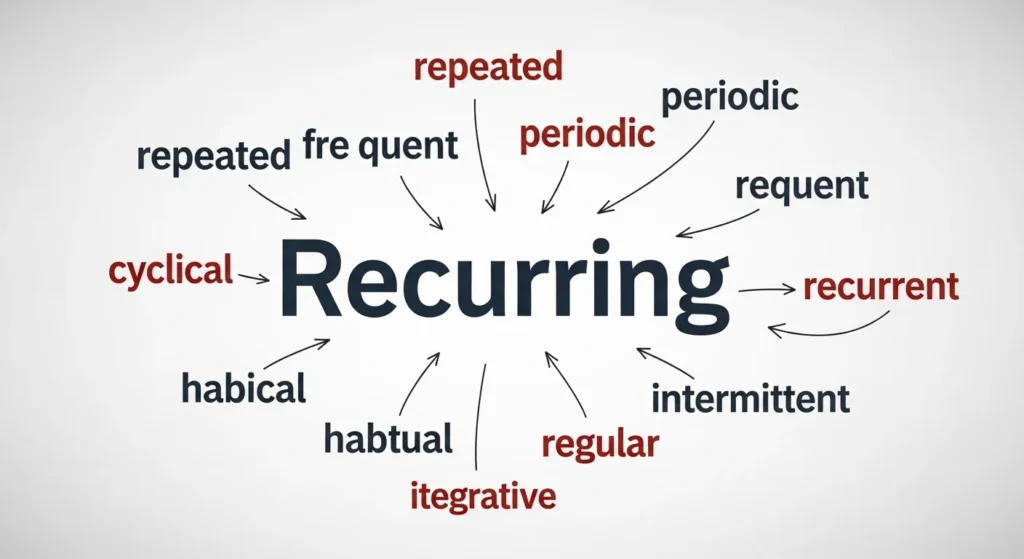
The word recurring means something that happens again and again. Imagine a student who pays a monthly internet bill. Every month the same payment appears. The charge keeps coming back. This is a recurring payment. Many things in life are recurring: meetings, problems, dreams, or even happy events like birthdays.
Because the word is common, writers and English learners often use it in daily speech and writing. However, using the same word many times can make writing dull. Learning synonyms of recurring helps you express ideas in fresh ways. It also improves clarity and vocabulary strength.
In this article, you will learn the meaning of recurring and explore 30 useful synonyms. You will also see example sentences, pronunciation, grammar details, word history, and semantic categories.
This guide will help learners and writers understand and use the word more effectively.
Meaning of Recurring
Definition
Recurring (Adjective):
Something that happens repeatedly or returns again after a period of time.
Examples
- The company charges a recurring monthly fee.
- She has a recurring dream about flying.
Connotative Meaning
(Connotation: the emotional feeling or association a word carries beyond its literal meaning.)
- Positive tone: A recurring celebration or happy tradition.
- Negative tone: A recurring problem or illness.
- Neutral tone: A recurring meeting or payment.
Etymology
- From Latin recurrere, meaning to run back or return.
- Entered English through French and Latin influences.
Short History
- Old English (450–1100): The concept of repetition existed but the word itself was not used.
- Middle English (1100–1500): Words from Latin and French influenced English vocabulary.
- Modern English (1500–Present): Recurring became common in writing to describe repeated events.
Pronunciation (US & UK – IPA)
US: /rɪˈkɝːɪŋ/
UK: /rɪˈkɜːrɪŋ/
Syllables
re-cur-ring
Affixation Pattern of Recurring
- Root: cur (run)
- Prefix: re- (again)
- Suffix: -ing
Word Formation
- Recur (verb)
- Recurrence (noun)
- Recurrent (adjective)
- Recurringly (adverb)
A List of Synonyms for Recurring
1. Repeated (Adjective)
US /rɪˈpiːtɪd/ | UK /rɪˈpiːtɪd/
Meaning: Happening again many times.
Examples:
- The teacher warned him about his repeated mistakes.
- The noise came from repeated hammering.
2. Frequent (Adjective)
US /ˈfriːkwənt/ | UK /ˈfriːkwənt/
Meaning: Happening often.
Examples:
- She makes frequent trips to the library.
- There were frequent power cuts.
3. Regular (Adjective)
US /ˈreɡjələr/ | UK /ˈreɡjʊlə/
Meaning: Happening at fixed times.
Examples:
- We have regular meetings every Monday.
- Exercise should be a regular habit.
4. Periodic (Adjective)
US /ˌpɪriˈɑːdɪk/ | UK /ˌpɪəriˈɒdɪk/
Meaning: Occurring at intervals.
Examples:
- The machine needs periodic checks.
- He suffers from periodic headaches.
5. Constant (Adjective)
US /ˈkɑːnstənt/ | UK /ˈkɒnstənt/
Meaning: Continuing without stopping.
Examples:
- She faces constant pressure at work.
- There was constant rain all day.
6. Recurrent (Adjective)
US /rɪˈkɝːənt/ | UK /rɪˈkʌrənt/
Meaning: Happening repeatedly.
Examples:
- The patient has recurrent infections.
- It is a recurrent theme in the story.
7. Cyclic (Adjective)
US /ˈsaɪklɪk/ | UK /ˈsaɪklɪk/
Meaning: Happening in cycles.
Examples:
- Nature follows cyclic patterns.
- The economy has cyclic changes.
8. Continual (Adjective)
US /kənˈtɪnjuəl/ | UK /kənˈtɪnjuəl/
Meaning: Repeated with short breaks.
Examples:
- The baby made continual cries.
- There were continual interruptions.
9. Continuous (Adjective)
US /kənˈtɪnjuəs/ | UK /kənˈtɪnjuəs/
Meaning: Without stopping.
Examples:
- The continuous rain caused floods.
- They worked for continuous hours.
10. Persistent (Adjective)
US /pərˈsɪstənt/ | UK /pəˈsɪstənt/
Meaning: Continuing for a long time.
Examples:
- She has a persistent cough.
- The problem remained persistent.
11. Repeating (Adjective)
US /rɪˈpiːtɪŋ/ | UK /rɪˈpiːtɪŋ/
Meaning: Occurring again.
Examples:
- The song has a repeating chorus.
- He made the repeating error.
12. Iterative (Adjective)
US /ˈɪtəreɪtɪv/ | UK /ˈɪtəreɪtɪv/
Meaning: Done again and again.
Examples:
- Coding uses an iterative process.
- The design followed an iterative method.
13. Habitual (Adjective)
US /həˈbɪtʃuəl/ | UK /həˈbɪtʃuəl/
Meaning: Done regularly as a habit.
Examples:
- Coffee drinking is his habitual routine.
- She is a habitual early riser.
14. Routine (Adjective)
US /ruːˈtiːn/ | UK /ruːˈtiːn/
Meaning: Done as part of a normal pattern.
Examples:
- The doctor performed a routine check.
- Cleaning became a routine task.
15. Serial (Adjective)
US /ˈsɪriəl/ | UK /ˈsɪəriəl/
Meaning: Happening in a sequence.
Examples:
- The magazine published serial stories.
- It was a serial set of events.
16. Successive (Adjective)
US /səkˈsesɪv/ | UK /səkˈsesɪv/
Meaning: Following one after another.
Examples:
- He won three successive games.
- The town faced successive storms.
17. Seasonal (Adjective)
US /ˈsiːzənl/ | UK /ˈsiːzənl/
Meaning: Happening in certain seasons.
Examples:
- Flu is a seasonal illness.
- Tourism is seasonal here.
18. Cyclical (Adjective)
US /ˈsaɪklɪkəl/ | UK /ˈsaɪklɪkəl/
Meaning: Repeating in cycles.
Examples:
- Weather changes are cyclical.
- The market has cyclical trends.
19. Recurring (Verb form idea variant: Recur)
US /rɪˈkɝː/ | UK /rɪˈkɜː/
Meaning: To happen again.
Examples:
- The error may recur later.
- The issue recurred last year.
20. Perpetual (Adjective)
US /pərˈpetʃuəl/ | UK /pəˈpetʃuəl/
Meaning: Never ending.
Examples:
- The village faced perpetual rain.
- He lived in perpetual worry.
21. Ongoing (Adjective)
US /ˈɔnˌɡoʊɪŋ/ | UK /ˈɒnɡəʊɪŋ/
Meaning: Still continuing.
Examples:
- The project is ongoing.
- Talks are ongoing.
22. Returning (Adjective)
US /rɪˈtɝːnɪŋ/ | UK /rɪˈtɜːnɪŋ/
Meaning: Coming back again.
Examples:
- The returning visitor knew the city well.
- He had a returning dream.
23. Reappearing (Adjective)
US /ˌriːəˈpɪrɪŋ/ | UK /ˌriːəˈpɪərɪŋ/
Meaning: Appearing again.
Examples:
- The rash kept reappearing.
- The character keeps reappearing.
24. Intermittent (Adjective)
US /ˌɪntərˈmɪtənt/ | UK /ˌɪntəˈmɪtənt/
Meaning: Starting and stopping repeatedly.
Examples:
- There was intermittent rain.
- The signal was intermittent.
25. Cycled (Adjective)
US /ˈsaɪkəld/ | UK /ˈsaɪkəld/
Meaning: Repeated in cycles.
Examples:
- The process is cycled weekly.
- The machine has cycled phases.
26. Duplicate (Adjective)
US /ˈduːplɪkət/ | UK /ˈdjuːplɪkət/
Meaning: Made again.
Examples:
- He received a duplicate message.
- They sent a duplicate bill.
27. Recapitulating (Adjective)
US /ˌriːkəˈpɪtʃuˌleɪtɪŋ/ | UK /ˌriːkəˈpɪtʃuˌleɪtɪŋ/
Meaning: Repeating in summary.
Examples:
- The speaker was recapitulating key points.
- The book recapitulates the story.
28. Looping (Adjective)
US /ˈluːpɪŋ/ | UK /ˈluːpɪŋ/
Meaning: Repeating in a loop.
Examples:
- The video kept looping.
- The sound was looping again.
29. Redundant (Adjective)
US /rɪˈdʌndənt/ | UK /rɪˈdʌndənt/
Meaning: Needlessly repeated.
Examples:
- The sentence sounded redundant.
- Avoid redundant phrases.
30. Recurring Pattern (Noun Phrase)
US /rɪˈkɝːɪŋ ˈpætərn/ | UK /rɪˈkɜːrɪŋ ˈpætən/
Meaning: A pattern that repeats.
Examples:
- There is a recurring pattern in the data.
- The story shows a recurring pattern of loss.
Prototype Meaning
The prototype meaning of recurring is something that returns again and again over time. Most people imagine events like monthly bills, repeated problems, or yearly celebrations. The idea focuses on repetition across time.
Prototype Categorization
Grouping synonyms helps writers choose the best word.
- Time-based repetition: periodic, seasonal, cyclic
- Frequency repetition: frequent, repeated, regular
- Continuous repetition: continual, constant, ongoing
- Pattern repetition: cyclical, serial, successive
Categorization helps writers pick the correct word for the exact situation.
Antonyms of Recurring
- Rare (Adjective): happening very seldom
- Single (Adjective): happening once
- Unique (Adjective): one of a kind
- Occasional (Adjective): happening sometimes but not regularly
Short Questions and Answers
- What does recurring mean?
A recurring event is something that happens again and again. - When should recurring be used?
Use it when describing repeated events, payments, problems, or patterns. - Is recurring positive or negative?
It depends on context. Recurring celebrations are positive, but recurring problems are negative. - How is it different from similar words?
Recurring stresses repetition over time, while words like continuous focus on something that never stops.
Conclusion
Learning the word recurring and its synonyms can greatly improve your English vocabulary. When you know many alternatives like frequent, periodic, continual, and repeated, you can express ideas more clearly and avoid repeating the same word too often. This skill makes both writing and speaking stronger and more engaging.
Expanding vocabulary also helps learners understand texts faster and communicate with confidence. Content writers especially benefit because varied word choice improves readability and SEO quality. The best way to grow vocabulary is to learn a few new words every day and practice them in sentences. Over time, your English will become more natural, rich, and powerful.

I am a linguist with 17 years of experience in English language teaching, including postgraduate-level instruction. My expertise includes English grammar, and I contribute as a content and blog writer, producing scholarly and educational language resources.