
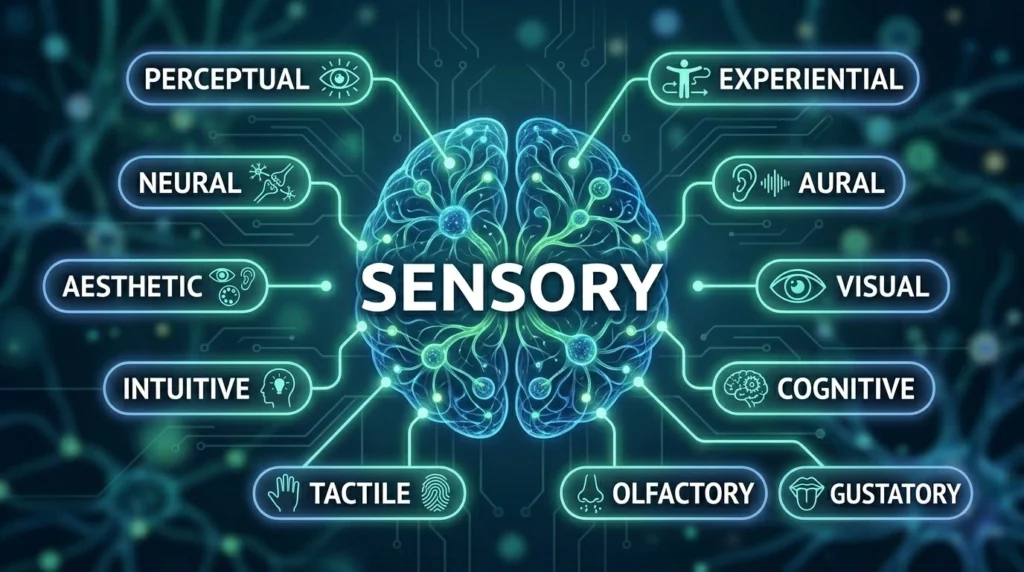
Sensory means related to the senses — sight, sound, smell, taste, and touch. Imagine walking into a bakery. You smell fresh bread. You see golden cakes. You hear soft music. You feel warmth. All these experiences are sensory.
The word sensory is common in education, psychology, health, and daily life. Teachers talk about sensory learning. Doctors mention sensory nerves. Writers describe sensory details in stories.
Learning synonyms of sensory helps English learners and content writers avoid repetition. It also makes writing richer and more vivid.
In this article, you will learn the meaning of sensory, its pronunciation, grammar, history, tone, and word formation. You will also explore 30 powerful synonyms with examples and categories to improve your vocabulary step by step.
Meaning of Sensory
Definition
Sensory (Adjective):
Related to the physical senses or the process of feeling and perceiving through the body.
Examples
- The room was full of sensory stimulation.
- Babies explore the world through sensory experiences.
Connotative Meaning
(Connotation means the emotional feeling or tone a word carries beyond its basic meaning.)
- Positive tone: relaxing sensory experience, rich sensory detail
- Negative tone: sensory overload, sensory disturbance
- Neutral tone: sensory nerves, sensory system
Etymology
- From Latin sensus meaning “feeling” or “perception.”
- Entered English through French.
Short History:
- Old English (450–1100): No direct use; related ideas expressed differently.
- Middle English (1100–1500): Latin-based terms began entering English.
- Modern English (1500–Present): “Sensory” became common in science and psychology.
Pronunciation (US & UK – IPA)
US: /ˈsen.sɔːr.i/
UK: /ˈsen.sər.i/
Syllables
sen-so-ry
Affixation Pattern of Sensory
- Root: sense
- Prefix: none
- Suffix: -ory (meaning “relating to”)
Word Formation (4 words formed):
- Sense (noun/verb)
- Sensory (adjective)
- Sensation (noun)
- Sensible (adjective)
A List of 30 Synonyms for Sensory
1. Perceptual (Adjective)
US: /pərˈsep.tʃu.əl/ | UK: /pəˈsep.tʃu.əl/
Meaning: Related to perception or understanding through senses.
Examples:
- Perceptual skills help children learn.
- The test measures perceptual ability.
2. Sensual (Adjective)
US: /ˈsen.su.əl/ | UK: /ˈsen.sju.əl/
Meaning: Giving pleasure to the senses.
Examples:
- The music created a sensual mood.
- She enjoyed the sensual taste of chocolate.
3. Sensitive (Adjective)
US: /ˈsen.sə.tɪv/ | UK: /ˈsen.sɪ.tɪv/
Meaning: Easily affected by physical feeling.
Examples:
- Her skin is sensitive to heat.
- Dogs are sensitive to sound.
4. Sensational (Adjective)
US: /senˈseɪ.ʃə.nəl/ | UK: /senˈseɪ.ʃə.nəl/
Meaning: Causing strong sensory excitement.
Examples:
- The food tasted sensational.
- It was a sensational show.
5. Tactile (Adjective)
US: /ˈtæk.taɪl/ | UK: /ˈtæk.taɪl/
Meaning: Related to touch.
Examples:
- The toy gives tactile feedback.
- Blind people rely on tactile reading.
6. Visual (Adjective)
US: /ˈvɪʒ.u.əl/ | UK: /ˈvɪʒ.u.əl/
Meaning: Related to sight.
Examples:
- The film is full of visual effects.
- Visual learning helps memory.
7. Auditory (Adjective)
US: /ˈɔː.də.tɔːr.i/ | UK: /ˈɔː.dɪ.tər.i/
Meaning: Related to hearing.
Examples:
- She has strong auditory skills.
- The message was given in auditory form.
8. Olfactory (Adjective)
US: /ɒlˈfæk.tər.i/ | UK: /ɒlˈfæk.tər.i/
Meaning: Related to smell.
Examples:
- Dogs have sharp olfactory senses.
- The flower has strong olfactory appeal.
9. Gustatory (Adjective)
US: /ˈɡʌs.tə.tɔːr.i/ | UK: /ˈɡʌs.tə.tər.i/
Meaning: Related to taste.
Examples:
- The meal was a gustatory delight.
- Taste buds control gustatory response.
10. Kinesthetic (Adjective)
US: /ˌkɪn.əsˈθet.ɪk/ | UK: /ˌkɪn.esˈθet.ɪk/
Meaning: Related to body movement sensation.
Examples:
- Some students are kinesthetic learners.
- Dance builds kinesthetic awareness.
11. Feeling (Adjective)
US: /ˈfiː.lɪŋ/ | UK: /ˈfiː.lɪŋ/
Meaning: Relating to touch or emotion.
Examples:
- He gave a feeling response.
- It was a feeling experience.
12. Perceiving (Adjective)
US: /pərˈsiː.vɪŋ/ | UK: /pəˈsiː.vɪŋ/
Meaning: Receiving through senses.
Examples:
- Perceiving details is important.
- She is good at perceiving sound changes.
13. Experiential (Adjective)
US: /ɪkˌspɪr.iˈen.ʃəl/ | UK: /ɪkˌspɪə.riˈen.ʃəl/
Meaning: Based on experience and senses.
Examples:
- The course uses experiential learning.
- Travel gives experiential knowledge.
14. Physical (Adjective)
US: /ˈfɪz.ɪ.kəl/ | UK: /ˈfɪz.ɪ.kəl/
Meaning: Related to the body.
Examples:
- Exercise improves physical health.
- Pain is a physical sensation.
15. Nervous (Adjective)
US: /ˈnɝː.vəs/ | UK: /ˈnɜː.vəs/
Meaning: Related to nerves.
Examples:
- The nervous system controls senses.
- It is a nervous reaction.
16. Responsive (Adjective)
US: /rɪˈspɑːn.sɪv/ | UK: /rɪˈspɒn.sɪv/
Meaning: Reacting quickly to stimuli.
Examples:
- The baby is responsive to sound.
- Plants are responsive to light.
17. Perceivable (Adjective)
US: /pərˈsiː.və.bəl/ | UK: /pəˈsiː.və.bəl/
Meaning: Able to be noticed by senses.
Examples:
- There was a perceivable smell.
- A perceivable change occurred.
18. Concrete (Adjective)
US: /ˈkɑːn.kriːt/ | UK: /ˈkɒŋ.kriːt/
Meaning: Real and touchable.
Examples:
- We need concrete examples.
- The object felt concrete.
19. Tangible (Adjective)
US: /ˈtæn.dʒə.bəl/ | UK: /ˈtæn.dʒɪ.bəl/
Meaning: Able to be touched or clearly felt.
Examples:
- There was tangible excitement.
- The proof was tangible.
20. Observable (Adjective)
US: /əbˈzɝː.və.bəl/ | UK: /əbˈzɜː.və.bəl/
Meaning: Able to be seen or noticed.
Examples:
- The change was observable.
- Observable behavior matters.
21. Stimulating (Adjective)
US: /ˈstɪm.jə.leɪ.tɪŋ/ | UK: /ˈstɪm.jʊ.leɪ.tɪŋ/
Meaning: Exciting the senses.
Examples:
- It was a stimulating lesson.
- The smell was stimulating.
22. Sensate (Adjective)
US: /ˈsen.seɪt/ | UK: /ˈsen.seɪt/
Meaning: Having sensation.
Examples:
- Humans are sensate beings.
- Sensate awareness is natural.
23. Sensing (Adjective)
US: /ˈsen.sɪŋ/ | UK: /ˈsen.sɪŋ/
Meaning: Detecting through senses.
Examples:
- The device is sensing heat.
- She is sensing danger.
24. Empirical (Adjective)
US: /ɪmˈpɪr.ɪ.kəl/ | UK: /ɪmˈpɪr.ɪ.kəl/
Meaning: Based on observation and experience.
Examples:
- The study used empirical data.
- Empirical proof is strong.
25. Real (Adjective)
US: /riːl/ | UK: /rɪəl/
Meaning: Existing physically.
Examples:
- The pain felt real.
- It was a real sensation.
26. Bodily (Adjective)
US: /ˈbɑː.də.li/ | UK: /ˈbɒd.ɪ.li/
Meaning: Related to the body.
Examples:
- He felt bodily pain.
- Bodily senses guide us.
27. Organic (Adjective)
US: /ɔːrˈɡæn.ɪk/ | UK: /ɔːˈɡæn.ɪk/
Meaning: Related to living body systems.
Examples:
- The brain is an organic organ.
- It was an organic reaction.
28. Somatic (Adjective)
US: /səˈmæt.ɪk/ | UK: /səˈmæt.ɪk/
Meaning: Related to the body.
Examples:
- Stress causes somatic symptoms.
- It was a somatic response.
29. Aesthetic (Adjective)
US: /esˈθet̬.ɪk/ | UK: /iːsˈθet.ɪk/
Meaning: Related to beauty and senses.
Examples:
- The room has aesthetic appeal.
- She values aesthetic design.
30. Emotional (Adjective)
US: /ɪˈmoʊ.ʃə.nəl/ | UK: /ɪˈməʊ.ʃə.nəl/
Meaning: Related to feelings.
Examples:
- It was an emotional reaction.
- Music creates emotional responses.
Prototype Meaning
The most typical meaning of sensory relates to the five physical senses. When people hear “sensory,” they imagine sight, sound, smell, taste, and touch working together.
Prototype Categorization
- Five-sense specific: visual, auditory, tactile, olfactory, gustatory
- Body-related: somatic, bodily, organic
- Experience-based: experiential, empirical
- Reaction-focused: responsive, stimulating
Categorization helps writers choose the best synonym depending on whether they describe sight, touch, emotion, or physical reaction.
Antonyms of Sensory
- Abstract (Adjective): Not related to physical senses.
- Mental (Adjective): Related to the mind, not senses.
- Spiritual (Adjective): Related to soul, not body.
- Intellectual (Adjective): Related to thinking only.
Short Questions and Answers
- What does sensory mean?
It means related to the physical senses. - When should sensory be used?
Use it when describing sight, sound, smell, taste, or touch. - Is sensory positive or negative?
It is neutral, but context can make it positive or negative. - How is it different from similar words?
“Sensory” focuses on physical senses, while “emotional” focuses on feelings.
CONCLUSION
Learning the word sensory and its synonyms improves vocabulary. It makes writing rich and clear. It helps speakers avoid repetition. It strengthens both speaking and writing skills. When you understand tone, pronunciation, and meaning, your English becomes more confident. Practice using new synonyms daily. Try to describe your day with sensory words. Over time, your vocabulary will grow naturally and powerfully.

I am a linguist with 17 years of experience in English language teaching, including postgraduate-level instruction. My expertise includes English grammar, and I contribute as a content and blog writer, producing scholarly and educational language resources.