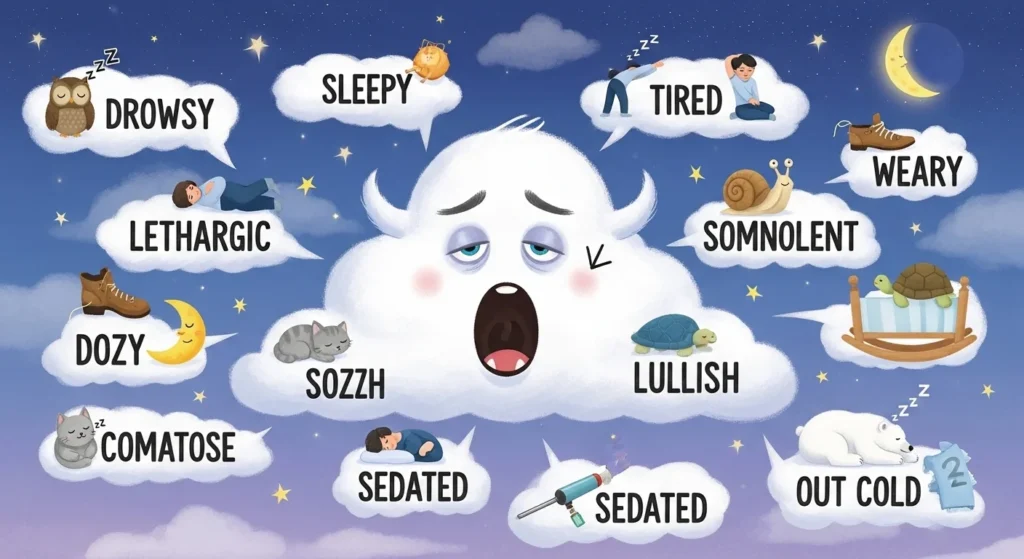
The word sleepy describes the feeling of wanting to sleep or lacking energy because of tiredness. Imagine waking up very early for school or work. Your eyes feel heavy, and you keep yawning while drinking tea or coffee. At that moment, you might say, “I feel sleepy.”
This word is very common in everyday English. People use it to describe tired feelings, quiet towns, calm places, or slow moods.
Learning synonyms of sleepy is useful for English learners and content writers. It helps improve vocabulary, makes writing more interesting, and prevents repeating the same word again and again.
In this article, we will explore the meaning of sleepy, its pronunciation, grammar, origin, and many useful synonyms. Each synonym will include simple meanings and examples to help learners understand and use them confidently.
Meaning of Sleepy
Sleepy (adjective):
Feeling tired and ready to fall asleep.
Examples
- I feel sleepy after studying for many hours.
- The baby looked sleepy and slowly closed her eyes.
Connotative Meaning
- Positive tone: Calm, peaceful, relaxed feeling before sleep.
- Negative tone: Lack of energy or difficulty focusing.
- Neutral tone: A simple description of feeling tired.
(Connotation: the emotional or cultural meaning connected to a word beyond its literal definition.)
Etymology
- Origin: From Old English “slǣpig”, meaning “inclined to sleep.”
Historical Development
- Old English (450–1100): The word appeared as slǣpig, meaning sleepy or drowsy.
- Middle English (1100–1500): The spelling changed to slepy.
- Modern English (1500–Present): The form sleepy became standard in everyday speech.
Pronunciation (US & UK – IPA)
US: /ˈsliːpi/
UK: /ˈsliːpi/
Syllables
sleep-y
Affixation Pattern of Sleepy
Root: sleep
Prefix: none
Suffix: -y (meaning “having the quality of”)
Word Formation
- sleep (noun / verb)
- sleepy (adjective)
- sleepiness (noun)
- sleeping (adjective / participle)
- sleepless (adjective)
A List of 30 Synonyms for Sleepy
1. Drowsy (adjective)
US: /ˈdraʊzi/ | UK: /ˈdraʊzi/
Meaning: Feeling very tired and ready to sleep.
Examples:
- The warm room made me drowsy.
- He felt drowsy during the long lecture.
2. Tired (adjective)
US: /ˈtaɪərd/ | UK: /ˈtaɪəd/
Meaning: Feeling a need to rest or sleep.
Examples:
- I am tired after a long day.
- She looked tired after studying all night.
3. Fatigued (adjective)
US: /fəˈtiːɡd/ | UK: /fəˈtiːɡd/
Meaning: Extremely tired because of work or activity.
Examples:
- The runners were fatigued after the race.
- He felt fatigued after hours of work.
4. Lethargic (adjective)
US: /ləˈθɑːrdʒɪk/ | UK: /ləˈθɑːdʒɪk/
Meaning: Feeling slow and lacking energy.
Examples:
- The heat made everyone lethargic.
- She felt lethargic in the afternoon.
5. Dozy (adjective)
US: /ˈdoʊzi/ | UK: /ˈdəʊzi/
Meaning: Half asleep or very relaxed.
Examples:
- The child looked dozy after lunch.
- The quiet music made him dozy.
6. Sluggish (adjective)
US: /ˈslʌɡɪʃ/ | UK: /ˈslʌɡɪʃ/
Meaning: Moving slowly because of tiredness.
Examples:
- I felt sluggish in the morning.
- The workers seemed sluggish after lunch.
7. Groggy (adjective)
US: /ˈɡrɑːɡi/ | UK: /ˈɡrɒɡi/
Meaning: Feeling weak or sleepy after waking up.
Examples:
- I felt groggy after the nap.
- He was groggy early in the morning.
8. Weary (adjective)
US: /ˈwɪri/ | UK: /ˈwɪəri/
Meaning: Very tired after effort.
Examples:
- The traveler felt weary.
- She looked weary after work.
9. Exhausted (adjective)
US: /ɪɡˈzɔːstɪd/ | UK: /ɪɡˈzɔːstɪd/
Meaning: Extremely tired.
Examples:
- He was exhausted after the game.
- I felt exhausted after cleaning the house.
10. Yawning (adjective)
US: /ˈjɔːnɪŋ/ | UK: /ˈjɔːnɪŋ/
Meaning: Showing tiredness by yawning.
Examples:
- The yawning student needed sleep.
- She sat yawning in class.
11. Nodding (adjective)
US: /ˈnɑːdɪŋ/ | UK: /ˈnɒdɪŋ/
Meaning: Nearly falling asleep.
Examples:
- He was nodding during the lecture.
- The guard sat nodding at the desk.
12. Slumberous (adjective)
US: /ˈslʌmbərəs/ | UK: /ˈslʌmbərəs/
Meaning: Full of sleepiness.
Examples:
- The warm afternoon felt slumberous.
- The village looked slumberous.
13. Somnolent (adjective)
US: /ˈsɑːmnələnt/ | UK: /ˈsɒmnələnt/
Meaning: Very sleepy or drowsy.
Examples:
- The medicine made him somnolent.
- She felt somnolent after lunch.
14. Hypnotic (adjective)
US: /hɪpˈnɑːtɪk/ | UK: /hɪpˈnɒtɪk/
Meaning: Causing sleep or deep relaxation.
Examples:
- The soft music felt hypnotic.
- The waves had a hypnotic effect.
15. Dreamy (adjective)
US: /ˈdriːmi/ | UK: /ˈdriːmi/
Meaning: Calm, relaxed, and slightly sleepy.
Examples:
- The warm day felt dreamy.
- She had a dreamy expression.
16. Idle (adjective)
US: /ˈaɪdəl/ | UK: /ˈaɪdəl/
Meaning: Not active or energetic.
Examples:
- The town felt idle in the afternoon.
- He looked idle and relaxed.
17. Slow (adjective)
US: /sloʊ/ | UK: /sləʊ/
Meaning: Moving without energy.
Examples:
- I felt slow this morning.
- His steps were slow.
18. Dull (adjective)
US: /dʌl/ | UK: /dʌl/
Meaning: Lacking energy or excitement.
Examples:
- The room felt dull and quiet.
- He looked dull after little sleep.
19. Relaxed (adjective)
US: /rɪˈlækst/ | UK: /rɪˈlækst/
Meaning: Calm and resting.
Examples:
- I felt relaxed after tea.
- The dog looked relaxed and sleepy.
20. Lazy (adjective)
US: /ˈleɪzi/ | UK: /ˈleɪzi/
Meaning: Not wanting to work due to tiredness.
Examples:
- I felt lazy on Sunday morning.
- The cat looked lazy in the sun.
21. Tranquil (adjective)
US: /ˈtræŋkwɪl/ | UK: /ˈtræŋkwɪl/
Meaning: Calm and peaceful.
Examples:
- The tranquil lake made us sleepy.
- The village felt tranquil.
22. Calm (adjective)
US: /kɑːm/ | UK: /kɑːm/
Meaning: Peaceful and relaxed.
Examples:
- The room felt calm and quiet.
- She felt calm and sleepy.
23. Quiet (adjective)
US: /ˈkwaɪət/ | UK: /ˈkwaɪət/
Meaning: Without noise or activity.
Examples:
- The town was quiet at night.
- The classroom became quiet.
24. Languid (adjective)
US: /ˈlæŋɡwɪd/ | UK: /ˈlæŋɡwɪd/
Meaning: Slow and lacking energy.
Examples:
- The heat made the day languid.
- She walked with languid steps.
25. Torpid (adjective)
US: /ˈtɔːrpɪd/ | UK: /ˈtɔːpɪd/
Meaning: Inactive due to tiredness.
Examples:
- The animal looked torpid in winter.
- The heat made him torpid.
26. Slumbery (adjective)
US: /ˈslʌmbəri/ | UK: /ˈslʌmbəri/
Meaning: Full of sleep or rest.
Examples:
- The afternoon felt slumbery.
- The warm bed felt slumbery.
27. Half-asleep (adjective)
US: /ˌhæf əˈsliːp/ | UK: /ˌhɑːf əˈsliːp/
Meaning: Not fully awake.
Examples:
- I walked to the kitchen half-asleep.
- He answered the phone half-asleep.
28. Droopy (adjective)
US: /ˈdruːpi/ | UK: /ˈdruːpi/
Meaning: Looking tired with heavy eyes.
Examples:
- The dog had droopy eyes.
- She looked droopy in class.
29. Heavy-eyed (adjective)
US: /ˈhevi aɪd/ | UK: /ˈhevi aɪd/
Meaning: Having eyes that feel ready to close.
Examples:
- The child was heavy-eyed.
- I felt heavy-eyed after midnight.
30. Slumbering (adjective)
US: /ˈslʌmbərɪŋ/ | UK: /ˈslʌmbərɪŋ/
Meaning: In a state of sleep.
Examples:
- The baby was slumbering peacefully.
- The town seemed slumbering at night.
Prototype Meaning
The prototype meaning of sleepy refers to the natural human feeling of being tired and ready to sleep. When people hear the word sleepy, they often imagine heavy eyes, slow movements, and frequent yawning. It usually happens late at night, after a long day of work, or when someone wakes up very early.
Prototype Categorization
Synonyms of sleepy can be grouped into useful categories.
- Physical tiredness: tired, exhausted, fatigued, weary
- Near sleep state: drowsy, groggy, half-asleep, nodding
- Slow energy: sluggish, languid, torpid
- Calm and peaceful mood: tranquil, calm, dreamy
Categorizing synonyms helps writers choose the most suitable word depending on context. For example, drowsy fits medical or physical tiredness, while dreamy suits poetic or emotional writing.
Antonyms of Sleepy
- Alert (adjective): fully awake and attentive
- Energetic (adjective): full of energy and activity
- Awake (adjective): not sleeping; conscious
- Active (adjective): full of movement and action
- Lively (adjective): energetic and enthusiastic
Short Questions and Answers
- What does sleepy mean?
It means feeling tired and ready to fall asleep. - When should sleepy be used?
It is used when someone feels tired or when a place feels calm and quiet. - Is sleepy positive or negative?
It can be positive when describing calm relaxation, but negative if it means low energy. - How is it different from similar words?
Words like tired describe general fatigue, while sleepy specifically suggests a desire to sleep.
Conclusion
Learning the word sleepy and its synonyms helps English learners expand their vocabulary and improve communication. By understanding words such as drowsy, groggy, weary, and languid, writers can describe tiredness in many different ways.
Using varied vocabulary strengthens both writing and speaking skills. It also prevents repetition and makes communication more interesting. When learners practice new words regularly, they become more confident in using English.
Exploring synonyms like those of sleepy is a great step toward building a strong vocabulary. Daily practice with new words will help learners express ideas clearly and naturally in both spoken and written English.

I am a linguist with 17 years of experience in English language teaching, including postgraduate-level instruction. My expertise includes English grammar, and I contribute as a content and blog writer, producing scholarly and educational language resources.