
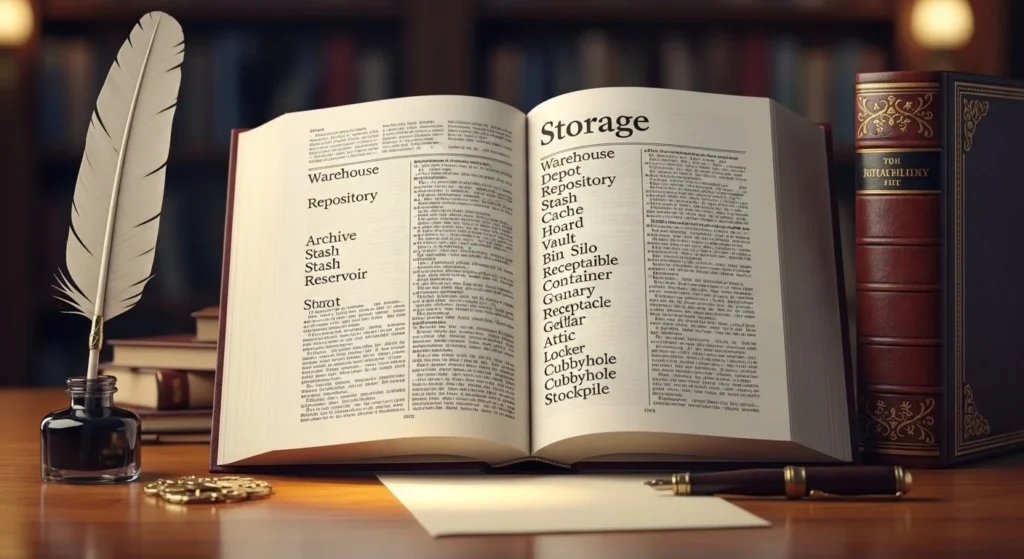
Storage means keeping things safe for future use. Think about a family moving to a new home. They pack clothes in boxes. They place old books in the attic. They keep food in the fridge. This is storage. We use this word at home, in offices, in shops, and in technology. We talk about food storage, data storage, and cloud storage.
The word is common in daily English. English learners often see it in school books and online articles. Content writers also use it in business and tech topics. Learning synonyms of storage helps avoid repetition. It makes writing clear and strong. It also builds speaking confidence.
In this article, you will learn the meaning of storage and its synonyms with examples, grammar, history, pronunciation, and categories in simple English sentences.
Meaning of Storage
Definition
Storage (Noun):
The act of keeping something in a safe place for future use.
Examples
The storage of food keeps it fresh.
We need more storage for old files.
Connotative Meaning
(Connotation means the feeling or idea a word suggests beyond its main meaning.)
- Positive tone: safety, protection, order
- Negative tone: clutter, hoarding, mess
- Neutral tone: keeping, holding, saving
Etymology
- From Old French estorage meaning “supply”
- From Latin instaurare meaning “to restore or provide”
Short History
- Old English (450–1100): People used words like “house” or “hold” instead.
- Middle English (1100–1500): “Storen” meant to supply or furnish.
- Modern English (1500–Present): Storage developed to mean keeping goods or data safely.
Pronunciation (US & UK – IPA)
US: /ˈstɔːrɪdʒ/
UK: /ˈstɔːrɪdʒ/
Syllables
stor-age
Affixation Pattern of Storage
- Root: store
- Prefix: none
- Suffix: -age
Word Formation
From the root store, we form:
- Store (verb, noun)
- Storage (noun)
- Stored (adjective/verb)
- Storing (verb form)
- Storehouse (noun)
A List of 30 Synonyms for Storage
1. Storehouse (Noun) — US /ˈstɔːrhaʊs/ | UK /ˈstɔːhaʊs/
Meaning: A building where goods are kept.
Examples:
The farm has a big storehouse.
Grain stays dry in the storehouse.
2. Warehouse (Noun) — US /ˈwerhaʊs/ | UK /ˈweəhaʊs/
Meaning: A large building for stored goods.
Examples:
The company owns a warehouse.
Boxes fill the warehouse.
3. Depot (Noun) — US /ˈdiːpoʊ/ | UK /ˈdepəʊ/
Meaning: A place for storing supplies.
Examples:
The bus depot stores buses.
Fuel is kept at the depot.
4. Repository (Noun) — US /rɪˈpɑːzɪtɔːri/ | UK /rɪˈpɒzɪtəri/
Meaning: A place where things are stored.
Examples:
The museum is a repository of art.
Data sits in a repository.
5. Vault (Noun) — US /vɔːlt/ | UK /vɔːlt/
Meaning: A secure room for valuables.
Examples:
Cash stays in the vault.
The vault door is heavy.
6. Archive (Noun) — US /ˈɑːrkaɪv/ | UK /ˈɑːkaɪv/
Meaning: A place for old records.
Examples:
The school archive holds files.
Photos rest in the archive.
7. Locker (Noun) — US /ˈlɑːkər/ | UK /ˈlɒkə/
Meaning: A small locked space.
Examples:
My bag is in the locker.
Students use lockers daily.
8. Pantry (Noun) — US /ˈpæntri/ | UK /ˈpæntri/
Meaning: A room for food storage.
Examples:
Rice is in the pantry.
The pantry holds cans.
9. Stockpile (Noun) — US /ˈstɑːkpaɪl/ | UK /ˈstɒkpaɪl/
Meaning: A large amount saved for later.
Examples:
They built a food stockpile.
Coal sits in a stockpile.
10. Reserve (Noun) — US /rɪˈzɜːrv/ | UK /rɪˈzɜːv/
Meaning: Something kept for future use.
Examples:
The army has fuel reserves.
Keep money in reserve.
11. Inventory (Noun) — US /ˈɪnvəntɔːri/ | UK /ˈɪnvəntəri/
Meaning: A list of stored goods.
Examples:
Check the inventory today.
The shop updated its inventory.
12. Cache (Noun) — US /kæʃ/ | UK /kæʃ/
Meaning: A hidden storage place.
Examples:
He found a cache of coins.
Clear your browser cache.
13. Shed (Noun) — US /ʃed/ | UK /ʃed/
Meaning: A small building for storage.
Examples:
Tools are in the shed.
The shed is behind the house.
14. Cellar (Noun) — US /ˈselər/ | UK /ˈselə/
Meaning: An underground room for storage.
Examples:
Wine rests in the cellar.
The cellar keeps food cool.
15. Attic (Noun) — US /ˈætɪk/ | UK /ˈætɪk/
Meaning: A space under the roof.
Examples:
Boxes are in the attic.
Old toys fill the attic.
16. Cupboard (Noun) — US /ˈkʌbərd/ | UK /ˈkʌbəd/
Meaning: A cabinet for storage.
Examples:
Plates are in the cupboard.
The cupboard is full.
17. Closet (Noun) — US /ˈklɑːzɪt/ | UK /ˈklɒzɪt/
Meaning: A small storage room.
Examples:
Shoes are in the closet.
Clean the closet today.
18. Granary (Noun) — US /ˈɡrænəri/ | UK /ˈɡrænəri/
Meaning: A place to store grain.
Examples:
Farmers use a granary.
The granary protects wheat.
19. Barn (Noun) — US /bɑːrn/ | UK /bɑːn/
Meaning: A farm building for storage.
Examples:
Hay stays in the barn.
The barn holds tools.
20. Container (Noun) — US /kənˈteɪnər/ | UK /kənˈteɪnə/
Meaning: An object that holds things.
Examples:
Water is in a container.
Use a sealed container.
21. Bin (Noun) — US /bɪn/ | UK /bɪn/
Meaning: A box for storage or waste.
Examples:
Clothes go in the bin.
The bin is full.
22. Safe (Noun) — US /seɪf/ | UK /seɪf/
Meaning: A strong box for valuables.
Examples:
Jewels are in the safe.
Lock the safe at night.
23. Depository (Noun) — US /dɪˈpɑːzɪtɔːri/ | UK /dɪˈpɒzɪtəri/
Meaning: A place where things are stored.
Examples:
The bank is a money depository.
Funds rest in a depository.
24. Holding (Noun) — US /ˈhoʊldɪŋ/ | UK /ˈhəʊldɪŋ/
Meaning: Property or goods owned and kept.
Examples:
The company expanded its holdings.
Land is part of his holding.
25. Supply (Noun) — US /səˈplaɪ/ | UK /səˈplaɪ/
Meaning: Stored goods ready for use.
Examples:
We have a water supply.
Food supply is low.
26. Collection (Noun) — US /kəˈlekʃən/ | UK /kəˈlekʃən/
Meaning: A group of stored items.
Examples:
She has a stamp collection.
The museum has a large collection.
27. Stock (Noun) — US /stɑːk/ | UK /stɒk/
Meaning: Goods kept for sale.
Examples:
The store has new stock.
Stock is in storage.
28. Hoard (Noun) — US /hɔːrd/ | UK /hɔːd/
Meaning: A hidden supply kept secretly.
Examples:
He found a gold hoard.
The hoard was buried.
29. Treasury (Noun) — US /ˈtreʒəri/ | UK /ˈtreʒəri/
Meaning: A place for valuable items.
Examples:
The palace has a treasury.
Gold stays in the treasury.
30. Bank (Noun) — US /bæŋk/ | UK /bæŋk/
Meaning: A place that stores money.
Examples:
She keeps money in the bank.
The bank protects savings.
Read More about 30 Synonyms of Rain Heavily with Examples and Explanation for 2026
Prototype Meaning
When people hear storage, they think of a room, box, or building where things are kept safely for later use. It often connects with safety, order, and planning for the future.
Prototype Categorization
- Buildings: warehouse, barn, granary, depot
- Home spaces: attic, cellar, pantry, closet
- Secure places: vault, safe, treasury
- Collections: archive, collection, hoard
- Containers: bin, container, cupboard
Categorization helps writers choose the right word. For example, “vault” shows security, while “pantry” shows food storage.
Antonyms of Storage
- waste
- disposal
- distribution
- release
- discard
Short Questions and Answers
- What does storage mean?
It means keeping something safe for future use. - When should storage be used?
Use it when talking about saving goods, food, or data. - Is storage positive or negative?
It is neutral. It can be positive if it means safety. - How is it different from similar words?
Storage is general. Words like vault or pantry are specific types.
CONCLUSION
Learning storage and its synonyms improves your vocabulary. It strengthens writing and speaking. It avoids repetition. It builds confidence in English.
When you know many related words, you can choose the best one for each situation. This skill helps students, writers, and professionals.
Practice new words every day. Use them in short sentences. Read and listen often. Step by step, your English will grow strong and natural.

I am a linguist with 17 years of experience in English language teaching, including postgraduate-level instruction. My expertise includes English grammar, and I contribute as a content and blog writer, producing scholarly and educational language resources.