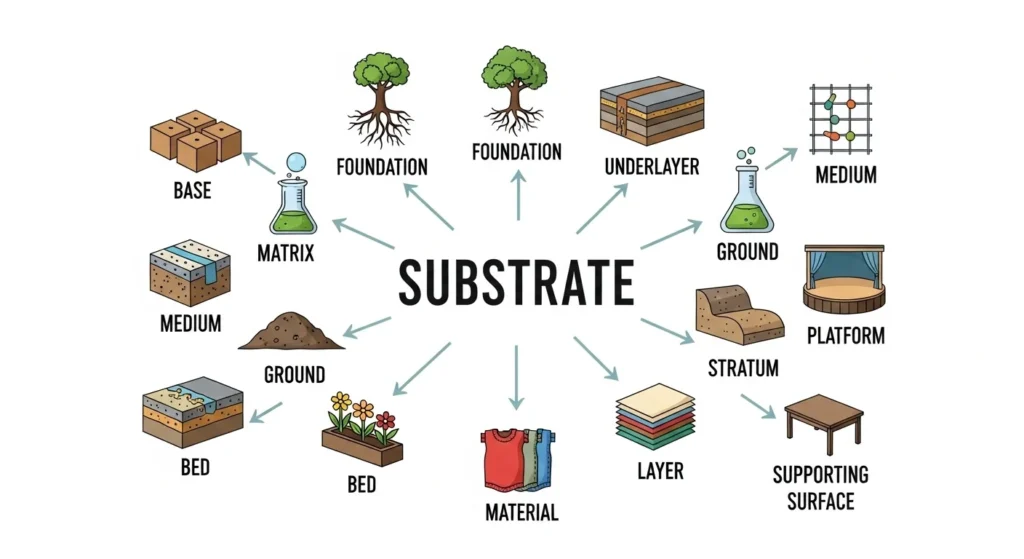
The word substrate refers to a base, surface, or underlying layer on which something develops or grows. Imagine a gardener planting seeds in soil. The soil supports the plants and allows them to grow. In this situation, the soil acts as the substrate because it provides the foundation for life and development.
The word is widely used in fields such as biology, chemistry, ecology, and technology. Scientists often use it when talking about surfaces where reactions happen or where organisms grow.
Learning synonyms of substrate is very helpful for English learners, writers, and researchers. It expands vocabulary, improves writing variety, and avoids repetition.
This article explains the meaning of the word substrate and explores its synonyms, pronunciation, grammar, history, and semantic categories with simple examples to help you use the word confidently.
Definition of Substrate
Substrate (noun):
A surface, base, or underlying layer where something grows, develops, or occurs.
Examples
- The soil acts as a substrate for plant roots.
- In chemistry, enzymes bind to a substrate during reactions.
Connotative Meaning
- Positive tone: A supportive base that helps growth or development.
- Negative tone: Rarely negative, but sometimes suggests something hidden or underlying.
- Neutral tone: Most commonly used in scientific or descriptive contexts.
(Connotation: the emotional or cultural meaning a word carries beyond its literal definition.)
Etymology
- Origin: From Latin “substratum”, meaning “that which is spread underneath.”
- The word combines sub (under) + sternere (to spread or lay down).
Historical Development
- Old English (450–1100): Concept of “foundation” existed but the word substrate was not used.
- Middle English (1100–1500): Latin-based scientific vocabulary began entering English.
- Modern English (1500–Present): The term substrate became common in science and philosophy.
Pronunciation (US & UK – IPA)
US: /ˈsʌbstreɪt/
UK: /ˈsʌbstreɪt/
Syllables
sub-strate
Affixation Pattern of Substrate
Root: strate (from Latin meaning layer or spread)
Prefix: sub- (under)
Suffix: none
Word Formation
- substrate (noun)
- substratal (adjective)
- substratum (noun)
- substructural (adjective)
A List of 30 Synonyms for Substrate
1. Base (noun)
US: /beɪs/ | UK: /beɪs/
Meaning: The bottom support or foundation of something.
Examples:
- The statue rests on a strong base.
- A good soil base helps plants grow.
2. Foundation (noun)
US: /faʊnˈdeɪʃən/ | UK: /faʊnˈdeɪʃən/
Meaning: The underlying structure that supports something.
Examples:
- The house has a strong foundation.
- Knowledge is the foundation of success.
3. Ground (noun)
US: /ɡraʊnd/ | UK: /ɡraʊnd/
Meaning: The surface or base layer.
Examples:
- Seeds fall on the ground and grow.
- The experiment used glass as the ground surface.
4. Bed (noun)
US: /bed/ | UK: /bed/
Meaning: A layer where something rests or grows.
Examples:
- Plants grow in a flower bed.
- Rivers move stones along the river bed.
5. Layer (noun)
US: /ˈleɪər/ | UK: /ˈleɪə/
Meaning: A sheet or thickness of material.
Examples:
- The cake has many layers.
- Soil forms different layers underground.
6. Platform (noun)
US: /ˈplætfɔːrm/ | UK: /ˈplætfɔːm/
Meaning: A raised base or supporting structure.
Examples:
- The speaker stood on a platform.
- The system uses a digital platform.
7. Surface (noun)
US: /ˈsɜːrfɪs/ | UK: /ˈsɜːfɪs/
Meaning: The outer layer of something.
Examples:
- The bacteria live on the surface.
- The table has a smooth surface.
8. Underlayer (noun)
US: /ˈʌndərˌleɪər/ | UK: /ˈʌndəˌleɪə/
Meaning: A layer beneath another layer.
Examples:
- The paint covers the underlayer.
- The soil underlayer holds moisture.
9. Base Layer (noun)
US: /beɪs ˈleɪər/ | UK: /beɪs ˈleɪə/
Meaning: The lowest layer supporting others.
Examples:
- Ice forms the base layer of glaciers.
- The cake needs a firm base layer.
10. Foundation Layer (noun)
US: /faʊnˈdeɪʃən ˈleɪər/ | UK: /faʊnˈdeɪʃən ˈleɪə/
Meaning: The supporting bottom layer.
Examples:
- Engineers prepared the foundation layer.
- Soil acts as a foundation layer for plants.
11. Basis (noun)
US: /ˈbeɪsɪs/ | UK: /ˈbeɪsɪs/
Meaning: The fundamental support or principle.
Examples:
- Evidence forms the basis of the study.
- Trust is the basis of friendship.
12. Support (noun)
US: /səˈpɔːrt/ | UK: /səˈpɔːt/
Meaning: Something that holds or carries weight.
Examples:
- The beams give support to the roof.
- Soil provides support to plant roots.
13. Framework (noun)
US: /ˈfreɪmwɜːrk/ | UK: /ˈfreɪmwɜːk/
Meaning: A basic structure that supports something.
Examples:
- The building’s framework is steel.
- The law created a new policy framework.
14. Matrix (noun)
US: /ˈmeɪtrɪks/ | UK: /ˈmeɪtrɪks/
Meaning: An environment where something develops.
Examples:
- Cells grow within a biological matrix.
- Culture forms the matrix of society.
15. Medium (noun)
US: /ˈmiːdiəm/ | UK: /ˈmiːdiəm/
Meaning: A substance in which something grows or moves.
Examples:
- Agar is a medium for bacteria.
- Water is the medium for fish.
16. Groundwork (noun)
US: /ˈɡraʊndwɜːrk/ | UK: /ˈɡraʊndwɜːk/
Meaning: Preparatory foundation.
Examples:
- Research lays the groundwork for discovery.
- Teachers provide the groundwork of knowledge.
17. Bedrock (noun)
US: /ˈbedrɑːk/ | UK: /ˈbedrɒk/
Meaning: The solid rock under soil; basic support.
Examples:
- The city stands on bedrock.
- Trust is the bedrock of relationships.
18. Core (noun)
US: /kɔːr/ | UK: /kɔː/
Meaning: The central or essential part.
Examples:
- Honesty is the core value.
- The earth has a hot core.
19. Ground Layer (noun)
US: /ɡraʊnd ˈleɪər/ | UK: /ɡraʊnd ˈleɪə/
Meaning: The lowest natural layer.
Examples:
- Moss grows on the ground layer.
- The forest ground layer supports insects.
20. Soil (noun)
US: /sɔɪl/ | UK: /sɔɪl/
Meaning: Earth where plants grow.
Examples:
- Fertile soil grows healthy crops.
- The roots spread through the soil.
21. Base Material (noun)
US: /beɪs məˈtɪriəl/ | UK: /beɪs məˈtɪəriəl/
Meaning: Primary material used underneath.
Examples:
- Wood is the base material of the table.
- Plastic acts as the base material.
22. Structural Base (noun)
US: /ˈstrʌktʃərəl beɪs/ | UK: /ˈstrʌktʃərəl beɪs/
Meaning: The main support of a structure.
Examples:
- The bridge needs a strong structural base.
- Engineers strengthened the structural base.
23. Understructure (noun)
US: /ˈʌndərˌstrʌktʃər/ | UK: /ˈʌndəˌstrʌktʃə/
Meaning: A structure beneath another structure.
Examples:
- The building’s understructure is concrete.
- The bridge’s understructure holds its weight.
24. Framework Base (noun)
US: /ˈfreɪmwɜːrk beɪs/ | UK: /ˈfreɪmwɜːk beɪs/
Meaning: The supporting structure at the bottom.
Examples:
- The tower rests on a framework base.
- The design used a steel framework base.
25. Substratum (noun)
US: /sʌbˈstreɪtəm/ | UK: /sʌbˈstreɪtəm/
Meaning: An underlying layer or base.
Examples:
- Coral grows on a rocky substratum.
- Culture forms a linguistic substratum.
26. Basis Layer (noun)
US: /ˈbeɪsɪs ˈleɪər/ | UK: /ˈbeɪsɪs ˈleɪə/
Meaning: The underlying supportive layer.
Examples:
- Clay forms the basis layer of the soil.
- The basis layer keeps the structure stable.
27. Ground Base (noun)
US: /ɡraʊnd beɪs/ | UK: /ɡraʊnd beɪs/
Meaning: The base on which something stands.
Examples:
- The tower stands on a concrete ground base.
- Plants depend on the ground base.
28. Root Layer (noun)
US: /ruːt ˈleɪər/ | UK: /ruːt ˈleɪə/
Meaning: The layer where roots grow.
Examples:
- Plants absorb nutrients from the root layer.
- Farmers improve the root layer soil.
29. Base Surface (noun)
US: /beɪs ˈsɜːrfɪs/ | UK: /beɪs ˈsɜːfɪs/
Meaning: The underlying surface.
Examples:
- Paint sticks to the base surface.
- The coating protects the base surface.
30. Support Layer (noun)
US: /səˈpɔːrt ˈleɪər/ | UK: /səˈpɔːt ˈleɪə/
Meaning: A layer that provides support.
Examples:
- The road has a gravel support layer.
- The support layer keeps the structure stable.
Prototype Meaning
The prototype meaning of substrate refers to a supporting base or surface where something grows or happens. Most people imagine soil supporting plants, or a surface where chemical reactions occur. It represents the hidden but essential layer that allows other processes to take place.
Prototype Categorization
Synonyms of substrate can be grouped into several categories.
- Physical base: base, foundation, bedrock, ground
- Scientific environment: medium, matrix, substratum
- Structural support: framework, understructure, structural base
- Natural growth surface: soil, ground layer, root layer
Categorizing synonyms helps writers choose the most precise word depending on context. Scientific writing may prefer matrix or medium, while everyday language may use base or foundation.
Antonyms of Substrate
- Surface layer (noun): the topmost layer rather than the underlying one
- Covering (noun): something that lies on top instead of below
- Overlay (noun): a layer placed above another
- Cap (noun): the upper covering of a structure
Short Questions and Answers
- What does substrate mean?
It means an underlying surface or base where something grows or develops. - When should substrate be used?
It is used in science, technology, and general writing when describing a supporting base. - Is substrate positive or negative?
It is usually neutral but can have a positive tone when referring to supportive foundations. - How is it different from similar words?
Words like base or foundation are general, while substrate is often used in scientific or technical contexts.
Conclusion
Learning the word substrate and its synonyms helps expand English vocabulary and improve communication. When writers understand multiple words with similar meanings, they can express ideas more clearly and avoid repetition. Synonyms such as foundation, matrix, medium, and base allow writers to choose the most accurate word for each context.
Strong vocabulary also improves speaking confidence and writing quality. By practicing new words daily, learners can build deeper language skills and better understand academic and professional texts. Exploring words like substrate not only strengthens vocabulary but also opens the door to more precise and effective communication in English.

I am a linguist with 17 years of experience in English language teaching, including postgraduate-level instruction. My expertise includes English grammar, and I contribute as a content and blog writer, producing scholarly and educational language resources.