
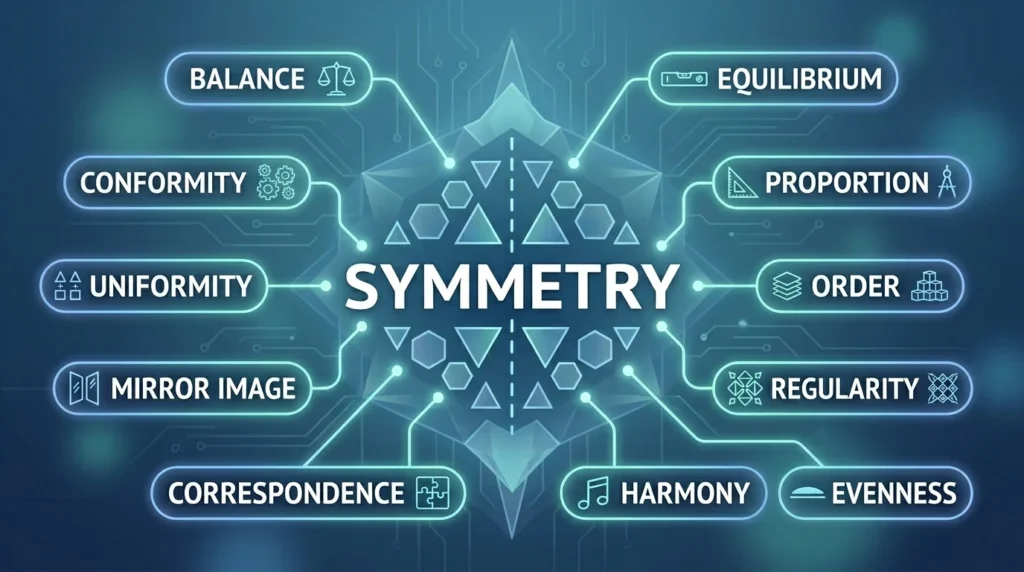
Symmetry means balanced shape or equal parts on both sides. Imagine you are folding a paper heart for a school project. When you open it, both sides look the same. That is symmetry. We see symmetry in faces, flowers, buildings, and art. It makes things look neat and beautiful.
The word is common in math, science, design, and daily talk. English learners and writers often need similar words to avoid repeating “symmetry” again and again. Learning synonyms of symmetry helps improve vocabulary and writing style.
In this article, you will learn the meaning of symmetry and its synonyms with examples, grammar, pronunciation, history, and semantic categories. Everything is explained in simple English for easy learning.
Meaning of Symmetry
Symmetry (Noun):
A balanced arrangement where two sides are equal or similar in shape, size, or position.
Examples:
- The butterfly shows perfect symmetry in its wings.
- The building’s design has beautiful symmetry.
Connotative Meaning
(Connotation means the emotional feeling or idea connected to a word.)
- Positive tone: beauty, balance, harmony, perfection
- Negative tone: strictness, stiffness (in some contexts)
- Neutral tone: equal arrangement or structure
Etymology
- From Greek symmetria meaning “measured together.”
- Entered Latin as symmetria.
- Came into English in the 16th century.
Short History:
- Old English (450–1100): Word not used; balance described differently.
- Middle English (1100–1500): Influence of Latin and French began.
- Modern English (1500–Present): “Symmetry” became common in science and art.
Pronunciation (US & UK – IPA)
US: /ˈsɪmətri/
UK: /ˈsɪmətri/
Syllables
sym-me-try
Affixation Pattern of Symmetry
- Root: symmetr-
- Prefix: sym- (together)
- Suffix: -y (noun ending)
Word Formation
- symmetry (noun)
- symmetrical (adjective)
- symmetrically (adverb)
- symmetrize (verb)
- symmetrization (noun)
A List of 30 Synonyms for Symmetry
1. Balance (Noun)
US /ˈbæləns/ | UK /ˈbæləns/
Meaning: Equal weight or importance on both sides.
Examples:
- The painting has good balance.
- She kept balance while walking.
2. Harmony (Noun)
US /ˈhɑːrməni/ | UK /ˈhɑːməni/
Meaning: Pleasant arrangement of parts.
Examples:
- Colors work in harmony.
- They lived in harmony.
3. Proportion (Noun)
US /prəˈpɔːrʃən/ | UK /prəˈpɔːʃən/
Meaning: Correct size relationship between parts.
Examples:
- The face has perfect proportion.
- Good art needs proportion.
4. Equilibrium (Noun)
US /ˌiːkwəˈlɪbriəm/ | UK /ˌiːkwɪˈlɪbriəm/
Meaning: A state of balance.
Examples:
- The system is in equilibrium.
- Plants keep natural equilibrium.
5. Order (Noun)
US /ˈɔːrdər/ | UK /ˈɔːdə/
Meaning: Organized arrangement.
Examples:
- The room shows order.
- Nature has order.
6. Regularity (Noun)
US /ˌreɡjəˈlærəti/ | UK /ˌreɡjʊˈlærəti/
Meaning: Even pattern or form.
Examples:
- The design shows regularity.
- Teeth grow with regularity.
7. Uniformity (Noun)
US /ˌjuːnɪˈfɔːrməti/ | UK /ˌjuːnɪˈfɔːməti/
Meaning: Sameness in form.
Examples:
- The tiles show uniformity.
- There is uniformity in dress.
8. Consistency (Noun)
US /kənˈsɪstənsi/ | UK /kənˈsɪstənsi/
Meaning: Steady similarity.
Examples:
- The pattern has consistency.
- She shows consistency in work.
9. Alignment (Noun)
US /əˈlaɪnmənt/ | UK /əˈlaɪnmənt/
Meaning: Correct position in a line.
Examples:
- Check the wheel alignment.
- The columns are in alignment.
10. Evenness (Noun)
US /ˈiːvnəs/ | UK /ˈiːvnəs/
Meaning: Smooth equality.
Examples:
- The floor has evenness.
- Her tone showed evenness.
11. Correspondence (Noun)
US /ˌkɔːrəˈspɑːndəns/ | UK /ˌkɒrəˈspɒndəns/
Meaning: Similar match between parts.
Examples:
- There is correspondence in style.
- The shapes show correspondence.
12. Parity (Noun)
US /ˈpærəti/ | UK /ˈpærəti/
Meaning: Equal status or amount.
Examples:
- The teams reached parity.
- There is pay parity.
13. Symmetricalness (Noun)
US /sɪˈmetrɪkəlnəs/ | UK /sɪˈmetrɪkəlnəs/
Meaning: Quality of being symmetrical.
Examples:
- The art shows symmetricalness.
- Designers value symmetricalness.
14. Concord (Noun)
US /ˈkɑːnkɔːrd/ | UK /ˈkɒŋkɔːd/
Meaning: Agreement and harmony.
Examples:
- They lived in concord.
- Colors blend in concord.
15. Structure (Noun)
US /ˈstrʌktʃər/ | UK /ˈstrʌktʃə/
Meaning: Organized arrangement.
Examples:
- The structure shows symmetry.
- Plants have strong structure.
16. Stability (Noun)
US /stəˈbɪləti/ | UK /stəˈbɪləti/
Meaning: Firm balanced state.
Examples:
- The table has stability.
- Balance brings stability.
17. Equality (Noun)
US /ɪˈkwɑːləti/ | UK /ɪˈkwɒləti/
Meaning: Being equal.
Examples:
- The design shows equality.
- We support equality.
18. Congruity (Noun)
US /kənˈɡruːəti/ | UK /kənˈɡruːəti/
Meaning: Agreement in form or size.
Examples:
- There is congruity in shapes.
- The parts show congruity.
19. Coherence (Noun)
US /koʊˈhɪrəns/ | UK /kəʊˈhɪərəns/
Meaning: Logical connection of parts.
Examples:
- The design has coherence.
- Her speech showed coherence.
20. Coordination (Noun)
US /koʊˌɔːrdɪˈneɪʃən/ | UK /kəʊˌɔːdɪˈneɪʃən/
Meaning: Organized movement together.
Examples:
- The dance shows coordination.
- Good art needs coordination.
21. Symmetry (Noun – Variant Use)
US /ˈsɪmətri/ | UK /ˈsɪmətri/
Meaning: Balanced equality.
Examples:
- The leaf shows symmetry.
- Architecture uses symmetry.
22. Mirror-image (Noun)
US /ˈmɪrər ɪmɪdʒ/ | UK /ˈmɪrə ɪmɪdʒ/
Meaning: Exact reflection.
Examples:
- The sides are mirror-image.
- It looks like a mirror-image copy.
23. Bilateralism (Noun)
US /ˌbaɪˈlætərəlɪzəm/ | UK /ˌbaɪˈlætərəlɪzəm/
Meaning: Two-sided equality.
Examples:
- Humans show bilateralism.
- Nature uses bilateralism.
24. Matching (Noun)
US /ˈmætʃɪŋ/ | UK /ˈmætʃɪŋ/
Meaning: Similar pairing.
Examples:
- The colors have matching.
- She wore matching shoes.
25. Pattern (Noun)
US /ˈpætərn/ | UK /ˈpætən/
Meaning: Repeated design form.
Examples:
- The carpet has pattern.
- Nature creates pattern.
26. Design (Noun)
US /dɪˈzaɪn/ | UK /dɪˈzaɪn/
Meaning: Planned arrangement.
Examples:
- The design shows symmetry.
- The artist created a fine design.
27. Geometry (Noun)
US /dʒiˈɑːmətri/ | UK /dʒiˈɒmətri/
Meaning: Mathematical shape study.
Examples:
- Geometry explains symmetry.
- Students learn geometry.
28. Regular Shape (Noun)
US /ˈreɡjələr ʃeɪp/ | UK /ˈreɡjʊlə ʃeɪp/
Meaning: Even, equal form.
Examples:
- The star is a regular shape.
- Crystals form regular shapes.
29. Poise (Noun)
US /pɔɪz/ | UK /pɔɪz/
Meaning: Balanced posture.
Examples:
- She stood with poise.
- The dancer kept poise.
30. Orderliness (Noun)
US /ˈɔːrdərlinəs/ | UK /ˈɔːdəlɪnəs/
Meaning: Neat and balanced arrangement.
Examples:
- The garden shows orderliness.
- His desk has orderliness.
Prototype Meaning
When people hear “symmetry,” they usually imagine a butterfly, a human face, or a folded paper heart where both sides look the same. The main idea is equal and balanced shape.
Prototype Categorization
Synonyms can be grouped into categories:
- Balance-related: balance, equilibrium, stability, parity
- Design-related: pattern, design, structure, geometry
- Agreement-related: harmony, concord, coherence, congruity
- Equality-related: equality, uniformity, regularity
Categorization helps writers choose the best word. For art, use “design” or “pattern.” For math, use “geometry” or “equilibrium.” For social topics, use “equality” or “parity.”
Antonyms of Symmetry:
- Asymmetry (noun): lack of balance
- Irregularity (noun): uneven form
- Imbalance (noun): unequal sides
- Disorder (noun): lack of order
- Chaos (noun): complete confusion
Short Questions and Answers
- What does symmetry mean?
It means balanced or equal parts on both sides. - When should symmetry be used?
Use it when describing equal shapes, designs, or balanced systems. - Is symmetry positive or negative?
Usually positive. It suggests beauty and balance. - How is it different from similar words?
Symmetry focuses on equal shape. Balance can mean weight or fairness too.
CONCLUSION
Learning the word symmetry and its 30 synonyms improves your vocabulary. It helps you speak and write with variety. You avoid repeating the same word. Your sentences become clearer and more interesting. Understanding pronunciation, history, tone, and categories builds strong English skills.
Practice one new synonym daily. Use it in a sentence. Over time, your confidence will grow. Strong vocabulary creates strong communication.

I am a linguist with 17 years of experience in English language teaching, including postgraduate-level instruction. My expertise includes English grammar, and I contribute as a content and blog writer, producing scholarly and educational language resources.