
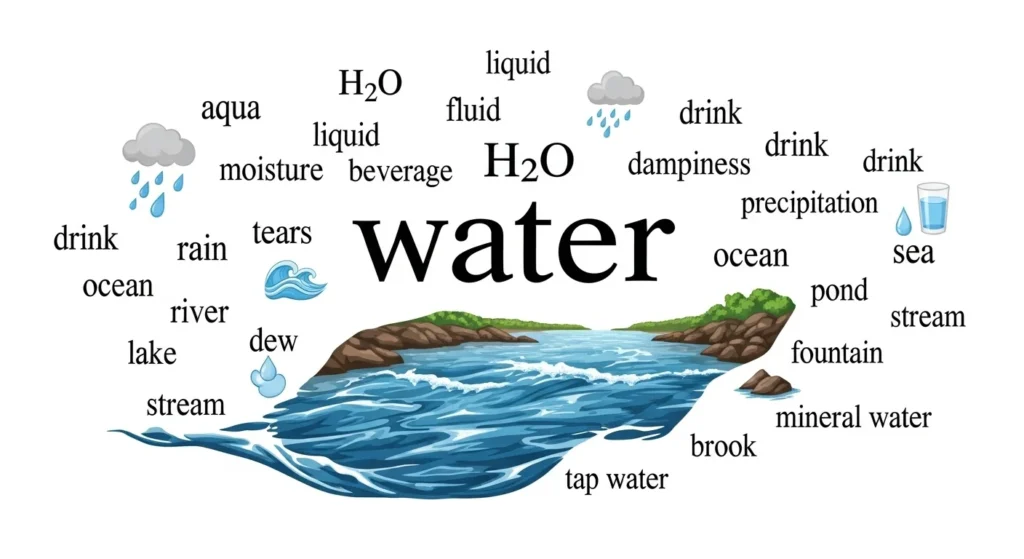
Water is one of the most common and important words in English. It refers to the clear liquid that all living things need to survive. Imagine a hot summer day when you feel thirsty after walking outside. The first thing you want is a glass of cold water. This simple word appears in daily conversation, science, nature, and writing.
Because it is used so often, English learners and writers benefit from knowing other words with similar meanings. Learning synonyms helps people avoid repeating the same word again and again. It also makes writing more interesting and precise.
In this article, you will learn the meaning of water and explore 30 useful synonyms. The guide also explains pronunciation, grammar, history, and semantic categories.
With examples and explanations, learners can easily understand how to use each word correctly.
Meaning of Water
Water (noun):
A clear, colorless liquid that forms rivers, lakes, rain, and oceans and is necessary for life.
Examples
- She drank a glass of water after the long walk.
- Plants need water to grow healthy and strong.
Connotative Meaning
(Connotation: the emotional or cultural meaning that a word suggests beyond its basic definition.)
- Positive tone: freshness, purity, life, renewal
- Negative tone: floods, drowning, storms
- Neutral tone: liquid substance, natural resource
Etymology
- Origin: Old English “wæter”, from Proto-Germanic “watar”, meaning “liquid for drinking or washing.”
Short History
- Old English (450–1100): Used as wæter to describe natural liquid sources.
- Middle English (1100–1500): Spelled as water and widely used in literature.
- Modern English (1500–Present): Standard spelling water, used in science, daily speech, and writing.
Pronunciation (US & UK – IPA)
- US: /ˈwɔːtər/
- UK: /ˈwɔːtə/
Syllables
wa-ter
Affixation Pattern of Water
- Root: water
- Prefix: none
- Suffix: none
Word Formation from “water”
- Watering (verb/gerund) – the act of giving water
- Watery (adjective) – full of or like water
- Waterless (adjective) – without water
- Waterproof (adjective) – resistant to water
- Waterway (noun) – a path for boats
A List of 30 Synonyms for Water
1. Liquid (noun)
US /ˈlɪkwɪd/ | UK /ˈlɪkwɪd/
Meaning: A substance that flows freely like water.
Examples:
- The bottle contains a clear liquid.
- Oil and water are different types of liquid.
2. Aqua (noun)
US /ˈækwə/ | UK /ˈækwə/
Meaning: A Latin-based term referring to water, often used in science.
Examples:
- The word aqua appears in many scientific names.
- The design used a bright aqua color.
3. Fluid (noun)
US /ˈfluːɪd/ | UK /ˈfluːɪd/
Meaning: A substance that can flow easily.
Examples:
- Water is a natural fluid.
- The machine runs on a cooling fluid.
4. Rainwater (noun)
US /ˈreɪnwɔːtər/ | UK /ˈreɪnwɔːtə/
Meaning: Water that falls as rain.
Examples:
- The tank collects rainwater.
- Plants grow well with fresh rainwater.
5. Freshwater (noun)
US /ˈfreʃwɔːtər/ | UK /ˈfreʃwɔːtə/
Meaning: Natural water that is not salty.
Examples:
- Fish live in freshwater lakes.
- The river provides freshwater for the town.
6. H₂O (noun)
US /ˌeɪtʃ tuː ˈoʊ/ | UK /ˌeɪtʃ tuː ˈəʊ/
Meaning: The chemical formula for water.
Examples:
- Scientists call water H₂O.
- The experiment required pure H₂O.
7. Moisture (noun)
US /ˈmɔɪstʃər/ | UK /ˈmɔɪstʃə/
Meaning: Small amounts of water in the air or soil.
Examples:
- The soil holds moisture.
- Plants need enough moisture.
8. Dew (noun)
US /duː/ | UK /djuː/
Meaning: Tiny drops of water that form overnight.
Examples:
- Dew covered the grass.
- Morning dew sparkled in the sunlight.
9. Stream (noun)
US /striːm/ | UK /striːm/
Meaning: A small flow of water in nature.
Examples:
- A clear stream runs through the forest.
- Children played near the stream.
10. River (noun)
US /ˈrɪvər/ | UK /ˈrɪvə/
Meaning: A large natural flow of water.
Examples:
- The river flows to the sea.
- People fish in the river.
11. Ocean (noun)
US /ˈoʊʃən/ | UK /ˈəʊʃən/
Meaning: A vast body of salt water.
Examples:
- The ocean looks endless.
- Many animals live in the ocean.
12. Sea (noun)
US /siː/ | UK /siː/
Meaning: A large area of salt water.
Examples:
- Ships travel across the sea.
- The sea was calm today.
13. Lake (noun)
US /leɪk/ | UK /leɪk/
Meaning: A large body of water surrounded by land.
Examples:
- The lake is very deep.
- Tourists visit the lake.
14. Pond (noun)
US /pɑːnd/ | UK /pɒnd/
Meaning: A small body of still water.
Examples:
- Ducks swim in the pond.
- The garden has a small pond.
15. Brook (noun)
US /brʊk/ | UK /brʊk/
Meaning: A small stream of water.
Examples:
- A quiet brook flows nearby.
- The brook runs through the meadow.
16. Fountain (noun)
US /ˈfaʊntən/ | UK /ˈfaʊntɪn/
Meaning: Water that flows upward from a structure.
Examples:
- The park has a beautiful fountain.
- Water sprays from the fountain.
17. Spring (noun)
US /sprɪŋ/ | UK /sprɪŋ/
Meaning: Natural water flowing from the ground.
Examples:
- The village drinks from a natural spring.
- Clear water rises from the spring.
18. Streamlet (noun)
US /ˈstriːmlɪt/ | UK /ˈstriːmlɪt/
Meaning: A very small stream.
Examples:
- A streamlet crossed the path.
- The streamlet dried in summer.
19. Torrent (noun)
US /ˈtɔːrənt/ | UK /ˈtɒrənt/
Meaning: A strong and fast flow of water.
Examples:
- Rain created a torrent.
- The torrent rushed downhill.
20. Floodwater (noun)
US /ˈflʌdwɔːtər/ | UK /ˈflʌdwɔːtə/
Meaning: Water that spreads during floods.
Examples:
- Floodwater covered the streets.
- The town was damaged by floodwater.
21. Ice Melt (noun)
US /aɪs melt/ | UK /aɪs melt/
Meaning: Water produced when ice melts.
Examples:
- Ice melt fills rivers in spring.
- The lake rises with ice melt.
22. Vapor (noun)
US /ˈveɪpər/ | UK /ˈveɪpə/
Meaning: Water in gas form.
Examples:
- Steam is water vapor.
- The air held warm vapor.
23. Steam (noun)
US /stiːm/ | UK /stiːm/
Meaning: Water heated until it becomes gas.
Examples:
- Steam rose from the kettle.
- The engine runs on steam.
24. Runoff (noun)
US /ˈrʌnɔːf/ | UK /ˈrʌnɒf/
Meaning: Water that flows over land after rain.
Examples:
- Runoff filled the drain.
- Farmers collect runoff.
25. Lagoon (noun)
US /ləˈɡuːn/ | UK /ləˈɡuːn/
Meaning: A shallow body of water near the sea.
Examples:
- Fish swim in the lagoon.
- The island has a blue lagoon.
26. Pool (noun)
US /puːl/ | UK /puːl/
Meaning: A small body of still water.
Examples:
- The cave has a deep pool.
- Rain formed a pool on the ground.
27. Aquifer (noun)
US /ˈækwɪfər/ | UK /ˈækwɪfə/
Meaning: Underground layer that stores water.
Examples:
- The city uses water from an aquifer.
- The aquifer supplies wells.
28. Hydration (noun)
US /haɪˈdreɪʃən/ | UK /haɪˈdreɪʃən/
Meaning: The process of supplying water.
Examples:
- Athletes need proper hydration.
- Hydration keeps the body healthy.
29. Distilled Water (noun)
US /dɪˈstɪld ˈwɔːtər/ | UK /dɪˈstɪld ˈwɔːtə/
Meaning: Water purified by boiling and condensing.
Examples:
- The lab uses distilled water.
- Distilled water is very pure.
30. Mineral Water (noun)
US /ˈmɪnərəl ˈwɔːtər/ | UK /ˈmɪnərəl ˈwɔːtə/
Meaning: Water containing natural minerals.
Examples:
- She ordered mineral water at dinner.
- The spring produces mineral water.
Prototype Meaning
The prototype meaning of water is the clear, drinkable liquid that people imagine in a glass, river, or rain. It is colorless, tasteless, and essential for life.
Prototype Categorization
Grouping synonyms helps writers choose the right word.
- Natural water bodies: river, lake, sea, ocean
- Small water sources: stream, brook, pond
- Scientific forms: H₂O, fluid, vapor
- Water conditions: steam, moisture, dew
- Special types: distilled water, mineral water
Categorizing synonyms helps writers select the most precise word for a specific situation.
Antonyms of Water
- Dryness (noun): absence of water
- Drought (noun): long period without rain
- Aridity (noun): extreme dryness of land
- Dehydration (noun): lack of water in the body
Short Questions and Answers
- What does water mean?
- Water is a clear liquid that all living things need to survive.
- Water is a clear liquid that all living things need to survive.
- When should water be used?
- It is used when referring to the basic liquid found in rivers, rain, and drinking sources.
- It is used when referring to the basic liquid found in rivers, rain, and drinking sources.
- Is water positive or negative?
- Usually positive because it represents life, but it can be negative in contexts like floods.
- Usually positive because it represents life, but it can be negative in contexts like floods.
- How is it different from similar words?
- Words like river or ocean describe places where water exists, while water refers to the liquid itself.
- Words like river or ocean describe places where water exists, while water refers to the liquid itself.
Conclusion
Learning the word water and its many synonyms helps English learners expand their vocabulary and communicate more clearly. Instead of repeating the same word, writers can choose from many related terms depending on the context. This improves both writing and speaking skills.
Understanding pronunciation, meaning, history, and usage makes vocabulary learning easier and more practical. With practice, learners become more confident in using different expressions.
Try to learn a few new words every day. Over time, your vocabulary will grow stronger, and your English communication will become more natural and powerful.

I am a linguist with 17 years of experience in English language teaching, including postgraduate-level instruction. My expertise includes English grammar, and I contribute as a content and blog writer, producing scholarly and educational language resources.