
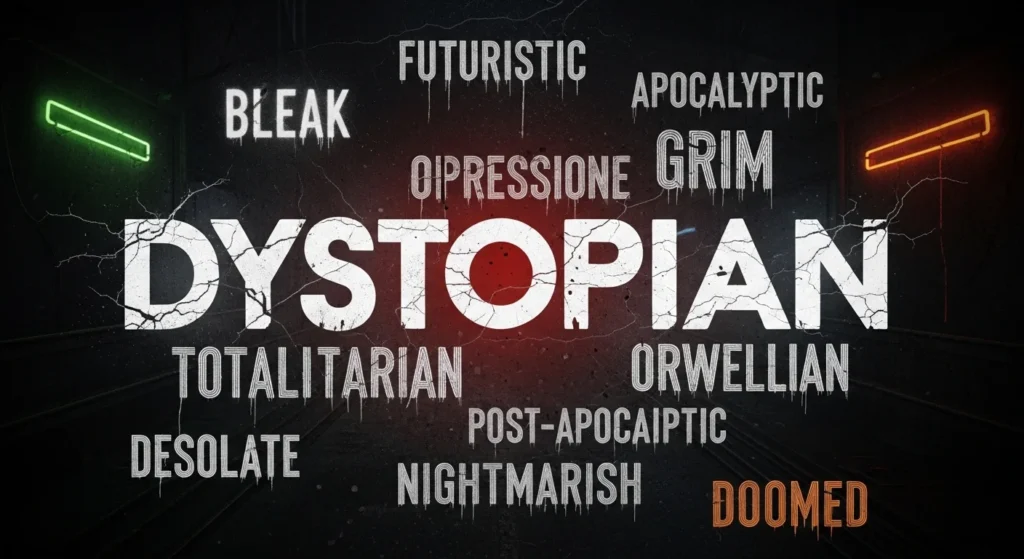
The word dystopian describes a world that feels dark, broken, and unfair. Imagine a city where people live in fear, freedom is gone, and rules control every part of life. Many movies and books show such worlds, so this word is common in daily talk and writing. English learners often hear it in stories, news, and social media.
Learning synonyms of dystopian is very helpful. It helps you avoid repeating the same word again and again. It also makes your writing richer and clearer.
In this article, you will learn the meaning of dystopian and its synonyms. You will also explore examples, grammar, history, pronunciation, and categories.
This will help you use the word correctly and confidently.
Meaning of Dystopian
Definition
Dystopian (Adjective):
A word used to describe an imagined world or society where life is very bad, unfair, or full of suffering.
Examples
- The movie shows a dystopian future where robots control humans.
- They lived in a dystopian city with no freedom.
Connotative Meaning
(Connotation: the emotional feeling or idea a word suggests beyond its basic meaning)
- Positive tone: Rarely positive; sometimes used creatively in art
- Negative tone: Dark, hopeless, fearful, oppressive
- Neutral tone: Used in academic or descriptive writing
Etymology
- From Greek: dys (bad) + topos (place)
- Meaning: “bad place”
Short History
- Old English (450–1100): Concept not present
- Middle English (1100–1500): Idea of ideal societies (utopia) develops
- Modern English (1500–Present): Word “dystopia” appears in the 19th century
Pronunciation (US & UK – IPA)
- US: /dɪsˈtoʊ.pi.ən/
- UK: /dɪsˈtəʊ.pi.ən/
Syllables
dys-to-pi-an
Affixation Pattern of Dystopian
- Root: top (place)
- Prefix: dys- (bad)
- Suffix: -ian (related to)
Word Formation
- Dystopia (noun)
- Dystopian (adjective)
- Dystopianism (noun)
A List of 30 Synonyms for Dystopian
1. Bleak (Adjective)
US: /bliːk/ | UK: /bliːk/
Meaning: Very dark and without hope
Examples:
- The future looked bleak.
- They lived in a bleak environment.
2. Oppressive (Adjective)
US: /əˈprɛsɪv/ | UK: /əˈprɛsɪv/
Meaning: Harsh and controlling
Examples:
- The government was oppressive.
- People suffered under oppressive laws.
3. Grim (Adjective)
US: /ɡrɪm/ | UK: /ɡrɪm/
Meaning: Very serious and sad
Examples:
- The story had a grim ending.
- Life felt grim in that place.
4. Harsh (Adjective)
US: /hɑːrʃ/ | UK: /hɑːʃ/
Meaning: Very strict or cruel
Examples:
- The rules were harsh.
- They lived under harsh conditions.
5. Dark (Adjective)
US: /dɑːrk/ | UK: /dɑːk/
Meaning: Full of fear or evil
Examples:
- It was a dark world.
- The novel has a dark theme.
6. Hopeless (Adjective)
US: /ˈhoʊpləs/ | UK: /ˈhəʊpləs/
Meaning: Without any hope
Examples:
- The situation was hopeless.
- People felt hopeless.
7. Desolate (Adjective)
US: /ˈdɛsəleɪt/ | UK: /ˈdɛsələt/
Meaning: Empty and sad
Examples:
- The land looked desolate.
- It was a desolate city.
8. Tyrannical (Adjective)
US: /tɪˈrænɪkəl/ | UK: /tɪˈrænɪkəl/
Meaning: Ruled by a cruel leader
Examples:
- A tyrannical ruler controlled them.
- Life under tyranny was hard.
9. Nightmarish (Adjective)
US: /ˈnaɪtˌmɛrɪʃ/ | UK: /ˈnaɪtˌmɛərɪʃ/
Meaning: Like a bad dream
Examples:
- It felt nightmarish.
- The scene was nightmarish.
10. Apocalyptic (Adjective)
US: /əˌpɑːkəˈlɪptɪk/ | UK: /əˌpɒkəˈlɪptɪk/
Meaning: Related to the end of the world
Examples:
- The movie was apocalyptic.
- The sky looked apocalyptic.
11. Futuristic (Adjective)
US: /ˌfjuːtʃəˈrɪstɪk/ | UK: /ˌfjuːtʃəˈrɪstɪk/
Meaning: About the future (often negative here)
Examples:
- A futuristic world.
- The design felt futuristic.
12. Totalitarian (Adjective)
US: /toʊˌtælɪˈtɛriən/ | UK: /təʊˌtælɪˈteəriən/
Meaning: Complete control by the state
Examples:
- A totalitarian regime.
- Citizens had no freedom.
13. Brutal (Adjective)
US: /ˈbruːtl/ | UK: /ˈbruːtəl/
Meaning: Very violent or cruel
Examples:
- A brutal system.
- Life was brutal there.
14. Corrupt (Adjective)
US: /kəˈrʌpt/ | UK: /kəˈrʌpt/
Meaning: Dishonest and unfair
Examples:
- A corrupt society.
- Leaders were corrupt.
15. Bleeding-edge (Adjective)
US: /ˈbliːdɪŋ/ | UK: /ˈbliːdɪŋ/
Meaning: Extremely advanced but risky
Examples:
- A bleeding-edge world.
- Technology felt dangerous.
16. Ruined (Adjective)
US: /ˈruːɪnd/ | UK: /ˈruːɪnd/
Meaning: Destroyed or broken
Examples:
- A ruined city.
- The world was ruined.
17. Decaying (Adjective)
US: /dɪˈkeɪɪŋ/ | UK: /dɪˈkeɪɪŋ/
Meaning: Slowly breaking down
Examples:
- A decaying system.
- Buildings were decaying.
18. Barren (Adjective)
US: /ˈbærən/ | UK: /ˈbærən/
Meaning: Empty and lifeless
Examples:
- A barren land.
- The area felt barren.
19. Cruel (Adjective)
US: /ˈkruːəl/ | UK: /ˈkruːəl/
Meaning: Causing pain
Examples:
- A cruel leader.
- Life was cruel.
20. Unjust (Adjective)
US: /ʌnˈdʒʌst/ | UK: /ʌnˈdʒʌst/
Meaning: Not fair
Examples:
- An unjust system.
- The law was unjust.
21. Chaotic (Adjective)
US: /keɪˈɑːtɪk/ | UK: /keɪˈɒtɪk/
Meaning: Full of disorder
Examples:
- A chaotic world.
- Life was chaotic.
22. Fearful (Adjective)
US: /ˈfɪrfəl/ | UK: /ˈfɪəfəl/
Meaning: Full of fear
Examples:
- A fearful society.
- People were fearful.
23. Miserable (Adjective)
US: /ˈmɪzərəbəl/ | UK: /ˈmɪzərəbəl/
Meaning: Very unhappy
Examples:
- A miserable life.
- They felt miserable.
24. Alienated (Adjective)
US: /ˈeɪliəneɪtɪd/ | UK: /ˈeɪliəneɪtɪd/
Meaning: Feeling isolated
Examples:
- People felt alienated.
- Society was alienated.
25. Disturbing (Adjective)
US: /dɪˈstɜːrbɪŋ/ | UK: /dɪˈstɜːbɪŋ/
Meaning: Causing worry
Examples:
- A disturbing scene.
- The idea was disturbing.
26. Restricted (Adjective)
US: /rɪˈstrɪktɪd/ | UK: /rɪˈstrɪktɪd/
Meaning: Limited freedom
Examples:
- Restricted movement.
- People were restricted.
27. Controlled (Adjective)
US: /kənˈtroʊld/ | UK: /kənˈtrəʊld/
Meaning: Managed strictly
Examples:
- A controlled society.
- Everything was controlled.
28. Harrowing (Adjective)
US: /ˈhærəʊɪŋ/ | UK: /ˈhærəʊɪŋ/
Meaning: Very painful or shocking
Examples:
- A harrowing story.
- The journey was harrowing.
29. Broken (Adjective)
US: /ˈbroʊkən/ | UK: /ˈbrəʊkən/
Meaning: Damaged or not working
Examples:
- A broken system.
- Society was broken.
30. Unlivable (Adjective)
US: /ʌnˈlɪvəbəl/ | UK: /ʌnˈlɪvəbəl/
Meaning: Not suitable to live in
Examples:
- An unlivable place.
- Conditions were unlivable.
Prototype Meaning
When people hear dystopian, they imagine a future world where life is controlled, unfair, and full of suffering. It often includes strict governments, poor living conditions, and fear.
Prototype Categorization
- Control & Power: oppressive, totalitarian, tyrannical
- Emotion & Mood: bleak, grim, hopeless
- Environment: barren, ruined, desolate
- Violence & Harm: brutal, cruel, harrowing
These categories help writers choose the best synonym based on context and tone.
Antonyms of Dystopian
- Utopian (Adjective): Perfect and ideal society
- Peaceful (Adjective): Calm and free from conflict
- Fair (Adjective): Just and equal
- Prosperous (Adjective): Successful and rich
Short Questions and Answers
- What does dystopian mean?
A world that is bad, unfair, and full of suffering. - When should dystopian be used?
Use it when describing dark futures, stories, or societies. - Is dystopian positive or negative?
It is mostly negative. - How is it different from similar words?
It focuses on imagined bad societies, not just general sadness.
Conclusion
Learning the word dystopian and its synonyms can greatly improve your English. It helps you express ideas clearly and avoid repeating the same words. You can describe stories, movies, and real-life situations with more detail. It also builds strong writing and speaking skills. When you know many synonyms, your language becomes more powerful and engaging. This also increases your confidence in English. Try to learn and use a few new words every day. Over time, your vocabulary will grow, and your communication will become much better.

I am a linguist with 17 years of experience in English language teaching, including postgraduate-level instruction. My expertise includes English grammar, and I contribute as a content and blog writer, producing scholarly and educational language resources.