
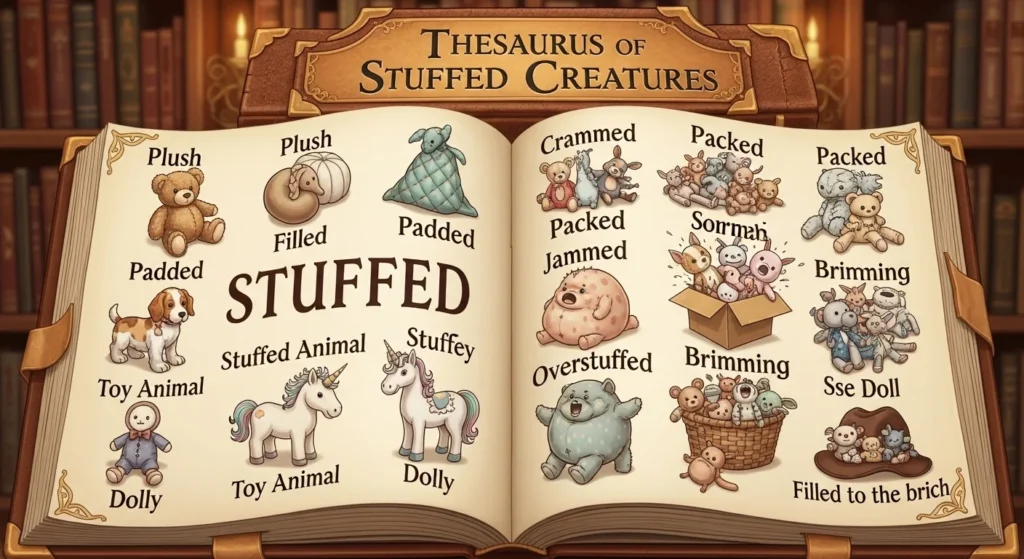
Stuffed is a common English word. It often means filled too much. Imagine you just ate a big meal at a wedding. You say, “I am stuffed!” You feel full and heavy. This word is used in daily talk, food, and even objects like pillows or bags.
People use stuffed a lot because it is simple and expressive. But using the same word again and again can make your writing dull. Learning synonyms helps you sound smarter and more natural. It also improves your speaking and writing skills.
In this article, you will learn the meaning of stuffed, its synonyms, examples, grammar, pronunciation, history, and categories.
Everything is explained in easy English to help beginners and content writers grow their vocabulary.
Meaning of Stuffed
Definition
Stuffed (adjective / verb – past tense): Filled completely or too much with something.
Examples
- I feel stuffed after eating so much food.
- The pillow is stuffed with soft cotton.
Connotative Meaning
(Connotation: the emotional feeling a word carries beyond its basic meaning)
- Positive tone: Comfort, fullness, satisfaction
- Negative tone: Overeating, discomfort, too crowded
- Neutral tone: Simply filled or packed
Etymology
- From Old French estoffer meaning “to fill or furnish”
- Entered English as stuffen meaning “to fill tightly”
Short History
- Old English (450–1100): No direct form, similar ideas of filling existed
- Middle English (1100–1500): Word forms like stuffen appeared
- Modern English (1500–Present): Became common as stuffed
Pronunciation (US & UK – IPA)
- US: /stʌft/
- UK: /stʌft/
Syllables
- stuffed (1 syllable)
Affixation Pattern of Stuffed
- Root: stuff
- Prefix: none
- Suffix: -ed
Word Formation
- stuff (noun/verb)
- stuffed (adjective/verb)
- stuffing (noun)
A List of 30 Synonyms for Stuffed
1. Filled (adjective)
US: /fɪld/ | UK: /fɪld/
Meaning: Full of something inside
Examples:
- The bag is filled with books.
- She felt filled with joy.
2. Packed (adjective)
US: /pækt/ | UK: /pækt/
Meaning: Full to the limit
- The bus was packed.
- His schedule is packed today.
3. Full (adjective)
US: /fʊl/ | UK: /fʊl/
Meaning: Containing as much as possible
- My stomach is full.
- The glass is full of water.
4. Loaded (adjective)
US: /ˈloʊdɪd/ | UK: /ˈləʊdɪd/
Meaning: Heavily filled
- The truck is loaded.
- He gave a loaded answer.
5. Cramped (adjective)
US: /kræmpt/ | UK: /kræmpt/
Meaning: Too tight or crowded
- The room feels cramped.
- We sat in a cramped car.
6. Jammed (adjective)
US: /dʒæmd/ | UK: /dʒæmd/
Meaning: Packed tightly
- The road is jammed.
- The drawer is jammed shut.
7. Bursting (adjective)
US: /ˈbɜːrstɪŋ/ | UK: /ˈbɜːstɪŋ/
Meaning: So full it may break
- The bag is bursting.
- He is bursting with energy.
8. Overflowing (adjective)
US: /ˌoʊvərˈfloʊɪŋ/ | UK: /ˌəʊvəˈfləʊɪŋ/
Meaning: Flowing over due to fullness
- The cup is overflowing.
- The room was overflowing with people.
9. Sated (adjective)
US: /ˈseɪtɪd/ | UK: /ˈseɪtɪd/
Meaning: Fully satisfied, especially with food
- He felt sated after dinner.
- Her hunger was sated.
10. Gorged (verb/adjective)
US: /ɡɔːrdʒd/ | UK: /ɡɔːdʒd/
Meaning: Ate too much
- He gorged on sweets.
- She felt gorged and tired.
11. Replete (adjective)
US: /rɪˈpliːt/ | UK: /rɪˈpliːt/
Meaning: Completely filled
- The book is replete with facts.
- He was replete after lunch.
12. Saturated (adjective)
US: /ˈsætʃəreɪtɪd/ | UK: /ˈsætʃəreɪtɪd/
Meaning: Fully soaked or filled
- The cloth is saturated.
- The market is saturated.
13. Swollen (adjective)
US: /ˈswoʊlən/ | UK: /ˈswəʊlən/
Meaning: Enlarged from fullness
- His stomach felt swollen.
- The river is swollen.
14. Heavy (adjective)
US: /ˈhevi/ | UK: /ˈhevi/
Meaning: Feeling full or weighed down
- I feel heavy after eating.
- The bag is heavy.
15. Crowded (adjective)
US: /ˈkraʊdɪd/ | UK: /ˈkraʊdɪd/
Meaning: Full of people or things
- The market is crowded.
- The room felt crowded.
16. Crammed (adjective)
US: /kræmd/ | UK: /kræmd/
Meaning: Forced full
- The drawer is crammed.
- Students were crammed in class.
17. Brimming (adjective)
US: /ˈbrɪmɪŋ/ | UK: /ˈbrɪmɪŋ/
Meaning: Filled to the top
- The cup is brimming.
- She is brimming with joy.
18. Tight (adjective)
US: /taɪt/ | UK: /taɪt/
Meaning: No extra space
- The bag is tight.
- The shoes feel tight.
19. Stuffed-up (adjective)
US: /ˌstʌft ˈʌp/ | UK: /ˌstʌft ˈʌp/
Meaning: Blocked or filled
- My nose is stuffed-up.
- He sounded stuffed-up.
20. Chock-full (adjective)
US: /ˌtʃɑːk ˈfʊl/ | UK: /ˌtʃɒk ˈfʊl/
Meaning: Completely full
- The box is chock-full.
- The hall was chock-full.
21. Engorged (adjective)
US: /ɪnˈɡɔːrdʒd/ | UK: /ɪnˈɡɔːdʒd/
Meaning: Overfilled
- The river is engorged.
- He felt engorged after eating.
22. Bulging (adjective)
US: /ˈbʌldʒɪŋ/ | UK: /ˈbʌldʒɪŋ/
Meaning: Swelling out
- The bag is bulging.
- His pockets were bulging.
23. Stuffed-full (adjective)
US: /ˈstʌft fʊl/ | UK: /ˈstʌft fʊl/
Meaning: Filled completely
- The turkey is stuffed-full.
- The bag is stuffed-full.
24. Laden (adjective)
US: /ˈleɪdən/ | UK: /ˈleɪdən/
Meaning: Heavily loaded
- The tree is laden with fruit.
- He was laden with gifts.
25. Glutted (adjective)
US: /ˈɡlʌtɪd/ | UK: /ˈɡlʌtɪd/
Meaning: Overfilled or overfed
- The market is glutted.
- He felt glutted.
26. Filled-up (adjective)
US: /ˌfɪld ˈʌp/ | UK: /ˌfɪld ˈʌp/
Meaning: Completely filled
- The tank is filled-up.
- I am filled-up now.
27. Blocked (adjective)
US: /blɑːkt/ | UK: /blɒkt/
Meaning: Closed or filled
- The pipe is blocked.
- The road is blocked.
28. Overfilled (adjective)
US: /ˌoʊvərˈfɪld/ | UK: /ˌəʊvəˈfɪld/
Meaning: Filled too much
- The glass is overfilled.
- The bag is overfilled.
29. Stuffed-tight (adjective)
US: /ˈstʌft taɪt/ | UK: /ˈstʌft taɪt/
Meaning: Packed very tightly
- The suitcase is stuffed-tight.
- The drawer is stuffed-tight.
30. Full-up (adjective)
US: /ˌfʊl ˈʌp/ | UK: /ˌfʊl ˈʌp/
Meaning: Completely full
- I am full-up after dinner.
- The room is full-up.
Prototype Meaning
The most common meaning of stuffed is being very full, especially after eating too much food. People often imagine a person holding their stomach after a big meal.
Prototype Categorization
- Food-related: sated, gorged, glutted
- Object-related: filled, packed, loaded
- Crowded spaces: cramped, crowded, jammed
- Extreme fullness: bursting, overflowing, bulging
This helps writers choose the right word based on context and tone.
Antonyms of Stuffed
- Empty (adjective): having nothing inside
- Hungry (adjective): needing food
- Hollow (adjective): empty inside
- Vacant (adjective): not filled
Short Questions and Answers
- What does stuffed mean?
It means filled completely or too much. - When should stuffed be used?
Use it when something is very full, especially food or objects. - Is stuffed positive or negative?
It depends. It can mean happy fullness or uncomfortable overeating. - How is it different from similar words?
“Stuffed” is informal, while words like “replete” are more formal.
CONCLUSION
Learning the word stuffed and its synonyms is very useful. It helps you express ideas in many ways. You can describe food, objects, and feelings better. Using different words also avoids repetition in writing. This makes your content clear and interesting.
Strong vocabulary improves both speaking and writing. It builds confidence in English. When you know many synonyms, you can choose the best word for every situation.
Practice a few new words daily. Try to use them in sentences. Over time, your English will become more natural and powerful.

I am a linguist with 17 years of experience in English language teaching, including postgraduate-level instruction. My expertise includes English grammar, and I contribute as a content and blog writer, producing scholarly and educational language resources.