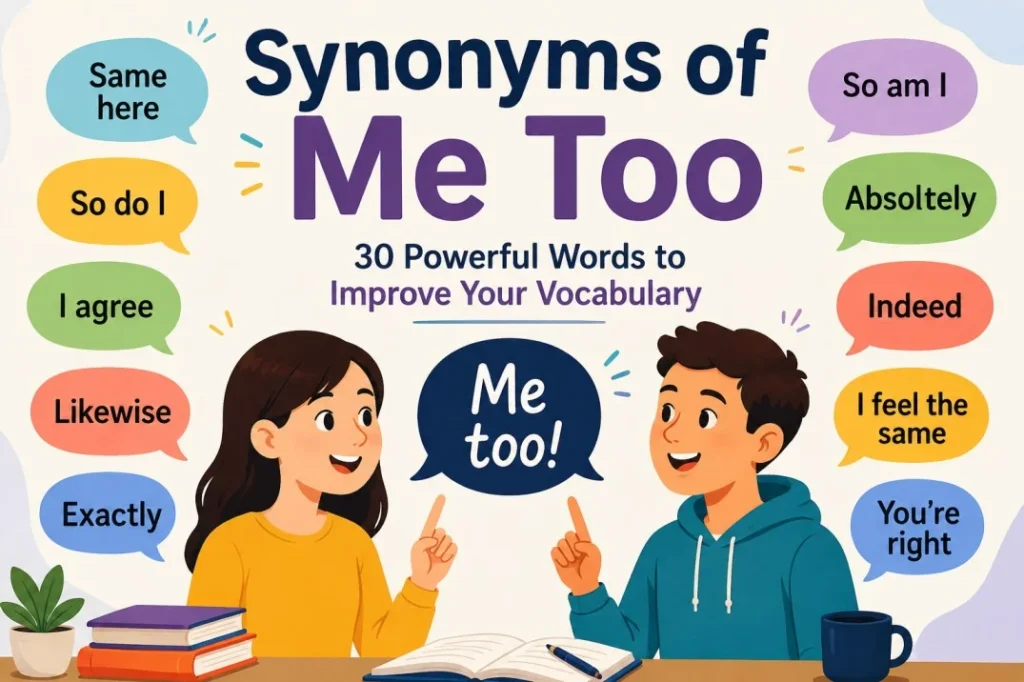
The phrase “me too” is one of the most common expressions in English. People use it when they want to show agreement, shared feelings, or a similar experience. For example, if a friend says, “I love coffee,” another person may reply, “Me too!” It is short, friendly, and easy to understand.
English learners often use “me too” because it sounds natural in daily conversation. However, repeating the same phrase again and again can make speaking and writing feel limited. Learning synonyms helps students, writers, and speakers express ideas in fresh and creative ways.
In this article, you will learn the meaning of “me too,” its synonyms, pronunciation, grammar, emotional tone, history, and usage examples. You will also discover different categories of similar expressions that can improve your vocabulary and communication skills.
Meaning of “Me Too”
Definition
Me too (Phrase):
A phrase used to show that you feel the same way or share the same opinion or experience as another person.
Examples
- “I enjoy reading books.” — “Me too!”
- “I was tired after work.” — “Me too. It was a long day.”
Connotative Meaning
(Connotation means the emotional feeling or idea connected to a word.)
- Positive tone: Friendly agreement, connection, support
- Negative tone: Sometimes sounds lazy or repetitive in writing
- Neutral tone: Simple shared opinion or feeling
Etymology
- The phrase comes from simple English pronouns and adverbs.
- “Me” comes from Old English mec meaning “myself.”
- “Too” comes from Old English to meaning “also” or “in addition.”
Short History of the Keyword
- Old English (450–1100): Early forms of “me” and “too” existed separately.
- Middle English (1100–1500): Speakers began using similar agreement phrases in conversation.
- Modern English (1500–Present): “Me too” became a common informal reply in spoken English.
Pronunciation (US & UK – IPA)
- US: /miː tuː/
- UK: /miː tuː/
Syllables
- me-too
Affixation Pattern of “Me Too”
- Root: me, too
- Prefix: None
- Suffix: None
Word Formation of the Keyword
- Me — pronoun
- Too — adverb
- Together “me too” — conversational phrase
A List of 30 Synonyms for “Me Too”
1. Likewise (Adverb)
US: /ˈlaɪkˌwaɪz/ | UK: /ˈlaɪkwaɪz/
Meaning: In the same way; also.
Examples:
- “I enjoyed the movie.”
- “Likewise, I thought it was great.”
2. Same Here (Phrase)
US: /seɪm hɪr/ | UK: /seɪm hɪə/
Meaning: Used to show the same feeling or opinion.
Examples:
- “I’m hungry.”
- “Same here.”
3. So Do I (Phrase)
US: /soʊ duː aɪ/ | UK: /səʊ duː aɪ/
Meaning: Used when agreeing with a positive statement.
Examples:
- “I love music.”
- “So do I.”
4. So Am I (Phrase)
US: /soʊ æm aɪ/ | UK: /səʊ æm aɪ/
Meaning: Shows agreement with feelings or states.
Examples:
- “I’m excited.”
- “So am I.”
5. I Agree (Phrase)
US: /aɪ əˈɡriː/ | UK: /aɪ əˈɡriː/
Meaning: To share the same opinion.
Examples:
- “This plan is good.”
- “I agree.”
6. Absolutely (Adverb)
US: /ˈæbsəluːtli/ | UK: /ˈæbsəluːtli/
Meaning: Completely yes; strong agreement.
Examples:
- “This food is delicious.”
- “Absolutely!”
7. Indeed (Adverb)
US: /ɪnˈdiːd/ | UK: /ɪnˈdiːd/
Meaning: Used to confirm agreement or truth.
Examples:
- “It was a difficult test.”
- “Indeed it was.”
8. Certainly (Adverb)
US: /ˈsɝːtnli/ | UK: /ˈsɜːtənli/
Meaning: Without doubt.
Examples:
- “You enjoyed the trip?”
- “Certainly.”
9. Exactly (Adverb)
US: /ɪɡˈzæktli/ | UK: /ɪɡˈzæktli/
Meaning: Completely correct or matching.
Examples:
- “That’s what I mean.”
- “Exactly!”
10. True (Adjective)
US: /truː/ | UK: /truː/
Meaning: Correct or accurate.
Examples:
- “Life is challenging.”
- “True.”
11. Agreed (Adjective)
US: /əˈɡriːd/ | UK: /əˈɡriːd/
Meaning: Sharing the same opinion.
Examples:
- “We should leave early.”
- “Agreed.”
12. Definitely (Adverb)
US: /ˈdefɪnətli/ | UK: /ˈdefɪnətli/
Meaning: Clearly yes; without doubt.
Examples:
- “That was fun.”
- “Definitely.”
13. Sure (Adjective)
US: /ʃʊr/ | UK: /ʃɔː/
Meaning: Certain or agreeing.
Examples:
- “You like tea too?”
- “Sure.”
14. Of Course (Phrase)
US: /əv kɔːrs/ | UK: /ɒv kɔːs/
Meaning: Naturally yes.
Examples:
- “You want to join?”
- “Of course.”
15. I Feel the Same (Phrase)
US: /aɪ fiːl ðə seɪm/ | UK: /aɪ fiːl ðə seɪm/
Meaning: To share identical feelings.
Examples:
- “I miss my hometown.”
- “I feel the same.”
16. Me Neither (Phrase)
US: /miː ˈnaɪðər/ | UK: /miː ˈnaɪðə/
Meaning: Used to agree with a negative statement.
Examples:
- “I don’t like cold weather.”
- “Me neither.”
17. Neither Do I (Phrase)
US: /ˈniːðər duː aɪ/ | UK: /ˈnaɪðə duː aɪ/
Meaning: Agreement with negative statements.
Examples:
- “I don’t watch horror movies.”
- “Neither do I.”
18. So Have I (Phrase)
US: /soʊ hæv aɪ/ | UK: /səʊ hæv aɪ/
Meaning: Used for shared experiences.
Examples:
- “I have visited Paris.”
- “So have I.”
19. Same (Adjective)
US: /seɪm/ | UK: /seɪm/
Meaning: Identical or similar.
Examples:
- “I’m tired today.”
- “Same.”
20. You’re Right (Phrase)
US: /jʊr raɪt/ | UK: /jɔː raɪt/
Meaning: Showing agreement with someone’s opinion.
Examples:
- “Practice improves skill.”
- “You’re right.”
21. Totally (Adverb)
US: /ˈtoʊtəli/ | UK: /ˈtəʊtəli/
Meaning: Completely or fully.
Examples:
- “That idea is amazing.”
- “Totally!”
22. Precisely (Adverb)
US: /prɪˈsaɪsli/ | UK: /prɪˈsaɪsli/
Meaning: Exactly correct.
Examples:
- “That explains the problem.”
- “Precisely.”
23. Without a Doubt (Phrase)
US: /wɪˈðaʊt ə daʊt/ | UK: /wɪˈðaʊt ə daʊt/
Meaning: Certainly true.
Examples:
- “She is talented.”
- “Without a doubt.”
24. I Think So Too (Phrase)
US: /aɪ θɪŋk soʊ tuː/ | UK: /aɪ θɪŋk səʊ tuː/
Meaning: Sharing the same opinion.
Examples:
- “This book is useful.”
- “I think so too.”
25. That’s True (Phrase)
US: /ðæts truː/ | UK: /ðæts truː/
Meaning: Agreeing something is correct.
Examples:
- “English takes practice.”
- “That’s true.”
26. Correct (Adjective)
US: /kəˈrekt/ | UK: /kəˈrekt/
Meaning: Accurate or right.
Examples:
- “Your answer is right.”
- “Correct.”
27. Right (Adjective)
US: /raɪt/ | UK: /raɪt/
Meaning: Accurate or true.
Examples:
- “This road is safer.”
- “Right.”
28. I Understand (Phrase)
US: /aɪ ˌʌndərˈstænd/ | UK: /aɪ ˌʌndəˈstænd/
Meaning: Showing shared understanding.
Examples:
- “This lesson is difficult.”
- “I understand.”
29. Count Me In (Phrase)
US: /kaʊnt mi ɪn/ | UK: /kaʊnt mi ɪn/
Meaning: Showing agreement to join something.
Examples:
- “We are going hiking.”
- “Count me in.”
30. Amen (Interjection)
US: /ɑːˈmen/ | UK: /ɑːˈmen/
Meaning: Strong agreement, often emotional or religious.
Examples:
- “Hard work brings success.”
- “Amen!”
Prototype Meaning
The most common meaning of “me too” is simple agreement. When people hear this phrase, they usually imagine two people sharing the same feeling, opinion, experience, or interest. It creates a sense of connection and similarity in conversation.
Prototype Categorization
- Casual agreement: same here, same, totally
- Formal agreement: indeed, certainly, precisely
- Strong agreement: absolutely, definitely, without a doubt
- Negative agreement: me neither, neither do I
- Emotional agreement: amen, I feel the same
- Opinion-based agreement: I agree, that’s true, you’re right
Categorization helps writers choose the best synonym for different situations. Formal writing needs formal words, while friendly conversations need casual expressions.
Antonyms of “Me Too”
- Disagree (Verb): To have a different opinion
- Object (Verb): To oppose something
- Differ (Verb): To be unlike
- Oppose (Verb): To go against an idea
- Reject (Verb): To refuse or not accept
- Contradict (Verb): To say the opposite
- Deny (Verb): To say something is not true
Short Questions and Answers
What does “me too” mean?
- It means you share the same feeling, opinion, or experience as another person.
When should “me too” be used?
- Use it in conversations when you agree with a positive statement.
Is “me too” positive or negative?
- It is usually positive or neutral, depending on the situation.
How is it different from similar words?
- “Me too” is informal and conversational, while words like “indeed” or “precisely” sound more formal.
Conclusion
Learning the phrase “me too” and its synonyms can greatly improve your English vocabulary. These words and expressions help you speak naturally, avoid repetition, and communicate with confidence. They also make your writing more interesting and professional.
By understanding meanings, pronunciation, emotional tone, and usage, English learners can choose the right synonym for every situation. Whether you are speaking with friends, writing essays, or creating online content, strong vocabulary skills are very useful.
Practice using new synonyms daily in conversations and sentences. Small vocabulary improvements can lead to big progress in English fluency and confidence.

I am a linguist with 17 years of experience in English language teaching, including postgraduate-level instruction. My expertise includes English grammar, and I contribute as a content and blog writer, producing scholarly and educational language resources.