The word modest is common in daily English. People use it to describe someone who is humble, simple, polite, or not proud. Imagine a student who wins a big award but still thanks everyone quietly and does not boast. Many people would call that student modest.
This word is useful in speaking, writing, education, and business English. It helps describe personality, behavior, clothing, achievements, and even prices or homes.
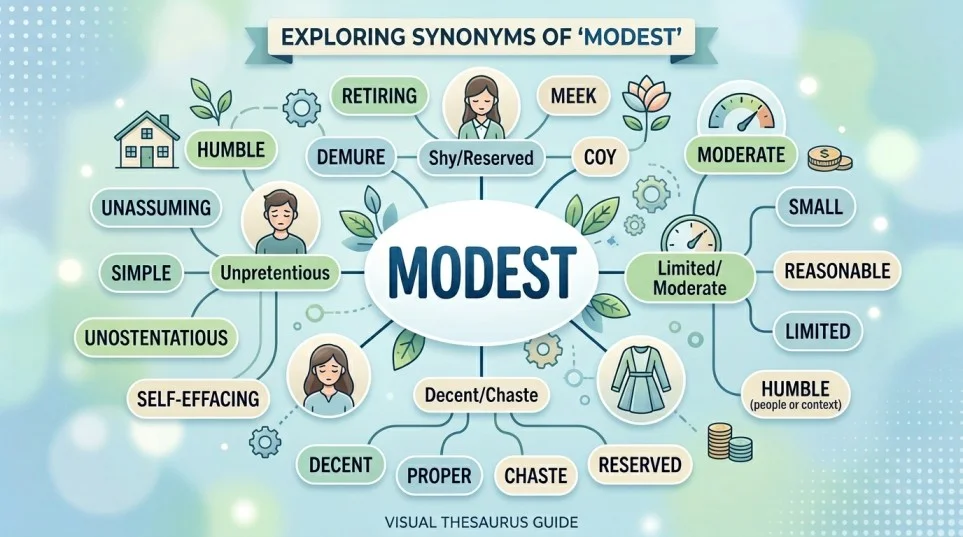
Learning synonyms of modest is important for English learners and writers because it improves vocabulary and avoids repeating the same word many times. Different synonyms also help express small changes in meaning and tone.
In this article, you will learn the meaning of modest, its pronunciation, grammar, history, semantic categories, and 30 powerful synonyms with easy examples.
Meaning of Modest
Definition
Modest (Adjective):
A person or thing that is simple, humble, not too proud, or not too large or expensive.
Examples
- She stayed modest after winning the competition.
- They live in a modest house near the park.
Connotative Meaning
(Connotation means the emotional feeling or cultural idea connected to a word.)
- Positive tone: humble, respectful, simple
- Negative tone: shy, lacking confidence
- Neutral tone: ordinary, moderate
Etymology
- The word modest comes from the Latin word modestus.
- Modestus means “keeping within measure” or “moderate.”
- It entered English through Old French.
Short History of the Keyword
- Old English (450–1100): The exact word was not used, but ideas of humility and moderation existed.
- Middle English (1100–1500): The word entered English from French and Latin influence.
- Modern English (1500–Present): Modest became common for describing humble people, simple lifestyles, and moderate amounts.
Pronunciation (US & UK – IPA)
- US: /ˈmɑː.dɪst/
- UK: /ˈmɒd.ɪst/
Syllables
mod-est
Affixation Pattern of Modest
- Root: mode
- Prefix: none
- Suffix: -est
Word Formation of Modest
- Modesty (noun)
- Modestly (adverb)
- Immodest (adjective)
- Immodestly (adverb)
A List of 30 Synonyms for Modest
1. Humble (Adjective)
US: /ˈhʌm.bəl/ | UK: /ˈhʌm.bəl/
Meaning: Not proud or arrogant.
Examples:
- He remained humble after becoming famous.
- The humble teacher thanked her students.
2. Simple (Adjective)
US: /ˈsɪm.pəl/ | UK: /ˈsɪm.pəl/
Meaning: Plain and not complicated or fancy.
Examples:
- They prefer a simple lifestyle.
- She wore a simple white dress.
3. Unassuming (Adjective)
US: /ˌʌn.əˈsuː.mɪŋ/ | UK: /ˌʌn.əˈsjuː.mɪŋ/
Meaning: Quiet and not trying to impress others.
Examples:
- He is an unassuming leader.
- Her unassuming nature made people comfortable.
4. Reserved (Adjective)
US: /rɪˈzɝːvd/ | UK: /rɪˈzɜːvd/
Meaning: Quiet and controlled in behavior.
Examples:
- She is reserved in public meetings.
- The boy gave a reserved smile.
5. Shy (Adjective)
US: /ʃaɪ/ | UK: /ʃaɪ/
Meaning: Nervous around people and not very confident.
Examples:
- The shy child hid behind his mother.
- She feels shy in large groups.
6. Polite (Adjective)
US: /pəˈlaɪt/ | UK: /pəˈlaɪt/
Meaning: Showing good manners and respect.
Examples:
- He gave a polite answer.
- The waiter was polite to customers.
7. Respectful (Adjective)
US: /rɪˈspekt.fəl/ | UK: /rɪˈspekt.fəl/
Meaning: Showing honor and care toward others.
Examples:
- The students were respectful to their teacher.
- She spoke in a respectful tone.
8. Moderate (Adjective)
US: /ˈmɑː.dɚ.ət/ | UK: /ˈmɒd.ər.ət/
Meaning: Not too much and not too little.
Examples:
- They earn a moderate income.
- Exercise at a moderate level is healthy.
9. Plain (Adjective)
US: /pleɪn/ | UK: /pleɪn/
Meaning: Simple and without decoration.
Examples:
- He wore plain clothes.
- The room looked plain but clean.
10. Decent (Adjective)
US: /ˈdiː.sənt/ | UK: /ˈdiː.sənt/
Meaning: Respectable and acceptable.
Examples:
- They live a decent life.
- She gave a decent explanation.
11. Quiet (Adjective)
US: /ˈkwaɪ.ət/ | UK: /ˈkwaɪ.ət/
Meaning: Calm and not noisy.
Examples:
- He is a quiet person.
- They spent a quiet evening at home.
12. Introverted (Adjective)
US: /ˈɪn.trə.vɝː.t̬ɪd/ | UK: /ˈɪn.trə.vɜː.tɪd/
Meaning: More focused on thoughts and feelings than social activity.
Examples:
- She is introverted but friendly.
- Introverted people often enjoy reading.
13. Mild (Adjective)
US: /maɪld/ | UK: /maɪld/
Meaning: Gentle and not strong or extreme.
Examples:
- He has a mild personality.
- The weather is mild today.
14. Meek (Adjective)
US: /miːk/ | UK: /miːk/
Meaning: Quiet and gentle.
Examples:
- The meek student never argued.
- She gave a meek reply.
15. Soft-spoken (Adjective)
US: /ˌsɑːftˈspoʊ.kən/ | UK: /ˌsɒftˈspəʊ.kən/
Meaning: Speaking in a gentle voice.
Examples:
- The soft-spoken man greeted everyone.
- She is kind and soft-spoken.
16. Courteous (Adjective)
US: /ˈkɝː.t̬i.əs/ | UK: /ˈkɜː.ti.əs/
Meaning: Very polite and respectful.
Examples:
- The staff were courteous.
- He gave a courteous response.
17. Low-key (Adjective)
US: /ˌloʊˈkiː/ | UK: /ˌləʊˈkiː/
Meaning: Relaxed and not attracting attention.
Examples:
- They planned a low-key wedding.
- Her style is low-key and elegant.
18. Conservative (Adjective)
US: /kənˈsɝː.və.t̬ɪv/ | UK: /kənˈsɜː.və.tɪv/
Meaning: Traditional and careful.
Examples:
- He has conservative tastes.
- She chose conservative colors.
19. Frugal (Adjective)
US: /ˈfruː.ɡəl/ | UK: /ˈfruː.ɡəl/
Meaning: Careful about spending money.
Examples:
- My grandfather is frugal.
- They live a frugal life.
20. Moderate-minded (Adjective)
US: /ˈmɑː.dɚ.ət ˈmaɪn.dɪd/ | UK: /ˈmɒd.ər.ət ˈmaɪn.dɪd/
Meaning: Balanced and not extreme.
Examples:
- She is moderate-minded in debates.
- His moderate-minded approach solved problems.
21. Restrained (Adjective)
US: /rɪˈstreɪnd/ | UK: /rɪˈstreɪnd/
Meaning: Controlled and calm.
Examples:
- He gave a restrained reaction.
- Her style is restrained and classy.
22. Bashful (Adjective)
US: /ˈbæʃ.fəl/ | UK: /ˈbæʃ.fəl/
Meaning: Easily embarrassed and shy.
Examples:
- The bashful boy looked away.
- She gave a bashful smile.
23. Humility-filled (Adjective)
US: /hjuːˈmɪl.ə.ti fɪld/ | UK: /hjuːˈmɪl.ə.ti fɪld/
Meaning: Full of humility and modesty.
Examples:
- His humility-filled speech touched people.
- She remained humility-filled after success.
24. Self-effacing (Adjective)
US: /ˌself ɪˈfeɪ.sɪŋ/ | UK: /ˌself ɪˈfeɪ.sɪŋ/
Meaning: Avoiding attention to oneself.
Examples:
- The actor was self-effacing.
- Her self-effacing attitude impressed everyone.
25. Down-to-earth (Adjective)
US: /ˌdaʊn.tuˈɝːθ/ | UK: /ˌdaʊn.tuˈɜːθ/
Meaning: Practical and friendly.
Examples:
- He is rich but down-to-earth.
- The manager is down-to-earth and kind.
26. Undemonstrative (Adjective)
US: /ˌʌn.dɪˈdem.ən.strə.t̬ɪv/ | UK: /ˌʌn.dɪˈdem.ən.strə.tɪv/
Meaning: Not showing strong emotions openly.
Examples:
- She is quiet and undemonstrative.
- His undemonstrative nature seemed calm.
27. Temperate (Adjective)
US: /ˈtem.pɚ.ət/ | UK: /ˈtem.pər.ət/
Meaning: Moderate and controlled.
Examples:
- He gave a temperate opinion.
- They live in a temperate climate.
28. Dignified (Adjective)
US: /ˈdɪɡ.nə.faɪd/ | UK: /ˈdɪɡ.nɪ.faɪd/
Meaning: Calm, respectful, and honorable.
Examples:
- She gave a dignified speech.
- The old man looked dignified.
29. Understated (Adjective)
US: /ˌʌn.dɚˈsteɪ.t̬ɪd/ | UK: /ˌʌn.dəˈsteɪ.tɪd/
Meaning: Simple and elegant without being flashy.
Examples:
- The room had understated beauty.
- He prefers understated fashion.
30. Unpretentious (Adjective)
US: /ˌʌn.prɪˈten.ʃəs/ | UK: /ˌʌn.prɪˈten.ʃəs/
Meaning: Simple and not trying to seem important.
Examples:
- They own an unpretentious café.
- Her unpretentious attitude was refreshing.
Prototype Meaning
The prototype meaning of modest usually describes a humble person who does not show pride or seek attention. People often imagine someone polite, simple, quiet, and respectful. The word also suggests balance, simplicity, and moderation in behavior, clothing, money, or lifestyle.
Prototype Categorization
Humility-Related Synonyms
- humble
- self-effacing
- meek
- unpretentious
Quiet Personality Synonyms
- shy
- reserved
- bashful
- introverted
Simple Lifestyle Synonyms
- plain
- frugal
- low-key
- understated
Respectful Behavior Synonyms
- polite
- courteous
- respectful
- dignified
Moderate Behavior Synonyms
- moderate
- temperate
- restrained
These categories help writers choose the best synonym for different situations. For example, “frugal” works for money habits, while “humble” works better for personality.
Antonyms of Modest
- Arrogant (Adjective): too proud and overconfident
- Proud (Adjective): feeling very important
- Boastful (Adjective): always talking about achievements
- Conceited (Adjective): thinking too highly of oneself
- Showy (Adjective): trying to attract attention
- Flashy (Adjective): very bright or attention-seeking
- Immodest (Adjective): lacking humility or modesty
Short Questions and Answers
What does modest mean?
It means humble, simple, and not too proud.
When should modest be used?
Use it to describe humble people, simple things, or moderate amounts.
Is modest positive or negative?
It is usually positive, but sometimes it can suggest shyness or low confidence.
How is it different from similar words?
“Modest” focuses on humility and simplicity, while words like “shy” focus more on fear or nervousness.
Conclusion
Learning the word modest and its synonyms can greatly improve English vocabulary. These words help learners speak and write more naturally and clearly. Using different synonyms also avoids repetition and makes communication more interesting. Understanding pronunciation, tone, history, and categories gives deeper knowledge of English usage. Whether you are a student, writer, ESL learner, or content creator, practicing words like humble, understated, and unpretentious can strengthen your speaking and writing skills. Daily vocabulary learning builds confidence and helps people express ideas more accurately in conversations, essays, emails, and professional writing.

I am a linguist with 17 years of experience in English language teaching, including postgraduate-level instruction. My expertise includes English grammar, and I contribute as a content and blog writer, producing scholarly and educational language resources.