
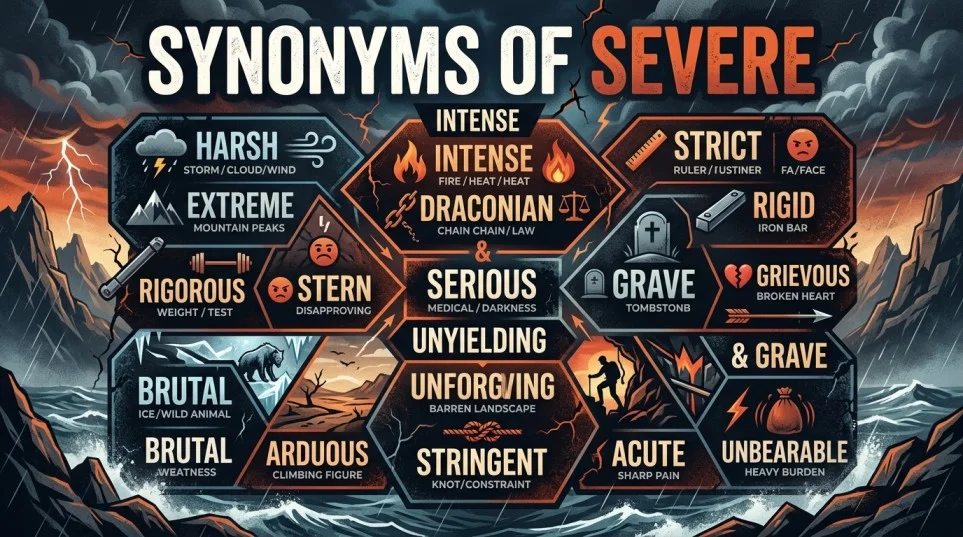
The word severe is common in English. People use it to talk about something very serious, harsh, painful, or strict. For example, a student may face severe punishment for breaking school rules, or a city may suffer severe weather during a storm. The word appears in daily conversation, news reports, books, and academic writing.
Learning synonyms of severe helps English learners speak and write more naturally. It also helps content writers avoid repeating the same word again and again. Different synonyms can show different emotions, levels of seriousness, or styles of writing.
In this article, you will learn the meaning of severe, its pronunciation, history, grammar, and connotative meaning. You will also explore 30 powerful synonyms with simple meanings and example sentences to improve your vocabulary and writing skills.
Meaning of Severe
Definition
Severe (Adjective):
Very serious, harsh, strict, painful, or intense.
Examples
- The patient had a severe headache.
- The teacher gave severe punishment to the students.
Connotative Meaning
(Connotation means the emotional feeling or idea connected to a word.)
- Positive tone: Can show discipline or strong control.
- Negative tone: Often suggests pain, cruelty, danger, or strictness.
- Neutral tone: Sometimes simply describes intensity or seriousness.
Etymology
- The word severe comes from the Latin word severus.
- Severus meant “strict,” “serious,” or “stern.”
Short History of the Keyword
- Old English (450–1100): The exact word was not common, but ideas of harshness existed in similar words.
- Middle English (1100–1500): The word entered English through Old French and Latin influence.
- Modern English (1500–Present): The word became widely used for strict behavior, serious conditions, and strong intensity.
Pronunciation (US & UK – IPA)
- US: /səˈvɪr/
- UK: /sɪˈvɪə/
Syllables
se-vere
Affixation Pattern of Severe
- Root: sever
- Prefix: None
- Suffix: -e
Word Formation of Severe
- Severity (Noun)
- Severely (Adverb)
- Severity level (Noun phrase)
- Severe-looking (Adjective)
A List of 30 Synonyms for Severe
1. Harsh (Adjective)
US: /hɑːrʃ/ | UK: /hɑːʃ/
Meaning: Very rough, strict, or unpleasant.
Examples:
- The winter was harsh this year.
- Her harsh words hurt his feelings.
2. Strict (Adjective)
US: /strɪkt/ | UK: /strɪkt/
Meaning: Strong about rules and discipline.
Examples:
- The school has strict rules.
- His parents are very strict.
3. Serious (Adjective)
US: /ˈsɪriəs/ | UK: /ˈsɪəriəs/
Meaning: Important and needing careful attention.
Examples:
- The accident was serious.
- She had a serious health problem.
4. Intense (Adjective)
US: /ɪnˈtens/ | UK: /ɪnˈtens/
Meaning: Very strong or powerful.
Examples:
- He felt intense pain.
- The competition was intense.
5. Stern (Adjective)
US: /stɝːn/ | UK: /stɜːn/
Meaning: Serious and strict in behavior.
Examples:
- The coach gave a stern warning.
- Her father looked stern.
6. Rigid (Adjective)
US: /ˈrɪdʒɪd/ | UK: /ˈrɪdʒɪd/
Meaning: Very strict and not flexible.
Examples:
- The company follows rigid rules.
- He has a rigid schedule.
7. Tough (Adjective)
US: /tʌf/ | UK: /tʌf/
Meaning: Difficult, strong, or strict.
Examples:
- It was a tough decision.
- The coach is tough on players.
8. Cruel (Adjective)
US: /ˈkruːəl/ | UK: /ˈkruːəl/
Meaning: Causing pain or suffering.
Examples:
- The ruler was cruel.
- It was a cruel joke.
9. Brutal (Adjective)
US: /ˈbruːtəl/ | UK: /ˈbruːtəl/
Meaning: Extremely harsh or violent.
Examples:
- The war was brutal.
- He faced brutal criticism.
10. Fierce (Adjective)
US: /fɪrs/ | UK: /fɪəs/
Meaning: Very strong or aggressive.
Examples:
- A fierce storm hit the town.
- The dogs had a fierce fight.
11. Violent (Adjective)
US: /ˈvaɪələnt/ | UK: /ˈvaɪələnt/
Meaning: Using strong physical force.
Examples:
- The movie contains violent scenes.
- A violent storm damaged homes.
12. Grave (Adjective)
US: /ɡreɪv/ | UK: /ɡreɪv/
Meaning: Very serious or important.
Examples:
- The country faces grave problems.
- His condition is grave.
13. Critical (Adjective)
US: /ˈkrɪtɪkəl/ | UK: /ˈkrɪtɪkəl/
Meaning: Extremely serious or dangerous.
Examples:
- The patient is in critical condition.
- We reached a critical point.
14. Extreme (Adjective)
US: /ɪkˈstriːm/ | UK: /ɪkˈstriːm/
Meaning: Very great in degree.
Examples:
- The desert has extreme heat.
- She showed extreme anger.
15. Acute (Adjective)
US: /əˈkjuːt/ | UK: /əˈkjuːt/
Meaning: Very serious or sharp.
Examples:
- He suffered acute pain.
- The city has an acute water shortage.
16. Hard (Adjective)
US: /hɑːrd/ | UK: /hɑːd/
Meaning: Difficult or severe.
Examples:
- She had a hard life.
- The exam was hard.
17. Merciless (Adjective)
US: /ˈmɝːsɪləs/ | UK: /ˈmɜːsɪləs/
Meaning: Showing no kindness or pity.
Examples:
- The soldiers were merciless.
- He faced merciless attacks online.
18. Ruthless (Adjective)
US: /ˈruːθləs/ | UK: /ˈruːθləs/
Meaning: Very cruel and without sympathy.
Examples:
- The dictator was ruthless.
- She is ruthless in business.
19. Sharp (Adjective)
US: /ʃɑːrp/ | UK: /ʃɑːp/
Meaning: Sudden, strong, or severe.
Examples:
- He felt sharp pain.
- Prices saw a sharp increase.
20. Oppressive (Adjective)
US: /əˈpresɪv/ | UK: /əˈpresɪv/
Meaning: Very heavy, unfair, or difficult.
Examples:
- The heat was oppressive.
- People protested against oppressive laws.
21. Unforgiving (Adjective)
US: /ˌʌnfərˈɡɪvɪŋ/ | UK: /ˌʌnfəˈɡɪvɪŋ/
Meaning: Harsh and not merciful.
Examples:
- The desert is unforgiving.
- The judge was unforgiving.
22. Rigorous (Adjective)
US: /ˈrɪɡərəs/ | UK: /ˈrɪɡərəs/
Meaning: Very strict and careful.
Examples:
- The course has rigorous training.
- Scientists follow rigorous methods.
23. Austere (Adjective)
US: /ɔːˈstɪr/ | UK: /ɒˈstɪə/
Meaning: Very simple, strict, or serious.
Examples:
- The room looked austere.
- He lived an austere life.
24. Dire (Adjective)
US: /ˈdaɪər/ | UK: /ˈdaɪə/
Meaning: Extremely serious or terrible.
Examples:
- The country faces dire poverty.
- We are in dire need of help.
25. Bitter (Adjective)
US: /ˈbɪtər/ | UK: /ˈbɪtə/
Meaning: Very painful or unpleasant.
Examples:
- They fought in bitter cold.
- It was a bitter defeat.
26. Ferocious (Adjective)
US: /fəˈroʊʃəs/ | UK: /fəˈrəʊʃəs/
Meaning: Extremely fierce or violent.
Examples:
- The lion looked ferocious.
- A ferocious storm hit the coast.
27. Weighty (Adjective)
US: /ˈweɪti/ | UK: /ˈweɪti/
Meaning: Very important or serious.
Examples:
- They discussed weighty matters.
- The judge made a weighty decision.
28. Stringent (Adjective)
US: /ˈstrɪndʒənt/ | UK: /ˈstrɪndʒənt/
Meaning: Very strict and demanding.
Examples:
- The bank has stringent rules.
- Safety checks are stringent.
29. Daunting (Adjective)
US: /ˈdɔːntɪŋ/ | UK: /ˈdɔːntɪŋ/
Meaning: Difficult and frightening.
Examples:
- Climbing the mountain was daunting.
- The task looked daunting.
30. Formidable (Adjective)
US: /ˈfɔːrmɪdəbəl/ | UK: /ˈfɔːmɪdəbəl/
Meaning: Very powerful, difficult, or impressive.
Examples:
- She is a formidable opponent.
- They faced formidable challenges.
Prototype Meaning
The most common meaning of severe is something very serious, strict, or painful. People often imagine severe weather, severe illness, or severe punishment when hearing this word. It usually describes situations that are difficult, strong, or dangerous.
Prototype Categorization
- Strictness and Discipline: strict, stern, rigid, rigorous, stringent
- Pain and Difficulty: harsh, acute, bitter, hard, daunting
- Danger and Seriousness: grave, critical, dire, serious, extreme
- Violence and Cruelty: brutal, cruel, ruthless, merciless, ferocious
- Strength and Power: fierce, intense, formidable, violent
Categorization helps writers choose the best synonym for different situations. For example, rigorous works well in academic writing, while brutal fits violent or emotional contexts better.
Antonyms of Severe
- Gentle (Adjective): Soft and kind
- Mild (Adjective): Not strong or serious
- Lenient (Adjective): Not strict
- Easy (Adjective): Simple and not difficult
- Kind (Adjective): Caring and helpful
- Tender (Adjective): Soft and gentle
- Merciful (Adjective): Showing forgiveness
- Moderate (Adjective): Average and controlled
Short Questions and Answers
- What does severe mean?
Severe means very serious, harsh, strict, or painful. - When should severe be used?
Use it when talking about strong pain, strict behavior, dangerous situations, or serious problems. - Is severe positive or negative?
It is usually negative, but sometimes neutral when describing intensity or discipline. - How is it different from similar words?
Severe is broader than words like strict or brutal because it can describe rules, pain, weather, illness, and emotions.
Conclusion
Learning the word severe and its synonyms can greatly improve your English vocabulary. These words help you speak clearly, write better sentences, and express emotions more accurately. Using different synonyms also avoids repetition in essays, articles, conversations, and professional writing.
Understanding pronunciation, tone, history, and usage makes vocabulary learning easier and more memorable. Some synonyms describe pain, while others focus on strictness, danger, or intensity. Knowing these small differences helps writers and learners choose the perfect word for every situation.
Practice using new words daily in speaking and writing. Over time, your confidence, fluency, and communication skills will become much stronger.

I am a linguist with 17 years of experience in English language teaching, including postgraduate-level instruction. My expertise includes English grammar, and I contribute as a content and blog writer, producing scholarly and educational language resources.