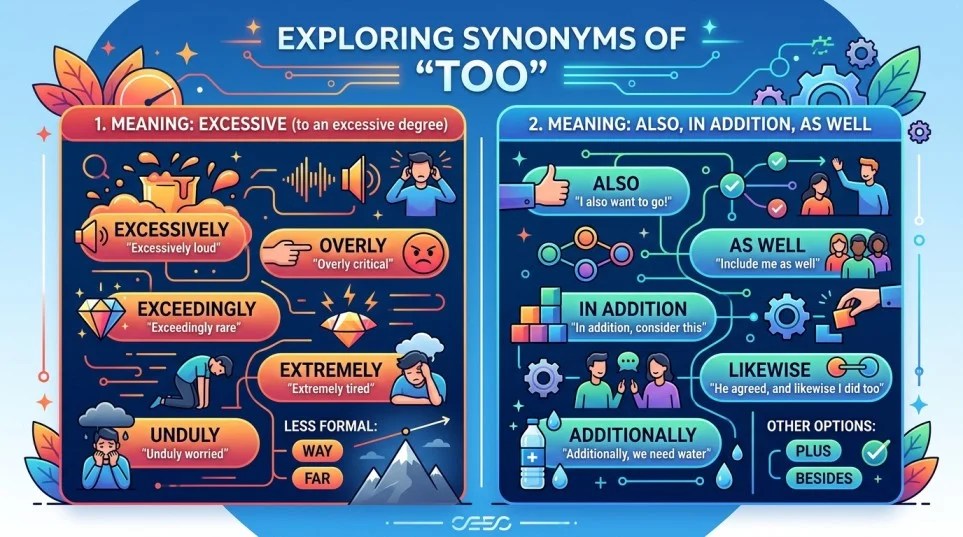
The word “too” is one of the most common words in English. People use it every day in speaking and writing. It can mean “also,” “more than needed,” or “extremely.” For example, a student may say, “This bag is too heavy,” or a friend may say, “I want to come too.”
Because the word is simple and useful, English learners often repeat it many times. Writers also use it often in blogs, stories, and daily communication. But using the same word again and again can make writing weak and boring.
Learning synonyms of “too” helps learners sound more natural and confident. It also improves speaking, writing, and vocabulary skills. In this article, you will learn the meaning of “too,” its pronunciation, history, grammar, tone, and 30 powerful synonyms with easy examples and useful categories.
Meaning of Too
Definition
Too (Adverb):
The word “too” means “also,” “more than needed,” or “very.”
Examples
- I want ice cream too.
- The soup is too hot to eat.
Connotative Meaning
(Connotation means the emotional feeling or idea connected to a word.)
- Positive tone: too kind, too beautiful
- Negative tone: too loud, too expensive
- Neutral tone: I went too, she came too
Etymology
- The word “too” comes from Old English “to,” meaning “in addition” or “besides.”
- It has Germanic roots related to addition and excess.
Short History of the Keyword
- Old English (450–1100): Used as “to” for addition.
- Middle English (1100–1500): Spelling slowly changed to “too.”
- Modern English (1500–Present): Became common for emphasis and excess.
Pronunciation (US & UK – IPA)
- US: /tuː/
- UK: /tuː/
Syllables
- too
Affixation Pattern of Too
- Root: too
- Prefix: none
- Suffix: none
Word Formation of the Keyword
- Too much — phrase
- Too many — phrase
- Too little — phrase
- Too late — phrase
- Too soon — phrase
Synonyms of Too
1. Also (Adverb)
US IPA | UK IPA
US: /ˈɔːl.soʊ/ | UK: /ˈɔːl.səʊ/
Meaning
Used to add similar information.
Examples
- She also likes music.
- I also watched the movie.
2. Excessively (Adverb)
US IPA | UK IPA
US: /ɪkˈsesɪvli/ | UK: /ɪkˈsesɪvli/
Meaning
More than what is normal or acceptable.
Examples
- The room was excessively cold.
- He talks excessively during class.
3. Overly (Adverb)
US IPA | UK IPA
US: /ˈoʊvərli/ | UK: /ˈəʊvəli/
Meaning
Too much in degree or amount.
Examples
- She is overly sensitive.
- The test was overly difficult.
4. Extremely (Adverb)
US IPA | UK IPA
US: /ɪkˈstriːmli/ | UK: /ɪkˈstriːmli/
Meaning
To a very high degree.
Examples
- The weather is extremely hot.
- He was extremely tired.
5. Very (Adverb)
US IPA | UK IPA
US: /ˈveri/ | UK: /ˈveri/
Meaning
Used for strong emphasis.
Examples
- She is very smart.
- The movie was very funny.
6. Likewise (Adverb)
US IPA | UK IPA
US: /ˈlaɪkwaɪz/ | UK: /ˈlaɪkwaɪz/
Meaning
In the same way or also.
Examples
- I enjoyed the trip likewise.
- She smiled and he likewise laughed.
7. Additionally (Adverb)
US IPA | UK IPA
US: /əˈdɪʃənəli/ | UK: /əˈdɪʃənəli/
Meaning
Used to add extra information.
Examples
- Additionally, we need more time.
- The book is cheap and additionally useful.
8. Furthermore (Adverb)
US IPA | UK IPA
US: /ˌfɜːrðərˈmɔːr/ | UK: /ˌfɜːðəˈmɔː/
Meaning
Used to introduce another important point.
Examples
- Furthermore, the plan saves money.
- She is talented and furthermore hardworking.
9. Moreover (Adverb)
US IPA | UK IPA
US: /mɔːrˈoʊvər/ | UK: /mɔːrˈəʊvə/
Meaning
Besides that; in addition.
Examples
- The house is beautiful; moreover, it is cheap.
- Moreover, the service is fast.
10. Besides (Adverb)
US IPA | UK IPA
US: /bɪˈsaɪdz/ | UK: /bɪˈsaɪdz/
Meaning
In addition to something.
Examples
- Besides, we already agreed.
- She sings besides acting.
11. As Well (Phrase)
US IPA | UK IPA
US: /æz wel/ | UK: /æz wel/
Meaning
Also or in addition.
Examples
- I want coffee as well.
- He plays football as well.
12. In Addition (Phrase)
US IPA | UK IPA
US: /ɪn əˈdɪʃən/ | UK: /ɪn əˈdɪʃən/
Meaning
Added to something else.
Examples
- In addition, we need chairs.
- She speaks French in addition to English.
13. Highly (Adverb)
US IPA | UK IPA
US: /ˈhaɪli/ | UK: /ˈhaɪli/
Meaning
To a great degree.
Examples
- This book is highly recommended.
- He is highly respected.
14. Intensely (Adverb)
US IPA | UK IPA
US: /ɪnˈtensli/ | UK: /ɪnˈtensli/
Meaning
In a very strong way.
Examples
- She felt intensely nervous.
- The light shone intensely.
15. Terribly (Adverb)
US IPA | UK IPA
US: /ˈterəbli/ | UK: /ˈterəbli/
Meaning
Very badly or very strongly.
Examples
- I am terribly sorry.
- The child was terribly upset.
16. Remarkably (Adverb)
US IPA | UK IPA
US: /rɪˈmɑːrkəbli/ | UK: /rɪˈmɑːkəbli/
Meaning
In an unusual or surprising way.
Examples
- She is remarkably calm.
- The results were remarkably good.
17. Exceptionally (Adverb)
US IPA | UK IPA
US: /ɪkˈsepʃənəli/ | UK: /ɪkˈsepʃənəli/
Meaning
More than average.
Examples
- He is exceptionally talented.
- The food was exceptionally tasty.
18. Extraordinarily (Adverb)
US IPA | UK IPA
US: /ɪkˈstrɔːrdənerəli/ | UK: /ɪkˈstrɔːdənərəli/
Meaning
Very unusual or great.
Examples
- The painting is extraordinarily beautiful.
- She performed extraordinarily well.
19. So (Adverb)
US IPA | UK IPA
US: /soʊ/ | UK: /səʊ/
Meaning
To a great degree.
Examples
- The cake is so sweet.
- I am so happy today.
20. Really (Adverb)
US IPA | UK IPA
US: /ˈriːəli/ | UK: /ˈrɪəli/
Meaning
Used for emphasis.
Examples
- This game is really fun.
- She is really tired.
21. Seriously (Adverb)
US IPA | UK IPA
US: /ˈsɪriəsli/ | UK: /ˈsɪəriəsli/
Meaning
In a strong or important way.
Examples
- He was seriously injured.
- I seriously need sleep.
22. Greatly (Adverb)
US IPA | UK IPA
US: /ˈɡreɪtli/ | UK: /ˈɡreɪtli/
Meaning
To a large extent.
Examples
- Your help greatly matters.
- The town greatly changed.
23. Immensely (Adverb)
US IPA | UK IPA
US: /ɪˈmensli/ | UK: /ɪˈmensli/
Meaning
Very much.
Examples
- I immensely enjoyed the concert.
- The idea helped immensely.
24. Tremendously (Adverb)
US IPA | UK IPA
US: /trɪˈmendəsli/ | UK: /trɪˈmendəsli/
Meaning
To a very large degree.
Examples
- Sales increased tremendously.
- She improved tremendously.
25. Hugely (Adverb)
US IPA | UK IPA
US: /ˈhjuːdʒli/ | UK: /ˈhjuːdʒli/
Meaning
Extremely or greatly.
Examples
- The film was hugely popular.
- He was hugely excited.
26. Radically (Adverb)
US IPA | UK IPA
US: /ˈrædɪkli/ | UK: /ˈrædɪkli/
Meaning
In a complete or extreme way.
Examples
- The city changed radically.
- Their ideas differ radically.
27. Considerably (Adverb)
US IPA | UK IPA
US: /kənˈsɪdərəbli/ | UK: /kənˈsɪdərəbli/
Meaning
By a large amount.
Examples
- Prices increased considerably.
- She looks considerably happier.
28. Particularly (Adverb)
US IPA | UK IPA
US: /pərˈtɪkjələrli/ | UK: /pəˈtɪkjələli/
Meaning
Especially or specifically.
Examples
- I particularly like this song.
- The teacher was particularly helpful.
29. Chiefly (Adverb)
US IPA | UK IPA
US: /ˈtʃiːfli/ | UK: /ˈtʃiːfli/
Meaning
Mostly or mainly.
Examples
- The area is chiefly farmland.
- She writes chiefly about travel.
30. Altogether (Adverb)
US IPA | UK IPA
US: /ˌɔːltəˈɡeðər/ | UK: /ˌɔːltəˈɡeðə/
Meaning
Completely or totally.
Examples
- The idea sounds altogether strange.
- They stopped talking altogether.
Prototype Meaning
The most typical meaning of “too” is “more than needed” or “also.” When people hear this word, they often imagine something extra. For example, “too hot,” “too fast,” or “me too.” The word usually adds emphasis or inclusion in daily conversation.
Prototype Categorization
- Addition words: also, besides, moreover, additionally, as well
- Strong emphasis words: extremely, very, intensely, immensely
- Formal writing words: furthermore, moreover, additionally
- Excess meaning words: overly, excessively, radically
- Casual speaking words: so, really, very
Categorization helps writers choose the best synonym for each situation. Formal essays need formal words, while daily speech uses simpler synonyms.
Antonyms of Too
- Enough (Adverb): as much as needed
- Slightly (Adverb): a little
- Moderately (Adverb): within limits
- Normally (Adverb): in a usual way
- Barely (Adverb): only just
Short Questions and Answers
- What does “too” mean?
It means “also” or “more than needed.” - When should “too” be used?
Use it when adding information or showing excess. - Is “too” positive or negative?
It depends on the context. It can be positive, negative, or neutral. - How is it different from similar words?
“Too” is shorter and more common, while synonyms may sound more formal or specific.
Conclusion
Learning the word “too” and its synonyms can greatly improve English vocabulary. These words help learners speak and write more naturally. They also make sentences stronger and clearer. Using different synonyms avoids repetition and keeps writing interesting.
Understanding meanings, pronunciation, tone, and categories also builds confidence in communication. English learners, students, bloggers, and content writers can all benefit from using richer vocabulary. Daily practice with synonyms is one of the best ways to become fluent and expressive in English. Keep learning new words every day and use them in real conversations and writing.

I am a linguist with 17 years of experience in English language teaching, including postgraduate-level instruction. My expertise includes English grammar, and I contribute as a content and blog writer, producing scholarly and educational language resources.