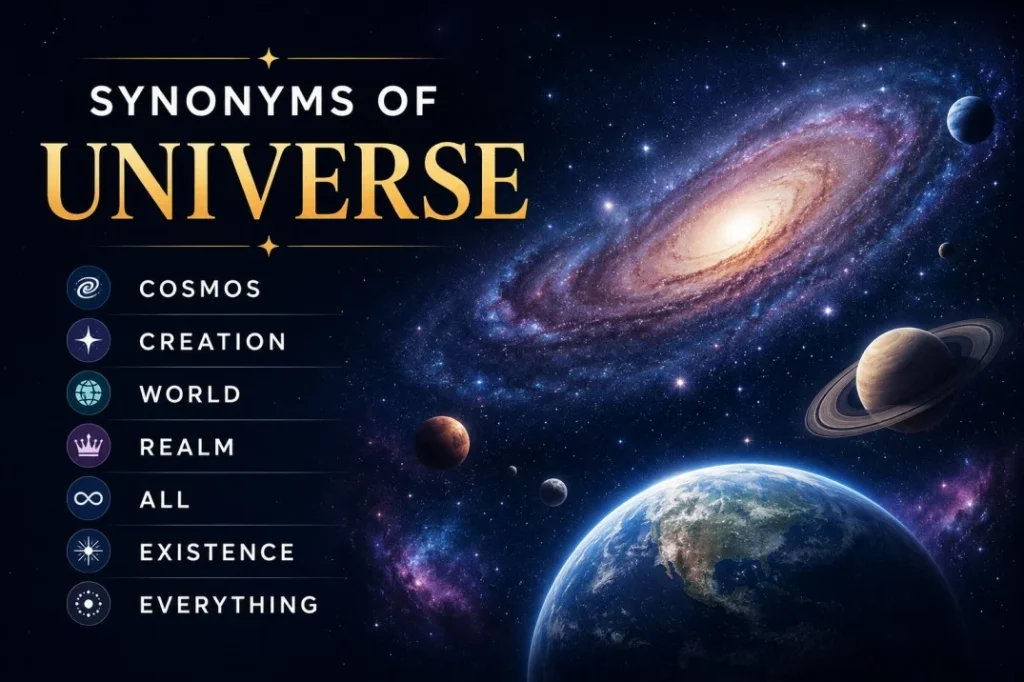
The word universe is one of the biggest words in English. It refers to everything that exists, including stars, planets, space, matter, energy, and even time. Imagine looking at the night sky and seeing countless stars. Many people wonder how large the universe is and what lies beyond it.
The word is common in science, education, literature, and everyday conversations. Writers also use it in a figurative way to describe a complete world, system, or area of life.
Learning synonyms of universe helps English learners understand different meanings and use richer vocabulary. It also helps content writers avoid repeating the same word again and again. In this article, you will learn the meaning of universe, its pronunciation, history, grammar, connotations, and 30 useful synonyms with examples and categories.
Meaning of Universe
Definition
Universe (Noun):
The whole of space and everything that exists in it, including stars, planets, galaxies, matter, and energy.
Examples
- The universe contains billions of galaxies.
- Scientists continue to study the mysteries of the universe.
Connotative Meaning
(Connotation: the emotional or cultural feeling connected to a word beyond its dictionary meaning.)
- Positive tone: wonder, greatness, discovery, possibility
- Negative tone: vastness, uncertainty, loneliness
- Neutral tone: space, existence, reality
Etymology
- Origin: Latin
- Source word: universum
- Original meaning: “all things combined into one”
Short History of the Keyword
- Old English (450–1100): People mainly used words meaning “world” or “creation.”
- Middle English (1100–1500): The idea of the universe appeared through Latin and French influences.
- Modern English (1500–Present): Universe became the standard word for all space and existence.
Pronunciation (US & UK – IPA)
US: /ˈjuː.nə.vɝːs/
UK: /ˈjuː.nɪ.vɜːs/
Syllables
u-ni-verse
Affixation Pattern of Universe
Root: verse (from Latin meaning “turned into one”)
Prefix: uni- (one)
Suffix: none
Word Formation of Universe
- Universe (Noun)
- Universal (Adjective)
- Universally (Adverb)
- Universality (Noun)
- Universalism (Noun)
- Universalist (Noun)
A List of 30 Synonyms for Universe
1. Cosmos (Noun)
US: /ˈkɑːz.moʊs/ | UK: /ˈkɒz.mɒs/
Meaning: The universe seen as an ordered system.
Examples:
- Scientists study the cosmos every day.
- The cosmos contains countless stars.
2. Creation (Noun)
US: /kriˈeɪ.ʃən/ | UK: /kriˈeɪ.ʃən/
Meaning: Everything that has been created.
Examples:
- Many religions speak about creation.
- Creation is full of beauty.
3. World (Noun)
US: /wɝːld/ | UK: /wɜːld/
Meaning: The earth or a particular sphere of life.
Examples:
- The world is changing quickly.
- She traveled around the world.
4. Existence (Noun)
US: /ɪɡˈzɪs.təns/ | UK: /ɪɡˈzɪs.təns/
Meaning: The state of being real.
Examples:
- Scientists debate the origin of existence.
- His theory explains existence.
5. Reality (Noun)
US: /riˈæl.ə.ti/ | UK: /riˈæl.ə.ti/
Meaning: The state of things as they truly are.
Examples:
- Reality can be surprising.
- We must face reality.
6. Macrocosm (Noun)
US: /ˈmæk.rəˌkɑː.zəm/ | UK: /ˈmæk.rəʊˌkɒz.əm/
Meaning: The whole universe viewed as one system.
Examples:
- The macrocosm reflects larger patterns.
- Philosophers studied the macrocosm.
7. Nature (Noun)
US: /ˈneɪ.tʃɚ/ | UK: /ˈneɪ.tʃə/
Meaning: The natural world and its forces.
Examples:
- Nature inspires many people.
- Nature follows its own laws.
8. Creation Order (Noun)
US: /kriˈeɪ.ʃən ˈɔːr.dɚ/ | UK: /kriˈeɪ.ʃən ˈɔː.də/
Meaning: The arrangement of all created things.
Examples:
- The creation order appears balanced.
- Many beliefs describe creation order.
9. Galaxy (Noun)
US: /ˈɡæl.ək.si/ | UK: /ˈɡæl.ək.si/
Meaning: A large system of stars.
Examples:
- Our galaxy is the Milky Way.
- The galaxy contains billions of stars.
10. Space (Noun)
US: /speɪs/ | UK: /speɪs/
Meaning: The vast area beyond Earth.
Examples:
- Astronauts travel through space.
- Space exploration continues.
11. Heavens (Noun)
US: /ˈhev.ənz/ | UK: /ˈhev.ənz/
Meaning: The sky or celestial realm.
Examples:
- The heavens looked beautiful.
- Ancient people studied the heavens.
12. Firmament (Noun)
US: /ˈfɝː.mə.mənt/ | UK: /ˈfɜː.mə.mənt/
Meaning: The sky viewed as a great dome.
Examples:
- Stars shone across the firmament.
- The firmament fascinated observers.
13. Creation Realm (Noun)
US: /kriˈeɪ.ʃən relm/ | UK: /kriˈeɪ.ʃən relm/
Meaning: The entire created domain.
Examples:
- The creation realm is immense.
- Life exists within the creation realm.
14. Sphere (Noun)
US: /sfɪr/ | UK: /sfɪə/
Meaning: An area or world of activity.
Examples:
- She entered a new sphere of knowledge.
- The scientific sphere grows rapidly.
15. Domain (Noun)
US: /doʊˈmeɪn/ | UK: /dəˈmeɪn/
Meaning: A territory or field.
Examples:
- Physics is his domain.
- The domain expanded.
16. Realm (Noun)
US: /relm/ | UK: /relm/
Meaning: A kingdom, world, or area.
Examples:
- The story takes place in a magical realm.
- This realm feels different.
17. System (Noun)
US: /ˈsɪs.təm/ | UK: /ˈsɪs.təm/
Meaning: A connected group of parts.
Examples:
- The solar system is part of the universe.
- Every system has structure.
18. Totality (Noun)
US: /toʊˈtæl.ə.ti/ | UK: /təʊˈtæl.ə.ti/
Meaning: The whole amount of something.
Examples:
- We cannot fully understand the totality.
- The totality includes everything.
19. Whole (Noun)
US: /hoʊl/ | UK: /həʊl/
Meaning: A complete thing.
Examples:
- Look at the whole, not the parts.
- The whole matters.
20. All (Noun)
US: /ɔːl/ | UK: /ɔːl/
Meaning: Everything together.
Examples:
- All is connected.
- The idea includes all.
21. Multiverse (Noun)
US: /ˈmʌl.tiˌvɝːs/ | UK: /ˈmʌl.ti.vɜːs/
Meaning: A hypothetical group of many universes.
Examples:
- Some theories discuss the multiverse.
- The multiverse remains unproven.
22. Creation World (Noun)
US: /kriˈeɪ.ʃən wɝːld/ | UK: /kriˈeɪ.ʃən wɜːld/
Meaning: The created world as a whole.
Examples:
- The creation world supports life.
- People explore the creation world.
23. Earthly Realm (Noun)
US: /ˈɝːθ.li relm/ | UK: /ˈɜːθ.li relm/
Meaning: The world of human life.
Examples:
- The earthly realm has many cultures.
- Life develops in the earthly realm.
24. Celestial Sphere (Noun)
US: /səˈles.tʃəl sfɪr/ | UK: /səˈles.ti.əl sfɪə/
Meaning: The imagined sphere of stars.
Examples:
- Ancient astronomers mapped the celestial sphere.
- The celestial sphere guided navigation.
25. Infinite Expanse (Noun)
US: /ˈɪn.fə.nət ɪkˈspæns/ | UK: /ˈɪn.fɪ.nət ɪkˈspɑːns/
Meaning: A limitless area.
Examples:
- The universe seems like an infinite expanse.
- They gazed into the infinite expanse.
26. Outer Space (Noun)
US: /ˌaʊ.tɚ ˈspeɪs/ | UK: /ˌaʊ.tə ˈspeɪs/
Meaning: The region beyond Earth.
Examples:
- Satellites orbit in outer space.
- Outer space attracts scientists.
27. Creation Universe (Noun)
US: /kriˈeɪ.ʃən ˈjuː.nə.vɝːs/ | UK: /kriˈeɪ.ʃən ˈjuː.nɪ.vɜːs/
Meaning: The whole created universe.
Examples:
- The creation universe is vast.
- Many mysteries remain in the creation universe.
28. Cosmic Order (Noun)
US: /ˈkɑːz.mɪk ˈɔːr.dɚ/ | UK: /ˈkɒz.mɪk ˈɔː.də/
Meaning: The organized structure of the universe.
Examples:
- Philosophers discussed cosmic order.
- Cosmic order appears complex.
29. Everything (Noun)
US: /ˈev.ri.θɪŋ/ | UK: /ˈev.ri.θɪŋ/
Meaning: All things without exception.
Examples:
- Everything changes over time.
- Everything exists within the universe.
30. Cosmic Whole (Noun)
US: /ˈkɑːz.mɪk hoʊl/ | UK: /ˈkɒz.mɪk həʊl/
Meaning: The complete universe.
Examples:
- The cosmic whole remains mysterious.
- Scientists study the cosmic whole.
Prototype Meaning
When people hear the word universe, they usually imagine a huge space filled with stars, planets, galaxies, black holes, and countless mysteries. It is often seen as everything that exists beyond and within our world.
Prototype Categorization
Categorizing synonyms helps writers choose the best word for the situation.
- Scientific Terms: cosmos, multiverse, galaxy, outer space, celestial sphere
- Philosophical Terms: existence, reality, totality, whole
- Religious Terms: creation, heavens, creation realm
- General Terms: world, all, everything, nature
- Figurative Terms: sphere, domain, realm, system
Using categories helps writers select precise words and improve clarity.
Antonyms of Universe
- Nothingness (Noun): complete absence of existence
- Void (Noun): an empty space with nothing in it
- Nonexistence (Noun): the state of not existing
- Emptiness (Noun): lack of substance or content
- Nullity (Noun): a condition of being nothing
Short Questions and Answers
- What does universe mean?
The universe means everything that exists, including space, matter, energy, and time. - When should universe be used?
Use it when talking about all existence, space, science, or a complete system. - Is universe positive or negative?
It is usually neutral, but it can have positive meanings of wonder or negative meanings of uncertainty. - How is it different from similar words?
Universe refers to everything that exists, while words like world or galaxy describe smaller parts of it.
Conclusion
Learning the word universe and its synonyms can greatly improve your English vocabulary. Different synonyms help you express ideas more clearly in writing and speaking. They also help you avoid repeating the same word too often. Understanding meanings, pronunciation, history, and connotations allows you to use each synonym correctly. Whether you are an English learner, student, teacher, or content writer, a strong vocabulary increases confidence and communication skills. Make vocabulary practice a daily habit. Learning just a few new words every day can help you become a more effective and fluent English speaker and writer.

I am a linguist with 17 years of experience in English language teaching, including postgraduate-level instruction. My expertise includes English grammar, and I contribute as a content and blog writer, producing scholarly and educational language resources.