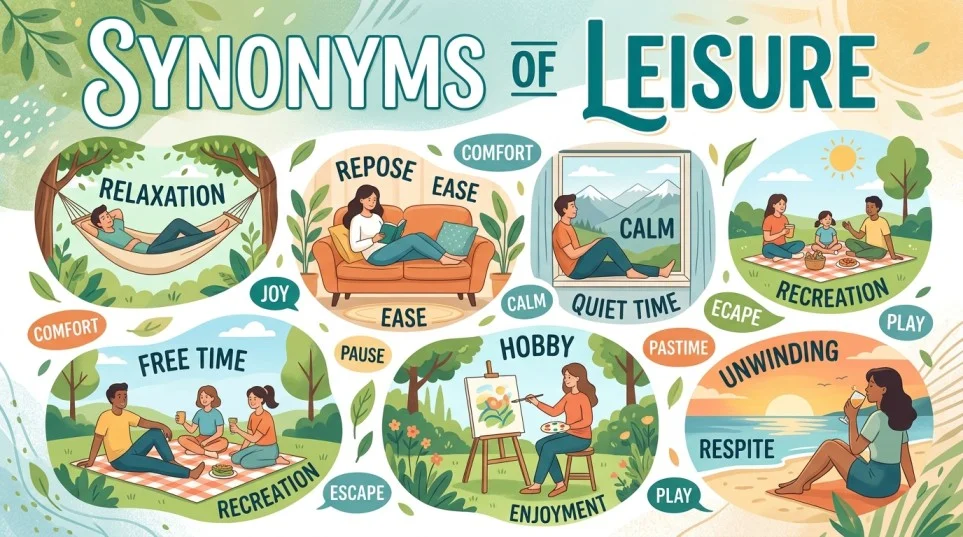
Leisure is a common English word that refers to free time when a person is not working or dealing with duties. Imagine finishing a busy week and spending a quiet afternoon reading a book, walking in a park, or relaxing with friends. That peaceful and enjoyable time is called leisure.
The word is widely used in daily conversations, education, travel, business, and lifestyle writing. Learning synonyms of leisure helps English learners express ideas more clearly and avoid repeating the same word. It also helps writers create richer and more engaging content.
In this article, you will learn the meaning of leisure, its pronunciation, history, grammar, connotations, and word formation. You will also discover 30 useful synonyms with meanings and examples, along with antonyms, categories, and practical questions and answers.
Meaning of Leisure
Definition
Leisure (Noun):
Time that is free from work, duties, or responsibilities and can be used for relaxation or enjoyment.
Examples
- I spend my leisure reading novels.
- She enjoys painting during her leisure time.
Connotative Meaning
(Connotation: the emotional feeling or association connected to a word beyond its dictionary meaning.)
- Positive tone: Relaxation, enjoyment, freedom, comfort.
- Negative tone: Laziness or idleness in some contexts.
- Neutral tone: Free time away from obligations.
Etymology
- Originated from Old French leisir.
- Derived from Latin licere, meaning “to be permitted” or “to be allowed.”
Short History of the Keyword
- Old English (450–1100): Native expressions for free time were used instead of the modern word.
- Middle English (1100–1500): The word entered English through Old French.
- Modern English (1500–Present): Leisure became widely used to describe free time, recreation, and relaxation.
Pronunciation (US & UK – IPA)
US: /ˈliːʒər/
UK: /ˈleʒə/
Syllables
lei-sure
Affixation Pattern of Leisure
Root: leisure
Prefix: None
Suffix: None
Word Formation of Leisure
- Leisure (noun)
- Leisurely (adjective)
- Leisurely (adverb)
- Leisureliness (noun)
A List of 30 Synonyms for Leisure
1. Relaxation (Noun)
US: /ˌriːlækˈseɪʃən/ | UK: /ˌriːlækˈseɪʃən/
Meaning: A state of rest and freedom from stress.
Examples:
- Relaxation is important for good health.
- She practices relaxation after work.
2. Recreation (Noun)
US: /ˌrekriˈeɪʃən/ | UK: /ˌrekriˈeɪʃən/
Meaning: Activities done for enjoyment.
Examples:
- Recreation helps people stay happy.
- Sports are popular forms of recreation.
3. Rest (Noun)
US: /rest/ | UK: /rest/
Meaning: A period of stopping work to recover energy.
Examples:
- I need some rest after the trip.
- Rest improves concentration.
4. Downtime (Noun)
US: /ˈdaʊntaɪm/ | UK: /ˈdaʊntaɪm/
Meaning: Time spent away from work or activity.
Examples:
- Everyone needs downtime.
- He spends his downtime gardening.
5. Free Time (Noun)
US: /friː taɪm/ | UK: /friː taɪm/
Meaning: Time available for personal activities.
Examples:
- I read books in my free time.
- She uses her free time wisely.
6. Spare Time (Noun)
US: /sper taɪm/ | UK: /speə taɪm/
Meaning: Extra time not occupied by duties.
Examples:
- He studies languages in his spare time.
- We travel during our spare time.
7. Ease (Noun)
US: /iːz/ | UK: /iːz/
Meaning: Freedom from effort or difficulty.
Examples:
- She completed the task with ease.
- They lived in comfort and ease.
8. Comfort (Noun)
US: /ˈkʌmfərt/ | UK: /ˈkʌmfət/
Meaning: A state of physical or mental relaxation.
Examples:
- The chair provides great comfort.
- Comfort is important after a long day.
9. Pleasure (Noun)
US: /ˈpleʒər/ | UK: /ˈpleʒə/
Meaning: A feeling of enjoyment.
Examples:
- Reading gives me pleasure.
- It was a pleasure to meet you.
10. Enjoyment (Noun)
US: /ɪnˈdʒɔɪmənt/ | UK: /ɪnˈdʒɔɪmənt/
Meaning: The feeling of having fun.
Examples:
- The trip brought great enjoyment.
- Music provides enjoyment for many people.
11. Amusement (Noun)
US: /əˈmjuːzmənt/ | UK: /əˈmjuːzmənt/
Meaning: Entertainment or fun.
Examples:
- The game provided amusement.
- Children seek amusement during holidays.
12. Entertainment (Noun)
US: /ˌentərˈteɪnmənt/ | UK: /ˌentəˈteɪnmənt/
Meaning: Activities that provide enjoyment.
Examples:
- Movies are a form of entertainment.
- The event offered family entertainment.
13. Hobby (Noun)
US: /ˈhɑːbi/ | UK: /ˈhɒbi/
Meaning: An activity done regularly for pleasure.
Examples:
- Painting is my hobby.
- Gardening became her hobby.
14. Pastime (Noun)
US: /ˈpæstaɪm/ | UK: /ˈpɑːstaɪm/
Meaning: A favorite activity done for enjoyment.
Examples:
- Fishing is his favorite pastime.
- Reading is a relaxing pastime.
15. Fun (Noun)
US: /fʌn/ | UK: /fʌn/
Meaning: Enjoyment and amusement.
Examples:
- The party was fun.
- We had fun at the beach.
16. Holiday (Noun)
US: /ˈhɑːlədeɪ/ | UK: /ˈhɒlədeɪ/
Meaning: A period for rest and recreation.
Examples:
- They went on holiday.
- The holiday was relaxing.
17. Vacation (Noun)
US: /veɪˈkeɪʃən/ | UK: /vəˈkeɪʃən/
Meaning: Time spent away from work or school.
Examples:
- We enjoyed our vacation.
- She planned a summer vacation.
18. Repose (Noun)
US: /rɪˈpoʊz/ | UK: /rɪˈpəʊz/
Meaning: A state of rest and peace.
Examples:
- The garden offered repose.
- He sat in quiet repose.
19. Serenity (Noun)
US: /səˈrenəti/ | UK: /səˈrenəti/
Meaning: Calmness and peacefulness.
Examples:
- The lake brought serenity.
- She enjoyed the serenity of nature.
20. Tranquility (Noun)
US: /træŋˈkwɪləti/ | UK: /trænˈkwɪləti/
Meaning: A peaceful and quiet state.
Examples:
- The village offers tranquility.
- Tranquility helps reduce stress.
21. Idleness (Noun)
US: /ˈaɪdəlnəs/ | UK: /ˈaɪdəlnəs/
Meaning: Being inactive or doing nothing.
Examples:
- Excessive idleness can be harmful.
- He spent the afternoon in idleness.
22. Inactivity (Noun)
US: /ˌɪnækˈtɪvəti/ | UK: /ˌɪnækˈtɪvəti/
Meaning: Lack of movement or activity.
Examples:
- Inactivity can affect health.
- The machine remained in inactivity.
23. Breather (Noun)
US: /ˈbriːðər/ | UK: /ˈbriːðə/
Meaning: A short rest.
Examples:
- Let’s take a breather.
- She stopped for a breather.
24. Intermission (Noun)
US: /ˌɪntərˈmɪʃən/ | UK: /ˌɪntəˈmɪʃən/
Meaning: A break between activities.
Examples:
- We talked during the intermission.
- The play had a short intermission.
25. Break (Noun)
US: /breɪk/ | UK: /breɪk/
Meaning: A short period of rest.
Examples:
- I took a break from work.
- Students enjoyed the break.
26. Respite (Noun)
US: /ˈrespɪt/ | UK: /ˈrespaɪt/
Meaning: A temporary relief from difficulty.
Examples:
- Rain provided respite from the heat.
- The holiday offered respite from stress.
27. Relief (Noun)
US: /rɪˈliːf/ | UK: /rɪˈliːf/
Meaning: Freedom from worry or discomfort.
Examples:
- She felt relief after the exam.
- The vacation brought relief.
28. Retreat (Noun)
US: /rɪˈtriːt/ | UK: /rɪˈtriːt/
Meaning: A place or period for relaxation.
Examples:
- They visited a mountain retreat.
- The retreat helped them relax.
29. Diversion (Noun)
US: /daɪˈvɜːrʒən/ | UK: /daɪˈvɜːʃən/
Meaning: An activity that distracts pleasantly.
Examples:
- Chess is a good diversion.
- The concert provided diversion.
30. Unwinding (Noun)
US: /ʌnˈwaɪndɪŋ/ | UK: /ʌnˈwaɪndɪŋ/
Meaning: Relaxing after stress or work.
Examples:
- Reading helps with unwinding.
- Evening walks are perfect for unwinding.
Prototype Meaning
When people hear the word leisure, they usually imagine free time after work, school, or responsibilities. They think of relaxing, enjoying hobbies, spending time with family, traveling, reading, or participating in recreational activities. The central idea is freedom from obligations and the opportunity to enjoy personal interests.
Prototype Categorization
Categorizing synonyms helps writers select the most accurate word for a specific context.
- Relaxation and Rest: relaxation, repose, serenity, tranquility, ease, comfort.
- Free Time: free time, spare time, downtime, break, breather.
- Entertainment and Enjoyment: fun, amusement, enjoyment, pleasure, entertainment.
- Activities and Hobbies: pastime, hobby, recreation, diversion.
- Vacations and Escapes: holiday, vacation, retreat.
- Inactive States: idleness, inactivity.
- Relief and Recovery: respite, relief, unwinding.
Using categories helps writers communicate precise meanings and avoid vague language.
Antonyms of Leisure
- Work (Noun): Activity done to achieve a task or earn money.
- Labor (Noun): Physical or mental effort.
- Duty (Noun): A responsibility or obligation.
- Business (Noun): Professional activity or occupation.
- Employment (Noun): Paid work.
- Occupation (Noun): Regular job or profession.
- Toil (Noun): Hard and continuous work.
- Responsibility (Noun): Something a person must do.
- Task (Noun): A specific piece of work.
- Industry (Noun): Productive work and effort.
Short Questions and Answers
- What does leisure mean?
Leisure means free time used for rest, enjoyment, or personal activities. - When should leisure be used?
Use leisure when talking about time that is free from work, study, or obligations. - Is leisure positive or negative?
It is usually positive because it suggests relaxation and enjoyment, but it can sometimes imply idleness. - How is it different from similar words?
Leisure refers broadly to free time, while words like recreation focus on activities and relaxation focuses on rest.
Conclusion
Learning the word leisure and its synonyms is an excellent way to strengthen your English vocabulary. Understanding related words such as recreation, relaxation, pastime, and downtime helps you express ideas more accurately in speaking and writing. A wider vocabulary also prevents repetition and makes communication more engaging. By learning meanings, pronunciation, history, connotations, and usage examples, you become more confident when using English in everyday situations. Try practicing a few new synonyms each day and use them in sentences. Over time, your vocabulary will grow naturally, making your English more fluent, expressive, and effective.

I am a linguist with 17 years of experience in English language teaching, including postgraduate-level instruction. My expertise includes English grammar, and I contribute as a content and blog writer, producing scholarly and educational language resources.