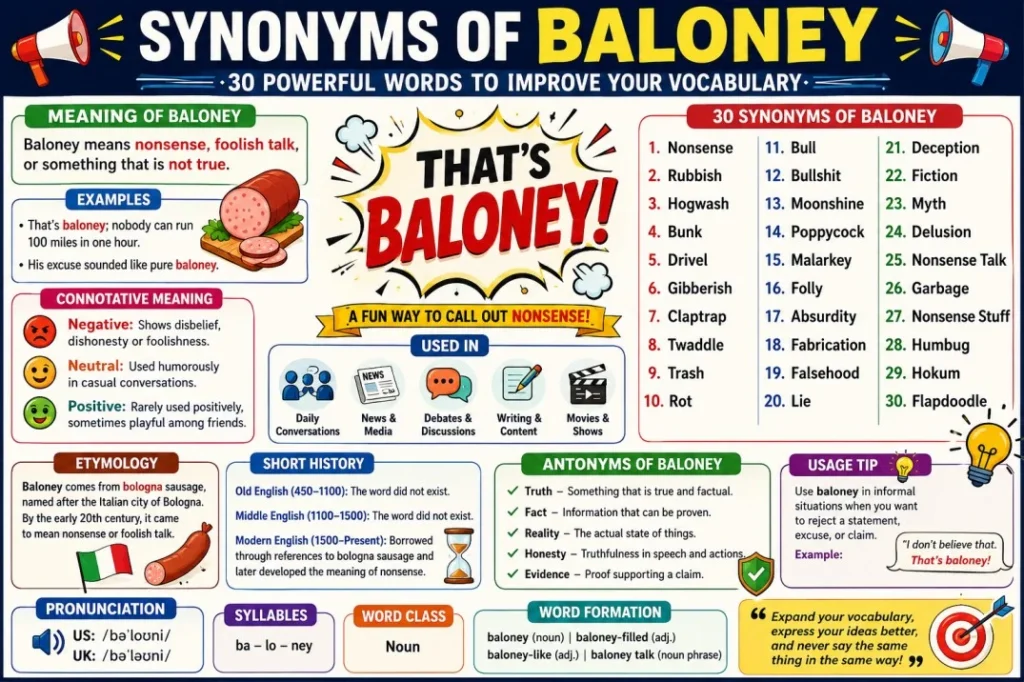
Baloney is a common English word used when someone thinks a statement, claim, or idea is not true. Imagine a friend tells you they can run faster than a race car. You would probably laugh and say, “That’s baloney!” The word is often used in casual conversations to express disbelief.
Learning synonyms of baloney is important because it helps English learners and writers use different words in different situations. Using a variety of synonyms makes speaking and writing more interesting and natural. It also helps avoid repeating the same word again and again.
In this article, you will learn the meaning of baloney, its pronunciation, history, grammar, connotation, and 30 useful synonyms. Each synonym includes meanings, pronunciations, and example sentences to help you build a stronger English vocabulary.
Meaning of Baloney
Definition
Baloney (Noun):
A statement, idea, or claim that is foolish, false, or not believable.
Examples
- That excuse is pure baloney.
- I don’t believe his story because it sounds like baloney.
Connotative Meaning
(Connotation means the emotional feeling or association connected with a word beyond its dictionary meaning.)
- Positive tone: Rarely used positively.
- Negative tone: Used to show disbelief, criticism, or rejection.
- Neutral tone: Can be playful among friends in informal conversations.
Etymology
- Originated from the word Bologna sausage.
- Source language: Italian.
- The city of Bologna in Italy gave the sausage its name.
- Over time, Americans began using “baloney” to mean nonsense or foolish talk.
Short History of the Keyword
- Old English (450–1100): The word did not exist.
- Middle English (1100–1500): The word did not exist.
- Modern English (1500–Present): Entered American English in the late 19th and early 20th centuries and developed the meaning “nonsense.”
Pronunciation (US & UK – IPA)
US: /bəˈloʊni/
UK: /bəˈləʊni/
Syllables
ba-lo-ney
Affixation Pattern of Baloney
Root: baloney
Prefix: None
Suffix: None
Word Formation of Baloney
- Baloney (Noun)
- Baloney-filled (Adjective)
- Baloney-like (Adjective)
- Baloney speaker (Noun phrase)
- Baloney story (Noun phrase)
Synonyms of Baloney
1. Nonsense (Noun)
US /ˈnɑːnsɛns/ | UK /ˈnɒnsəns/
Meaning: Words or ideas that make no sense.
Examples:
- That explanation is complete nonsense.
- We ignored the nonsense in the rumor.
2. Rubbish (Noun)
US /ˈrʌbɪʃ/ | UK /ˈrʌbɪʃ/
Meaning: Something considered foolish or untrue.
Examples:
- His argument is rubbish.
- Don’t listen to that rubbish.
3. Hogwash (Noun)
US /ˈhɔːɡwɑːʃ/ | UK /ˈhɒɡwɒʃ/
Meaning: Complete nonsense.
Examples:
- That theory is hogwash.
- I think the report is hogwash.
4. Bunk (Noun)
US /bʌŋk/ | UK /bʌŋk/
Meaning: False or foolish talk.
Examples:
- The advertisement was bunk.
- We knew it was bunk immediately.
5. Drivel (Noun)
US /ˈdrɪvəl/ | UK /ˈdrɪvəl/
Meaning: Silly or meaningless speech.
Examples:
- He spoke pure drivel.
- Nobody believed that drivel.
6. Claptrap (Noun)
US /ˈklæptræp/ | UK /ˈklæptræp/
Meaning: Empty or foolish talk.
Examples:
- The speech contained claptrap.
- Ignore that claptrap.
7. Gibberish (Noun)
US /ˈdʒɪbərɪʃ/ | UK /ˈdʒɪbərɪʃ/
Meaning: Meaningless words.
Examples:
- The note looked like gibberish.
- He was talking gibberish.
8. Trash (Noun)
US /træʃ/ | UK /træʃ/
Meaning: Something worthless or false.
Examples:
- The article was trash.
- That’s complete trash.
9. Rot (Noun)
US /rɑːt/ | UK /rɒt/
Meaning: Nonsense or foolish ideas.
Examples:
- What rot!
- I don’t believe that rot.
10. Bull (Noun)
US /bʊl/ | UK /bʊl/
Meaning: False or misleading talk.
Examples:
- That’s bull.
- He was spreading bull.
11. Blarney (Noun)
US /ˈblɑːrni/ | UK /ˈblɑːni/
Meaning: Flattering but untrue talk.
Examples:
- The salesman used blarney.
- She saw through the blarney.
12. Twaddle (Noun)
US /ˈtwɑːdəl/ | UK /ˈtwɒdəl/
Meaning: Silly speech or writing.
Examples:
- The article was twaddle.
- Stop talking twaddle.
13. Moonshine (Noun)
US /ˈmuːnʃaɪn/ | UK /ˈmuːnʃaɪn/
Meaning: Unrealistic ideas.
Examples:
- His plan was moonshine.
- They dismissed the moonshine.
14. Hokum (Noun)
US /ˈhoʊkəm/ | UK /ˈhəʊkəm/
Meaning: Nonsense designed to impress.
Examples:
- The presentation was hokum.
- We rejected the hokum.
15. Poppycock (Noun)
US /ˈpɑːpikɑːk/ | UK /ˈpɒpikɒk/
Meaning: Complete nonsense.
Examples:
- That’s poppycock.
- The claim sounded like poppycock.
16. Malarkey (Noun)
US /məˈlɑːrki/ | UK /məˈlɑːki/
Meaning: Meaningless or foolish talk.
Examples:
- Stop that malarkey.
- Nobody believed the malarkey.
17. Folly (Noun)
US /ˈfɑːli/ | UK /ˈfɒli/
Meaning: Lack of good judgment.
Examples:
- It was sheer folly.
- Their decision showed folly.
18. Absurdity (Noun)
US /əbˈsɜːrdəti/ | UK /əbˈsɜːdəti/
Meaning: Something unreasonable.
Examples:
- The idea was an absurdity.
- We laughed at the absurdity.
19. Foolishness (Noun)
US /ˈfuːlɪʃnəs/ | UK /ˈfuːlɪʃnəs/
Meaning: Lack of wisdom.
Examples:
- His actions showed foolishness.
- Avoid such foolishness.
20. Ninancompoopery (Noun)
US /ˌnɪn.i.kəmˈpuː.pə.ri/ | UK /ˌnɪn.i.kəmˈpuː.pər.i/
Meaning: Silly behavior or ideas.
Examples:
- We laughed at the nincompoopery.
- Such nincompoopery wastes time.
21. Deception (Noun)
US /dɪˈsepʃən/ | UK /dɪˈsepʃən/
Meaning: An act of misleading others.
Examples:
- The story involved deception.
- They uncovered the deception.
22. Falsehood (Noun)
US /ˈfɔːls.hʊd/ | UK /ˈfɔːls.hʊd/
Meaning: A statement that is not true.
Examples:
- The report contained falsehoods.
- We exposed the falsehood.
23. Fabrication (Noun)
US /ˌfæbrɪˈkeɪʃən/ | UK /ˌfæbrɪˈkeɪʃən/
Meaning: Something invented or made up.
Examples:
- The claim was a fabrication.
- Investigators proved the fabrication.
24. Lie (Noun)
US /laɪ/ | UK /laɪ/
Meaning: A deliberate false statement.
Examples:
- He told a lie.
- The lie caused problems.
25. Sham (Noun)
US /ʃæm/ | UK /ʃæm/
Meaning: Something fake or false.
Examples:
- The project was a sham.
- Everyone recognized the sham.
26. Fraud (Noun)
US /frɔːd/ | UK /frɔːd/
Meaning: Intentional deception.
Examples:
- The scheme was a fraud.
- Authorities investigated the fraud.
27. Bluff (Noun)
US /blʌf/ | UK /blʌf/
Meaning: A false display of confidence.
Examples:
- It was only a bluff.
- She called his bluff.
28. Spin (Noun)
US /spɪn/ | UK /spɪn/
Meaning: A misleading presentation of facts.
Examples:
- The statement was political spin.
- Voters noticed the spin.
29. Propaganda (Noun)
US /ˌprɑːpəˈɡændə/ | UK /ˌprɒpəˈɡændə/
Meaning: Information used to influence opinions.
Examples:
- The article resembled propaganda.
- They rejected the propaganda.
30. Humbug (Noun)
US /ˈhʌmbʌɡ/ | UK /ˈhʌmbʌɡ/
Meaning: Nonsense or deception.
Examples:
- What humbug!
- He considered it humbug.
Prototype Meaning
The most typical meaning of baloney is something that is not true or does not make sense. When people hear the word, they usually imagine someone making an unbelievable claim, telling an exaggerated story, or presenting an idea that seems foolish.
Prototype Categorization
Synonyms can be grouped into categories:
- General nonsense: nonsense, rubbish, hogwash, bunk, poppycock, malarkey
- Meaningless speech: drivel, gibberish, twaddle, claptrap
- False statements: lie, falsehood, fabrication, deception
- Fraud and trickery: sham, fraud, bluff, humbug
- Unreasonable ideas: absurdity, folly, moonshine
- Manipulative communication: propaganda, spin, blarney
Categorization helps writers choose the most accurate synonym based on context and meaning.
Antonyms of Baloney
- Truth (Noun): Something that is real and accurate.
- Fact (Noun): Information that can be proven.
- Reality (Noun): The true state of things.
- Honesty (Noun): Being truthful and sincere.
- Accuracy (Noun): Correctness and precision.
- Authenticity (Noun): Genuine quality.
- Validity (Noun): Soundness or correctness.
- Integrity (Noun): Strong moral honesty.
- Sincerity (Noun): Genuine honesty of feeling.
- Credibility (Noun): Ability to be believed.
Short Questions and Answers
- What does baloney mean?
Baloney means nonsense, false talk, or something difficult to believe. - When should baloney be used?
It is used when you want to express disbelief about a statement, claim, or idea. - Is baloney positive or negative?
It is usually negative because it criticizes something as untrue or foolish. - How is it different from similar words?
Baloney is informal and conversational, while words like falsehood and deception are more formal.
Conclusion
Learning the meaning of baloney and its synonyms can greatly improve your English vocabulary. These words help you express doubt, identify false information, and describe foolish ideas more precisely. Using different synonyms strengthens both writing and speaking because it prevents repetition and makes communication more engaging. Understanding pronunciation, history, connotation, and usage also helps learners use these words correctly in real situations. The more vocabulary you learn, the more confident you become in conversations, essays, and professional writing. Make vocabulary practice a daily habit, and soon these powerful synonyms will become a natural part of your English language skills.

I am a linguist with 17 years of experience in English language teaching, including postgraduate-level instruction. My expertise includes English grammar, and I contribute as a content and blog writer, producing scholarly and educational language resources.