
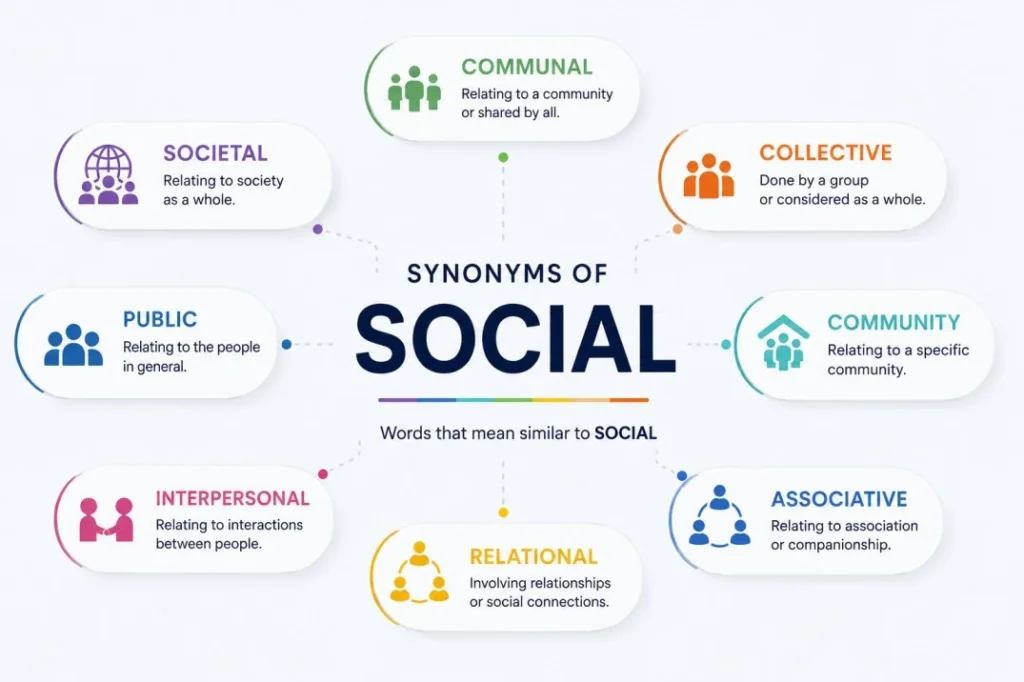
The word social is one of the most common words in English. It describes people, activities, or situations that involve interaction with others. Imagine a student joining a school club and making new friends. That student is being social because they are connecting with other people.
People use the word social in daily conversations, education, business, psychology, and online communication. Since it appears so often, learning its synonyms can greatly improve your English vocabulary.
For English learners, writers, and content creators, knowing different words for social helps avoid repetition and makes communication more interesting. In this article, you will learn the meaning of social, its pronunciation, history, grammar, connotations, and 30 powerful synonyms with examples. You will also discover antonyms, categories, and practical usage tips to strengthen your vocabulary.
Meaning of Social
Definition
Social (Adjective):
Relating to people, society, or activities that involve communication and interaction with others.
Examples
- Sarah is very social and enjoys meeting new people.
- The company organized a social event for all employees.
Connotative Meaning
(Connotation: the emotional or cultural feeling associated with a word beyond its basic dictionary meaning.)
- Positive tone: Friendly, outgoing, cooperative, welcoming.
- Negative tone: Sometimes suggests excessive dependence on others or constant socializing.
- Neutral tone: Simply relating to society, groups, or human interaction.
Etymology
- Origin: Latin socialis
- Original meaning: “Companion-like” or “allied”
- Entered English through Old French social
Short History of the Keyword
- Old English (450–1100): The modern word social was not commonly used.
- Middle English (1100–1500): Influences from French and Latin introduced related forms.
- Modern English (1500–Present): Social became widely used to describe society, relationships, and human interaction.
Pronunciation (US & UK – IPA)
- US: /ˈsoʊʃəl/
- UK: /ˈsəʊʃəl/
Syllables
so-cial
Affixation Pattern of Social
- Root: soci (companion, associate)
- Prefix: None
- Suffix: -al
Word Formation of the Keyword
- Sociality (Noun)
- Socialism (Noun)
- Socialist (Noun/Adjective)
- Socialize (Verb)
- Socialized (Adjective/Verb)
- Socializing (Verb/Noun)
- Socially (Adverb)
- Society (Noun)
Synonyms of Social
1. Friendly (Adjective)
US: /ˈfrɛndli/ | UK: /ˈfrendli/
Meaning: Kind and pleasant toward other people.
Examples:
- The new neighbor is very friendly.
- She gave us a friendly smile.
2. Outgoing (Adjective)
US: /ˈaʊtɡoʊɪŋ/ | UK: /ˈaʊtɡəʊɪŋ/
Meaning: Enjoying meeting and talking with people.
Examples:
- Tom is outgoing and confident.
- Outgoing people often make friends quickly.
3. Sociable (Adjective)
US: /ˈsoʊʃəbəl/ | UK: /ˈsəʊʃəbəl/
Meaning: Enjoying the company of others.
Examples:
- She is a sociable person.
- Sociable children enjoy group activities.
4. Companionable (Adjective)
US: /kəmˈpæniənəbəl/ | UK: /kəmˈpæniənəbəl/
Meaning: Pleasant to spend time with.
Examples:
- He is companionable and easy to talk to.
- We had a companionable evening.
5. Gregarious (Adjective)
US: /ɡrɪˈɡeriəs/ | UK: /ɡrɪˈɡeəriəs/
Meaning: Fond of being with people.
Examples:
- She has a gregarious personality.
- Gregarious individuals enjoy large gatherings.
6. Communicative (Adjective)
US: /kəˈmjunɪkeɪtɪv/ | UK: /kəˈmjuːnɪkətɪv/
Meaning: Willing to share information and ideas.
Examples:
- The manager is communicative.
- Good leaders are communicative.
7. Interactive (Adjective)
US: /ˌɪntərˈæktɪv/ | UK: /ˌɪntərˈæktɪv/
Meaning: Involving communication between people.
Examples:
- The lesson was interactive.
- Interactive activities increase participation.
8. Cooperative (Adjective)
US: /koʊˈɑːpərətɪv/ | UK: /kəʊˈɒpərətɪv/
Meaning: Willing to work with others.
Examples:
- The team was cooperative.
- Cooperative workers achieve goals faster.
9. Neighborly (Adjective)
US: /ˈneɪbərli/ | UK: /ˈneɪbəli/
Meaning: Friendly and helpful toward neighbors.
Examples:
- They showed a neighborly attitude.
- Neighborly acts strengthen communities.
10. Cordial (Adjective)
US: /ˈkɔːrdʒəl/ | UK: /ˈkɔːdiəl/
Meaning: Warm and polite.
Examples:
- The meeting remained cordial.
- We received a cordial welcome.
11. Amiable (Adjective)
US: /ˈeɪmiəbəl/ | UK: /ˈeɪmiəbəl/
Meaning: Friendly and pleasant.
Examples:
- She is amiable and cheerful.
- Everyone likes his amiable nature.
12. Affable (Adjective)
US: /ˈæfəbəl/ | UK: /ˈæfəbəl/
Meaning: Easy to approach and talk to.
Examples:
- The professor is affable.
- Affable people make others comfortable.
13. Personable (Adjective)
US: /ˈpɜːrsənəbəl/ | UK: /ˈpɜːsənəbəl/
Meaning: Pleasant and attractive in personality.
Examples:
- She is personable and professional.
- A personable guide improves the tour.
14. Extroverted (Adjective)
US: /ˈekstrəvɜːrtɪd/ | UK: /ˈekstrəvɜːtɪd/
Meaning: Energized by social interaction.
Examples:
- He is extroverted and talkative.
- Extroverted people enjoy crowds.
15. Engaging (Adjective)
US: /ɪnˈɡeɪdʒɪŋ/ | UK: /ɪnˈɡeɪdʒɪŋ/
Meaning: Pleasant and interesting.
Examples:
- She has an engaging personality.
- The speaker was engaging.
16. Approachable (Adjective)
US: /əˈproʊtʃəbəl/ | UK: /əˈprəʊtʃəbəl/
Meaning: Easy to talk to.
Examples:
- The teacher is approachable.
- Approachable leaders gain trust.
17. Warm (Adjective)
US: /wɔːrm/ | UK: /wɔːm/
Meaning: Showing kindness and friendliness.
Examples:
- They gave us a warm welcome.
- Her warm nature attracts people.
18. Welcoming (Adjective)
US: /ˈwelkəmɪŋ/ | UK: /ˈwelkəmɪŋ/
Meaning: Making others feel comfortable.
Examples:
- The staff was welcoming.
- A welcoming environment encourages participation.
19. Congenial (Adjective)
US: /kənˈdʒiːniəl/ | UK: /kənˈdʒiːniəl/
Meaning: Pleasant and compatible.
Examples:
- They found a congenial group.
- The atmosphere was congenial.
20. Clubbable (Adjective)
US: /ˈklʌbəbəl/ | UK: /ˈklʌbəbəl/
Meaning: Enjoying groups and social activities.
Examples:
- He is clubbable and active.
- Clubbable people enjoy organizations.
21. Community-Oriented (Adjective)
US: /kəˈmjuːnəti ˈɔːriˌentɪd/ | UK: /kəˈmjuːnəti ˈɔːriəntɪd/
Meaning: Focused on helping a community.
Examples:
- The mayor is community-oriented.
- Community-oriented projects help society.
22. Civic (Adjective)
US: /ˈsɪvɪk/ | UK: /ˈsɪvɪk/
Meaning: Related to citizens and society.
Examples:
- Civic duties are important.
- They attended a civic event.
23. Public (Adjective)
US: /ˈpʌblɪk/ | UK: /ˈpʌblɪk/
Meaning: Relating to people as a whole.
Examples:
- Public services benefit everyone.
- The issue received public attention.
24. Collective (Adjective)
US: /kəˈlektɪv/ | UK: /kəˈlektɪv/
Meaning: Done by a group.
Examples:
- The decision was collective.
- Collective effort brought success.
25. Communal (Adjective)
US: /kəˈmjuːnəl/ | UK: /kəˈmjuːnəl/
Meaning: Shared by a community.
Examples:
- They use a communal garden.
- Communal living encourages cooperation.
26. Collaborative (Adjective)
US: /kəˈlæbəreɪtɪv/ | UK: /kəˈlæbərətɪv/
Meaning: Involving people working together.
Examples:
- The project was collaborative.
- Collaborative learning is effective.
27. Team-Oriented (Adjective)
US: /tiːm ˈɔːriˌentɪd/ | UK: /tiːm ˈɔːriəntɪd/
Meaning: Focused on teamwork.
Examples:
- Employers value team-oriented workers.
- She has a team-oriented mindset.
28. Associative (Adjective)
US: /əˈsoʊʃiətɪv/ | UK: /əˈsəʊʃiətɪv/
Meaning: Connected with groups or associations.
Examples:
- The club has associative activities.
- Associative learning links ideas together.
29. Interpersonal (Adjective)
US: /ˌɪntərˈpɜːrsənəl/ | UK: /ˌɪntəˈpɜːsənəl/
Meaning: Relating to relationships between people.
Examples:
- Good interpersonal skills matter.
- Interpersonal communication builds trust.
30. Connected (Adjective)
US: /kəˈnektɪd/ | UK: /kəˈnektɪd/
Meaning: Linked with people or groups.
Examples:
- She feels connected to her community.
- Social media keeps people connected.
Prototype Meaning
The most typical meaning of social refers to people interacting, communicating, and building relationships with others. When people hear the word social, they often imagine friends talking, families gathering, coworkers collaborating, or communities participating in events together.
Prototype Categorization
Categorizing synonyms helps writers select the most accurate word for different situations.
- Friendly Personality: Friendly, Amiable, Affable, Warm, Welcoming
- Outgoing Behavior: Sociable, Gregarious, Outgoing, Extroverted, Clubbable
- Communication-Based: Communicative, Interactive, Interpersonal, Engaging
- Teamwork and Cooperation: Cooperative, Collaborative, Team-Oriented, Collective
- Community and Society: Civic, Public, Community-Oriented, Communal
- Relationship-Based: Companionable, Congenial, Connected, Personable
Antonyms of Social
- Unsociable (Adjective) — Not interested in interacting with others.
- Antisocial (Adjective) — Against social norms or avoiding society.
- Reserved (Adjective) — Quiet and not openly expressive.
- Introverted (Adjective) — Preferring solitude or small groups.
- Withdrawn (Adjective) — Keeping away from social interaction.
- Isolated (Adjective) — Separated from others.
- Lonely (Adjective) — Lacking companionship.
- Detached (Adjective) — Emotionally distant from people.
- Aloof (Adjective) — Unfriendly and distant.
- Reclusive (Adjective) — Living apart from society.
Short Questions and Answers
- What does social mean?
It means relating to people, society, or interaction with others. - When should social be used?
Use it when talking about communication, relationships, communities, or group activities. - Is social positive or negative?
It is usually positive or neutral, depending on context. - How is it different from similar words?
Social is a broad term, while words like sociable, outgoing, and gregarious focus more on personality traits.
Conclusion
Learning the word social and its synonyms can greatly improve your English vocabulary. These alternative words help you express ideas more clearly and accurately in speaking and writing. They also prevent repetition and make communication more engaging. Understanding pronunciation, history, connotations, and categories gives you a deeper knowledge of how the word works in real situations. Whether you are an English learner, student, teacher, blogger, or content writer, mastering social and its related words will strengthen your language skills and build confidence. Practice using a few new synonyms every day, and you will soon notice improvement in both your vocabulary and communication.

I am a linguist with 17 years of experience in English language teaching, including postgraduate-level instruction. My expertise includes English grammar, and I contribute as a content and blog writer, producing scholarly and educational language resources.