
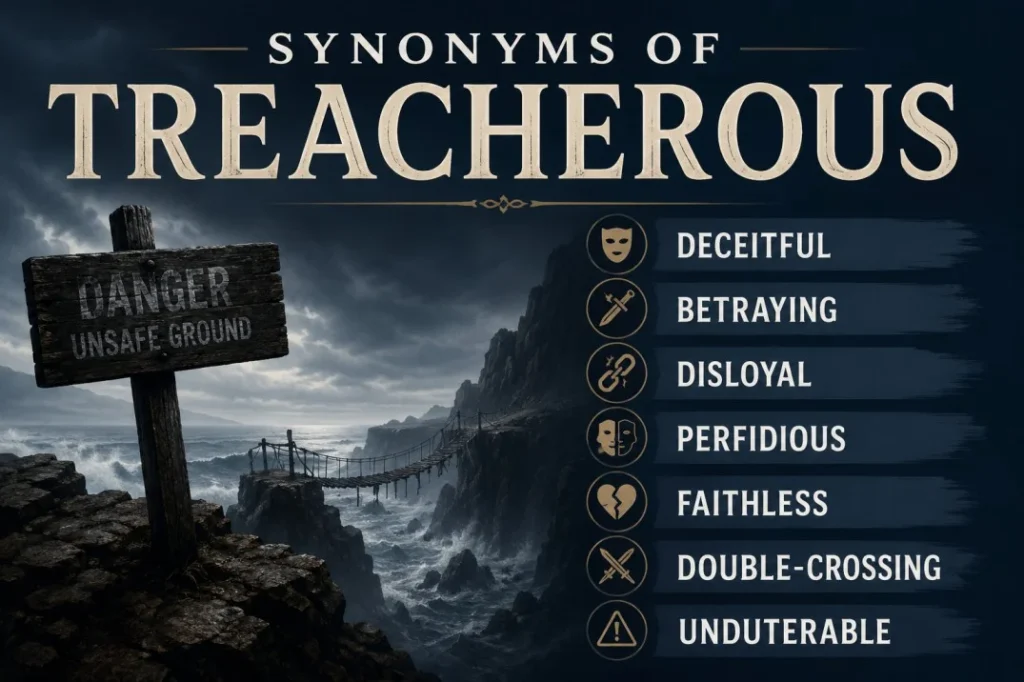
The word treacherous describes someone or something that cannot be trusted because they are likely to betray, deceive, or harm others. Imagine a person who pretends to be your friend but secretly shares your private information. Such behavior can be called treacherous.
This word is commonly used in daily conversations, literature, news reports, and professional writing. It can describe dishonest people, dangerous situations, or unsafe conditions.
Learning synonyms of treacherous is important for English learners, students, writers, and content creators. Knowing different words with similar meanings helps improve vocabulary, avoid repetition, and express ideas more accurately. In this article, you will learn the meaning of treacherous, its pronunciation, history, grammar, word formation, connotations, and 30 useful synonyms with examples. You will also explore semantic categories and antonyms to strengthen your understanding of this powerful English word.
Meaning of Treacherous
Definition
Treacherous (Adjective):
A person, action, or situation that is dishonest, untrustworthy, dangerous, or likely to cause harm through betrayal or deception.
Examples
- The treacherous soldier revealed secret plans to the enemy.
- The hikers avoided the treacherous mountain path during the storm.
Connotative Meaning
(Connotation: the emotional or cultural feeling associated with a word beyond its basic dictionary meaning.)
- Positive tone: None in most contexts.
- Negative tone: Betrayal, deception, danger, dishonesty, disloyalty.
- Neutral tone: Can describe physically dangerous conditions without moral judgment, such as a treacherous road.
Etymology
- Origin: Old French trechier meaning “to cheat or deceive.”
- Source language: Anglo-French and Latin roots.
- Original meaning: To betray, trick, or act dishonestly.
Short History of the Keyword
- Old English (450–1100): The exact word was not used, but related concepts of betrayal existed.
- Middle English (1100–1500): Borrowed from Old French and used to describe traitors and deceitful behavior.
- Modern English (1500–Present): Expanded to include dangerous places, roads, weather, and situations.
Pronunciation (US & UK – IPA)
US: /ˈtretʃərəs/
UK: /ˈtretʃərəs/
Syllables
treach-er-ous
Affixation Pattern of Treacherous
Root: treach (related to betrayal)
Prefix: None
Suffix: -ous (meaning “full of” or “having the quality of”)
Word Formation of the Keyword
- Treachery (Noun)
- Treacherously (Adverb)
- Treacherousness (Noun)
- Traitor (Noun)
- Traitorous (Adjective)
Synonyms of Treacherous
1. Deceitful (Adjective)
US: /dɪˈsiːtfəl/ | UK: /dɪˈsiːtfəl/
Meaning: Intentionally misleading others.
Examples:
- The deceitful salesman hid important facts.
- Her deceitful behavior damaged trust.
2. Dishonest (Adjective)
US: /dɪsˈɑːnɪst/ | UK: /dɪsˈɒnɪst/
Meaning: Not truthful or trustworthy.
Examples:
- The dishonest employee stole company money.
- Everyone avoided his dishonest schemes.
3. Untrustworthy (Adjective)
US: /ʌnˈtrʌstwɜːrði/ | UK: /ʌnˈtrʌstwɜːði/
Meaning: Not deserving trust.
Examples:
- The witness seemed untrustworthy.
- Many people doubted his promises.
4. Betraying (Adjective)
US: /bɪˈtreɪɪŋ/ | UK: /bɪˈtreɪɪŋ/
Meaning: Showing disloyalty.
Examples:
- His betraying actions hurt his friends.
- The betraying partner lost all respect.
5. Faithless (Adjective)
US: /ˈfeɪθləs/ | UK: /ˈfeɪθləs/
Meaning: Lacking loyalty.
Examples:
- The faithless ally changed sides.
- She felt hurt by her faithless friend.
6. Disloyal (Adjective)
US: /dɪsˈlɔɪəl/ | UK: /dɪsˈlɔɪəl/
Meaning: Not loyal.
Examples:
- The disloyal servant joined the enemy.
- Disloyal behavior destroys relationships.
7. Traitorous (Adjective)
US: /ˈtreɪtərəs/ | UK: /ˈtreɪtərəs/
Meaning: Showing betrayal.
Examples:
- The traitorous act shocked the nation.
- He was punished for traitorous conduct.
8. Double-crossing (Adjective)
US: /ˌdʌbəl ˈkrɔːsɪŋ/ | UK: /ˌdʌbəl ˈkrɒsɪŋ/
Meaning: Secretly betraying someone.
Examples:
- The double-crossing criminal escaped.
- Everyone feared his double-crossing nature.
9. Devious (Adjective)
US: /ˈdiːviəs/ | UK: /ˈdiːviəs/
Meaning: Using dishonest methods.
Examples:
- He used a devious plan.
- The devious politician fooled voters.
10. Cunning (Adjective)
US: /ˈkʌnɪŋ/ | UK: /ˈkʌnɪŋ/
Meaning: Clever in a dishonest way.
Examples:
- The cunning thief avoided capture.
- Her cunning strategy succeeded.
11. Sneaky (Adjective)
US: /ˈsniːki/ | UK: /ˈsniːki/
Meaning: Secretive and dishonest.
Examples:
- That was a sneaky trick.
- The sneaky child hid the evidence.
12. Fraudulent (Adjective)
US: /ˈfrɔːdjələnt/ | UK: /ˈfrɔːdjʊlənt/
Meaning: Involving deception for gain.
Examples:
- The company made fraudulent claims.
- Fraudulent activities were investigated.
13. Corrupt (Adjective)
US: /kəˈrʌpt/ | UK: /kəˈrʌpt/
Meaning: Morally dishonest.
Examples:
- The corrupt official accepted bribes.
- Corrupt leadership caused problems.
14. Perfidious (Adjective)
US: /pərˈfɪdiəs/ | UK: /pəˈfɪdiəs/
Meaning: Deliberately betraying trust.
Examples:
- The perfidious spy revealed secrets.
- His perfidious actions ended friendships.
15. False (Adjective)
US: /fɔːls/ | UK: /fɔːls/
Meaning: Not genuine or truthful.
Examples:
- She spread false information.
- False promises disappointed voters.
16. Misleading (Adjective)
US: /mɪsˈliːdɪŋ/ | UK: /mɪsˈliːdɪŋ/
Meaning: Giving wrong impressions.
Examples:
- The advertisement was misleading.
- Misleading statements confused customers.
17. Two-faced (Adjective)
US: /ˌtuː ˈfeɪst/ | UK: /ˌtuː ˈfeɪst/
Meaning: Friendly in front but hostile behind.
Examples:
- Nobody trusted the two-faced coworker.
- Her two-faced attitude upset friends.
18. Backstabbing (Adjective)
US: /ˈbækstæbɪŋ/ | UK: /ˈbækstæbɪŋ/
Meaning: Secretly harming a trusted person.
Examples:
- Backstabbing behavior ruins teams.
- He suffered from a backstabbing colleague.
19. Unscrupulous (Adjective)
US: /ʌnˈskruːpjələs/ | UK: /ʌnˈskruːpjʊləs/
Meaning: Without moral principles.
Examples:
- The unscrupulous dealer cheated customers.
- Unscrupulous tactics brought criticism.
20. Underhanded (Adjective)
US: /ˌʌndərˈhændɪd/ | UK: /ˌʌndəˈhændɪd/
Meaning: Secretly dishonest.
Examples:
- The company used underhanded methods.
- Underhanded actions damaged its reputation.
21. Shifty (Adjective)
US: /ˈʃɪfti/ | UK: /ˈʃɪfti/
Meaning: Appearing dishonest.
Examples:
- The shifty stranger avoided eye contact.
- His shifty behavior raised suspicion.
22. Crafty (Adjective)
US: /ˈkræfti/ | UK: /ˈkrɑːfti/
Meaning: Clever and deceptive.
Examples:
- The crafty fox escaped.
- A crafty plan fooled everyone.
23. Manipulative (Adjective)
US: /məˈnɪpjələtɪv/ | UK: /məˈnɪpjʊlətɪv/
Meaning: Controlling others unfairly.
Examples:
- The manipulative leader influenced people.
- She avoided manipulative friends.
24. Dangerous (Adjective)
US: /ˈdeɪndʒərəs/ | UK: /ˈdeɪndʒərəs/
Meaning: Likely to cause harm.
Examples:
- The dangerous road was icy.
- Dangerous weather delayed travel.
25. Hazardous (Adjective)
US: /ˈhæzərdəs/ | UK: /ˈhæzədəs/
Meaning: Full of risk.
Examples:
- Workers entered a hazardous area.
- Hazardous conditions caused delays.
26. Perilous (Adjective)
US: /ˈperələs/ | UK: /ˈperələs/
Meaning: Extremely dangerous.
Examples:
- They crossed a perilous bridge.
- The mission was perilous.
27. Risky (Adjective)
US: /ˈrɪski/ | UK: /ˈrɪski/
Meaning: Having possible danger.
Examples:
- It was a risky decision.
- Risky investments may fail.
28. Unreliable (Adjective)
US: /ˌʌnrɪˈlaɪəbəl/ | UK: /ˌʌnrɪˈlaɪəbəl/
Meaning: Cannot be depended on.
Examples:
- The unreliable worker missed deadlines.
- That source is unreliable.
29. Duplicitous (Adjective)
US: /duːˈplɪsɪtəs/ | UK: /djuːˈplɪsɪtəs/
Meaning: Deceptively double-minded.
Examples:
- The duplicitous official lied repeatedly.
- Her duplicitous conduct caused distrust.
30. Betrayal-Prone (Adjective)
US: /bɪˈtreɪəl proʊn/ | UK: /bɪˈtreɪəl prəʊn/
Meaning: Likely to betray trust.
Examples:
- He appeared betrayal-prone.
- People avoided betrayal-prone partners.
Prototype Meaning
The most typical meaning of treacherous is someone who betrays the trust of another person. When people hear the word, they often imagine a disloyal friend, a spy sharing secrets, or a person pretending to help while secretly causing harm. The word can also describe dangerous roads, weather, or situations that unexpectedly put people at risk.
Prototype Categorization
Categorizing synonyms helps writers choose the most accurate word for a specific context.
- Betrayal and Disloyalty: traitorous, faithless, disloyal, perfidious, betraying
- Deception and Dishonesty: deceitful, fraudulent, duplicitous, false, misleading
- Secretive Behavior: sneaky, shifty, underhanded, double-crossing, two-faced
- Manipulation and Clever Deceit: crafty, cunning, manipulative, devious
- Dangerous Situations: hazardous, perilous, risky, dangerous
- Moral Corruption: corrupt, unscrupulous
Writers can select a synonym based on whether they want to emphasize betrayal, deception, danger, or dishonesty.
Antonyms of Treacherous
- Loyal (Adjective) — faithful and devoted
- Trustworthy (Adjective) — deserving trust
- Honest (Adjective) — truthful and sincere
- Faithful (Adjective) — reliable and loyal
- Dependable (Adjective) — can be relied upon
- Reliable (Adjective) — consistently trustworthy
- Sincere (Adjective) — genuine and honest
- Truthful (Adjective) — telling the truth
- Principled (Adjective) — guided by strong morals
- Devoted (Adjective) — strongly loyal
Short Questions and Answers
- What does treacherous mean?
It means dishonest, disloyal, dangerous, or likely to betray trust. - When should treacherous be used?
Use it to describe people, actions, roads, weather, or situations that involve betrayal or danger. - Is treacherous positive or negative?
It is usually a strongly negative word. - How is it different from similar words?
Treacherous often emphasizes betrayal and broken trust, while words like dangerous focus mainly on physical risk.
Conclusion
Learning the word treacherous and its synonyms can greatly improve your English vocabulary. These words help you describe betrayal, dishonesty, danger, and deception with greater accuracy. Understanding different synonyms also strengthens your writing and speaking skills by helping you avoid repeating the same word. In addition, learning pronunciation, word history, connotations, and semantic categories gives you a deeper understanding of how English works. The more vocabulary you learn, the more confident you become when reading, writing, speaking, and listening. Make vocabulary practice a daily habit, and soon these powerful words will become a natural part of your English communication.

I am a linguist with 17 years of experience in English language teaching, including postgraduate-level instruction. My expertise includes English grammar, and I contribute as a content and blog writer, producing scholarly and educational language resources.