
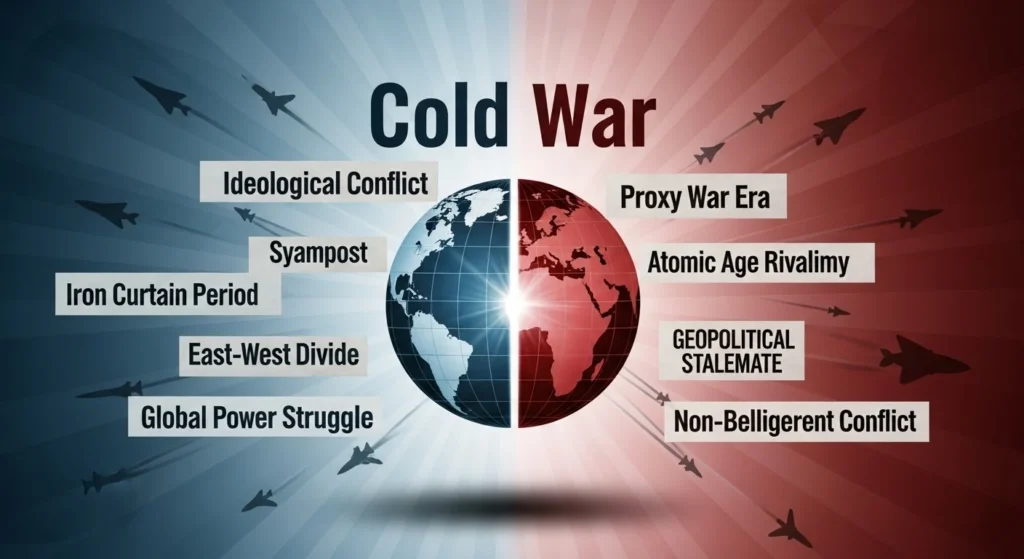
The term cold war means a state of tension between countries without direct fighting. Imagine two neighbors who stop talking after a disagreement. They do not fight, but they compete, spread rumors, and avoid each other. This is like a cold war. The word is common in history, politics, and even daily talk. People use it to describe silent conflict or hidden rivalry.
Learning synonyms is important for English learners and writers. It helps you express ideas in new ways and avoid repeating the same word. It also improves clarity and style.
This article explains the meaning of cold war and its synonyms with examples, grammar, history, pronunciation, and categories. It will help you build strong vocabulary in a simple way.
Meaning of Cold War
Definition
Cold war (noun):
A situation of strong political or personal tension where there is no direct fighting, but there is rivalry, fear, and competition.
Examples
- The two countries were in a cold war for many years.
- After the argument, a cold war started between the friends.
Connotative Meaning
(Connotation means the emotional feeling a word gives beyond its basic meaning.)
- Positive tone: Rarely positive; may suggest control or patience
- Negative tone: Tension, fear, distrust, rivalry
- Neutral tone: Silent conflict, competition without violence
Etymology
- Origin: English (20th century)
- Original meaning: A war without active fighting
History
- Old English (450–1100): No direct use
- Middle English (1100–1500): No use of this term
- Modern English (1500–Present): Term became popular after World War II
Pronunciation (US & UK – IPA)
- US: /ˈkoʊld wɔːr/
- UK: /ˈkəʊld wɔː/
Syllables
cold-war
Affixation Pattern of Cold War
- Root: cold, war
- Prefix: none
- Suffix: none
Word Formation
- cold (adjective)
- war (noun)
- coldness (noun)
- warfare (noun)
- warlike (adjective)
A List of 30 Synonyms for Cold War
1. Rivalry (noun)
US: /ˈraɪvəlri/ | UK: /ˈraɪvəlri/
Meaning: A situation where people or groups compete strongly
Examples:
- The rivalry lasted for years.
- There was rivalry between the two teams.
2. Tension (noun)
US: /ˈtenʃən/ | UK: /ˈtenʃən/
Meaning: A feeling of stress or strain between people
Examples:
- Tension grew between the nations.
- You could feel the tension in the room.
3. Hostility (noun)
US: /hɑːˈstɪləti/ | UK: /hɒˈstɪləti/
Meaning: Strong dislike or anger
Examples:
- There was open hostility.
- His words showed hostility.
4. Standoff (noun)
US: /ˈstændɔːf/ | UK: /ˈstændɒf/
Meaning: A situation where neither side moves
Examples:
- The standoff lasted weeks.
- Both sides refused to act.
5. Conflict (noun)
US: /ˈkɑːnflɪkt/ | UK: /ˈkɒnflɪkt/
Meaning: A serious disagreement
Examples:
- Conflict grew quickly.
- They avoided open conflict.
6. Antagonism (noun)
US: /ænˈtæɡəˌnɪzəm/ | UK: /ænˈtæɡənɪzəm/
Meaning: Active opposition or dislike
Examples:
- There was deep antagonism.
- His tone showed antagonism.
7. Competition (noun)
US: /ˌkɑːmpəˈtɪʃən/ | UK: /ˌkɒmpəˈtɪʃən/
Meaning: Struggle to win or succeed
Examples:
- Competition increased.
- Healthy competition is good.
8. Dispute (noun)
US: /dɪˈspjuːt/ | UK: /dɪˈspjuːt/
Meaning: Argument or disagreement
Examples:
- The dispute lasted long.
- They settled the dispute.
9. Feud (noun)
US: /fjuːd/ | UK: /fjuːd/
Meaning: Long-lasting conflict
Examples:
- The families had a feud.
- The feud never ended.
10. Estrangement (noun)
US: /ɪˈstreɪndʒmənt/ | UK: /ɪˈstreɪndʒmənt/
Meaning: Loss of closeness
Examples:
- Estrangement hurt both sides.
- They lived in estrangement.
11. Opposition (noun)
US: /ˌɑːpəˈzɪʃən/ | UK: /ˌɒpəˈzɪʃən/
Meaning: Strong resistance
Examples:
- There was strong opposition.
- He faced opposition.
12. Friction (noun)
US: /ˈfrɪkʃən/ | UK: /ˈfrɪkʃən/
Meaning: Small disagreements
Examples:
- Friction increased daily.
- Minor friction is normal.
13. Cold conflict (noun)
US: /koʊld ˈkɑːnflɪkt/ | UK: /kəʊld ˈkɒnflɪkt/
Meaning: Conflict without fighting
Examples:
- It was a cold conflict.
- No violence occurred.
14. Diplomatic tension (noun)
US: /ˌdɪpləˈmætɪk ˈtenʃən/ | UK: /ˌdɪpləˈmætɪk ˈtenʃən/
Meaning: Strain between governments
Examples:
- Diplomatic tension rose.
- Talks failed due to tension.
15. Silent conflict (noun)
US: /ˈsaɪlənt ˈkɑːnflɪkt/ | UK: /ˈsaɪlənt ˈkɒnflɪkt/
Meaning: Hidden disagreement
Examples:
- A silent conflict existed.
- They avoided speaking.
16. Power struggle (noun)
US: /ˈpaʊər ˈstrʌɡəl/ | UK: /ˈpaʊə ˈstrʌɡəl/
Meaning: Fight for control
Examples:
- There was a power struggle.
- Leaders fought silently.
17. Ideological clash (noun)
US: /ˌaɪdiəˈlɑːdʒɪkəl klæʃ/ | UK: /ˌaɪdiəˈlɒdʒɪkəl klæʃ/
Meaning: Conflict of beliefs
Examples:
- Ideological clash grew.
- Beliefs caused tension.
18. Deadlock (noun)
US: /ˈdedlɑːk/ | UK: /ˈdedlɒk/
Meaning: No progress possible
Examples:
- Talks ended in deadlock.
- The situation froze.
19. Standstill (noun)
US: /ˈstændstɪl/ | UK: /ˈstændstɪl/
Meaning: Complete stop
Examples:
- Work came to a standstill.
- The talks stopped.
20. Discord (noun)
US: /ˈdɪskɔːrd/ | UK: /ˈdɪskɔːd/
Meaning: Lack of agreement
Examples:
- Discord spread fast.
- Their voices showed discord.
21. Mistrust (noun)
US: /ˌmɪsˈtrʌst/ | UK: /ˌmɪsˈtrʌst/
Meaning: Lack of trust
Examples:
- Mistrust grew daily.
- They acted with mistrust.
22. Unease (noun)
US: /ʌnˈiːz/ | UK: /ʌnˈiːz/
Meaning: Feeling of worry
Examples:
- Unease filled the room.
- He felt unease.
23. Suspicion (noun)
US: /səˈspɪʃən/ | UK: /səˈspɪʃən/
Meaning: Doubt or distrust
Examples:
- Suspicion increased.
- She showed suspicion.
24. Alienation (noun)
US: /ˌeɪliəˈneɪʃən/ | UK: /ˌeɪliəˈneɪʃən/
Meaning: Feeling distant
Examples:
- Alienation hurt relations.
- He felt alienation.
25. Rival conflict (noun)
US: /ˈraɪvəl ˈkɑːnflɪkt/ | UK: /ˈraɪvəl ˈkɒnflɪkt/
Meaning: Conflict between rivals
Examples:
- Rival conflict grew.
- Both sides competed.
26. Strategic tension (noun)
US: /strəˈtiːdʒɪk ˈtenʃən/ | UK: /strəˈtiːdʒɪk ˈtenʃən/
Meaning: Planned tension for advantage
Examples:
- Strategic tension was clear.
- Leaders used tension.
27. Political rivalry (noun)
US: /pəˈlɪtɪkəl ˈraɪvəlri/ | UK: /pəˈlɪtɪkəl ˈraɪvəlri/
Meaning: Competition in politics
Examples:
- Political rivalry grew.
- Parties fought silently.
28. Competitive tension (noun)
US: /kəmˈpetɪtɪv ˈtenʃən/ | UK: /kəmˈpetɪtɪv ˈtenʃən/
Meaning: Stress due to competition
Examples:
- Competitive tension increased.
- Teams felt pressure.
29. Diplomatic standoff (noun)
US: /ˌdɪpləˈmætɪk ˈstændɔːf/ | UK: /ˌdɪpləˈmætɪk ˈstændɒf/
Meaning: No agreement between countries
Examples:
- A diplomatic standoff occurred.
- Talks failed again.
30. Covert conflict (noun)
US: /ˈkoʊvɜːrt ˈkɑːnflɪkt/ | UK: /ˈkəʊvɜːt ˈkɒnflɪkt/
Meaning: Hidden conflict
Examples:
- Covert conflict continued.
- Actions stayed secret.
Prototype Meaning
The most typical meaning of cold war is a silent but serious conflict between two powerful sides. People imagine tension, fear, and competition without direct fighting.
Prototype Categorization
- Political terms: diplomatic tension, political rivalry, strategic tension
- Emotional states: mistrust, suspicion, unease
- Conflict types: rivalry, feud, conflict, discord
- Situational states: deadlock, standoff, standstill
These categories help writers choose the best word based on context, tone, and purpose.
Antonyms of Cold War
- Peace (noun): A state of calm and no conflict
- Harmony (noun): Agreement and unity
- Friendship (noun): Positive relationship
- Cooperation (noun): Working together
- Agreement (noun): Shared decision
Short Questions and Answers
- What does cold war mean?
A situation of tension without direct fighting. - When should cold war be used?
When describing silent conflict or rivalry. - Is cold war positive or negative?
Usually negative, as it shows tension and distrust. - How is it different from similar words?
It means no direct fighting, unlike open war or conflict.
CONCLUSION
Learning the word cold war and its synonyms improves your vocabulary in many ways. It helps you understand political and social situations better. It also strengthens your writing and speaking by giving you many word choices. Using synonyms avoids repetition and makes your language more interesting. It builds confidence in English communication. Practice using these words daily in sentences and real-life situations. Over time, you will speak and write more clearly and effectively.

I am a linguist with 17 years of experience in English language teaching, including postgraduate-level instruction. My expertise includes English grammar, and I contribute as a content and blog writer, producing scholarly and educational language resources.