
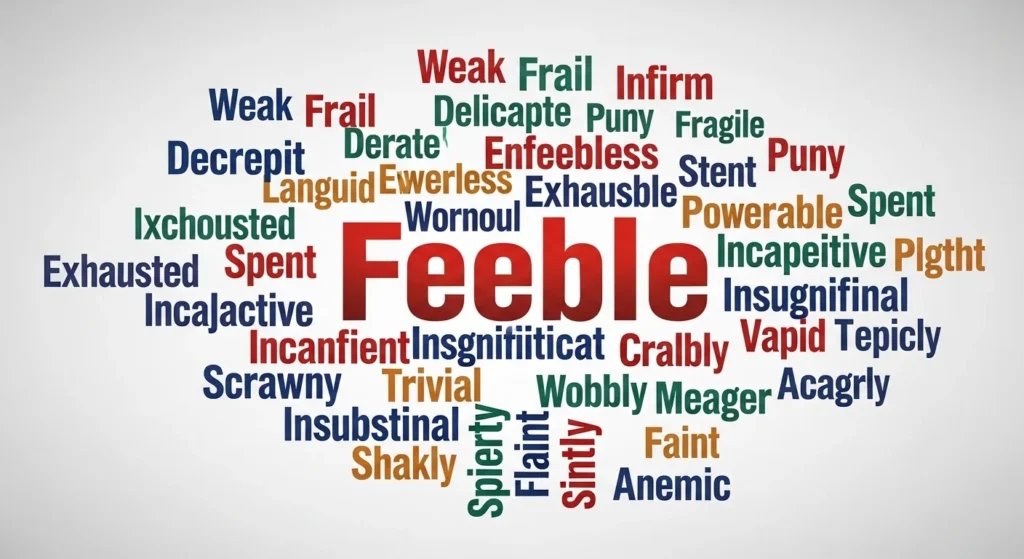
Feeble is a word that describes something weak, lacking strength, or not powerful. Imagine an older person trying to lift a heavy bag at a grocery store. His hands shake, and he struggles to hold it because his body has become feeble with age. In daily life, people often use this word to talk about weak health, weak arguments, or weak efforts.
The word feeble appears often in conversations, books, and academic writing. For English learners and content writers, knowing synonyms of this word is very useful. Learning synonyms helps avoid repetition and makes writing more expressive and precise. When you understand similar words, you can choose the best one for each situation.
This article explains the meaning of feeble, its pronunciation, history, grammar structure, and semantic use.
It also introduces 30 useful synonyms with examples to help you expand your vocabulary and improve your English communication skills.
Meaning of Feeble
Definition
Feeble (Adjective):
Something that is weak, lacking strength, energy, or effectiveness.
Examples
- The old man spoke in a feeble voice.
- After the illness, she felt feeble and tired.
Connotative Meaning
(Connotation: the emotional or cultural feeling associated with a word beyond its dictionary meaning.)
- Positive tone: Sometimes used gently for older people to show sympathy.
- Negative tone: Often suggests weakness, lack of power, or poor ability.
- Neutral tone: Can simply describe low strength or intensity.
Etymology
- Origin: From Old French “feble”, meaning weak or frail.
- Root Source: Latin “flebilis” or “debilis”, meaning weak or powerless.
Short History
- Old English (450–1100): The concept of weakness existed but the exact word was rare.
- Middle English (1100–1500): Borrowed from Old French as feble.
- Modern English (1500–Present): Spelling evolved to feeble, widely used to describe weakness in strength, health, or ideas.
Pronunciation (US & UK – IPA)
US: /ˈfiːbəl/
UK: /ˈfiːbəl/
Syllables
fee-ble
Affixation Pattern of Feeble
Root: feeble
Prefix: none
Suffix: none
Word Formation
- Feebly (Adverb) – in a weak manner
- Feebleness (Noun) – the state of being weak
- Feeble-minded (Adjective) – lacking strong mental ability
A List of 30 Synonyms for Feeble
1. Weak (Adjective)
US /wiːk/ | UK /wiːk/
Meaning: lacking physical strength or power.
Examples:
- He felt weak after the long illness.
- The bridge looked too weak to hold the heavy truck.
2. Frail (Adjective)
US /freɪl/ | UK /freɪl/
Meaning: physically delicate and easily harmed.
Examples:
- The frail woman walked slowly with a cane.
- His frail body needed rest.
3. Fragile (Adjective)
US /ˈfrædʒəl/ | UK /ˈfrædʒaɪl/
Meaning: easily broken or damaged.
Examples:
- The vase is fragile, so handle it carefully.
- Her health became fragile after the surgery.
4. Infirm (Adjective)
US /ɪnˈfɜːrm/ | UK /ɪnˈfɜːm/
Meaning: physically weak, often due to age.
Examples:
- The infirm patient needed assistance.
- The shelter cares for infirm older people.
5. Delicate (Adjective)
US /ˈdelɪkət/ | UK /ˈdelɪkət/
Meaning: easily damaged or weak in structure.
Examples:
- The baby has delicate skin.
- The plant has delicate leaves.
6. Powerless (Adjective)
US /ˈpaʊərləs/ | UK /ˈpaʊələs/
Meaning: without power or control.
Examples:
- He felt powerless to change the situation.
- The workers were powerless against the decision.
7. Helpless (Adjective)
US /ˈhelp.ləs/ | UK /ˈhelp.ləs/
Meaning: unable to help oneself.
Examples:
- The injured bird looked helpless.
- She felt helpless during the storm.
8. Sickly (Adjective)
US /ˈsɪkli/ | UK /ˈsɪkli/
Meaning: often ill and weak.
Examples:
- The child looked sickly.
- He had a sickly appearance.
9. Debilitated (Adjective)
US /dɪˈbɪlɪteɪtɪd/ | UK /dɪˈbɪlɪteɪtɪd/
Meaning: weakened by illness or hardship.
Examples:
- The patient was debilitated after surgery.
- Years of stress left him debilitated.
10. Exhausted (Adjective)
US /ɪɡˈzɔːstɪd/ | UK /ɪɡˈzɔːstɪd/
Meaning: extremely tired and weak.
Examples:
- She felt exhausted after the marathon.
- The workers looked exhausted.
11. Tired (Adjective)
US /ˈtaɪərd/ | UK /ˈtaɪəd/
Meaning: lacking energy due to effort.
Examples:
- I am too tired to work today.
- The child felt tired after playing.
12. Faint (Adjective)
US /feɪnt/ | UK /feɪnt/
Meaning: barely strong or noticeable.
Examples:
- He spoke in a faint voice.
- A faint sound came from the room.
13. Lame (Adjective)
US /leɪm/ | UK /leɪm/
Meaning: weak or ineffective.
Examples:
- That was a lame excuse.
- The joke sounded lame.
14. Ineffective (Adjective)
US /ˌɪnɪˈfektɪv/ | UK /ˌɪnɪˈfektɪv/
Meaning: not producing the desired result.
Examples:
- The treatment was ineffective.
- His argument seemed ineffective.
15. Soft (Adjective)
US /sɔːft/ | UK /sɒft/
Meaning: lacking firmness or strength.
Examples:
- The metal felt too soft.
- He spoke in a soft voice.
16. Flimsy (Adjective)
US /ˈflɪmzi/ | UK /ˈflɪmzi/
Meaning: weak and easily broken.
Examples:
- The chair looked flimsy.
- They built a flimsy shelter.
17. Puny (Adjective)
US /ˈpjuːni/ | UK /ˈpjuːni/
Meaning: very small and weak.
Examples:
- The kitten looked puny.
- His puny attempt failed.
18. Meager (Adjective)
US /ˈmiːɡər/ | UK /ˈmiːɡə/
Meaning: lacking strength, amount, or quality.
Examples:
- They had a meager meal.
- His support was meager.
19. Slight (Adjective)
US /slaɪt/ | UK /slaɪt/
Meaning: small or weak in degree.
Examples:
- She felt a slight pain.
- There was a slight chance of rain.
20. Tender (Adjective)
US /ˈtendər/ | UK /ˈtendə/
Meaning: sensitive or easily hurt.
Examples:
- His arm felt tender.
- The child had tender skin.
21. Underpowered (Adjective)
US /ˌʌndərˈpaʊərd/ | UK /ˌʌndəˈpaʊəd/
Meaning: lacking enough strength or power.
Examples:
- The engine felt underpowered.
- The device seemed underpowered.
22. Withered (Adjective)
US /ˈwɪðərd/ | UK /ˈwɪðəd/
Meaning: weak or dried due to age or heat.
Examples:
- The plant looked withered.
- His hands were withered with age.
23. Weak-kneed (Adjective)
US /ˌwiːkˈniːd/ | UK /ˌwiːkˈniːd/
Meaning: lacking courage or strength.
Examples:
- He felt weak-kneed before the speech.
- The leader looked weak-kneed.
24. Impotent (Adjective)
US /ˈɪmpətənt/ | UK /ˈɪmpətənt/
Meaning: lacking power or effectiveness.
Examples:
- The protest felt impotent.
- The government seemed impotent.
25. Sluggish (Adjective)
US /ˈslʌɡɪʃ/ | UK /ˈslʌɡɪʃ/
Meaning: slow and lacking energy.
Examples:
- The computer became sluggish.
- He felt sluggish in the morning.
26. Listless (Adjective)
US /ˈlɪstləs/ | UK /ˈlɪstləs/
Meaning: lacking energy or enthusiasm.
Examples:
- She felt listless all day.
- The students looked listless.
27. Drained (Adjective)
US /dreɪnd/ | UK /dreɪnd/
Meaning: extremely tired and weak.
Examples:
- I felt drained after work.
- The long trip left him drained.
28. Fragilized (Adjective)
US /ˈfrædʒəlaɪzd/ | UK /ˈfrædʒəlaɪzd/
Meaning: made weak or brittle.
Examples:
- The metal became fragilized.
- Heat fragilized the material.
29. Anemic (Adjective)
US /əˈniːmɪk/ | UK /əˈniːmɪk/
Meaning: weak or lacking strength.
Examples:
- The patient looked anemic.
- Sales growth was anemic.
30. Power-starved (Adjective)
US /ˈpaʊər stɑːrvd/ | UK /ˈpaʊə stɑːvd/
Meaning: lacking energy or strength.
Examples:
- The system felt power-starved.
- The machine was power-starved.
Prototype Meaning
The typical meaning of feeble refers to something physically weak or lacking strength. Most people imagine an older person with little energy, a weak voice, or a weak attempt when they hear the word. The word often describes low physical strength, weak health, or ineffective effort.
Prototype Categorization
Synonyms of feeble can be grouped based on context:
- Physical weakness: frail, infirm, sickly, debilitated
- Low energy: tired, exhausted, drained, sluggish
- Weak structure: fragile, flimsy, delicate
- Weak effectiveness: ineffective, lame, powerless
Categorizing synonyms helps writers choose the best word depending on whether they are describing health, strength, structure, or effectiveness.
Antonyms of Feeble
- Strong (Adjective): having great power or strength
- Powerful (Adjective): having strong influence or force
- Robust (Adjective): healthy and strong
- Energetic (Adjective): full of energy and activity
- Vigorous (Adjective): strong, active, and healthy
Short Questions and Answers
- What does feeble mean?
It means weak, lacking strength, energy, or effectiveness. - When should feeble be used?
It is used to describe weak health, weak voices, weak arguments, or weak attempts. - Is feeble positive or negative?
It is usually negative, but it can be neutral or sympathetic when describing older people. - How is it different from similar words?
Feeble focuses on lack of strength, while words like fragile focus on easily broken, and tired focuses on lack of energy.
Conclusion
Learning the word feeble and its synonyms is a great way to strengthen your English vocabulary. When you understand many related words, you can express ideas more clearly and avoid repeating the same term again and again. These synonyms help improve writing, speaking, and reading skills. Writers can choose the most suitable word depending on context, tone, and meaning. Expanding vocabulary also builds confidence in communication and makes language more expressive. By practicing new words daily and using them in sentences, learners gradually become more fluent in English. Keep exploring synonyms, meanings, and examples to develop a richer and more powerful vocabulary.

I am a linguist with 17 years of experience in English language teaching, including postgraduate-level instruction. My expertise includes English grammar, and I contribute as a content and blog writer, producing scholarly and educational language resources.