
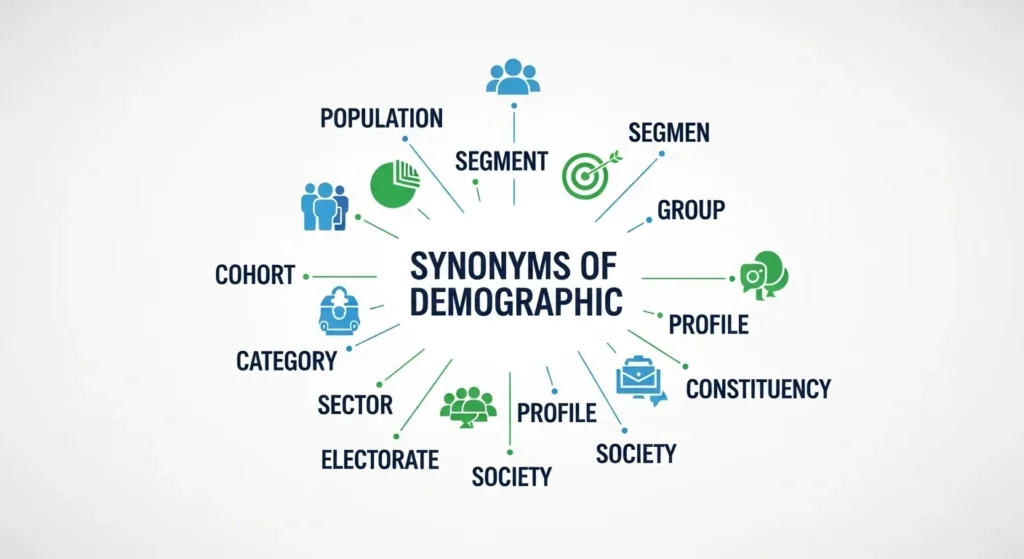
The word demographic is common in daily life. It refers to a group of people who share certain features like age, gender, or income. Imagine a company planning to sell a new phone. They study young people, working adults, or seniors. These groups are called demographics. This word is widely used in business, marketing, education, and social studies.
Learning synonyms of demographic helps English learners and writers avoid repeating the same word again and again. It also helps you express ideas more clearly in different situations.
In this article, you will learn the meaning of demographic, its pronunciation, history, and word structure. You will also explore 30 useful synonyms with examples, so you can improve your vocabulary and writing skills in an easy and practical way.
Meaning of Demographic
Definition
Demographic (noun):
A group of people in a population who share similar characteristics such as age, gender, income, or education.
Examples
- The company is targeting a young demographic.
- This product is popular among a specific demographic.
Connotative Meaning
(Connotation: the emotional or cultural meaning linked to a word beyond its basic definition)
- Positive tone: Useful for research, planning, and understanding people
- Negative tone: Can feel too technical or impersonal
- Neutral tone: Commonly used in data, studies, and reports
Etymology
- From Greek dēmos (people) + graphia (writing or description)
History:
- Old English (450–1100): No direct use, but ideas about population existed
- Middle English (1100–1500): Concepts of people groups developed
- Modern English (1500–Present): Word formed in the 19th century for population studies
Pronunciation (US & UK – IPA)
- US: /ˌdɛməˈɡræfɪk/
- UK: /ˌdeməˈɡræfɪk/
Syllables
de-mo-graph-ic
Affixation Pattern of Demographic
- Root: demo (people)
- Prefix: none
- Suffix: -graphic (related to writing or description)
Word Formation of Demographic
- Demography (noun) – study of populations
- Demographer (noun) – person who studies populations
- Demographically (adverb) – in terms of population groups
A List of 30 Synonyms for Demographic
1. Population (noun)
US: /ˌpɑːpjəˈleɪʃən/ | UK: /ˌpɒpjʊˈleɪʃən/
Meaning: All people living in a place
Examples:
- The population is growing fast.
- The city has a large population.
2. Group (noun)
US: /ɡruːp/ | UK: /ɡruːp/
Meaning: A number of people together
Examples:
- A group of students joined.
- This group prefers online learning.
3. Segment (noun)
US: /ˈseɡmənt/ | UK: /ˈseɡmənt/
Meaning: A part of a larger group
Examples:
- The market segment is small.
- This segment includes teens.
4. Category (noun)
US: /ˈkætəɡɔːri/ | UK: /ˈkætəɡəri/
Meaning: A class or division
Examples:
- This falls into a new category.
- Age is one category.
5. Sector (noun)
US: /ˈsektər/ | UK: /ˈsektə/
Meaning: A part of society or economy
Examples:
- The youth sector is active.
- This sector is growing.
6. Class (noun)
US: /klæs/ | UK: /klɑːs/
Meaning: A group based on status
Examples:
- The middle class is rising.
- This class spends more.
7. Audience (noun)
US: /ˈɔːdiəns/ | UK: /ˈɔːdiəns/
Meaning: People watching or listening
Examples:
- The audience liked the show.
- Target audience matters.
8. Market (noun)
US: /ˈmɑːrkɪt/ | UK: /ˈmɑːkɪt/
Meaning: Group of buyers
Examples:
- The market is young.
- This market prefers apps.
9. Community (noun)
US: /kəˈmjuːnəti/ | UK: /kəˈmjuːnəti/
Meaning: People living together
Examples:
- The community is helpful.
- A strong community grows.
10. Public (noun)
US: /ˈpʌblɪk/ | UK: /ˈpʌblɪk/
Meaning: Ordinary people
Examples:
- The public supports this.
- Public opinion matters.
11. Society (noun)
US: /səˈsaɪəti/ | UK: /səˈsaɪəti/
Meaning: People as a whole
Examples:
- Society is changing.
- This affects society.
12. Subgroup (noun)
US: /ˈsʌbɡruːp/ | UK: /ˈsʌbɡruːp/
Meaning: Smaller group within a group
Examples:
- A subgroup was studied.
- This subgroup is unique.
13. Tribe (noun)
US: /traɪb/ | UK: /traɪb/
Meaning: Social group with shared culture
Examples:
- The tribe lives nearby.
- Each tribe has traditions.
14. Ethnicity (noun)
US: /eθˈnɪsɪti/ | UK: /eθˈnɪsɪti/
Meaning: Cultural background group
Examples:
- Ethnicity shapes identity.
- Many ethnicities live here.
15. Age group (noun)
US: /eɪdʒ ɡruːp/ | UK: /eɪdʒ ɡruːp/
Meaning: People of similar age
Examples:
- This age group loves games.
- Teens are one age group.
16. Gender group (noun)
US: /ˈdʒɛndər ɡruːp/ | UK: /ˈdʒɛndə ɡruːp/
Meaning: Group based on gender
Examples:
- This gender group buys more.
- Data shows differences.
17. Income group (noun)
US: /ˈɪnkʌm ɡruːp/ | UK: /ˈɪnkʌm ɡruːp/
Meaning: Group based on income
Examples:
- High-income groups spend more.
- This group saves money.
18. Target group (noun)
US: /ˈtɑːrɡɪt ɡruːp/ | UK: /ˈtɑːɡɪt ɡruːp/
Meaning: Intended audience
Examples:
- The target group is students.
- Ads focus on this group.
19. Cohort (noun)
US: /ˈkoʊhɔːrt/ | UK: /ˈkəʊhɔːt/
Meaning: Group with shared time or experience
Examples:
- The 2020 cohort graduated.
- Each cohort differs.
20. People (noun)
US: /ˈpiːpəl/ | UK: /ˈpiːpəl/
Meaning: Humans in general
Examples:
- People like comfort.
- People change trends.
21. Masses (noun)
US: /ˈmæsɪz/ | UK: /ˈmæsɪz/
Meaning: Large number of people
Examples:
- The masses supported it.
- It reached the masses.
22. Constituency (noun)
US: /kənˈstɪtʃuənsi/ | UK: /kənˈstɪtjuənsi/
Meaning: Group of supporters
Examples:
- The constituency voted.
- Each group matters.
23. Clientele (noun)
US: /ˌkliːənˈtɛl/ | UK: /ˌkliːɒnˈtɛl/
Meaning: Customers of a service
Examples:
- The clientele is loyal.
- New clientele arrived.
24. Base (noun)
US: /beɪs/ | UK: /beɪs/
Meaning: Main group of users
Examples:
- The user base is large.
- A strong base helps.
25. Followers (noun)
US: /ˈfɑːloʊərz/ | UK: /ˈfɒləʊəz/
Meaning: People who support
Examples:
- Followers grew fast.
- Many followers joined.
26. Residents (noun)
US: /ˈrɛzɪdənts/ | UK: /ˈrɛzɪdənts/
Meaning: People living in a place
Examples:
- Residents complained.
- City residents voted.
27. Citizens (noun)
US: /ˈsɪtɪzənz/ | UK: /ˈsɪtɪzənz/
Meaning: Legal members of a country
Examples:
- Citizens have rights.
- Citizens voted today.
28. Participants (noun)
US: /pɑːrˈtɪsɪpənts/ | UK: /pɑːˈtɪsɪpənts/
Meaning: People taking part
Examples:
- Participants joined the study.
- All participants agreed.
29. Sample (noun)
US: /ˈsæmpəl/ | UK: /ˈsɑːmpəl/
Meaning: Small group for study
Examples:
- The sample was small.
- Researchers used a sample.
30. Segment of population (noun)
US: /ˈseɡmənt/ | UK: /ˈseɡmənt/
Meaning: Specific part of people
Examples:
- A segment of population responded.
- This segment is active.
Prototype Meaning
The typical meaning of demographic is a specific group of people defined by shared features like age, income, or gender. People often imagine charts, surveys, or market research when they hear this word.
Prototype Categorization
- General groups: population, people, public
- Social divisions: class, community, society
- Market-related: audience, target group, clientele
- Data-focused: sample, cohort, segment
Categorization helps writers choose the best word based on context. For example, use audience for media and cohort for research.
Antonyms of Demographic
- Individual (noun): one person
- Single entity (noun): one unit only
- Isolation (noun): being alone
- Outlier (noun): someone outside a group
Short Questions and Answers
- What does demographic mean?
It means a group of people with shared traits. - When should demographic be used?
Use it in studies, business, and social topics. - Is demographic positive or negative?
It is neutral, depending on context. - How is it different from similar words?
It is more formal and used for data and analysis.
Conclusion
Learning the word demographic and its synonyms helps you grow your vocabulary in a smart way. It improves your writing and speaking by giving you many options to express ideas clearly. It also helps you avoid repeating the same word again and again. Understanding these words builds confidence in English, especially for students, writers, and professionals. With regular practice, you can use these synonyms in real-life situations like essays, reports, and conversations. Make it a habit to learn and use new words daily. Over time, your English will become stronger, clearer, and more effective.

I am a linguist with 17 years of experience in English language teaching, including postgraduate-level instruction. My expertise includes English grammar, and I contribute as a content and blog writer, producing scholarly and educational language resources.