The word “don’t” is one of the most common words in English. It is a short form of “do not.” People use it every day in speaking and writing. For example, a mother may say, “Don’t touch the stove.” A teacher may say, “Don’t forget your homework.” The word helps people give warnings, advice, requests, or negative statements in a quick and natural way.
Learning synonyms of “don’t” is useful for English learners, students, bloggers, and writers. It helps improve vocabulary, makes writing more interesting, and avoids repeating the same word again and again. Different synonyms also fit different situations and tones.
In this article, you will learn the meaning of “don’t,” its pronunciation, history, grammar, semantic categories, and 30 useful synonyms with simple examples.
Meaning of Don’t
Definition
Don’t (Contraction / Auxiliary Verb):
A short form of “do not.” It is used to make negative sentences, commands, warnings, and requests.
Examples
- “Don’t open the door late at night.”
- “I don’t like cold weather.”
Connotative Meaning
(Connotation means the emotional feeling or tone connected with a word.)
- Positive tone: Used for gentle advice or care.
- Negative tone: Used for warnings, anger, or refusal.
- Neutral tone: Used in normal daily conversation.
Etymology
- The word “don’t” comes from the phrase “do not.”
- Source language: English
- Original meaning: Negative form of the verb “do.”
Short History of the Keyword
- Old English (450–1100): People used separate negative forms instead of contractions.
- Middle English (1100–1500): “Do” became common in questions and negatives.
- Modern English (1500–Present): “Don’t” appeared as a shortened spoken form of “do not.”
Pronunciation (US & UK – IPA)
- US: /doʊnt/
- UK: /dəʊnt/
Syllables
- don’t
Affixation Pattern of Don’t
- Root: do
- Prefix: none
- Suffix: not (contracted form)
Word Formation of the Keyword
- Do — Verb
- Does — Verb
- Did — Verb
- Doing — Verb/Gerund
- Done — Verb/Adjective
- Don’t — Contraction
- Doesn’t — Contraction
- Didn’t — Contraction
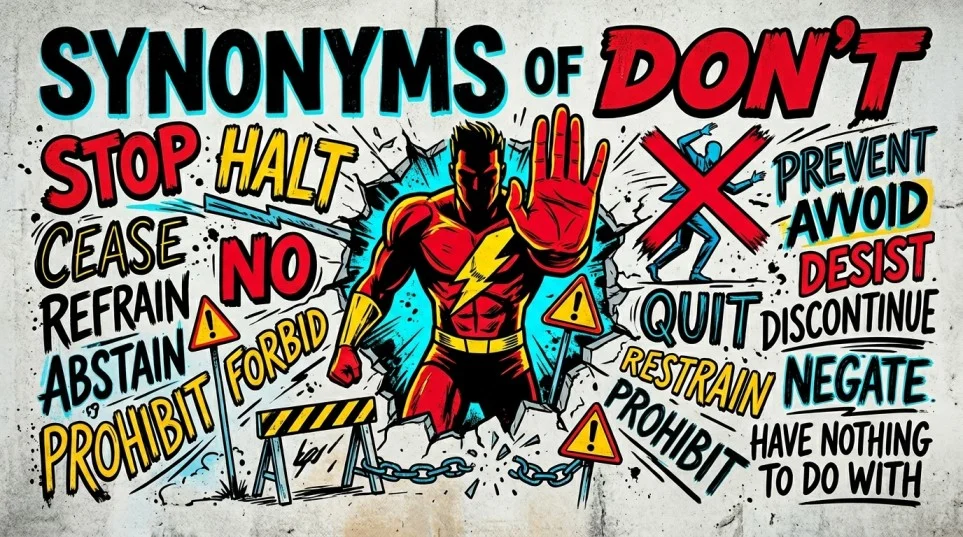
A List of 30 Synonyms for Don’t
1. Avoid (Verb)
US: /əˈvɔɪd/ | UK: /əˈvɔɪd/
Meaning: To stay away from something.
Examples:
- Avoid talking during the meeting.
- She avoids unhealthy food.
2. Refrain (Verb)
US: /rɪˈfreɪn/ | UK: /rɪˈfreɪn/
Meaning: To stop yourself from doing something.
Examples:
- Refrain from shouting.
- Please refrain from smoking here.
3. Stop (Verb)
US: /stɑːp/ | UK: /stɒp/
Meaning: To end an action.
Examples:
- Stop making noise.
- He stopped arguing.
4. Prevent (Verb)
US: /prɪˈvent/ | UK: /prɪˈvent/
Meaning: To keep something from happening.
Examples:
- Good habits prevent illness.
- The police prevented the fight.
5. Forbid (Verb)
US: /fərˈbɪd/ | UK: /fəˈbɪd/
Meaning: To officially not allow something.
Examples:
- The school forbids cheating.
- Smoking is forbidden here.
6. Prohibit (Verb)
US: /proʊˈhɪbɪt/ | UK: /prəˈhɪbɪt/
Meaning: To ban something by rule or law.
Examples:
- The law prohibits theft.
- The park prohibits littering.
7. Decline (Verb)
US: /dɪˈklaɪn/ | UK: /dɪˈklaɪn/
Meaning: To politely refuse.
Examples:
- She declined the offer.
- He declined to comment.
8. Reject (Verb)
US: /rɪˈdʒekt/ | UK: /rɪˈdʒekt/
Meaning: To refuse to accept something.
Examples:
- They rejected the plan.
- He rejected the invitation.
9. Resist (Verb)
US: /rɪˈzɪst/ | UK: /rɪˈzɪst/
Meaning: To fight against something.
Examples:
- Resist bad habits.
- She resisted temptation.
10. Oppose (Verb)
US: /əˈpoʊz/ | UK: /əˈpəʊz/
Meaning: To disagree with something.
Examples:
- Many people oppose violence.
- He opposed the decision.
11. Deny (Verb)
US: /dɪˈnaɪ/ | UK: /dɪˈnaɪ/
Meaning: To say something is not true.
Examples:
- He denied the rumor.
- She denied knowing him.
12. Refuse (Verb)
US: /rɪˈfjuːz/ | UK: /rɪˈfjuːz/
Meaning: To say no to something.
Examples:
- They refused help.
- I refuse to lie.
13. Ignore (Verb)
US: /ɪɡˈnɔːr/ | UK: /ɪɡˈnɔː/
Meaning: To pay no attention.
Examples:
- Ignore negative comments.
- He ignored the warning.
14. Disallow (Verb)
US: /ˌdɪsəˈlaʊ/ | UK: /ˌdɪsəˈlaʊ/
Meaning: To not permit something.
Examples:
- The teacher disallowed phones.
- Rules disallow cheating.
15. Ban (Verb)
US: /bæn/ | UK: /bæn/
Meaning: To officially stop something.
Examples:
- The city banned smoking.
- They banned plastic bags.
16. Block (Verb)
US: /blɑːk/ | UK: /blɒk/
Meaning: To stop movement or action.
Examples:
- The wall blocks the road.
- He blocked harmful websites.
17. Hinder (Verb)
US: /ˈhɪndər/ | UK: /ˈhɪndə/
Meaning: To make progress difficult.
Examples:
- Rain hindered travel.
- Fear hinders success.
18. Discourage (Verb)
US: /dɪsˈkɜːrɪdʒ/ | UK: /dɪsˈkʌrɪdʒ/
Meaning: To make someone less confident.
Examples:
- Bad words discourage children.
- Do not discourage new learners.
19. Abstain (Verb)
US: /əbˈsteɪn/ | UK: /əbˈsteɪn/
Meaning: To choose not to do something.
Examples:
- He abstained from alcohol.
- Many voters abstained.
20. Cease (Verb)
US: /siːs/ | UK: /siːs/
Meaning: To stop completely.
Examples:
- The noise ceased suddenly.
- Fighting finally ceased.
21. Withhold (Verb)
US: /wɪðˈhoʊld/ | UK: /wɪðˈhəʊld/
Meaning: To keep back something.
Examples:
- She withheld information.
- They withheld payment.
22. Cancel (Verb)
US: /ˈkænsəl/ | UK: /ˈkænsəl/
Meaning: To decide something will not happen.
Examples:
- They canceled the trip.
- The game was canceled.
23. Neglect (Verb)
US: /nɪˈɡlekt/ | UK: /nɪˈɡlekt/
Meaning: To fail to care for something.
Examples:
- Do not neglect your studies.
- He neglected his duties.
24. Suppress (Verb)
US: /səˈpres/ | UK: /səˈpres/
Meaning: To stop something forcefully.
Examples:
- The army suppressed the protest.
- She suppressed her anger.
25. Restrict (Verb)
US: /rɪˈstrɪkt/ | UK: /rɪˈstrɪkt/
Meaning: To limit something.
Examples:
- Rules restrict parking.
- The doctor restricted sugar.
26. Eliminate (Verb)
US: /ɪˈlɪməneɪt/ | UK: /ɪˈlɪmɪneɪt/
Meaning: To remove completely.
Examples:
- Exercise eliminates stress.
- The team eliminated errors.
27. Quit (Verb)
US: /kwɪt/ | UK: /kwɪt/
Meaning: To stop doing something.
Examples:
- He quit smoking.
- She quit the job.
28. Escape (Verb)
US: /ɪˈskeɪp/ | UK: /ɪˈskeɪp/
Meaning: To get away from something.
Examples:
- The bird escaped the cage.
- He escaped danger.
29. Dodge (Verb)
US: /dɑːdʒ/ | UK: /dɒdʒ/
Meaning: To avoid something quickly.
Examples:
- She dodged the question.
- He dodged the ball.
30. Evade (Verb)
US: /ɪˈveɪd/ | UK: /ɪˈveɪd/
Meaning: To avoid something cleverly.
Examples:
- The thief evaded police.
- He evaded responsibility.
Prototype Meaning
The most common meaning of “don’t” is telling someone not to do something. People usually imagine a warning, request, or negative statement. It is often used in daily speech between friends, parents, teachers, and workers.
Prototype Categorization
- Warning words: avoid, refrain, stop, prevent
- Refusal words: decline, reject, refuse
- Law and rule words: ban, prohibit, forbid
- Limitation words: restrict, hinder, block
- Avoidance words: dodge, evade, escape
Categorization helps writers choose the best synonym for each situation. Some words sound formal, while others sound casual or emotional.
Antonyms of Don’t
- Allow (Verb): To permit something.
- Accept (Verb): To receive willingly.
- Encourage (Verb): To give support or confidence.
- Approve (Verb): To agree with something.
- Permit (Verb): To officially allow.
- Support (Verb): To help or back someone.
- Continue (Verb): To keep doing something.
Short Questions and Answers
- What does “don’t” mean?
It means “do not.” It makes sentences negative. - When should “don’t” be used?
Use it in warnings, advice, commands, and negative statements. - Is “don’t” positive or negative?
It is mostly negative, but it can sound caring or helpful depending on context. - How is it different from similar words?
“Don’t” is a contraction used in grammar, while many synonyms are full action verbs.
Conclusion
Learning the word “don’t” and its synonyms can greatly improve English vocabulary. It helps learners speak and write with more variety and confidence. Using different synonyms also makes writing stronger and less repetitive. Some synonyms are formal, while others fit daily conversation better. Understanding meanings, pronunciation, tone, and usage helps English learners choose the correct word in every situation. Daily vocabulary practice is one of the best ways to become fluent in English. By learning these 30 powerful synonyms, students and writers can communicate ideas more clearly and naturally.

I am a linguist with 17 years of experience in English language teaching, including postgraduate-level instruction. My expertise includes English grammar, and I contribute as a content and blog writer, producing scholarly and educational language resources.