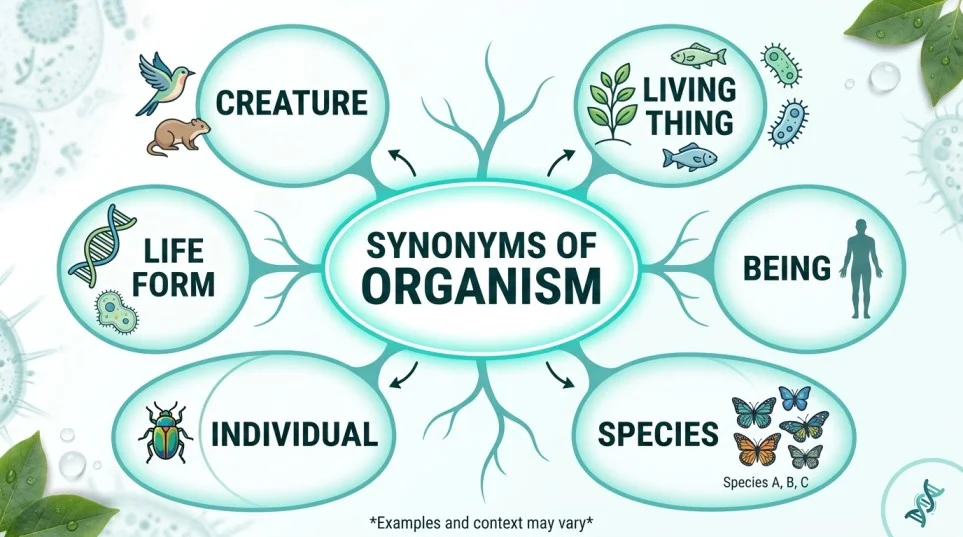
The word organism is common in science, biology, health, and daily learning. It refers to any living thing, such as a human, animal, plant, or tiny microbe. For example, a student may study how an organism grows in nature or how organisms live together in an ecosystem. This word is useful because it helps describe life in a simple and clear way.
Learning synonyms of organism is important for English learners, writers, bloggers, and students. Using different words improves speaking and writing skills. It also helps avoid repeating the same word again and again. In this article, you will learn the meaning of organism, its synonyms, pronunciation, grammar, history, connotation, and categories. Simple examples will help you understand each word more easily.
Meaning of Organism
Definition
Organism (noun):
A living thing that can grow, breathe, reproduce, and survive on its own.
Examples
- The human body is a complex organism.
- Every organism needs food and water to live.
Connotative Meaning
(Connotation means the emotional feeling or idea connected to a word.)
- Positive tone: Used to describe life, growth, and nature.
- Negative tone: Sometimes used in disease or infection discussions.
- Neutral tone: Most commonly used in scientific and educational contexts.
Etymology
- The word organism comes from Greek and Latin roots.
- It comes from the Greek word organon, meaning “tool” or “instrument.”
- The Latin word organismus later referred to a living structure.
Short History of the Keyword
- Old English (450–1100): The exact word was not used, but people used words for living beings and creatures.
- Middle English (1100–1500): Scientific language slowly developed through Latin influence.
- Modern English (1500–Present): The word organism became common in biology and science.
Pronunciation (US & UK – IPA)
- US: /ˈɔːrɡəˌnɪzəm/
- UK: /ˈɔːɡənɪzəm/
Syllables
or-gan-ism
Affixation Pattern of Organism
- Root: organ
- Prefix: none
- Suffix: -ism
Word Formation of the Keyword
- Organ (noun)
- Organic (adjective)
- Organize (verb)
- Organization (noun)
- Organically (adverb)
- Organismal (adjective)
A List of 30 Synonyms for Organism
1. Creature (Noun)
US: /ˈkriːtʃər/ | UK: /ˈkriːtʃə/
Meaning: A living being, usually an animal or human.
Examples:
- The forest is home to many creatures.
- Every creature needs shelter.
2. Being (Noun)
US: /ˈbiːɪŋ/ | UK: /ˈbiːɪŋ/
Meaning: A living thing with life and existence.
Examples:
- Human beings need sleep.
- Every being deserves respect.
3. Life-form (Noun)
US: /ˈlaɪf fɔːrm/ | UK: /ˈlaɪf fɔːm/
Meaning: Any form of living thing.
Examples:
- Scientists found a new life-form.
- Tiny life-forms live in water.
4. Animal (Noun)
US: /ˈænɪməl/ | UK: /ˈænɪməl/
Meaning: A living creature that is not a plant.
Examples:
- The zoo has many animals.
- Some animals live in deserts.
5. Plant (Noun)
US: /plænt/ | UK: /plɑːnt/
Meaning: A living thing that grows in soil.
Examples:
- This plant needs sunlight.
- Plants produce oxygen.
6. Microbe (Noun)
US: /ˈmaɪkroʊb/ | UK: /ˈmaɪkrəʊb/
Meaning: A tiny living organism seen only with a microscope.
Examples:
- Some microbes cause disease.
- Water contains helpful microbes.
7. Bacterium (Noun)
US: /bækˈtɪriəm/ | UK: /bækˈtɪəriəm/
Meaning: A single-celled microorganism.
Examples:
- The bacterium spread quickly.
- Scientists studied the bacterium.
8. Microorganism (Noun)
US: /ˌmaɪkroʊˈɔːrɡənɪzəm/ | UK: /ˌmaɪkrəʊˈɔːɡənɪzəm/
Meaning: A very small living thing.
Examples:
- Microorganisms live everywhere.
- Some foods contain healthy microorganisms.
9. Species (Noun)
US: /ˈspiːʃiːz/ | UK: /ˈspiːʃiːz/
Meaning: A group of similar living organisms.
Examples:
- Tigers are an endangered species.
- This species lives in cold areas.
10. Life (Noun)
US: /laɪf/ | UK: /laɪf/
Meaning: Living existence.
Examples:
- Life exists in the ocean.
- Scientists search for life in space.
11. Entity (Noun)
US: /ˈentəti/ | UK: /ˈentɪti/
Meaning: Something that exists separately.
Examples:
- The cell acts as an entity.
- Each entity has a role.
12. Individual (Noun)
US: /ˌɪndɪˈvɪdʒuəl/ | UK: /ˌɪndɪˈvɪdʒuəl/
Meaning: A single living being.
Examples:
- Each individual is unique.
- The study focused on one individual.
13. Living Thing (Noun)
US: /ˈlɪvɪŋ θɪŋ/ | UK: /ˈlɪvɪŋ θɪŋ/
Meaning: Anything alive.
Examples:
- Water is important for every living thing.
- A tree is a living thing.
14. Mammal (Noun)
US: /ˈmæməl/ | UK: /ˈmæməl/
Meaning: A warm-blooded animal with hair or fur.
Examples:
- Dolphins are mammals.
- Every mammal feeds its young milk.
15. Human (Noun)
US: /ˈhjuːmən/ | UK: /ˈhjuːmən/
Meaning: A person or member of the human race.
Examples:
- Humans need clean air.
- The human body is complex.
16. Fauna (Noun)
US: /ˈfɔːnə/ | UK: /ˈfɔːnə/
Meaning: Animal life in a region.
Examples:
- Australia has unique fauna.
- The island protects rare fauna.
17. Flora (Noun)
US: /ˈflɔːrə/ | UK: /ˈflɔːrə/
Meaning: Plant life in a region.
Examples:
- The forest has rich flora.
- Desert flora survives with little water.
18. Cell (Noun)
US: /sel/ | UK: /sel/
Meaning: The smallest unit of life.
Examples:
- Every organism has cells.
- The doctor examined the cell.
19. Biota (Noun)
US: /baɪˈoʊtə/ | UK: /baɪˈəʊtə/
Meaning: Plant and animal life in an area.
Examples:
- Pollution harmed the biota.
- Ocean biota is diverse.
20. Beast (Noun)
US: /biːst/ | UK: /biːst/
Meaning: A large or wild animal.
Examples:
- The beast ran into the woods.
- Stories described the beast as dangerous.
21. Critter (Noun)
US: /ˈkrɪtər/ | UK: /ˈkrɪtə/
Meaning: A small living creature.
Examples:
- The child found a tiny critter.
- Small critters lived under the rock.
22. Organismal Form (Noun)
US: /ˌɔːrɡəˈnɪzəməl fɔːrm/ | UK: /ˌɔːɡənɪzəməl fɔːm/
Meaning: The physical structure of a living organism.
Examples:
- Scientists studied the organismal form.
- Shape affects the organismal form.
23. Living Entity (Noun)
US: /ˈlɪvɪŋ ˈentəti/ | UK: /ˈlɪvɪŋ ˈentɪti/
Meaning: Something alive that exists independently.
Examples:
- A virus is debated as a living entity.
- Every living entity depends on energy.
24. Soul (Noun)
US: /soʊl/ | UK: /səʊl/
Meaning: The spiritual or living essence of a being.
Examples:
- Many cultures respect every soul.
- The poem spoke about the human soul.
25. Wildlife (Noun)
US: /ˈwaɪldlaɪf/ | UK: /ˈwaɪldlaɪf/
Meaning: Animals living in nature.
Examples:
- Wildlife needs protection.
- The park supports local wildlife.
26. Inhabitant (Noun)
US: /ɪnˈhæbɪtənt/ | UK: /ɪnˈhæbɪtənt/
Meaning: A living resident of a place.
Examples:
- Fish are inhabitants of rivers.
- Forest inhabitants depend on trees.
27. Biological Unit (Noun)
US: /ˌbaɪəˈlɑːdʒɪkəl ˈjuːnɪt/ | UK: /ˌbaɪəˈlɒdʒɪkəl ˈjuːnɪt/
Meaning: A separate living system.
Examples:
- The body acts as a biological unit.
- Cells are biological units.
28. Life Creature (Noun)
US: /laɪf ˈkriːtʃər/ | UK: /laɪf ˈkriːtʃə/
Meaning: A living creature or being.
Examples:
- Every life creature needs food.
- Sea life creatures are colorful.
29. Organized Being (Noun)
US: /ˈɔːrɡənaɪzd ˈbiːɪŋ/ | UK: /ˈɔːɡənaɪzd ˈbiːɪŋ/
Meaning: A structured living form.
Examples:
- Humans are organized beings.
- Nature contains organized beings.
30. Sentient Being (Noun)
US: /ˈsenʃənt ˈbiːɪŋ/ | UK: /ˈsenʃənt ˈbiːɪŋ/
Meaning: A living being able to feel or think.
Examples:
- Many animals are sentient beings.
- People should respect sentient beings.
Prototype Meaning
The most common meaning of organism is a living thing that survives on its own. Most people imagine a human, animal, plant, or tiny microbe when they hear this word. It is strongly connected with biology, nature, and life sciences.
Prototype Categorization
- General living things: creature, being, life-form, living thing
- Scientific terms: microorganism, bacterium, biological unit, cell
- Humans and animals: mammal, human, beast, wildlife
- Plants and nature: flora, fauna, biota
- Spiritual or abstract terms: soul, sentient being
Categorization helps writers choose better words. Scientific writing may use “microorganism,” while casual speech may use “creature” or “living thing.”
Antonyms of Organism
- Object (noun): A non-living thing
- Machine (noun): A mechanical device
- Dead matter (noun): Material without life
- Nonliving entity (noun): Something without life
- Artifact (noun): A man-made object
Short Questions and Answers
- What does organism mean?
It means any living thing that can survive and grow. - When should organism be used?
It is used in biology, science, education, and discussions about life. - Is organism positive or negative?
It is usually neutral, but context may change the tone. - How is it different from similar words?
“Organism” is more scientific, while words like “creature” are more general.
Conclusion
Learning the word organism and its synonyms helps improve English vocabulary and communication skills. It makes writing and speaking more interesting because you can use different words instead of repeating the same one. Understanding pronunciation, history, meaning, and connotation also builds stronger language knowledge. Students, bloggers, and English learners can use these synonyms in science, education, and daily conversations. Regular vocabulary practice improves confidence and helps people express ideas more clearly. The more words you learn, the easier English becomes in reading, writing, and speaking.

I am a linguist with 17 years of experience in English language teaching, including postgraduate-level instruction. My expertise includes English grammar, and I contribute as a content and blog writer, producing scholarly and educational language resources.