
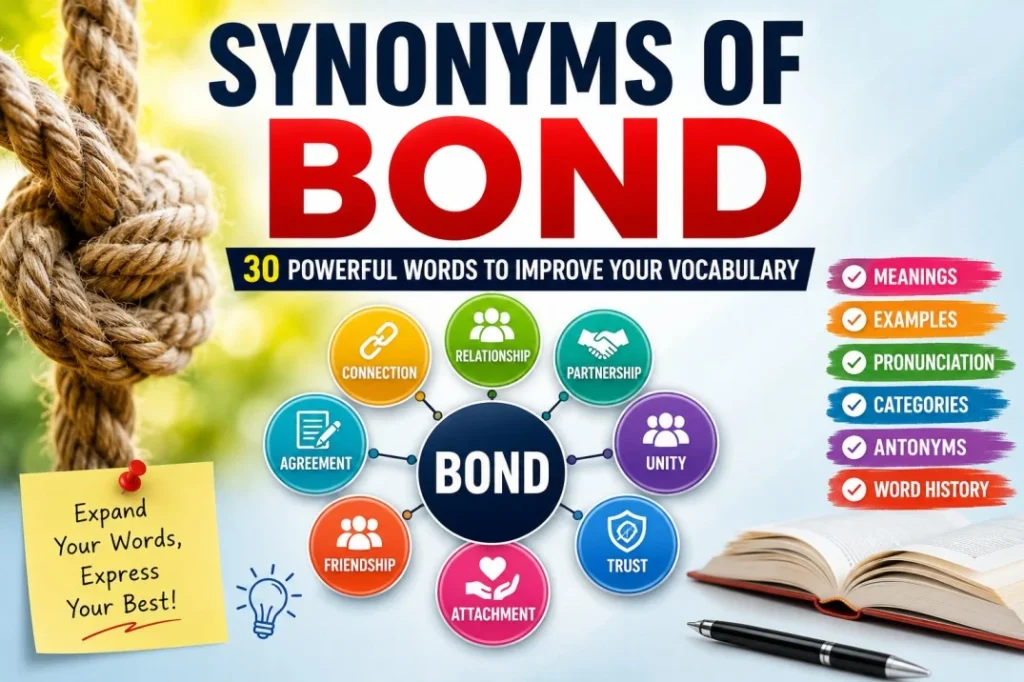
The word bond is a common English word that describes a strong connection, relationship, agreement, or tie between people, groups, or things. Imagine two childhood friends who always help each other during difficult times. Their close friendship is a strong bond. People also use this word for emotional relationships, legal agreements, financial papers, and social connections.
Learning synonyms of bond is very important for English learners, students, bloggers, and content writers. Using different words helps improve speaking and writing skills. It also avoids repetition and makes sentences sound more natural and professional.
In this article, you will learn the meaning of bond, its pronunciation, grammar, history, and emotional tone. You will also explore 30 powerful synonyms with examples, semantic categories, antonyms, and short questions and answers to improve your vocabulary.
Meaning of Bond
Definition
Bond (Noun / Verb):
A bond is a strong connection, relationship, agreement, or force that joins people or things together.
Examples
- The bond between the mother and child was very strong.
- Good teamwork creates a strong bond among workers.
Connotative Meaning
(Connotation means the emotional feeling or idea connected with a word.)
- Positive tone: love, trust, friendship, unity
- Negative tone: restriction, obligation, pressure
- Neutral tone: agreement, connection, link
Etymology
- The word bond comes from Old English bonda and Old Norse bondi.
- The original meaning related to “binding” or “tying together.”
Short History of the Keyword
- Old English (450–1100): Used for binding agreements and relationships.
- Middle English (1100–1500): Expanded to legal and social meanings.
- Modern English (1500–Present): Used for emotional ties, finance, chemistry, and human relationships.
Pronunciation (US & UK – IPA)
- US: /bɑːnd/
- UK: /bɒnd/
Syllables
bond
Affixation Pattern of Bond
- Root: bond
- Prefix: none
- Suffix: none
Word Formation of Bond
- bonding (noun/verb)
- bonded (adjective/verb)
- bondholder (noun)
- bondman (noun)
- bondless (adjective)
- bondage (noun)
A List of 30 Synonyms for Bond
1. Connection (Noun)
US: /kəˈnek.ʃən/ | UK: /kəˈnek.ʃən/
Meaning: A relationship or link between people or things.
Examples:
- She felt a deep connection with her teacher.
- Technology creates connections across the world.
2. Relationship (Noun)
US: /rɪˈleɪ.ʃən.ʃɪp/ | UK: /rɪˈleɪ.ʃən.ʃɪp/
Meaning: The way people are linked or connected.
Examples:
- Their relationship became stronger over time.
- A healthy relationship needs trust.
3. Tie (Noun)
US: /taɪ/ | UK: /taɪ/
Meaning: A connection between people or groups.
Examples:
- Family ties are important.
- The countries have strong economic ties.
4. Link (Noun)
US: /lɪŋk/ | UK: /lɪŋk/
Meaning: Something that joins two things together.
Examples:
- There is a close link between diet and health.
- Friendship creates a strong link.
5. Attachment (Noun)
US: /əˈtætʃ.mənt/ | UK: /əˈtætʃ.mənt/
Meaning: Strong emotional closeness.
Examples:
- The child had an attachment to the puppy.
- Emotional attachment can grow quickly.
6. Union (Noun)
US: /ˈjuː.njən/ | UK: /ˈjuː.njən/
Meaning: The act of joining together.
Examples:
- Marriage is a union of two people.
- The union helped workers gain rights.
7. Association (Noun)
US: /əˌsoʊ.siˈeɪ.ʃən/ | UK: /əˌsəʊ.siˈeɪ.ʃən/
Meaning: A connection between people or ideas.
Examples:
- He has a strong association with the company.
- People make associations between colors and emotions.
8. Alliance (Noun)
US: /əˈlaɪ.əns/ | UK: /əˈlaɪ.əns/
Meaning: A formal partnership or agreement.
Examples:
- The countries formed an alliance.
- Strong alliances improve business growth.
9. Friendship (Noun)
US: /ˈfrend.ʃɪp/ | UK: /ˈfrend.ʃɪp/
Meaning: A close and caring relationship.
Examples:
- Their friendship lasted many years.
- Friendship brings happiness.
10. Partnership (Noun)
US: /ˈpɑːrt.nɚ.ʃɪp/ | UK: /ˈpɑːt.nə.ʃɪp/
Meaning: Two or more people working together.
Examples:
- The business partnership was successful.
- Partnership builds trust.
11. Affiliation (Noun)
US: /əˌfɪl.iˈeɪ.ʃən/ | UK: /əˌfɪl.iˈeɪ.ʃən/
Meaning: An official connection with a group.
Examples:
- His affiliation with the school helped him.
- Political affiliations affect opinions.
12. Contact (Noun)
US: /ˈkɑːn.tækt/ | UK: /ˈkɒn.tækt/
Meaning: Communication or connection.
Examples:
- Keep contact with your family.
- She lost contact with old friends.
13. Kinship (Noun)
US: /ˈkɪn.ʃɪp/ | UK: /ˈkɪn.ʃɪp/
Meaning: Family relationship or closeness.
Examples:
- They felt a sense of kinship.
- Kinship ties unite families.
14. Unity (Noun)
US: /ˈjuː.nə.t̬i/ | UK: /ˈjuː.nə.ti/
Meaning: Being joined together.
Examples:
- Unity makes teams stronger.
- The community showed unity.
15. Harmony (Noun)
US: /ˈhɑːr.mə.ni/ | UK: /ˈhɑː.mə.ni/
Meaning: Peaceful agreement and balance.
Examples:
- The group lived in harmony.
- Harmony creates happiness.
16. Agreement (Noun)
US: /əˈɡriː.mənt/ | UK: /əˈɡriː.mənt/
Meaning: A shared decision or contract.
Examples:
- They signed an agreement.
- The agreement solved the problem.
17. Pact (Noun)
US: /pækt/ | UK: /pækt/
Meaning: A formal promise or agreement.
Examples:
- The leaders made a peace pact.
- Friends sometimes create secret pacts.
18. Contract (Noun)
US: /ˈkɑːn.trækt/ | UK: /ˈkɒn.trækt/
Meaning: A legal written agreement.
Examples:
- She signed a work contract.
- Contracts protect both sides.
19. Commitment (Noun)
US: /kəˈmɪt.mənt/ | UK: /kəˈmɪt.mənt/
Meaning: A promise or dedication.
Examples:
- Marriage requires commitment.
- His commitment impressed everyone.
20. Loyalty (Noun)
US: /ˈlɔɪ.əl.ti/ | UK: /ˈlɔɪ.əl.ti/
Meaning: Strong support and faithfulness.
Examples:
- Dogs show loyalty to owners.
- Loyalty builds strong bonds.
21. Trust (Noun)
US: /trʌst/ | UK: /trʌst/
Meaning: Confidence in someone’s honesty.
Examples:
- Trust is important in friendship.
- Broken trust hurts relationships.
22. Rapport (Noun)
US: /ræˈpɔːr/ | UK: /ræˈpɔː/
Meaning: Friendly understanding between people.
Examples:
- The teacher built rapport with students.
- Good rapport improves teamwork.
23. Brotherhood (Noun)
US: /ˈbrʌð.ɚ.hʊd/ | UK: /ˈbrʌð.ə.hʊd/
Meaning: A feeling of unity and friendship.
Examples:
- Soldiers shared brotherhood.
- Brotherhood creates support.
24. Fellowship (Noun)
US: /ˈfel.oʊ.ʃɪp/ | UK: /ˈfel.əʊ.ʃɪp/
Meaning: Friendly companionship.
Examples:
- The club encouraged fellowship.
- Fellowship brings people together.
25. Cohesion (Noun)
US: /koʊˈhiː.ʒən/ | UK: /kəʊˈhiː.ʒən/
Meaning: The act of sticking together.
Examples:
- Team cohesion improved performance.
- Strong cohesion helps success.
26. Closeness (Noun)
US: /ˈkloʊs.nəs/ | UK: /ˈkləʊs.nəs/
Meaning: Emotional nearness.
Examples:
- Their closeness was obvious.
- Family closeness is valuable.
27. Affinity (Noun)
US: /əˈfɪn.ə.t̬i/ | UK: /əˈfɪn.ə.ti/
Meaning: A natural liking or connection.
Examples:
- She has an affinity for music.
- They felt an affinity immediately.
28. Interaction (Noun)
US: /ˌɪn.t̬ɚˈæk.ʃən/ | UK: /ˌɪn.tərˈæk.ʃən/
Meaning: Communication or activity between people.
Examples:
- Social interaction improves learning.
- Positive interaction builds trust.
29. Understanding (Noun)
US: /ˌʌn.dɚˈstæn.dɪŋ/ | UK: /ˌʌn.dəˈstæn.dɪŋ/
Meaning: Shared knowledge or emotional agreement.
Examples:
- Good understanding strengthens marriage.
- The friends had mutual understanding.
30. Cooperation (Noun)
US: /koʊˌɑː.pəˈreɪ.ʃən/ | UK: /kəʊˌɒp.əˈreɪ.ʃən/
Meaning: Working together for a shared goal.
Examples:
- Cooperation improves teamwork.
- International cooperation helps peace.
Prototype Meaning
The most common meaning of bond is a strong emotional or social connection between people. When people hear the word, they usually imagine close friendships, family love, trust, loyalty, or relationships that keep people united.
Prototype Categorization
Emotional Relationships
- friendship
- attachment
- closeness
- rapport
- trust
Legal or Formal Agreements
- contract
- pact
- agreement
- alliance
Social and Human Connections
- relationship
- connection
- association
- interaction
Unity and Teamwork
- cohesion
- unity
- fellowship
- brotherhood
Family and Natural Relations
- kinship
- affinity
- loyalty
Categorization helps writers choose the best synonym for each situation. For example, “contract” fits legal writing, while “friendship” fits emotional contexts.
Antonyms of Bond
- Separation (Noun): The act of moving apart.
- Division (Noun): Breaking into parts or groups.
- Conflict (Noun): A serious disagreement.
- Distance (Noun): Lack of closeness.
- Disconnection (Noun): Absence of connection.
- Isolation (Noun): Being alone or separated.
- Hostility (Noun): Unfriendly behavior.
- Alienation (Noun): Feeling separated from others.
Short Questions and Answers
- What does bond mean?
A bond means a strong connection, relationship, or agreement. - When should bond be used?
Use bond when describing emotional ties, legal agreements, or close relationships. - Is bond positive or negative?
It is mostly positive, but sometimes neutral or negative depending on context. - How is it different from similar words?
“Bond” often suggests a stronger and deeper connection than simple words like “link” or “contact.”
Conclusion
Learning the word bond and its synonyms can greatly improve your English vocabulary. These words help writers and speakers express relationships, emotions, agreements, and human connections more clearly. Using different synonyms also avoids repetition and makes communication more natural and powerful.
Understanding pronunciation, tone, history, and categories gives learners deeper language knowledge. Whether you are a student, blogger, ESL learner, or content writer, practicing these words daily will strengthen your writing and speaking confidence. Small vocabulary improvements can create big changes in communication skills over time.

I am a linguist with 17 years of experience in English language teaching, including postgraduate-level instruction. My expertise includes English grammar, and I contribute as a content and blog writer, producing scholarly and educational language resources.