
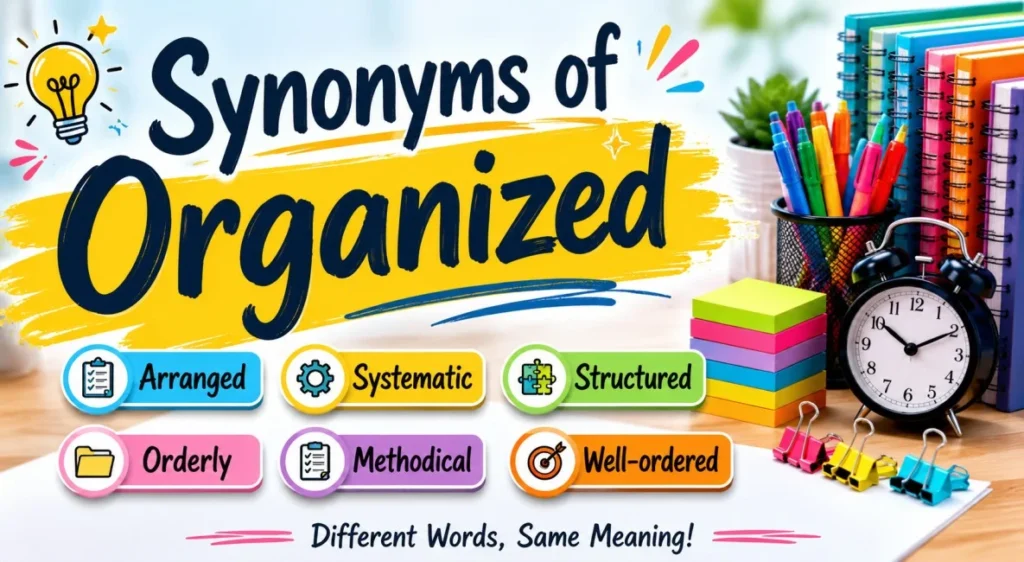
The word organized is one of the most common words in English. It describes someone or something that is arranged neatly, planned carefully, and managed efficiently. Imagine a student who keeps all notes in separate folders and always finishes assignments on time. Most people would describe that student as organized.
This word is widely used in schools, workplaces, businesses, and everyday conversations. Learning synonyms of organized helps English learners express ideas more clearly and avoid repeating the same word. It also helps content writers create richer and more engaging content.
In this article, you will learn the meaning of organized, its pronunciation, history, grammar, connotation, and word formation. You will also discover 30 powerful synonyms with meanings and examples to strengthen your vocabulary and improve your English communication skills.
Meaning of Organized
Definition
Organized (Adjective):
Arranged in a neat, orderly, and systematic way; planned and managed efficiently.
Examples
- She keeps her desk organized and clean.
- Our team is organized and completes projects on time.
Connotative Meaning
(Connotation: the emotional feeling or idea that a word suggests beyond its dictionary meaning.)
- Positive tone: Efficient, reliable, prepared, responsible.
- Negative tone: Can sometimes suggest being overly strict or controlling.
- Neutral tone: Simply arranged or structured properly.
Etymology
- Origin: From French organiser and Latin organum.
- Original meaning: “To arrange parts into a functioning whole.”
Short History of the Keyword
- Old English (450–1100): No direct form existed.
- Middle English (1100–1500): Latin and French influences introduced related concepts of arrangement.
- Modern English (1500–Present): Organized developed to mean arranged, coordinated, and managed efficiently.
Pronunciation (US & UK – IPA)
US: /ˈɔːrɡənaɪzd/
UK: /ˈɔːɡənaɪzd/
Syllables
or-gan-ized
Affixation Pattern of Organized
Root: organ
Prefix: None
Suffix: -ized
Word Formation of Organized
- Organize (Verb)
- Organization (Noun)
- Organizer (Noun)
- Organized (Adjective)
- Organizing (Verb/Adjective)
- Organizational (Adjective)
- Organizationally (Adverb)
- Reorganize (Verb)
- Reorganized (Adjective)
- Reorganization (Noun)
A List of 30 Synonyms for Organized
1. Orderly (Adjective)
US: /ˈɔːrdərli/ | UK: /ˈɔːdəli/
Meaning: Arranged neatly and systematically.
Examples:
- The files were kept in an orderly manner.
- She has an orderly workspace.
2. Systematic (Adjective)
US: /ˌsɪstəˈmætɪk/ | UK: /ˌsɪstəˈmætɪk/
Meaning: Done according to a clear system or plan.
Examples:
- He uses a systematic approach to learning.
- The investigation was systematic.
3. Structured (Adjective)
US: /ˈstrʌktʃərd/ | UK: /ˈstrʌktʃəd/
Meaning: Arranged according to a clear framework.
Examples:
- The course is highly structured.
- They followed a structured schedule.
4. Methodical (Adjective)
US: /məˈθɑːdɪkəl/ | UK: /məˈθɒdɪkəl/
Meaning: Done carefully and in an ordered way.
Examples:
- She is methodical in her work.
- His methodical planning ensured success.
5. Efficient (Adjective)
US: /ɪˈfɪʃənt/ | UK: /ɪˈfɪʃənt/
Meaning: Working effectively with little waste.
Examples:
- The office runs efficiently.
- She is an efficient manager.
6. Neat (Adjective)
US: /niːt/ | UK: /niːt/
Meaning: Clean and well arranged.
Examples:
- His room is always neat.
- She keeps neat records.
7. Tidy (Adjective)
US: /ˈtaɪdi/ | UK: /ˈtaɪdi/
Meaning: Clean and arranged properly.
Examples:
- Keep your desk tidy.
- The house looked tidy.
8. Coordinated (Adjective)
US: /koʊˈɔːrdɪneɪtɪd/ | UK: /kəʊˈɔːdɪneɪtɪd/
Meaning: Managed so that all parts work together.
Examples:
- The event was well coordinated.
- They made a coordinated effort.
9. Arranged (Adjective)
US: /əˈreɪndʒd/ | UK: /əˈreɪndʒd/
Meaning: Put into a proper order.
Examples:
- The books were arranged alphabetically.
- Everything was arranged before the meeting.
10. Planned (Adjective)
US: /plænd/ | UK: /plænd/
Meaning: Prepared in advance.
Examples:
- The trip was carefully planned.
- They followed a planned schedule.
11. Prepared (Adjective)
US: /prɪˈperd/ | UK: /prɪˈpeəd/
Meaning: Ready for a situation.
Examples:
- She was prepared for the interview.
- The team arrived prepared.
12. Disciplined (Adjective)
US: /ˈdɪsəplɪnd/ | UK: /ˈdɪsəplɪnd/
Meaning: Showing self-control and order.
Examples:
- He is a disciplined worker.
- Disciplined habits bring success.
13. Well-Ordered (Adjective)
US: /ˌwel ˈɔːrdərd/ | UK: /ˌwel ˈɔːdəd/
Meaning: Carefully arranged.
Examples:
- The library was well-ordered.
- They maintained a well-ordered system.
14. Regulated (Adjective)
US: /ˈreɡjəleɪtɪd/ | UK: /ˈreɡjʊleɪtɪd/
Meaning: Controlled according to rules.
Examples:
- The process is regulated.
- Activities were regulated properly.
15. Managed (Adjective)
US: /ˈmænɪdʒd/ | UK: /ˈmænɪdʒd/
Meaning: Controlled effectively.
Examples:
- The project was well managed.
- Resources were carefully managed.
16. Sorted (Adjective)
US: /ˈsɔːrtɪd/ | UK: /ˈsɔːtɪd/
Meaning: Put into categories or order.
Examples:
- The papers are sorted by date.
- Everything is sorted now.
17. Categorized (Adjective)
US: /ˈkætəɡəraɪzd/ | UK: /ˈkætəɡəraɪzd/
Meaning: Divided into groups.
Examples:
- The products were categorized.
- Files are categorized by subject.
18. Streamlined (Adjective)
US: /ˈstriːmlaɪnd/ | UK: /ˈstriːmlaɪnd/
Meaning: Made simpler and more efficient.
Examples:
- The workflow is streamlined.
- They streamlined the process.
19. Controlled (Adjective)
US: /kənˈtroʊld/ | UK: /kənˈtrəʊld/
Meaning: Kept in proper order.
Examples:
- The situation remained controlled.
- A controlled environment improves results.
20. Balanced (Adjective)
US: /ˈbælənst/ | UK: /ˈbælənst/
Meaning: Properly arranged without excess.
Examples:
- She has a balanced routine.
- The schedule is balanced.
21. Logical (Adjective)
US: /ˈlɑːdʒɪkəl/ | UK: /ˈlɒdʒɪkəl/
Meaning: Following clear reasoning.
Examples:
- The plan is logical.
- They used a logical method.
22. Precise (Adjective)
US: /prɪˈsaɪs/ | UK: /prɪˈsaɪs/
Meaning: Exact and carefully arranged.
Examples:
- Her records are precise.
- The instructions were precise.
23. Accurate (Adjective)
US: /ˈækjərət/ | UK: /ˈækjərət/
Meaning: Correct and carefully maintained.
Examples:
- The database is accurate.
- Accurate records are important.
24. Businesslike (Adjective)
US: /ˈbɪznəslaɪk/ | UK: /ˈbɪznəslaɪk/
Meaning: Efficient and practical.
Examples:
- She has a businesslike approach.
- The meeting was businesslike.
25. Reliable (Adjective)
US: /rɪˈlaɪəbəl/ | UK: /rɪˈlaɪəbəl/
Meaning: Dependable and consistent.
Examples:
- He is reliable at work.
- Reliable systems save time.
26. Orderly-Minded (Adjective)
US: /ˈɔːrdərli maɪndɪd/ | UK: /ˈɔːdəli maɪndɪd/
Meaning: Naturally inclined toward order.
Examples:
- She is orderly-minded.
- Orderly-minded people enjoy planning.
27. Organized-Looking (Adjective)
US: /ˈɔːrɡənaɪzd ˈlʊkɪŋ/ | UK: /ˈɔːɡənaɪzd ˈlʊkɪŋ/
Meaning: Appearing neat and arranged.
Examples:
- The office looks organized-looking.
- His desk appeared organized-looking.
28. Well-Planned (Adjective)
US: /ˌwel ˈplænd/ | UK: /ˌwel ˈplænd/
Meaning: Carefully prepared beforehand.
Examples:
- It was a well-planned event.
- Their strategy was well-planned.
29. Efficiently Managed (Adjective)
US: /ɪˈfɪʃəntli ˈmænɪdʒd/ | UK: /ɪˈfɪʃəntli ˈmænɪdʒd/
Meaning: Controlled in an effective way.
Examples:
- The company is efficiently managed.
- The project remained efficiently managed.
30. Well-Structured (Adjective)
US: /ˌwel ˈstrʌktʃərd/ | UK: /ˌwel ˈstrʌktʃəd/
Meaning: Arranged according to a strong structure.
Examples:
- The report is well-structured.
- Students benefit from a well-structured lesson.
Prototype Meaning
When people hear the word organized, they usually imagine a person, room, office, or system where everything is in the correct place. They think of someone who plans ahead, manages time well, and keeps things neat and orderly. This is the most typical and common meaning of the word.
Prototype Categorization
Categorizing synonyms helps writers choose the most suitable word for different situations.
- For neatness and cleanliness: Neat, Tidy, Orderly, Sorted
- For planning and management: Planned, Managed, Coordinated, Prepared
- For systems and processes: Systematic, Structured, Streamlined, Regulated
- For personal qualities: Disciplined, Reliable, Methodical, Orderly-Minded
- For professional settings: Businesslike, Efficient, Well-Planned, Well-Structured
Writers can select a synonym based on the exact meaning they want to express rather than using the same word repeatedly.
Antonyms of Organized
- Disorganized (Adjective) — Not arranged properly.
- Messy (Adjective) — Untidy and cluttered.
- Chaotic (Adjective) — Completely lacking order.
- Confused (Adjective) — Unclear or mixed up.
- Unsystematic (Adjective) — Not following a method.
- Disorderly (Adjective) — Not neat or controlled.
- Scattered (Adjective) — Spread around without order.
- Cluttered (Adjective) — Filled with too many things.
- Random (Adjective) — Without a plan or pattern.
- Unplanned (Adjective) — Not prepared beforehand.
Short Questions and Answers
- What does organized mean?
Organized means arranged neatly and managed in a planned, efficient way. - When should organized be used?
Use organized when describing people, systems, events, schedules, or places that are well arranged and properly managed. - Is organized positive or negative?
It is usually positive because it suggests efficiency and responsibility, though it can sometimes imply excessive control. - How is it different from similar words?
Organized is a broad term. Words like systematic emphasize method, tidy emphasizes neatness, and efficient emphasizes productivity.
Conclusion
Learning the word organized and its synonyms is an excellent way to improve your English vocabulary. These words help you describe people, workplaces, schedules, and systems more accurately. Using a variety of synonyms strengthens both writing and speaking by making communication clearer and more engaging. It also helps you avoid repeating the same word again and again. Understanding meanings, pronunciation, connotations, and usage gives you greater confidence in English. Try practicing a few new synonyms every day and use them in conversations, essays, emails, and social media posts. Small vocabulary improvements can lead to stronger communication skills and greater fluency over time.

I am a linguist with 17 years of experience in English language teaching, including postgraduate-level instruction. My expertise includes English grammar, and I contribute as a content and blog writer, producing scholarly and educational language resources.