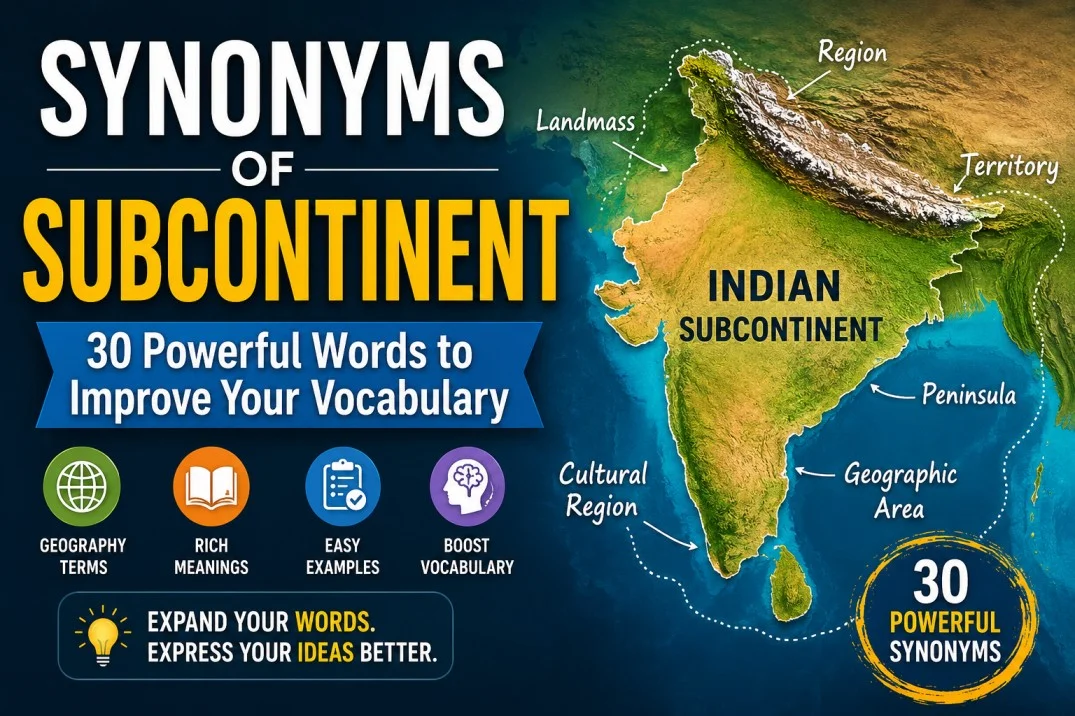
The word subcontinent is often used when talking about large land areas that are smaller than a continent but still very large and important. For example, people often call South Asia the “Indian subcontinent” because it has many countries, cultures, and languages connected by geography and history.
This word is common in geography, history, travel writing, and news articles. Students, writers, and English learners often see it in books and academic content.
Learning synonyms of subcontinent helps improve vocabulary and makes writing more natural. It also helps content writers avoid repeating the same word again and again. Some synonyms sound formal, while others fit casual or scientific contexts.
In this article, you will learn the meaning of subcontinent, its pronunciation, history, grammar, semantic categories, and 30 useful synonyms with simple examples. This guide uses easy English so beginners can understand and use the word with confidence.
Meaning of Subcontinent
Definition
Subcontinent (noun):
A very large part of a continent that has its own geography, culture, or identity.
Examples
- The Indian subcontinent includes several South Asian countries.
- The subcontinent is famous for its rich history and traditions.
Connotative Meaning
(Connotation means the emotional or cultural feeling connected to a word.)
- Positive tone: Suggests cultural richness, diversity, and importance.
- Negative tone: Sometimes used in political or historical debates.
- Neutral tone: Commonly used in geography and education.
Etymology
- Comes from Latin roots.
- “Sub” means “under” or “smaller.”
- “Continent” means a large continuous landmass.
- The word literally means “a smaller division of a continent.”
Short History of the Keyword
- Old English (450–1100): The exact word did not exist, but people used terms for large lands and regions.
- Middle English (1100–1500): Geographic language expanded through trade and exploration.
- Modern English (1500–Present): “Subcontinent” became common in geography and colonial-era writing.
Pronunciation (US & UK – IPA)
- US: /ˌsʌbˈkɑːn.tə.nənt/
- UK: /ˌsʌbˈkɒn.tɪ.nənt/
Syllables
sub-con-ti-nent
Affixation Pattern of Subcontinent
- Root: continent
- Prefix: sub-
- Suffix: none
Word Formation of the Keyword
- Subcontinental (adjective)
- Continent (noun)
- Continental (adjective)
- Intercontinental (adjective)
- Contiguity (noun)
A List of 30 Synonyms for Subcontinent
1. Region (noun)
US: /ˈriː.dʒən/ | UK: /ˈriː.dʒən/
Meaning: A large area with common features or identity.
Examples:
- The region has a warm climate.
- This region is known for farming.
2. Territory (noun)
US: /ˈter.ə.tɔːr.i/ | UK: /ˈter.ɪ.tər.i/
Meaning: An area controlled or occupied by a group or country.
Examples:
- The territory stretches across mountains.
- They explored the new territory.
3. Landmass (noun)
US: /ˈlænd.mæs/ | UK: /ˈlænd.mæs/
Meaning: A large continuous area of land.
Examples:
- Australia is a separate landmass.
- The landmass connects several nations.
4. Area (noun)
US: /ˈer.i.ə/ | UK: /ˈeə.ri.ə/
Meaning: A particular part of a place or surface.
Examples:
- The area receives heavy rainfall.
- Many people moved to the area.
5. Zone (noun)
US: /zoʊn/ | UK: /zəʊn/
Meaning: A section with a special purpose or feature.
Examples:
- The zone has tropical weather.
- It is an economic zone.
6. Division (noun)
US: /dɪˈvɪʒ.ən/ | UK: /dɪˈvɪʒ.ən/
Meaning: A separated part of something larger.
Examples:
- The division has unique traditions.
- Asia has many geographic divisions.
7. Province (noun)
US: /ˈprɑː.vɪns/ | UK: /ˈprɒv.ɪns/
Meaning: An administrative or geographic area.
Examples:
- The province is rich in minerals.
- Several provinces joined together.
8. Domain (noun)
US: /doʊˈmeɪn/ | UK: /dəˈmeɪn/
Meaning: An area controlled or influenced by someone.
Examples:
- The kingdom expanded its domain.
- Geography was his domain of study.
9. Sector (noun)
US: /ˈsek.tɚ/ | UK: /ˈsek.tər/
Meaning: A distinct part of a larger area.
Examples:
- The sector faces water shortages.
- This sector attracts tourists.
10. Sphere (noun)
US: /sfɪr/ | UK: /sfɪə/
Meaning: An area of activity or influence.
Examples:
- The sphere included nearby lands.
- The empire ruled a wide sphere.
11. Belt (noun)
US: /belt/ | UK: /belt/
Meaning: A long area with shared features.
Examples:
- The desert belt covers many miles.
- The belt produces rice and wheat.
12. Tract (noun)
US: /trækt/ | UK: /trækt/
Meaning: A large area of land.
Examples:
- A huge tract of land remained empty.
- The tract supports wildlife.
13. Expanse (noun)
US: /ɪkˈspæns/ | UK: /ɪkˈspæns/
Meaning: A wide and open area.
Examples:
- The expanse looked endless.
- Snow covered the whole expanse.
14. Territory Block (noun)
US: /ˈter.ə.tɔːr.i blɑːk/ | UK: /ˈter.ɪ.tər.i blɒk/
Meaning: A connected group of lands.
Examples:
- The territory block shared one culture.
- Trade increased across the territory block.
15. Geographic Unit (noun)
US: /ˌdʒiː.əˈɡræf.ɪk ˈjuː.nɪt/ | UK: /ˌdʒiː.əˈɡræf.ɪk ˈjuː.nɪt/
Meaning: A defined geographic section.
Examples:
- The area is treated as one geographic unit.
- Maps show the geographic unit clearly.
16. Mainland (noun)
US: /ˈmeɪn.lænd/ | UK: /ˈmeɪn.lænd/
Meaning: The main part of a country or continent.
Examples:
- Goods arrived from the mainland.
- The mainland has large cities.
17. Stretch (noun)
US: /stretʃ/ | UK: /stretʃ/
Meaning: A continuous area of land.
Examples:
- A long stretch of desert appeared ahead.
- The stretch borders the ocean.
18. Quarter (noun)
US: /ˈkwɔːr.t̬ɚ/ | UK: /ˈkwɔː.tər/
Meaning: A section or division of an area.
Examples:
- The northern quarter is colder.
- Traders lived in that quarter.
19. Segment (noun)
US: /ˈseɡ.mənt/ | UK: /ˈseɡ.mənt/
Meaning: A separated part of something larger.
Examples:
- The segment has a unique language.
- Each segment has different customs.
20. Partition (noun)
US: /pɑːrˈtɪʃ.ən/ | UK: /pɑːˈtɪʃ.ən/
Meaning: A division into parts.
Examples:
- The partition changed borders.
- People migrated after the partition.
21. District (noun)
US: /ˈdɪs.trɪkt/ | UK: /ˈdɪs.trɪkt/
Meaning: A defined local area.
Examples:
- The district is famous for tea farms.
- They traveled across the district.
22. Realm (noun)
US: /relm/ | UK: /relm/
Meaning: A kingdom or area of influence.
Examples:
- The realm covered vast lands.
- Legends came from that realm.
23. Domain Area (noun)
US: /doʊˈmeɪn ˈer.i.ə/ | UK: /dəˈmeɪn ˈeə.ri.ə/
Meaning: An area under authority or influence.
Examples:
- The ruler controlled the domain area.
- The domain area grew over time.
24. Geographic Region (noun)
US: /ˌdʒiː.əˈɡræf.ɪk ˈriː.dʒən/ | UK: /ˌdʒiː.əˈɡræf.ɪk ˈriː.dʒən/
Meaning: A specific area defined by geography.
Examples:
- The geographic region has many rivers.
- Climate shapes the geographic region.
25. Cultural Region (noun)
US: /ˈkʌl.tʃɚ.əl ˈriː.dʒən/ | UK: /ˈkʌl.tʃər.əl ˈriː.dʒən/
Meaning: An area sharing similar traditions and culture.
Examples:
- The cultural region celebrates many festivals.
- Food varies across the cultural region.
26. Peninsula (noun)
US: /pəˈnɪn.sə.lə/ | UK: /pəˈnɪn.sjʊ.lə/
Meaning: Land surrounded by water on most sides.
Examples:
- India is a large peninsula.
- The peninsula has many beaches.
27. Territory Zone (noun)
US: /ˈter.ə.tɔːr.i zoʊn/ | UK: /ˈter.ɪ.tər.i zəʊn/
Meaning: A marked geographic area.
Examples:
- The territory zone is heavily populated.
- Borders define the territory zone.
28. Continental Division (noun)
US: /ˌkɑːn.təˈnen.t̬əl dɪˈvɪʒ.ən/ | UK: /ˌkɒn.tɪˈnen.təl dɪˈvɪʒ.ən/
Meaning: A major section of a continent.
Examples:
- South Asia is a continental division.
- The continental division has diverse climates.
29. Macroregion (noun)
US: /ˈmæk.roʊˌriː.dʒən/ | UK: /ˈmæk.rəʊˌriː.dʒən/
Meaning: A very large region with shared features.
Examples:
- Economists studied the macroregion.
- The macroregion supports trade.
30. Geographical Area (noun)
US: /ˌdʒiː.əˈɡræf.ɪ.kəl ˈer.i.ə/ | UK: /ˌdʒiː.əˈɡræf.ɪ.kəl ˈeə.ri.ə/
Meaning: A specific area identified by geography.
Examples:
- The geographical area includes forests.
- Rainfall shapes the geographical area.
Prototype Meaning
The typical meaning of subcontinent is a very large land area that is smaller than a continent but still has its own culture, geography, and history. Most people imagine South Asia when they hear this word because it is the most common example.
Prototype Categorization
Synonyms of subcontinent can be grouped into categories to help writers choose the best word.
- Geographic terms: region, area, geographic region, geographical area
- Political terms: territory, province, district, partition
- Land-related terms: landmass, peninsula, tract, expanse
- Abstract divisions: segment, sector, sphere, division
- Cultural terms: cultural region, realm, domain
Categorization helps writers select the most accurate synonym for geography, politics, history, or culture.
Antonyms of Subcontinent
- Island (noun): A piece of land surrounded by water.
- Village (noun): A very small settlement or community.
- Locality (noun): A small local area.
- Point (noun): A tiny geographic location.
- Single State (noun): One political unit instead of a large region.
Short Questions and Answers
- What does subcontinent mean?
A subcontinent is a very large part of a continent with its own identity and geography. - When should subcontinent be used?
Use it when talking about large geographic regions such as South Asia. - Is subcontinent positive or negative?
It is usually neutral, but context can make it positive or political. - How is it different from similar words?
“Subcontinent” refers to a very large and distinct land area, while words like “region” or “area” may describe smaller places.
Conclusion
Learning the word subcontinent and its synonyms improves vocabulary and helps English learners express ideas more clearly. These synonyms make writing stronger and more interesting because they prevent repetition. They also improve speaking skills by giving more word choices for geography, culture, and history topics.
Understanding pronunciation, connotation, grammar, and word history builds confidence in English communication. Some synonyms fit formal writing, while others work better in casual speech. Knowing these differences helps writers choose the best word in every situation.
Daily vocabulary practice is one of the best ways to become fluent in English. By learning words like subcontinent and their meanings, learners can speak and write with greater accuracy and confidence.

I am a linguist with 17 years of experience in English language teaching, including postgraduate-level instruction. My expertise includes English grammar, and I contribute as a content and blog writer, producing scholarly and educational language resources.