
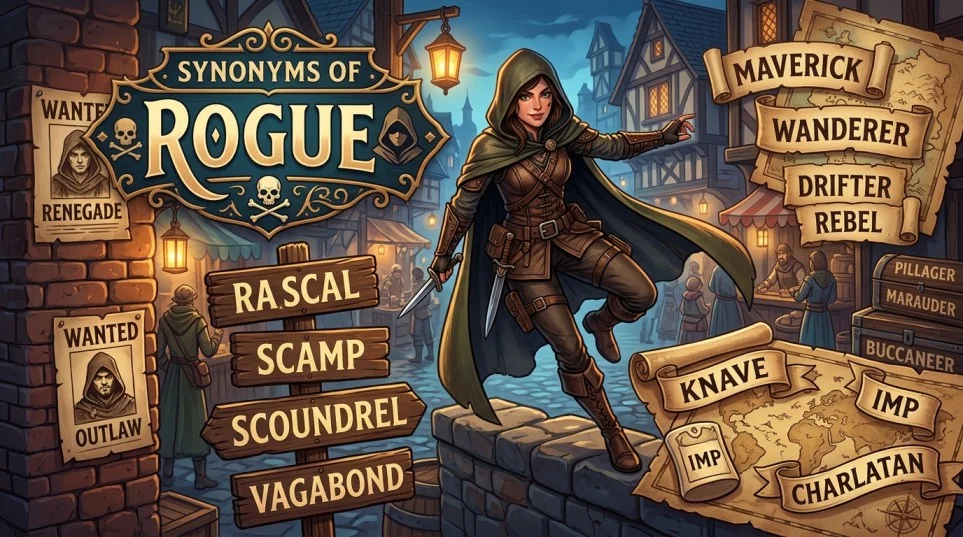
The word rogue is common in English. People use it to describe someone dishonest, wild, tricky, or different from normal rules. Imagine a student who breaks school rules but still makes everyone laugh. Many people may call that student a “rogue.” The word can sound funny, negative, or even exciting depending on the situation.
Writers, students, and English learners often see this word in books, movies, news stories, and daily conversation. Learning synonyms of rogue helps improve vocabulary and makes speaking and writing more natural. It also helps avoid repeating the same word again and again.
In this article, you will learn the meaning of rogue, its pronunciation, history, grammar, emotional tone, and 30 useful synonyms with easy examples. You will also learn antonyms and simple questions with answers to build strong English skills.
Meaning of Rogue
Rogue (noun/adjective):
A dishonest, tricky, or unpredictable person who often breaks rules.
Examples
- The rogue stole money from the old man.
- He acted like a rogue but still helped his friends sometimes.
Connotative Meaning
(Connotation means the emotional feeling or idea connected to a word.)
- Positive tone: adventurous, playful, independent
- Negative tone: dishonest, criminal, dangerous
- Neutral tone: unusual, unpredictable
Etymology
- The word rogue came from uncertain origins in the 16th century.
- It was first used for wandering beggars or dishonest people.
- Later, it described tricksters, criminals, or rebellious individuals.
Short History of the Keyword
- Old English (450–1100): The exact word did not exist in Old English.
- Middle English (1100–1500): Similar words described beggars and wanderers.
- Modern English (1500–Present): “Rogue” became common for dishonest or rebellious people.
Pronunciation (US & UK – IPA)
- US: /roʊɡ/
- UK: /rəʊɡ/
Syllables
- rogue
Affixation Pattern of Rogue
- Root: rogue
- Prefix: none
- Suffix: none
Word Formation of the Keyword
- Roguery (noun)
- Roguish (adjective)
- Roguishly (adverb)
- Roguishness (noun)
A List of Synonyms for Rogue
1. Criminal (noun)
US: /ˈkrɪmənəl/ | UK: /ˈkrɪmɪnəl/
Meaning: A person who breaks the law.
Examples:
- The criminal escaped from prison.
- Police caught the criminal quickly.
2. Villain (noun)
US: /ˈvɪlən/ | UK: /ˈvɪlən/
Meaning: A bad or evil person.
Examples:
- The villain tried to destroy the city.
- Every story needs a strong villain.
3. Trickster (noun)
US: /ˈtrɪkstər/ | UK: /ˈtrɪkstə/
Meaning: Someone who enjoys playing tricks on others.
Examples:
- The trickster fooled everyone at the party.
- He acted like a clever trickster.
4. Scoundrel (noun)
US: /ˈskaʊndrəl/ | UK: /ˈskaʊndrəl/
Meaning: A dishonest or bad person.
Examples:
- The scoundrel lied to his friends.
- Everyone avoided the scoundrel.
5. Rascal (noun)
US: /ˈræskəl/ | UK: /ˈrɑːskəl/
Meaning: A playful but troublesome person.
Examples:
- That little rascal hid my keys.
- The boy smiled like a rascal.
6. Rebel (noun)
US: /ˈrebəl/ | UK: /ˈrebəl/
Meaning: A person who fights against rules or authority.
Examples:
- The rebel refused to obey orders.
- Teenagers sometimes act like rebels.
7. Outlaw (noun)
US: /ˈaʊtlɔː/ | UK: /ˈaʊtlɔː/
Meaning: A person outside the protection of the law.
Examples:
- The outlaw rode across the desert.
- Police searched for the outlaw.
8. Bandit (noun)
US: /ˈbændɪt/ | UK: /ˈbændɪt/
Meaning: A robber or thief.
Examples:
- The bandit stole gold from travelers.
- Villagers feared the bandit.
9. Crook (noun)
US: /krʊk/ | UK: /krʊk/
Meaning: A dishonest person.
Examples:
- The crook cheated many people.
- Police arrested the crook yesterday.
10. Cheat (noun)
US: /tʃiːt/ | UK: /tʃiːt/
Meaning: A person who acts dishonestly.
Examples:
- Nobody trusts a cheat.
- The cheat copied answers in class.
11. Fraud (noun)
US: /frɔːd/ | UK: /frɔːd/
Meaning: Someone who deceives people for gain.
Examples:
- The fraud stole money online.
- She exposed the fraud.
12. Swindler (noun)
US: /ˈswɪndlər/ | UK: /ˈswɪndlə/
Meaning: A person who cheats others.
Examples:
- The swindler tricked old customers.
- Police captured the swindler.
13. Deceiver (noun)
US: /dɪˈsiːvər/ | UK: /dɪˈsiːvə/
Meaning: A person who lies or misleads.
Examples:
- The deceiver hid the truth.
- Nobody liked the deceiver.
14. Misfit (noun)
US: /ˈmɪsfɪt/ | UK: /ˈmɪsfɪt/
Meaning: Someone who does not fit into society.
Examples:
- He felt like a misfit at school.
- The movie follows a young misfit.
15. Maverick (noun)
US: /ˈmævərɪk/ | UK: /ˈmævərɪk/
Meaning: An independent-minded person.
Examples:
- The maverick rejected old ideas.
- She became a political maverick.
16. Renegade (noun)
US: /ˈrenɪɡeɪd/ | UK: /ˈrenɪɡeɪd/
Meaning: Someone who betrays or leaves a group.
Examples:
- The renegade ignored the team.
- He became a renegade soldier.
17. Lawbreaker (noun)
US: /ˈlɔːˌbreɪkər/ | UK: /ˈlɔːˌbreɪkə/
Meaning: A person who breaks laws.
Examples:
- The lawbreaker paid a fine.
- Police punished the lawbreaker.
18. Thief (noun)
US: /θiːf/ | UK: /θiːf/
Meaning: Someone who steals.
Examples:
- The thief ran away quickly.
- Cameras caught the thief.
19. Pirate (noun)
US: /ˈpaɪrət/ | UK: /ˈpaɪrət/
Meaning: A robber at sea or someone who steals illegally.
Examples:
- Pirates attacked the ship.
- The pirate searched for treasure.
20. Gangster (noun)
US: /ˈɡæŋstər/ | UK: /ˈɡæŋstə/
Meaning: A member of a criminal gang.
Examples:
- The gangster controlled the city.
- Movies often show gangsters.
21. Hoodlum (noun)
US: /ˈhuːdləm/ | UK: /ˈhuːdləm/
Meaning: A violent troublemaker.
Examples:
- The hoodlum damaged the store.
- Neighbors feared the hoodlum.
22. Delinquent (noun)
US: /dɪˈlɪŋkwənt/ | UK: /dɪˈlɪŋkwənt/
Meaning: A young person who behaves badly.
Examples:
- The delinquent skipped school often.
- Teachers tried to help the delinquent.
23. Knave (noun)
US: /neɪv/ | UK: /neɪv/
Meaning: A dishonest man.
Examples:
- The old story featured a knave.
- Nobody trusted the knave.
24. Charlatan (noun)
US: /ˈʃɑːrlətən/ | UK: /ˈʃɑːlətən/
Meaning: Someone pretending to have special skills.
Examples:
- The charlatan sold fake medicine.
- People discovered the charlatan.
25. Rogue Elephant (idiomatic noun)
US: /roʊɡ ˈelɪfənt/ | UK: /rəʊɡ ˈelɪfənt/
Meaning: Someone or something acting out of control.
Examples:
- The company became a rogue elephant.
- The officer acted like a rogue elephant.
26. Troublemaker (noun)
US: /ˈtrʌbəlˌmeɪkər/ | UK: /ˈtrʌbəlˌmeɪkə/
Meaning: A person who causes problems.
Examples:
- The troublemaker started fights.
- Teachers warned the troublemaker.
27. Con Artist (noun)
US: /ˈkɑːn ˌɑːrtɪst/ | UK: /ˈkɒn ˌɑːtɪst/
Meaning: A person who tricks others for money.
Examples:
- The con artist fooled tourists.
- Police searched for the con artist.
28. Rogue Agent (noun)
US: /roʊɡ ˈeɪdʒənt/ | UK: /rəʊɡ ˈeɪdʒənt/
Meaning: A person acting independently without permission.
Examples:
- The rogue agent ignored commands.
- The movie featured a rogue agent.
29. Deviant (noun/adjective)
US: /ˈdiːviənt/ | UK: /ˈdiːviənt/
Meaning: Someone whose behavior is unusual or unacceptable.
Examples:
- Society rejected the deviant behavior.
- The deviant ignored social rules.
30. Vagabond (noun)
US: /ˈvæɡəbɑːnd/ | UK: /ˈvæɡəbɒnd/
Meaning: A person who wanders without a home.
Examples:
- The vagabond traveled from town to town.
- People offered food to the vagabond.
Prototype Meaning
The most common meaning of rogue is a dishonest or rebellious person who breaks rules. People often imagine someone clever, risky, and unpredictable. In movies, a rogue may be a criminal, spy, pirate, or playful troublemaker.
Prototype Categorization
- Criminal people: criminal, thief, gangster, outlaw, bandit
- Dishonest people: fraud, swindler, cheat, deceiver, con artist
- Rebellious people: rebel, renegade, maverick
- Playful troublemakers: rascal, trickster, rogue
- Social outsiders: misfit, vagabond, deviant
Categorization helps writers choose the best synonym for the correct situation. Some words sound dangerous, while others sound playful or independent.
Antonyms of Rogue
- Hero (noun): a brave and good person
- Saint (noun): a morally good person
- Honest person (noun): someone truthful and fair
- Law-abiding citizen (noun): someone who follows laws
- Guardian (noun): a protector or defender
- Gentleman (noun): a polite and honorable man
- Protector (noun): someone who keeps others safe
Short Questions and Answers
- What does rogue mean?
A rogue is a dishonest, rebellious, or unpredictable person. - When should rogue be used?
Use it when describing someone who breaks rules or behaves in a tricky way. - Is rogue positive or negative?
It is usually negative, but sometimes it sounds playful or adventurous. - How is it different from similar words?
“Rogue” can describe both criminals and charming rule-breakers, while words like “criminal” are always negative.
Conclusion
Learning the word rogue and its synonyms helps improve English vocabulary in a powerful way. These words make writing and speaking more interesting and natural. They also help avoid repeating the same word many times. Some synonyms describe criminals, while others describe playful rebels or independent thinkers. Understanding these differences builds stronger communication skills and better word choice. English learners, students, and writers can use these synonyms in essays, conversations, stories, and daily speaking. Practice using one new synonym each day to grow your vocabulary and speak English with greater confidence.

I am a linguist with 17 years of experience in English language teaching, including postgraduate-level instruction. My expertise includes English grammar, and I contribute as a content and blog writer, producing scholarly and educational language resources.