
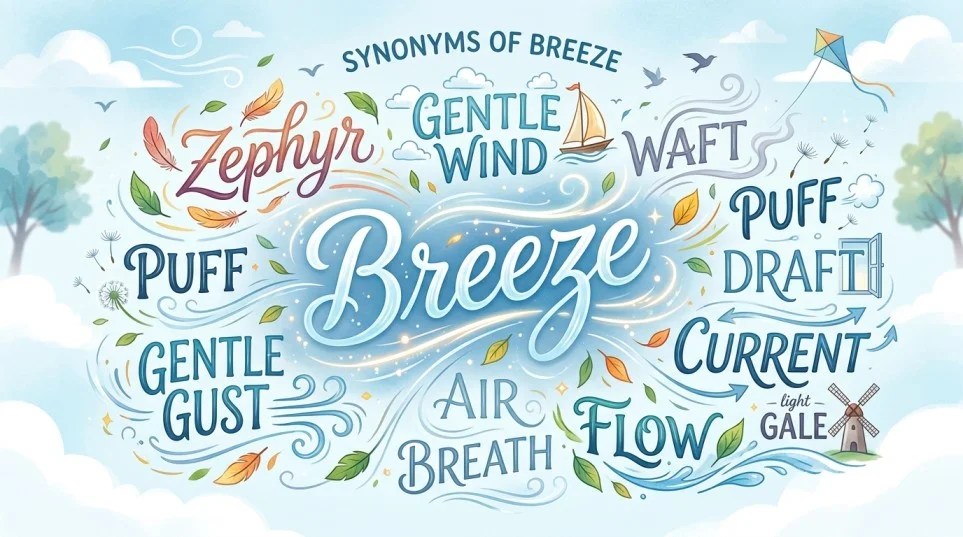
The word breeze is a common English word that describes a light and gentle wind. Imagine sitting near a window on a warm day when cool air softly touches your face. That calm and fresh feeling is often called a breeze. People use this word in daily conversations, stories, poems, travel writing, and weather reports because it creates a peaceful image in the reader’s mind.
Learning synonyms of “breeze” is important for English learners, students, bloggers, and content writers. Using different words helps improve speaking and writing skills. It also makes sentences more colorful and less repetitive.
In this article, you will learn the meaning of “breeze,” its pronunciation, history, grammar, connotation, and 30 useful synonyms with simple meanings and example sentences. You will also learn categories, antonyms, and common questions related to the word.
Meaning of Breeze
Breeze (Noun):
A light and gentle wind.
Examples
- A cool breeze came through the open window.
- We enjoyed the soft breeze at the beach.
Connotative Meaning
(Connotation means the emotional feeling or idea connected to a word.)
- Positive tone: freshness, peace, comfort, relaxation
- Negative tone: sometimes weakness or short-lasting effect
- Neutral tone: a natural movement of air
Etymology
- The word “breeze” came from Spanish and Old Italian language roots.
- It originally referred to a cold north-east wind.
Short History of the Keyword
- Old English (450–1100): The exact word was not commonly used.
- Middle English (1100–1500): Similar sea-wind terms started appearing.
- Modern English (1500–Present): “Breeze” became popular for gentle wind and easy movement.
Pronunciation (US & UK – IPA)
- US: /briːz/
- UK: /briːz/
Syllables
breeze
Affixation Pattern of Breeze
- Root: breeze
- Prefix: none
- Suffix: none
Word Formation of Breeze
- Breeze (noun)
- Breezy (adjective)
- Breezily (adverb)
- Breeziness (noun)
A List of 30 Synonyms for Breeze
1. Wind (Noun)
US: /wɪnd/ | UK: /wɪnd/
Meaning: Moving air in nature.
Examples:
- The wind became stronger at night.
- Cold wind entered the room.
2. Gust (Noun)
US: /ɡʌst/ | UK: /ɡʌst/
Meaning: A short and strong rush of wind.
Examples:
- A gust blew leaves across the road.
- Strong gusts shook the trees.
3. Draft (Noun)
US: /dræft/ | UK: /drɑːft/
Meaning: A flow of cool air inside a building.
Examples:
- A draft came under the door.
- She closed the window to stop the draft.
4. Zephyr (Noun)
US: /ˈzefər/ | UK: /ˈzefə/
Meaning: A soft and gentle breeze.
Examples:
- A warm zephyr moved through the garden.
- The evening zephyr felt relaxing.
5. Air Current (Noun)
US: /er ˈkɜːrənt/ | UK: /eə ˈkʌrənt/
Meaning: Moving flow of air.
Examples:
- Birds used the air current to fly.
- Warm air currents filled the room.
6. Waft (Noun)
US: /wɑːft/ | UK: /wɒft/
Meaning: A light movement through the air.
Examples:
- A waft of cool air entered the hall.
- We felt a waft from the fan.
7. Puff (Noun)
US: /pʌf/ | UK: /pʌf/
Meaning: A small amount of moving air.
Examples:
- A puff of wind blew the paper away.
- Smoke moved in little puffs.
8. Blast (Noun)
US: /blæst/ | UK: /blɑːst/
Meaning: A sudden strong wind.
Examples:
- A blast of cold air hit us.
- The blast opened the gate.
9. Gale (Noun)
US: /ɡeɪl/ | UK: /ɡeɪl/
Meaning: A very strong wind.
Examples:
- The gale damaged many trees.
- Ships stayed in the harbor during the gale.
10. Squall (Noun)
US: /skwɔːl/ | UK: /skwɔːl/
Meaning: A sudden violent wind.
Examples:
- A squall arrived before the rain.
- Fishermen returned because of the squall.
11. Current (Noun)
US: /ˈkɜːrənt/ | UK: /ˈkʌrənt/
Meaning: Continuous movement of air or water.
Examples:
- The current carried warm air upward.
- Air currents affect weather changes.
12. Flurry (Noun)
US: /ˈflɜːri/ | UK: /ˈflʌri/
Meaning: Quick movement of wind or snow.
Examples:
- A flurry of wind moved the leaves.
- Snow came in a sudden flurry.
13. Tempest (Noun)
US: /ˈtempɪst/ | UK: /ˈtempɪst/
Meaning: A violent storm with strong wind.
Examples:
- The ship crossed the tempest safely.
- Loud winds filled the tempest.
14. Breath (Noun)
US: /breθ/ | UK: /breθ/
Meaning: A very soft movement of air.
Examples:
- There was not a breath of wind.
- A gentle breath cooled the room.
15. Stream (Noun)
US: /striːm/ | UK: /striːm/
Meaning: A steady flow of air.
Examples:
- A stream of cool air entered the car.
- Warm air streams rose upward.
16. Drift (Noun)
US: /drɪft/ | UK: /drɪft/
Meaning: Slow movement through the air.
Examples:
- A drift of air moved the curtains.
- Smoke drifted into the sky.
17. Ventilation (Noun)
US: /ˌventəˈleɪʃən/ | UK: /ˌventɪˈleɪʃən/
Meaning: Fresh movement of air in a place.
Examples:
- Good ventilation keeps rooms cool.
- The office needs better ventilation.
18. Whiff (Noun)
US: /wɪf/ | UK: /wɪf/
Meaning: A slight movement of air or smell.
Examples:
- A whiff of wind touched my face.
- We felt a whiff from the sea.
19. Flutter (Noun)
US: /ˈflʌtər/ | UK: /ˈflʌtə/
Meaning: Light quick movement caused by air.
Examples:
- The breeze made a flutter in the flag.
- Leaves moved with a flutter.
20. Monsoon (Noun)
US: /mɑːnˈsuːn/ | UK: /mɒnˈsuːn/
Meaning: Seasonal wind bringing heavy rain.
Examples:
- The monsoon arrived early this year.
- Farmers waited for the monsoon winds.
21. Trade Wind (Noun)
US: /treɪd wɪnd/ | UK: /treɪd wɪnd/
Meaning: Steady tropical wind.
Examples:
- Sailors depended on trade winds.
- Trade winds helped ships travel faster.
22. Chinook (Noun)
US: /ʃɪˈnʊk/ | UK: /ʃɪˈnʊk/
Meaning: A warm dry wind.
Examples:
- The Chinook melted the snow quickly.
- Warm Chinook winds reached the valley.
23. Mistral (Noun)
US: /mɪˈstrɑːl/ | UK: /mɪˈstræl/
Meaning: A cold strong wind in France.
Examples:
- The mistral blew across the coast.
- Farmers protected crops from the mistral.
24. Sirocco (Noun)
US: /səˈrɑːkoʊ/ | UK: /sɪˈrɒkəʊ/
Meaning: A hot desert wind.
Examples:
- The sirocco made the day very hot.
- Dust filled the air during the sirocco.
25. Hurricane (Noun)
US: /ˈhɜːrɪkeɪn/ | UK: /ˈhʌrɪkən/
Meaning: A powerful tropical storm.
Examples:
- The hurricane damaged homes.
- People moved to safe places before the hurricane.
26. Cyclone (Noun)
US: /ˈsaɪkloʊn/ | UK: /ˈsaɪkləʊn/
Meaning: A large rotating storm.
Examples:
- The cyclone caused flooding.
- Strong winds came with the cyclone.
27. Tornado (Noun)
US: /tɔːrˈneɪdoʊ/ | UK: /tɔːˈneɪdəʊ/
Meaning: A violent spinning windstorm.
Examples:
- The tornado destroyed buildings.
- Dark clouds formed before the tornado.
28. Whisper (Noun)
US: /ˈwɪspər/ | UK: /ˈwɪspə/
Meaning: A very soft sound or movement like light wind.
Examples:
- A whisper of wind moved the grass.
- We heard the whisper of leaves.
29. Breath of Air (Noun)
US: /breθ əv er/ | UK: /breθ əv eə/
Meaning: A small amount of fresh air.
Examples:
- We needed a breath of air outside.
- Fresh breath of air entered the room.
30. Draught (Noun)
US: /dræft/ | UK: /drɑːft/
Meaning: British spelling for draft meaning cool moving air.
Examples:
- A draught came through the hallway.
- She blocked the draught with a towel.
Prototype Meaning
The most common meaning of “breeze” is a soft and gentle wind that feels cool and pleasant. Most people imagine relaxing weather, beaches, trees moving slowly, or fresh outdoor air when they hear this word.
Prototype Categorization
- Gentle wind words: zephyr, breath, whisper, waft
- Strong wind words: gale, tempest, hurricane, cyclone
- Indoor air movement words: draft, ventilation, draught
- Weather-related wind words: monsoon, trade wind, sirocco
- Short bursts of air: puff, gust, blast
Categorization helps writers choose the correct synonym for the right situation. Soft words create calm feelings, while strong words describe danger or power.
Antonyms of Breeze
- Stillness (Noun): complete lack of movement in air
- Calm (Noun): peaceful condition without wind
- Silence (Noun): absence of movement or sound
- Stagnation (Noun): no flow or movement
- Heaviness (Noun): thick and unmoving atmosphere
Short Questions and Answers
- What does breeze mean?
A breeze is a light and gentle wind. - When should breeze be used?
Use “breeze” when talking about soft moving air or calm weather. - Is breeze positive or negative?
It is usually positive because it suggests comfort and freshness. - How is it different from similar words?
“Breeze” means soft wind, while words like “gale” or “storm” describe much stronger wind.
Conclusion
Learning the word “breeze” and its synonyms can greatly improve English vocabulary. It helps learners describe weather, feelings, and movement more clearly. Using different synonyms also makes writing and speaking more natural and interesting. Writers can avoid repeating the same word again and again by choosing the best synonym for each situation. Understanding pronunciation, tone, meaning, and history also builds stronger language skills. Daily vocabulary practice helps students, bloggers, and English learners become more confident communicators. The more words you learn, the easier it becomes to express ideas in creative and powerful ways.

I am a linguist with 17 years of experience in English language teaching, including postgraduate-level instruction. My expertise includes English grammar, and I contribute as a content and blog writer, producing scholarly and educational language resources.