
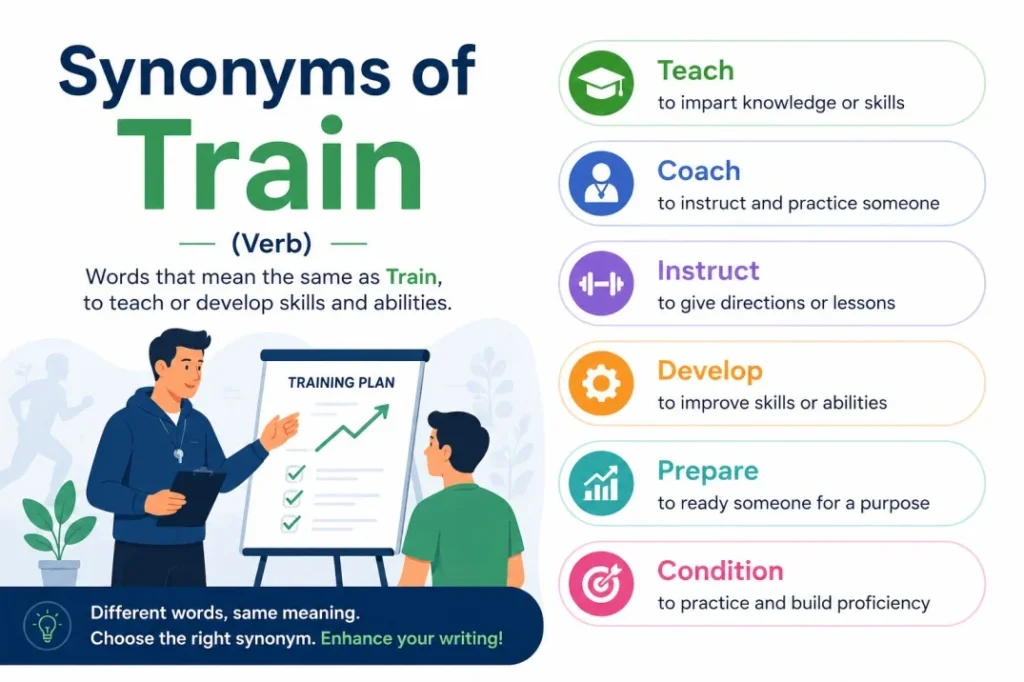
The word train is a common English word with several meanings. Most people think of a vehicle that runs on railway tracks, but train can also mean to teach, practice, develop a skill, or prepare someone for a task.
Imagine a young athlete preparing for an important competition. Every day, she works hard, follows instructions, and improves her skills. In this situation, she is training for success. Because the word is used in education, sports, business, and everyday life, it is one of the most useful words in English.
Learning synonyms of train helps English learners, students, writers, and content creators express ideas more clearly and avoid repeating the same word.
In this article, you will learn the meaning of train, its pronunciation, history, grammar, connotations, and 30 powerful synonyms with examples and semantic categories.
Meaning of Train
Definition
Train (Verb/Noun):
As a verb, train means to teach, instruct, practice, prepare, or develop skills through learning and repetition.
As a noun, train refers to a railway vehicle that carries passengers or goods on tracks.
Examples
- The coach trains the players every morning.
- The company trains new employees before they begin work.
Connotative Meaning
(Connotation: the emotional or cultural feeling associated with a word beyond its dictionary meaning.)
- Positive tone: development, improvement, growth, preparation, achievement
- Negative tone: strict discipline, pressure, hard work, exhaustion
- Neutral tone: teaching, practicing, preparing
Etymology
- Origin: Old French trainer
- Source Language: French
- Original Meaning: “to draw, pull, drag along”
Short History of the Keyword
- Old English (450–1100): The exact word train was not commonly used.
- Middle English (1100–1500): Borrowed from Old French with meanings related to pulling or dragging.
- Modern English (1500–Present): Expanded to include educating, coaching, preparing, and railway transportation.
Pronunciation (US & UK – IPA)
US: /treɪn/
UK: /treɪn/
Syllables
train
Affixation Pattern of Train
Root: train
Prefix: None
Suffix: None
Word Formation of Train
- Train (Verb/Noun)
- Training (Noun)
- Trainer (Noun)
- Trained (Adjective/Verb)
- Trainee (Noun)
- Trainable (Adjective)
- Retrain (Verb)
- Retraining (Noun)
- Untrained (Adjective)
- Trainership (Noun)
Synonyms of Train
1. Teach (Verb)
US: /tiːtʃ/ | UK: /tiːtʃ/
Meaning: To give knowledge or instruction.
Examples:
- The professor teaches biology.
- Parents teach children good manners.
2. Educate (Verb)
US: /ˈedʒəkeɪt/ | UK: /ˈedʒʊkeɪt/
Meaning: To provide formal learning and knowledge.
Examples:
- Schools educate young people.
- Books educate readers about history.
3. Instruct (Verb)
US: /ɪnˈstrʌkt/ | UK: /ɪnˈstrʌkt/
Meaning: To give detailed directions or teaching.
Examples:
- The manager instructed the staff.
- She instructed students carefully.
4. Coach (Verb)
US: /koʊtʃ/ | UK: /kəʊtʃ/
Meaning: To guide and improve someone’s performance.
Examples:
- He coaches a football team.
- She coached him for the interview.
5. Tutor (Verb)
US: /ˈtuːtər/ | UK: /ˈtjuːtə/
Meaning: To teach an individual or small group.
Examples:
- She tutors math students.
- He tutored his younger brother.
6. Mentor (Verb)
US: /ˈmentɔːr/ | UK: /ˈmentɔː/
Meaning: To advise and guide someone.
Examples:
- Senior workers mentor newcomers.
- She mentored young entrepreneurs.
7. Drill (Verb)
US: /drɪl/ | UK: /drɪl/
Meaning: To practice repeatedly.
Examples:
- The teacher drilled vocabulary words.
- Soldiers drill daily.
8. Prepare (Verb)
US: /prɪˈper/ | UK: /prɪˈpeə/
Meaning: To make ready for a task.
Examples:
- Teachers prepare students for exams.
- The coach prepared the team.
9. Develop (Verb)
US: /dɪˈveləp/ | UK: /dɪˈveləp/
Meaning: To improve abilities gradually.
Examples:
- Reading develops language skills.
- The program develops leadership.
10. Condition (Verb)
US: /kənˈdɪʃən/ | UK: /kənˈdɪʃən/
Meaning: To prepare physically or mentally.
Examples:
- Athletes condition their bodies.
- The army conditioned recruits.
11. Discipline (Verb)
US: /ˈdɪsəplɪn/ | UK: /ˈdɪsɪplɪn/
Meaning: To train through rules and control.
Examples:
- Parents discipline children carefully.
- Coaches discipline team members.
12. School (Verb)
US: /skuːl/ | UK: /skuːl/
Meaning: To educate formally.
Examples:
- The village schools children.
- He was schooled abroad.
13. Groom (Verb)
US: /ɡruːm/ | UK: /ɡruːm/
Meaning: To prepare someone for a future role.
Examples:
- The company groomed future leaders.
- She was groomed for management.
14. Cultivate (Verb)
US: /ˈkʌltɪveɪt/ | UK: /ˈkʌltɪveɪt/
Meaning: To develop qualities or skills.
Examples:
- Schools cultivate creativity.
- He cultivated leadership skills.
15. Exercise (Verb)
US: /ˈeksərsaɪz/ | UK: /ˈeksəsaɪz/
Meaning: To practice regularly.
Examples:
- Athletes exercise daily.
- She exercises her memory.
16. Practice (Verb)
US: /ˈpræktɪs/ | UK: /ˈpræktɪs/
Meaning: To repeat an activity to improve.
Examples:
- Musicians practice often.
- Students practice speaking English.
17. Rehearse (Verb)
US: /rɪˈhɜːrs/ | UK: /rɪˈhɜːs/
Meaning: To practice before an event.
Examples:
- Actors rehearse every day.
- The band rehearsed the song.
18. Prepare For (Verb)
US: /prɪˈper fɔːr/ | UK: /prɪˈpeə fə/
Meaning: To get ready for something.
Examples:
- Students prepare for exams.
- The team prepared for victory.
19. Guide (Verb)
US: /ɡaɪd/ | UK: /ɡaɪd/
Meaning: To direct or lead.
Examples:
- Teachers guide learners.
- She guided the new employee.
20. Direct (Verb)
US: /dəˈrekt/ | UK: /daɪˈrekt/
Meaning: To control or manage actions.
Examples:
- The supervisor directed workers.
- She directed the project team.
21. Enlighten (Verb)
US: /ɪnˈlaɪtən/ | UK: /ɪnˈlaɪtən/
Meaning: To provide understanding.
Examples:
- Books enlighten readers.
- The lecture enlightened students.
22. Improve (Verb)
US: /ɪmˈpruːv/ | UK: /ɪmˈpruːv/
Meaning: To make better.
Examples:
- Practice improves skills.
- Training improved performance.
23. Strengthen (Verb)
US: /ˈstreŋθən/ | UK: /ˈstreŋθən/
Meaning: To make stronger.
Examples:
- Exercise strengthens muscles.
- Training strengthened confidence.
24. Sharpen (Verb)
US: /ˈʃɑːrpən/ | UK: /ˈʃɑːpən/
Meaning: To improve skill or ability.
Examples:
- Reading sharpens thinking.
- The workshop sharpened skills.
25. Prepare Mentally (Verb)
US: /prɪˈper ˈmentəli/ | UK: /prɪˈpeə ˈmentəli/
Meaning: To become mentally ready.
Examples:
- Athletes prepare mentally.
- He prepared mentally for challenges.
26. Equip (Verb)
US: /ɪˈkwɪp/ | UK: /ɪˈkwɪp/
Meaning: To provide necessary skills or tools.
Examples:
- The course equips students.
- Training equipped workers.
27. Familiarize (Verb)
US: /fəˈmɪljəraɪz/ | UK: /fəˈmɪliəraɪz/
Meaning: To make someone comfortable with something.
Examples:
- The instructor familiarized trainees with rules.
- New workers were familiarized with procedures.
28. Ready (Verb)
US: /ˈredi/ | UK: /ˈredi/
Meaning: To prepare for action.
Examples:
- The coach readied the team.
- She readied herself for the test.
29. Build Up (Verb)
US: /bɪld ʌp/ | UK: /bɪld ʌp/
Meaning: To gradually increase ability.
Examples:
- Exercise builds up endurance.
- Practice built up confidence.
30. Empower (Verb)
US: /ɪmˈpaʊər/ | UK: /ɪmˈpaʊə/
Meaning: To give confidence and ability.
Examples:
- Good teachers empower students.
- Training empowered employees.
Prototype Meaning
The most typical meaning of train is to teach or prepare someone to perform a skill, task, job, sport, or activity successfully. When people hear the word, they often imagine a coach helping athletes, a teacher educating students, or a company preparing new employees.
Prototype Categorization
Categorizing synonyms helps writers choose the most accurate word for a situation.
- Teaching Synonyms: teach, educate, instruct, tutor, school
- Guidance Synonyms: coach, mentor, guide, direct
- Practice Synonyms: drill, practice, rehearse, exercise
- Development Synonyms: cultivate, develop, strengthen, sharpen, improve
- Preparation Synonyms: prepare, condition, equip, ready
- Leadership Synonyms: groom, empower, mentor
Antonyms of Train
- Neglect (Verb) — to fail to teach or care for properly
- Ignore (Verb) — to pay no attention to learning needs
- Misguide (Verb) — to direct incorrectly
- Confuse (Verb) — to make understanding difficult
- Discourage (Verb) — to reduce confidence or motivation
- Unteach (Verb) — to remove learned habits or ideas
- Weaken (Verb) — to make less capable
- Hinder (Verb) — to slow development or progress
- Prevent (Verb) — to stop preparation or learning
- Misinform (Verb) — to provide incorrect information
Short Questions and Answers
- What does train mean?
Train means to teach, prepare, practice, or develop skills through learning and experience. - When should train be used?
Use train when talking about teaching skills, preparing people, practicing abilities, or improving performance. - Is train positive or negative?
It is usually positive because it suggests growth and improvement, although intensive training can sometimes feel demanding. - How is it different from similar words?
Train focuses on developing practical skills through practice, while educate focuses on knowledge and mentor focuses on guidance.
Conclusion
Learning the word train and its synonyms is an excellent way to expand your English vocabulary. Understanding related words such as teach, coach, mentor, develop, and prepare helps you communicate more clearly in speaking and writing. These synonyms allow you to avoid repetition and select the most suitable word for different situations. They also improve reading comprehension because many of these words appear in books, articles, schools, workplaces, and everyday conversations. By studying one new word and its related vocabulary each day, you can steadily build confidence, strengthen communication skills, and become a more effective English user.

I am a linguist with 17 years of experience in English language teaching, including postgraduate-level instruction. My expertise includes English grammar, and I contribute as a content and blog writer, producing scholarly and educational language resources.