
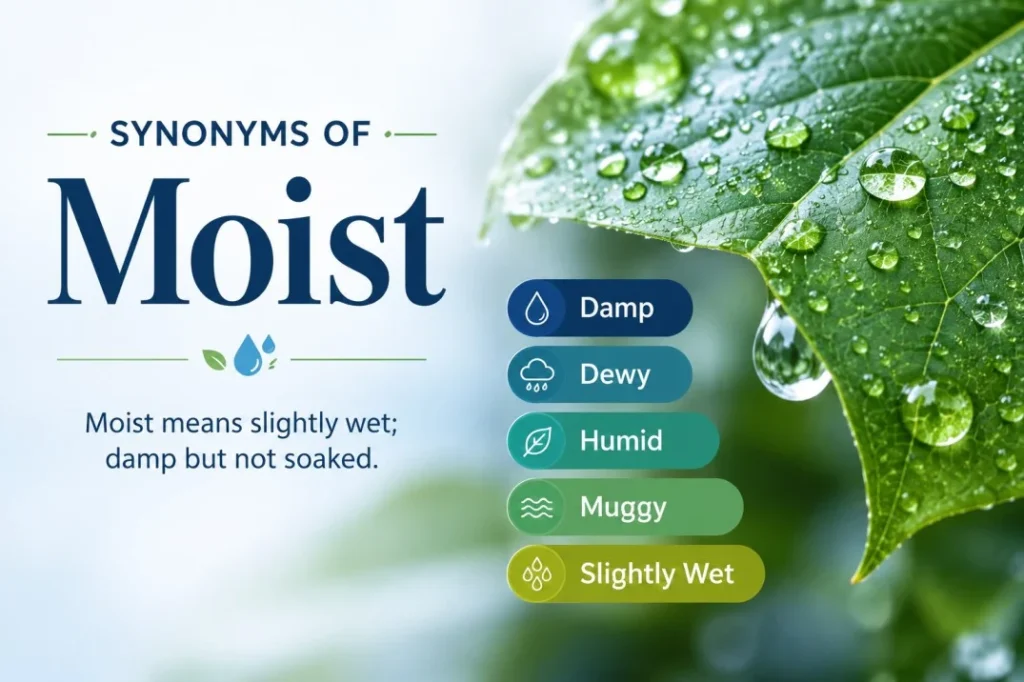
Moist is a common English word that describes something that is slightly wet or contains a small amount of water. Imagine taking a freshly baked cake out of the oven. When you cut a slice, the inside feels soft, tender, and moist. This everyday situation shows how naturally the word fits into daily conversations.
The word moist is widely used when talking about food, weather, skin, soil, air, and many other things. Because it appears in so many contexts, understanding its synonyms can greatly improve your English skills.
Learning synonyms helps English learners, students, writers, and content creators avoid repetition and communicate more clearly.
In this article, you will learn the meaning of moist, its pronunciation, history, grammar, connotations, and 30 useful synonyms with examples. You will also discover semantic categories, antonyms, and practical usage tips to strengthen your vocabulary.
Meaning of Moist
Definition
Moist (Adjective):
Slightly wet; containing a small amount of water but not completely wet.
Examples
- The cake remained moist even after cooling.
- The soil is moist after last night’s rain.
Connotative Meaning
(Connotation: the emotional or cultural feeling associated with a word beyond its dictionary meaning.)
- Positive tone: Fresh, soft, tender, hydrated.
- Negative tone: Damp, sticky, clammy.
- Neutral tone: Slightly wet, containing moisture.
Etymology
- Origin: Old French moiste
- Source Language: Latin mucidus
- Original Meaning: Moldy, damp, or moist
Short History of the Keyword
- Old English (450–1100): The exact word moist was not commonly used; speakers used native words for wetness.
- Middle English (1100–1500): Borrowed from Old French moiste.
- Modern English (1500–Present): Became widely used to describe slight wetness in food, weather, and physical conditions.
Pronunciation (US & UK – IPA)
US: /mɔɪst/
UK: /mɔɪst/
Syllables
moist
Affixation Pattern of Moist
Root: moist
Prefix: None
Suffix: None
Word Formation of Moist
- Moist (Adjective)
- Moisten (Verb)
- Moisture (Noun)
- Moistly (Adverb)
- Moistness (Noun)
A List of 30 Synonyms for Moist
1. Damp (Adjective)
US: /dæmp/ | UK: /dæmp/
Meaning: Slightly wet, often from humidity.
Examples:
- The towel felt damp after use.
- The walls became damp during the rainy season.
2. Humid (Adjective)
US: /ˈhjuːmɪd/ | UK: /ˈhjuːmɪd/
Meaning: Containing a high amount of moisture in the air.
Examples:
- The weather was humid all day.
- Tropical regions are often humid.
3. Dewy (Adjective)
US: /ˈduːi/ | UK: /ˈdjuːi/
Meaning: Covered with tiny drops of water.
Examples:
- The grass looked dewy in the morning.
- Her skin appeared fresh and dewy.
4. Wet (Adjective)
US: /wet/ | UK: /wet/
Meaning: Covered or soaked with water.
Examples:
- My shoes became wet in the rain.
- The floor is still wet.
5. Clammy (Adjective)
US: /ˈklæmi/ | UK: /ˈklæmi/
Meaning: Unpleasantly moist and sticky.
Examples:
- His hands felt clammy.
- The room had a clammy atmosphere.
6. Sticky (Adjective)
US: /ˈstɪki/ | UK: /ˈstɪki/
Meaning: Slightly wet and adhesive.
Examples:
- The table felt sticky.
- The candy left sticky fingers.
7. Soggy (Adjective)
US: /ˈsɑːɡi/ | UK: /ˈsɒɡi/
Meaning: Very wet and soft.
Examples:
- The bread became soggy.
- Walking on soggy ground was difficult.
8. Saturated (Adjective)
US: /ˈsætʃəreɪtɪd/ | UK: /ˈsætʃəreɪtɪd/
Meaning: Completely filled with liquid.
Examples:
- The sponge was saturated.
- The soil became saturated after heavy rain.
9. Hydrated (Adjective)
US: /ˈhaɪdreɪtɪd/ | UK: /ˈhaɪdreɪtɪd/
Meaning: Containing sufficient moisture.
Examples:
- Keep your skin hydrated.
- The plant remained hydrated.
10. Fresh (Adjective)
US: /freʃ/ | UK: /freʃ/
Meaning: Clean and pleasantly moist.
Examples:
- Fresh vegetables taste better.
- The flowers looked fresh.
11. Juicy (Adjective)
US: /ˈdʒuːsi/ | UK: /ˈdʒuːsi/
Meaning: Full of liquid.
Examples:
- The orange was juicy.
- They served juicy burgers.
12. Succulent (Adjective)
US: /ˈsʌkjələnt/ | UK: /ˈsʌkjələnt/
Meaning: Tender and juicy.
Examples:
- The meat was succulent.
- The peaches were succulent.
13. Lush (Adjective)
US: /lʌʃ/ | UK: /lʌʃ/
Meaning: Rich and healthy because of moisture.
Examples:
- The garden looked lush.
- Lush vegetation covered the valley.
14. Waterlogged (Adjective)
US: /ˈwɔːtərlɔːɡd/ | UK: /ˈwɔːtəlɒɡd/
Meaning: Filled with too much water.
Examples:
- The field was waterlogged.
- Waterlogged soil harms roots.
15. Rain-soaked (Adjective)
US: /ˈreɪn soʊkt/ | UK: /ˈreɪn səʊkt/
Meaning: Thoroughly wet from rain.
Examples:
- We returned rain-soaked.
- The clothes were rain-soaked.
16. Muggy (Adjective)
US: /ˈmʌɡi/ | UK: /ˈmʌɡi/
Meaning: Warm and uncomfortably humid.
Examples:
- It was a muggy afternoon.
- Muggy weather can feel exhausting.
17. Sweaty (Adjective)
US: /ˈsweti/ | UK: /ˈsweti/
Meaning: Covered with perspiration.
Examples:
- His shirt became sweaty.
- We felt sweaty after exercise.
18. Dripping (Adjective)
US: /ˈdrɪpɪŋ/ | UK: /ˈdrɪpɪŋ/
Meaning: Releasing drops of liquid.
Examples:
- The umbrella was dripping.
- Her hair was dripping wet.
19. Drenched (Adjective)
US: /drentʃt/ | UK: /drentʃt/
Meaning: Completely wet.
Examples:
- We were drenched by rain.
- The jacket became drenched.
20. Soaked (Adjective)
US: /soʊkt/ | UK: /səʊkt/
Meaning: Thoroughly wet.
Examples:
- My socks are soaked.
- The towel was soaked.
21. Bedewed (Adjective)
US: /bɪˈduːd/ | UK: /bɪˈdjuːd/
Meaning: Covered with dew.
Examples:
- The leaves were bedewed.
- Bedewed flowers sparkled.
22. Misty (Adjective)
US: /ˈmɪsti/ | UK: /ˈmɪsti/
Meaning: Filled with fine moisture.
Examples:
- The valley looked misty.
- A misty morning greeted us.
23. Condensed (Adjective)
US: /kənˈdenst/ | UK: /kənˈdenst/
Meaning: Formed into water droplets.
Examples:
- Condensed water appeared on the glass.
- The mirror became condensed.
24. Soft (Adjective)
US: /sɔːft/ | UK: /sɒft/
Meaning: Pleasantly moist and tender.
Examples:
- The cake was soft.
- Soft soil is easy to dig.
25. Tender (Adjective)
US: /ˈtendər/ | UK: /ˈtendə/
Meaning: Soft and moist in texture.
Examples:
- The chicken remained tender.
- Tender vegetables cook quickly.
26. Plump (Adjective)
US: /plʌmp/ | UK: /plʌmp/
Meaning: Full because of moisture.
Examples:
- The grapes looked plump.
- The raisins became plump in water.
27. Moisturized (Adjective)
US: /ˈmɔɪstʃəraɪzd/ | UK: /ˈmɔɪstʃəraɪzd/
Meaning: Treated to retain moisture.
Examples:
- Her skin felt moisturized.
- Use lotion for moisturized hands.
28. Steamy (Adjective)
US: /ˈstiːmi/ | UK: /ˈstiːmi/
Meaning: Full of warm moisture.
Examples:
- The bathroom was steamy.
- A steamy kitchen greeted us.
29. Foggy (Adjective)
US: /ˈfɔːɡi/ | UK: /ˈfɒɡi/
Meaning: Filled with moisture in the air.
Examples:
- It was a foggy morning.
- The road became foggy.
30. Mellow (Adjective)
US: /ˈmeloʊ/ | UK: /ˈmeləʊ/
Meaning: Soft and pleasantly moist.
Examples:
- The fruit became mellow.
- The cake stayed mellow and rich.
Prototype Meaning
When people hear the word moist, they usually imagine something that is slightly wet but not soaked. A freshly baked cake, healthy skin, rich soil, or a towel with a little water in it are common mental images. The idea is gentle wetness rather than complete saturation.
Prototype Categorization
Categorizing synonyms helps writers select the most accurate word for a specific situation.
- Weather and Air: humid, muggy, misty, foggy, steamy
- Food and Texture: juicy, succulent, tender, soft, mellow
- Skin and Beauty: hydrated, moisturized, dewy
- Heavy Wetness: soaked, drenched, saturated, waterlogged, soggy
- Light Wetness: damp, bedewed, condensed
- Unpleasant Moisture: clammy, sticky, sweaty
Understanding these categories allows writers to choose precise words instead of using the same word repeatedly.
Antonyms of Moist
- Dry (Adjective) — Free from moisture.
- Arid (Adjective) — Extremely dry.
- Parched (Adjective) — Dried out due to heat.
- Dehydrated (Adjective) — Lacking water.
- Desiccated (Adjective) — Thoroughly dried.
- Barren (Adjective) — Dry and unproductive.
- Cracked (Adjective) — Split due to dryness.
- Powdery (Adjective) — Dry and dusty.
- Withered (Adjective) — Dried and shriveled.
- Crisp (Adjective) — Pleasantly dry and firm.
Short Questions and Answers
- What does moist mean?
Moist means slightly wet or containing a small amount of water. - When should moist be used?
Use it when describing something that is not dry but also not completely wet. - Is moist positive or negative?
It depends on context. It is positive for food and skin but can be negative when describing uncomfortable conditions. - How is it different from similar words?
Moist usually indicates light wetness, while words like soaked and drenched indicate much more water.
Conclusion
Learning the word moist and its synonyms can greatly improve your English vocabulary. Instead of repeating the same word, you can choose more specific alternatives such as damp, juicy, humid, or hydrated. This makes your writing more precise, interesting, and professional.
A strong vocabulary also improves speaking skills because you can express ideas more clearly. Understanding pronunciation, history, connotation, and semantic categories helps learners use words correctly in different situations. By studying a few new synonyms every day and practicing them in sentences, you can build confidence and communicate more effectively in English. Small vocabulary improvements often lead to big language gains over time.

I am a linguist with 17 years of experience in English language teaching, including postgraduate-level instruction. My expertise includes English grammar, and I contribute as a content and blog writer, producing scholarly and educational language resources.