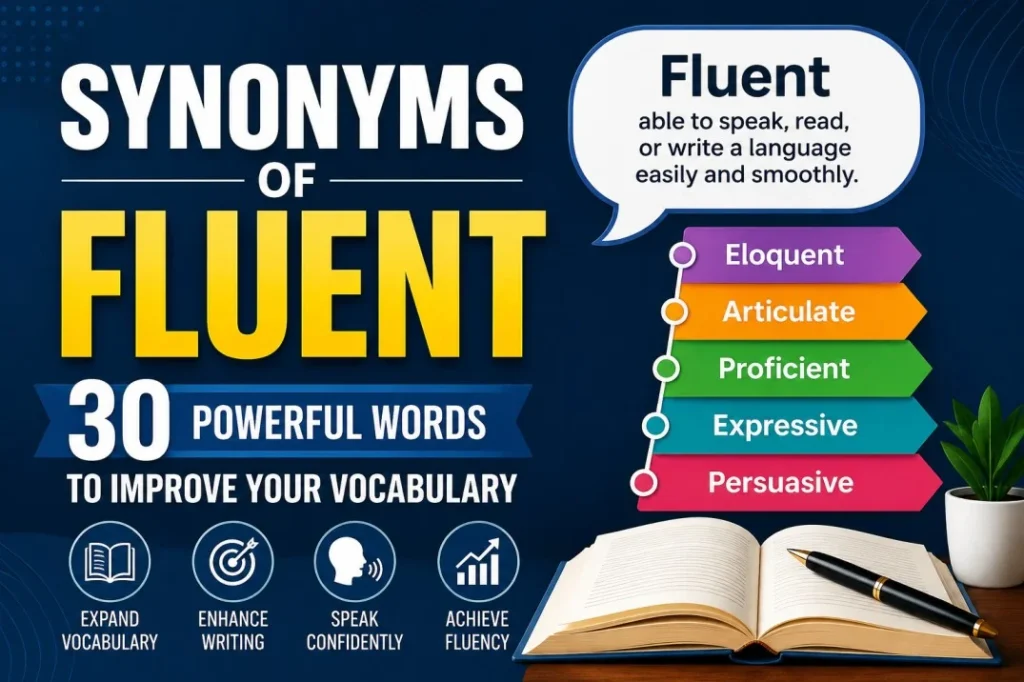
The word fluent is commonly used when talking about language skills, smooth communication, or effortless performance. Imagine meeting someone who speaks English, Spanish, and French with ease. You would probably describe that person as fluent. The word is popular in education, business, travel, and everyday conversation because it helps describe a high level of skill and confidence.
Learning synonyms of fluent is important for English learners, writers, students, and professionals. Using different words instead of repeating the same term makes writing more interesting and precise. It also helps speakers express ideas more clearly in different situations.
In this article, you will learn the meaning of fluent, its pronunciation, history, grammar, connotations, and 30 useful synonyms with examples. You will also discover categories of related words, antonyms, and practical questions and answers to strengthen your vocabulary.
Meaning of Fluent
Definition
Fluent (Adjective):
Able to speak, write, or express something smoothly, easily, and accurately.
Examples
- Maria is fluent in English and Arabic.
- He gave a fluent presentation without looking at his notes.
Connotative Meaning
(Connotation: the emotional or cultural feeling associated with a word beyond its dictionary meaning.)
- Positive tone: Skilled, confident, articulate, polished.
- Negative tone: Can sometimes imply being overly smooth or rehearsed.
- Neutral tone: Simply describes ease and proficiency.
Etymology
- Origin: Latin fluere meaning “to flow.”
- Entered English through French and Latin influences.
- Original meaning referred to something flowing smoothly.
Short History of the Keyword
- Old English (450–1100): The word did not exist in Old English.
- Middle English (1100–1500): Latin and French influences introduced related forms.
- Modern English (1500–Present): Fluent became widely used to describe smooth speech, writing, and expression.
Pronunciation (US & UK – IPA)
US: /ˈfluːənt/
UK: /ˈfluːənt/
Syllables
flu-ent
Affixation Pattern of Fluent
Root: flu (flow)
Prefix: None
Suffix: -ent
Word Formation of Fluent
- Fluent (Adjective)
- Fluency (Noun)
- Fluently (Adverb)
- Nonfluent (Adjective)
- Disfluency (Noun)
A List of 30 Synonyms for Fluent
1. Articulate (Adjective)
US: /ɑːrˈtɪkjəleɪt/ | UK: /ɑːˈtɪkjʊlət/
Meaning: Able to express thoughts clearly and effectively.
Examples:
- She is articulate during interviews.
- The speaker gave an articulate explanation.
2. Eloquent (Adjective)
US: /ˈeləkwənt/ | UK: /ˈeləkwənt/
Meaning: Expressing ideas beautifully and persuasively.
Examples:
- His speech was eloquent and inspiring.
- She gave an eloquent defense of her ideas.
3. Smooth (Adjective)
US: /smuːð/ | UK: /smuːð/
Meaning: Easy and effortless in expression.
Examples:
- He is a smooth communicator.
- Her delivery was smooth and natural.
4. Polished (Adjective)
US: /ˈpɑːlɪʃt/ | UK: /ˈpɒlɪʃt/
Meaning: Refined and well-practiced.
Examples:
- She sounded polished during the meeting.
- His polished speaking impressed everyone.
5. Expressive (Adjective)
US: /ɪkˈspresɪv/ | UK: /ɪkˈspresɪv/
Meaning: Able to communicate feelings clearly.
Examples:
- She has an expressive speaking style.
- His expressive voice captured attention.
6. Persuasive (Adjective)
US: /pərˈsweɪsɪv/ | UK: /pəˈsweɪsɪv/
Meaning: Effective at convincing others.
Examples:
- Her persuasive arguments won support.
- He is a persuasive speaker.
7. Lucid (Adjective)
US: /ˈluːsɪd/ | UK: /ˈluːsɪd/
Meaning: Clear and easy to understand.
Examples:
- The explanation was lucid.
- She gave a lucid presentation.
8. Clear (Adjective)
US: /klɪr/ | UK: /klɪə/
Meaning: Easy to understand.
Examples:
- He gave a clear answer.
- Her instructions were clear.
9. Coherent (Adjective)
US: /koʊˈhɪrənt/ | UK: /kəʊˈhɪərənt/
Meaning: Logical and connected.
Examples:
- Her argument was coherent.
- He spoke in a coherent manner.
10. Well-spoken (Adjective)
US: /ˌwelˈspoʊkən/ | UK: /ˌwelˈspəʊkən/
Meaning: Speaking correctly and pleasantly.
Examples:
- He is well-spoken.
- She sounded well-spoken in the interview.
11. Communicative (Adjective)
US: /kəˈmjuːnɪkeɪtɪv/ | UK: /kəˈmjuːnɪkətɪv/
Meaning: Good at sharing information.
Examples:
- She is highly communicative.
- The manager remained communicative.
12. Verbal (Adjective)
US: /ˈvɜːrbəl/ | UK: /ˈvɜːbəl/
Meaning: Skilled in using words.
Examples:
- He has strong verbal abilities.
- She is verbally gifted.
13. Silver-tongued (Adjective)
US: /ˌsɪlvər ˈtʌŋd/ | UK: /ˌsɪlvə ˈtʌŋd/
Meaning: Very persuasive in speech.
Examples:
- The salesman was silver-tongued.
- She is a silver-tongued negotiator.
14. Facile (Adjective)
US: /ˈfæsəl/ | UK: /ˈfæsʌɪl/
Meaning: Appearing effortless and smooth.
Examples:
- He gave a facile response.
- Her writing seems facile.
15. Readable (Adjective)
US: /ˈriːdəbəl/ | UK: /ˈriːdəbəl/
Meaning: Easy to read and understand.
Examples:
- The report is readable.
- Her articles are highly readable.
16. Conversational (Adjective)
US: /ˌkɑːnvərˈseɪʃənəl/ | UK: /ˌkɒnvəˈseɪʃənəl/
Meaning: Natural and informal in style.
Examples:
- His writing feels conversational.
- She uses a conversational tone.
17. Skilled (Adjective)
US: /skɪld/ | UK: /skɪld/
Meaning: Having expertise.
Examples:
- She is a skilled communicator.
- He is skilled in public speaking.
18. Competent (Adjective)
US: /ˈkɑːmpɪtənt/ | UK: /ˈkɒmpɪtənt/
Meaning: Able to do something effectively.
Examples:
- He is competent in English.
- She proved competent during discussions.
19. Proficient (Adjective)
US: /prəˈfɪʃənt/ | UK: /prəˈfɪʃənt/
Meaning: Very capable and experienced.
Examples:
- She is proficient in German.
- He became proficient after years of study.
20. Adept (Adjective)
US: /əˈdept/ | UK: /əˈdept/
Meaning: Highly skilled.
Examples:
- She is adept at communication.
- He is adept in several languages.
21. Accomplished (Adjective)
US: /əˈkɑːmplɪʃt/ | UK: /əˈkʌmplɪʃt/
Meaning: Highly trained and successful.
Examples:
- She is an accomplished speaker.
- He is an accomplished writer.
22. Masterful (Adjective)
US: /ˈmæstərfəl/ | UK: /ˈmɑːstəfəl/
Meaning: Showing great skill.
Examples:
- Her speech was masterful.
- He delivered a masterful performance.
23. Effortless (Adjective)
US: /ˈefərtləs/ | UK: /ˈefətləs/
Meaning: Appearing easy and natural.
Examples:
- Her communication seems effortless.
- He speaks with effortless confidence.
24. Graceful (Adjective)
US: /ˈɡreɪsfəl/ | UK: /ˈɡreɪsfəl/
Meaning: Smooth and elegant.
Examples:
- She gave a graceful speech.
- His language was graceful.
25. Natural (Adjective)
US: /ˈnætʃrəl/ | UK: /ˈnætʃrəl/
Meaning: Easy and not forced.
Examples:
- She sounds natural in English.
- His speaking style is natural.
26. Flowing (Adjective)
US: /ˈfloʊɪŋ/ | UK: /ˈfləʊɪŋ/
Meaning: Moving smoothly without interruption.
Examples:
- Her writing is flowing.
- He delivered a flowing narrative.
27. Fluid (Adjective)
US: /ˈfluːɪd/ | UK: /ˈfluːɪd/
Meaning: Smooth and adaptable.
Examples:
- She has a fluid speaking style.
- The discussion remained fluid.
28. Easygoing (Adjective)
US: /ˌiːziˈɡoʊɪŋ/ | UK: /ˌiːziˈɡəʊɪŋ/
Meaning: Relaxed and natural.
Examples:
- He has an easygoing communication style.
- Her tone was easygoing.
29. Dynamic (Adjective)
US: /daɪˈnæmɪk/ | UK: /daɪˈnæmɪk/
Meaning: Energetic and effective.
Examples:
- She is a dynamic speaker.
- His dynamic presentation held attention.
30. Gifted (Adjective)
US: /ˈɡɪftɪd/ | UK: /ˈɡɪftɪd/
Meaning: Naturally talented.
Examples:
- He is a gifted communicator.
- She is gifted in languages.
Prototype Meaning
The most common meaning of fluent is the ability to speak, write, or communicate smoothly and confidently without frequent mistakes or hesitation. When people hear the word, they often imagine someone who speaks a language naturally and effortlessly.
Prototype Categorization
Categorizing synonyms helps writers select the most suitable word for a specific context.
- Language Skill: Proficient, Competent, Adept, Accomplished, Gifted
- Clear Communication: Articulate, Lucid, Clear, Coherent, Communicative
- Persuasive Speaking: Eloquent, Persuasive, Silver-tongued
- Smooth Expression: Flowing, Fluid, Graceful, Effortless, Natural
- Professional Communication: Polished, Well-spoken, Masterful
- Writing Style: Readable, Conversational, Expressive
Using categories helps writers avoid repetition and choose the exact shade of meaning needed.
Antonyms of Fluent
- Hesitant (Adjective) — Speaking with pauses and uncertainty.
- Inarticulate (Adjective) — Unable to express ideas clearly.
- Awkward (Adjective) — Lacking smoothness in communication.
- Confused (Adjective) — Difficult to understand.
- Halting (Adjective) — Stopping and starting repeatedly.
- Broken (Adjective) — Not spoken smoothly or correctly.
- Unclear (Adjective) — Difficult to understand.
- Tongue-tied (Adjective) — Unable to speak freely.
- Ineffective (Adjective) — Not successful in communication.
- Disjointed (Adjective) — Lacking logical flow.
Short Questions and Answers
- What does fluent mean?
Fluent means being able to speak, write, or communicate smoothly and effectively. - When should fluent be used?
It is used when describing someone who communicates easily and confidently, especially in a language. - Is fluent positive or negative?
It is generally a positive word because it suggests skill and confidence. - How is it different from similar words?
Fluent emphasizes smoothness and ease, while words like eloquent focus on beauty and persuasion, and proficient focuses on skill level.
Conclusion
Learning the word fluent and its synonyms is an excellent way to expand your English vocabulary. These related words help you describe communication, language ability, writing style, and speaking skills with greater precision. Using synonyms such as articulate, eloquent, proficient, and fluid makes your writing more engaging and prevents repetition. A stronger vocabulary also improves speaking confidence and helps you communicate ideas more effectively in academic, professional, and everyday situations. Try learning a few new synonyms each day and use them in your conversations and writing. Consistent practice will gradually make your English richer, clearer, and more natural.

I am a linguist with 17 years of experience in English language teaching, including postgraduate-level instruction. My expertise includes English grammar, and I contribute as a content and blog writer, producing scholarly and educational language resources.