
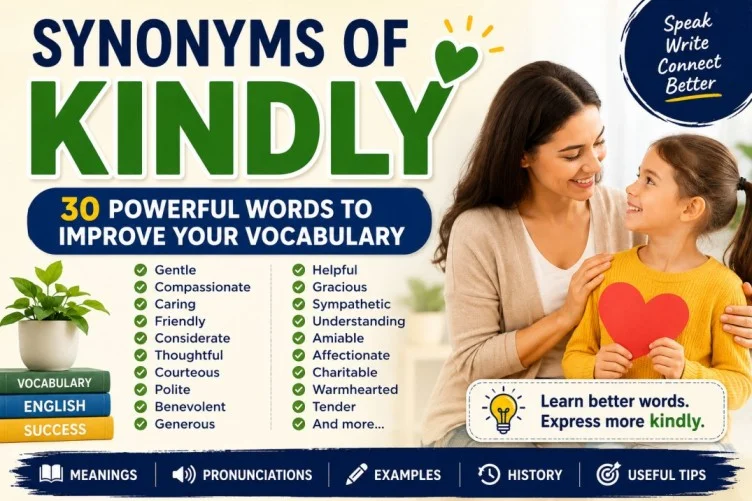
Have you ever asked someone for a favor and they responded with a warm smile and a gentle “yes”? That feeling of warmth and care is what the word “kindly” represents. It is a word we use every day to show friendliness and consideration toward others. People often use it when making requests or describing someone’s gentle nature.
Learning synonyms of “kindly” helps English learners and content writers expand their vocabulary and avoid repetition. Many students struggle to find the right word to express kindness in different situations.
This article will explore the meaning of kindly, its synonyms, grammar, history, pronunciation, and semantic categories. By the end, you will have 30 powerful words to use in your daily conversations and writing.
Meaning of Kindly
Definition
Kindly (Adverb or Adjective):
A simple definition: In a gentle, caring, or generous way. It can also mean showing friendliness and consideration toward others.
Examples:
- She spoke kindly to the frightened child
- The teacher kindly offered extra help to struggling students
Connotative Meaning
The emotional tone of “kindly” changes based on how it is used:
- Positive tone: Shows warmth, care, and genuine friendliness
- Negative tone: Can sound sarcastic or passive-aggressive in some contexts
- Neutral tone: Used in formal requests without strong emotion
(Connotation is the emotional or cultural meaning attached to a word beyond its literal definition.)
Etymology
The origin and history of “kindly”:
- Origin: Comes from Old English “gecyndelīce” meaning “naturally” or “innately”
- Source language: Old English and Germanic roots
- Original meaning: “Of one’s own nature” or “according to nature”
Short History:
- Old English (450–1100): Used as “gecyndelīce” meaning natural or innate
- Middle English (1100–1500): Evolved to “kindely” meaning “naturally” or “fittingly”
- Modern English (1500–Present): Took on the meaning of “friendly” and “considerate”
Pronunciation (US & UK)
- US: /ˈkaɪnd.li/
- UK: /ˈkaɪnd.li/
Syllables
kind-ly
Affixation Pattern of Kindly
- Root: kind
- Prefix: None
- Suffix: -ly
Word Formation of Kindly
- Kind (Adjective, Noun) – The base word
- Kindly (Adverb, Adjective) – Derived from adding suffix
- Kindness (Noun) – Formed by adding -ness
- Kindhearted (Adjective) – Compound word with heart
- Unkindly (Adverb) – Formed by adding un- prefix
A List of 30 Synonyms for Kindly
1. Gently (Adverb)
US: /ˈdʒɛn.tli/ | UK: /ˈdʒɛn.tli/
Meaning: In a soft, careful, or mild manner.
Examples:
- She gently placed the baby in the crib
- He gently reminded her of the meeting time
2. Nicely (Adverb)
US: /ˈnaɪs.li/ | UK: /ˈnaɪs.li/
Meaning: In a pleasant, agreeable, or satisfactory way.
Examples:
- The neighbors always greet us nicely
- She nicely asked for help with her bags
3. Considerately (Adverb)
US: /kənˈsɪd.ər.ət.li/ | UK: /kənˈsɪd.ər.ət.li/
Meaning: Showing thoughtfulness and care for others’ feelings.
Examples:
- He considerately offered his seat to the elderly woman
- She considerately lowered her voice during the meeting
4. Warmly (Adverb)
US: /ˈwɔːrm.li/ | UK: /ˈwɔːm.li/
Meaning: In a friendly, affectionate, or enthusiastic manner.
Examples:
- She warmly welcomed the new students
- He warmly thanked everyone for their support
5. Politely (Adverb)
US: /pəˈlaɪt.li/ | UK: /pəˈlaɪt.li/
Meaning: In a respectful and courteous manner.
Examples:
- The waiter politely asked for our order
- She politely declined the invitation
6. Compassionately (Adverb)
US: /kəmˈpæʃ.ən.ət.li/ | UK: /kəmˈpæʃ.ən.ət.li/
Meaning: Showing deep sympathy and concern for others’ suffering.
Examples:
- The nurse compassionately cared for the sick patients
- He compassionately listened to her problems
7. Tenderly (Adverb)
US: /ˈtɛn.dər.li/ | UK: /ˈtɛn.də.li/
Meaning: With gentleness, love, and care.
Examples:
- She tenderly held her newborn baby
- He tenderly kissed her forehead
8. Graciously (Adverb)
US: /ˈɡreɪ.ʃəs.li/ | UK: /ˈɡreɪ.ʃəs.li/
Meaning: In a kind, polite, and elegant manner.
Examples:
- The hostess graciously welcomed all the guests
- She graciously accepted the award
9. Sympathetically (Adverb)
US: /ˌsɪm.pəˈθɛt.ɪk.li/ | UK: /ˌsɪm.pəˈθɛt.ɪk.li/
Meaning: Showing understanding and care for someone’s difficulties.
Examples:
- The counselor sympathetically listened to the student
- She sympathetically offered her support
10. Benevolently (Adverb)
US: /bəˈnɛv.əl.ənt.li/ | UK: /bəˈnɛv.əl.ənt.li/
Meaning: In a generous and kind manner.
Examples:
- The king benevolently provided food for the poor
- She benevolently donated to many charities
11. Cordially (Adverb)
US: /ˈkɔːr.dʒəl.i/ | UK: /ˈkɔː.di.ə.li/
Meaning: In a warm, friendly, and sincere manner.
Examples:
- He cordially invited everyone to the party
- They cordially greeted each other
12. Genially (Adverb)
US: /ˈdʒiː.ni.ə.li/ | UK: /ˈdʒiː.ni.ə.li/
Meaning: In a cheerful, friendly, and pleasant manner.
Examples:
- The shopkeeper genially helped every customer
- She genially smiled at the children
13. Lovingly (Adverb)
US: /ˈlʌv.ɪŋ.li/ | UK: /ˈlʌv.ɪŋ.li/
Meaning: Showing love, affection, or care.
Examples:
- She lovingly prepared her grandmother’s recipe
- He lovingly cared for his garden
14. Tolerantly (Adverb)
US: /ˈtɑːl.ər.ənt.li/ | UK: /ˈtɒl.ər.ənt.li/
Meaning: In a patient and understanding way.
Examples:
- The teacher tolerantly handled the noisy classroom
- She tolerantly accepted different opinions
15. Humanely (Adverb)
US: /hjuːˈmeɪn.li/ | UK: /hjuːˈmeɪn.li/
Meaning: Showing kindness and compassion, especially toward animals.
Examples:
- The shelter humanely cared for abandoned pets
- He humanely treated all living creatures
16. Magnanimously (Adverb)
US: /mæɡˈnæn.ɪ.məs.li/ | UK: /mæɡˈnæn.ɪ.məs.li/
Meaning: In a generous and forgiving manner.
Examples:
- She magnanimously forgave her enemies
- He magnanimously shared his success with others
17. Amiably (Adverb)
US: /ˈeɪ.mi.ə.bli/ | UK: /ˈeɪ.mi.ə.bli/
Meaning: In a friendly and agreeable manner.
Examples:
- The neighbors amiably chatted over the fence
- She amiably agreed to help with the project
18. Courteously (Adverb)
US: /ˈkɜːr.ti.əs.li/ | UK: /ˈkɜː.ti.əs.li/
Meaning: In a polite and respectful manner.
Examples:
- The receptionist courteously answered all questions
- He courteously held the door for others
19. Affectionately (Adverb)
US: /əˈfɛk.ʃən.ət.li/ | UK: /əˈfɛk.ʃən.ət.li/
Meaning: Showing fondness, love, or tenderness.
Examples:
- She affectionately hugged her best friend
- He affectionately called her by a nickname
20. Warmheartedly (Adverb)
US: /ˌwɔːrmˈhɑːr.tɪd.li/ | UK: /ˌwɔːmˈhɑː.tɪd.li/
Meaning: With genuine kindness and generosity of spirit.
Examples:
- She warmheartedly welcomed strangers into her home
- He warmheartedly supported the new initiative
21. Cheerfully (Adverb)
US: /ˈtʃɪr.fəl.i/ | UK: /ˈtʃɪə.fəl.i/
Meaning: In a happy and positive manner.
Examples:
- The cashier cheerfully greeted every customer
- She cheerfully completed her chores
22. Helpfully (Adverb)
US: /ˈhɛlp.fəl.i/ | UK: /ˈhɛlp.fəl.i/
Meaning: In a manner that provides assistance or support.
Examples:
- He helpfully explained the instructions
- She helpfully offered to carry the bags
23. Thoughtfully (Adverb)
US: /ˈθɔːt.fəl.i/ | UK: /ˈθɔːt.fəl.i/
Meaning: Showing careful consideration for others’ needs.
Examples:
- He thoughtfully brought coffee for everyone
- She thoughtfully remembered his birthday
24. Decently (Adverb)
US: /ˈdiː.sənt.li/ | UK: /ˈdiː.sənt.li/
Meaning: In a proper, acceptable, and kind manner.
Examples:
- He decently treated all employees fairly
- She decently responded to the criticism
25. Mannerly (Adverb)
US: /ˈmæn.ər.li/ | UK: /ˈmæn.ə.li/
Meaning: With good manners and politeness.
Examples:
- The children behaved mannerly at the dinner
- He mannerly greeted all the guests
26. Softly (Adverb)
US: /ˈsɔːft.li/ | UK: /ˈsɒft.li/
Meaning: In a quiet, gentle, or subdued manner.
Examples:
- She softly spoke to the scared puppy
- He softly closed the door behind him
27. Sweetly (Adverb)
US: /ˈswiːt.li/ | UK: /ˈswiːt.li/
Meaning: In a pleasant, charming, or endearing way.
Examples:
- The child sweetly asked for a cookie
- She sweetly smiled at the old man
28. Good-naturedly (Adverb)
US: /ˌɡʊdˈneɪ.tʃərd.li/ | UK: /ˌɡʊdˈneɪ.tʃəd.li/
Meaning: With a cheerful, agreeable, and tolerant disposition.
Examples:
- He good-naturedly accepted the joke about himself
- She good-naturedly helped her younger brother
29. Understandingly (Adverb)
US: /ˌʌn.dərˈstæn.dɪŋ.li/ | UK: /ˌʌn.dəˈstæn.dɪŋ.li/
Meaning: With empathy and comprehension of others’ situations.
Examples:
- She understandingly nodded at his explanation
- He understandingly gave her more time to finish
30. Indulgently (Adverb)
US: /ɪnˈdʌl.dʒənt.li/ | UK: /ɪnˈdʌl.dʒənt.li/
Meaning: In a generous, tolerant, or lenient manner.
Examples:
- The grandmother indulgently allowed extra dessert
- He indulgently overlooked the small mistake
Prototype Meaning
The most typical meaning of “kindly” is showing gentle, friendly, and considerate behavior toward others. When most people hear this word, they imagine someone speaking softly, helping without being asked, or treating others with respect and patience. It represents the natural human desire to be good to one another.
Prototype Categorization
These synonyms group into meaningful categories:
- Gentle and Soft Manner: Gently, softly, tenderly
- Friendly and Warm: Warmly, genially, amiably, cordially
- Polite and Respectful: Politely, courteously, mannerly
- Caring and Sympathetic: Compassionately, sympathetically, understandingly
- Generous and Forgiving: Benevolently, magnanimously, indulgently
- Happy and Positive: Cheerfully, sweetly, good-naturedly
- Helpful and Thoughtful: Helpfully, thoughtfully, considerately
Understanding these categories helps writers choose the perfect synonym for every situation. For example, use “gently” for soft actions, “warmly” for friendly moments, and “benevolently” for generous acts.
Antonyms of Kindly
- Cruelly (Adverb) – Showing harshness and causing pain
- Harshly (Adverb) – Acting with roughness or severity
- Rudely (Adverb) – Behaving in a disrespectful manner
- Coldly (Adverb) – Lacking warmth, emotion, or friendliness
- Unkindly (Adverb) – Acting without kindness or consideration
Short Questions and Answers
What does kindly mean?
Kindly means acting in a gentle, caring, or generous way toward others.
When should kindly be used?
Use kindly when making polite requests, describing gentle actions, or showing friendliness in conversations and writing.
Is kindly positive or negative?
Kindly is usually positive, but it can become sarcastic or passive-aggressive depending on tone and context.
How is kindly different from similar words?
Kindly focuses on gentleness and care, while nicely is more general, politely is about good manners, and warmly emphasizes emotional warmth.
Conclusion
Learning the word “kindly” and its 30 powerful synonyms can greatly improve your vocabulary and communication skills. Using different words for kindness helps you express yourself more clearly and avoid boring repetition in your writing and speaking. Each synonym carries a slightly different shade of meaning, allowing you to choose the exact word for any situation.
When you expand your vocabulary, you build confidence in English. Practice using these words daily in conversations, emails, and creative writing. Try replacing “kindly” with different synonyms to see how they change the tone and meaning of your sentences. Your English will become richer, more precise, and more engaging.

I am a linguist with 17 years of experience in English language teaching, including postgraduate-level instruction. My expertise includes English grammar, and I contribute as a content and blog writer, producing scholarly and educational language resources.