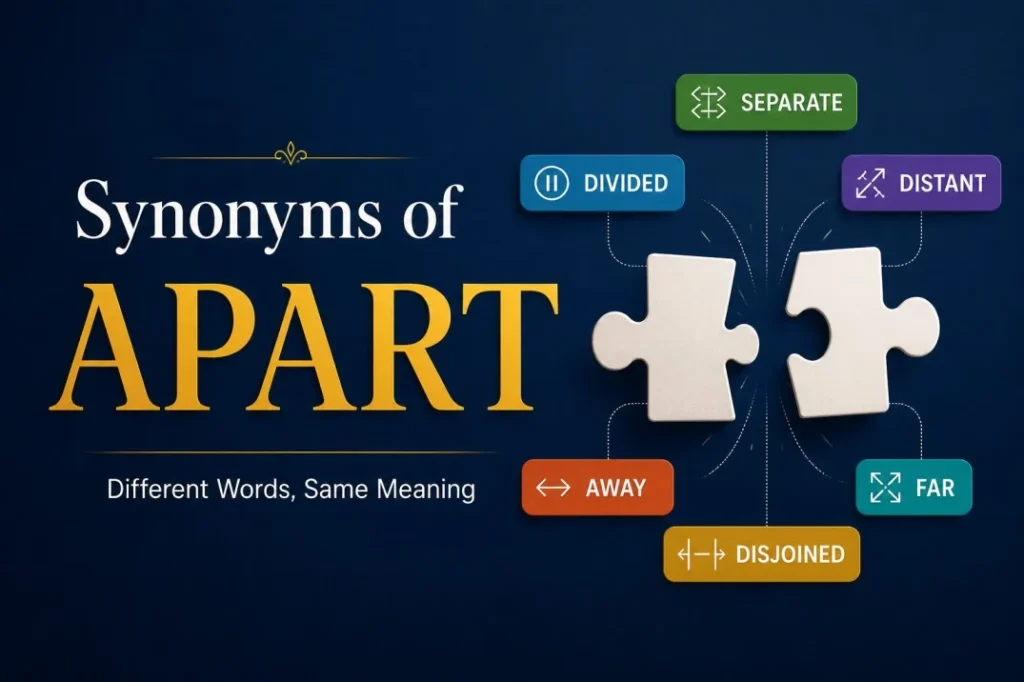
The word apart is a common English word that means being separated, divided, or at a distance from something else. Imagine two close friends moving to different cities for work. They still care about each other, but they now live apart. This simple word appears in everyday conversations, books, emails, and articles.
Because apart is used so often, learning its synonyms can help English learners and content writers avoid repetition and express ideas more clearly. Different synonyms can show different shades of meaning, such as distance, separation, isolation, or distinction.
In this article, you will learn the meaning of apart, its pronunciation, history, grammar, and word formation. You will also discover 30 useful synonyms with meanings and examples, semantic categories, antonyms, and practical questions and answers to strengthen your English vocabulary.
Meaning of Apart
Definition
Apart (Adverb / Adjective):
Apart means separated by distance, space, time, or relationship; not together.
Examples
- The two houses stand apart from each other.
- They lived apart for many years.
Connotative Meaning
(Connotation: the emotional or cultural feeling associated with a word beyond its dictionary meaning.)
- Positive tone: Independence, individuality, uniqueness.
- Negative tone: Loneliness, isolation, separation.
- Neutral tone: Physical distance or simple separation.
Etymology
- Origin: From Old French a part.
- Original meaning: “To one side” or “separately.”
- Entered English through Anglo-French influence.
Short History of the Keyword
- Old English (450–1100): Similar ideas were expressed using native words meaning separate or aside.
- Middle English (1100–1500): The phrase a part became common through French influence.
- Modern English (1500–Present): The spelling and usage evolved into apart, meaning separate or distant.
Pronunciation (US & UK – IPA)
US: /əˈpɑːrt/
UK: /əˈpɑːt/
Syllables
a-part
Affixation Pattern of Apart
Root: part
Prefix: a-
Suffix: None
Word Formation of the Keyword
- Apart (Adverb) – separately
- Apart (Adjective) – separated
- Part (Noun) – a piece or section
- Part (Verb) – to separate
- Parting (Noun/Adjective) – act of leaving
- Partial (Adjective) – incomplete
- Partially (Adverb) – not completely
- Partner (Noun) – one who shares
- Partition (Noun/Verb) – division
- Participation (Noun) – involvement
Synonyms of Apart
1. Separate (Adjective)
US: /ˈsɛprət/ | UK: /ˈsepərət/
Meaning: Not joined or connected.
Examples:
- The children sat at separate tables.
- We keep work and family life separate.
2. Divided (Adjective)
US: /dɪˈvaɪdɪd/ | UK: /dɪˈvaɪdɪd/
Meaning: Split into parts.
Examples:
- The land was divided into sections.
- Their opinions were divided.
3. Isolated (Adjective)
US: /ˈaɪsəleɪtɪd/ | UK: /ˈaɪsəleɪtɪd/
Meaning: Far from others.
Examples:
- The village is isolated.
- He felt isolated at school.
4. Detached (Adjective)
US: /dɪˈtætʃt/ | UK: /dɪˈtætʃt/
Meaning: Not connected.
Examples:
- The garage is detached from the house.
- She remained emotionally detached.
5. Distant (Adjective)
US: /ˈdɪstənt/ | UK: /ˈdɪstənt/
Meaning: Far away in space or relationship.
Examples:
- We saw distant mountains.
- They became distant friends.
6. Away (Adverb)
US: /əˈweɪ/ | UK: /əˈweɪ/
Meaning: At a distance.
Examples:
- She moved away last year.
- The store is miles away.
7. Aside (Adverb)
US: /əˈsaɪd/ | UK: /əˈsaɪd/
Meaning: To one side.
Examples:
- He stepped aside.
- Put the books aside.
8. Alone (Adjective/Adverb)
US: /əˈloʊn/ | UK: /əˈləʊn/
Meaning: Without others.
Examples:
- She was alone at home.
- I prefer to travel alone.
9. Independent (Adjective)
US: /ˌɪndɪˈpɛndənt/ | UK: /ˌɪndɪˈpendənt/
Meaning: Not controlled by others.
Examples:
- She is financially independent.
- The company operates independently.
10. Distinct (Adjective)
US: /dɪˈstɪŋkt/ | UK: /dɪˈstɪŋkt/
Meaning: Clearly different.
Examples:
- The two ideas are distinct.
- Each group has a distinct identity.
11. Different (Adjective)
US: /ˈdɪfrənt/ | UK: /ˈdɪfrənt/
Meaning: Not the same.
Examples:
- We chose different paths.
- Their styles are different.
12. Removed (Adjective)
US: /rɪˈmuːvd/ | UK: /rɪˈmuːvd/
Meaning: Taken away or distant.
Examples:
- The chair was removed.
- He felt removed from the discussion.
13. Disconnected (Adjective)
US: /ˌdɪskəˈnɛktɪd/ | UK: /ˌdɪskəˈnektɪd/
Meaning: Not linked.
Examples:
- The phone is disconnected.
- The ideas seem disconnected.
14. Segregated (Adjective)
US: /ˈsɛɡrɪɡeɪtɪd/ | UK: /ˈseɡrɪɡeɪtɪd/
Meaning: Kept apart from others.
Examples:
- The areas were segregated.
- The groups remained segregated.
15. Split (Adjective/Verb)
US: /splɪt/ | UK: /splɪt/
Meaning: Divided into parts.
Examples:
- The team split into groups.
- The road split ahead.
16. Severed (Adjective)
US: /ˈsɛvərd/ | UK: /ˈsevəd/
Meaning: Cut off completely.
Examples:
- The cable was severed.
- Relations were severed.
17. Broken Up (Adjective)
US: /ˈbroʊkən ʌp/ | UK: /ˈbrəʊkən ʌp/
Meaning: Separated into pieces or groups.
Examples:
- The crowd was broken up.
- The ice broke up in spring.
18. Remote (Adjective)
US: /rɪˈmoʊt/ | UK: /rɪˈməʊt/
Meaning: Far away.
Examples:
- They live in a remote area.
- The cabin is remote.
19. Faraway (Adjective)
US: /ˈfɑːrəweɪ/ | UK: /ˈfɑːrəweɪ/
Meaning: Located at a great distance.
Examples:
- We visited a faraway town.
- She dreams of faraway places.
20. Estranged (Adjective)
US: /ɪˈstreɪndʒd/ | UK: /ɪˈstreɪndʒd/
Meaning: No longer close.
Examples:
- He was estranged from his family.
- The brothers became estranged.
21. Solitary (Adjective)
US: /ˈsɑːləteri/ | UK: /ˈsɒlɪtəri/
Meaning: Existing alone.
Examples:
- He lived a solitary life.
- A solitary bird sat nearby.
22. Individual (Adjective)
US: /ˌɪndɪˈvɪdʒuəl/ | UK: /ˌɪndɪˈvɪdʒuəl/
Meaning: Separate and distinct.
Examples:
- Each student received an individual task.
- Individual rooms were available.
23. Unconnected (Adjective)
US: /ˌʌnkəˈnɛktɪd/ | UK: /ˌʌnkəˈnektɪd/
Meaning: Not related.
Examples:
- The events were unconnected.
- Their stories seem unconnected.
24. Disjoined (Adjective)
US: /dɪsˈdʒɔɪnd/ | UK: /dɪsˈdʒɔɪnd/
Meaning: Not joined together.
Examples:
- The sections appeared disjoined.
- The argument felt disjoined.
25. Scattered (Adjective)
US: /ˈskætərd/ | UK: /ˈskætəd/
Meaning: Spread over an area.
Examples:
- Houses were scattered across the valley.
- Papers lay scattered on the floor.
26. Dispersed (Adjective)
US: /dɪˈspɜːrst/ | UK: /dɪˈspɜːst/
Meaning: Spread out.
Examples:
- The crowd dispersed quickly.
- Seeds were dispersed by wind.
27. Secluded (Adjective)
US: /sɪˈkluːdɪd/ | UK: /sɪˈkluːdɪd/
Meaning: Private and away from others.
Examples:
- They stayed in a secluded cabin.
- The beach is secluded.
28. Withdrawn (Adjective)
US: /wɪðˈdrɔn/ | UK: /wɪðˈdrɔːn/
Meaning: Socially distant.
Examples:
- He seemed withdrawn lately.
- The child became withdrawn.
29. Distanced (Adjective)
US: /ˈdɪstənst/ | UK: /ˈdɪstənst/
Meaning: Kept at a distance.
Examples:
- She distanced herself from the rumor.
- The groups remained distanced.
30. Set Apart (Verb Phrase)
US: /sɛt əˈpɑːrt/ | UK: /set əˈpɑːt/
Meaning: Made different or separate.
Examples:
- Her talent set her apart.
- The award set the school apart.
Prototype Meaning
The most typical meaning of apart is being separated from something or someone else. When people hear the word, they often imagine two objects, people, or groups that are no longer together. The idea of distance or separation is the central meaning of the word.
Prototype Categorization
Categorizing synonyms helps writers select the most accurate word for a specific situation.
- Physical Separation: separate, divided, detached, split, severed
- Distance and Location: distant, remote, faraway, away, secluded
- Emotional Separation: estranged, withdrawn, detached, distanced
- Uniqueness and Difference: distinct, different, individual, independent, set apart
- Isolation and Loneliness: isolated, solitary, alone
- Distribution and Spread: scattered, dispersed
- Connection and Relationship: disconnected, unconnected, disjoined
Writers can choose a synonym based on whether they want to express distance, isolation, uniqueness, or division.
Antonyms of Apart
- Together (Adverb) – in one place or group
- United (Adjective) – joined as one
- Connected (Adjective) – linked together
- Joined (Adjective) – attached to another thing
- Combined (Adjective) – merged into one
- Integrated (Adjective) – brought together into a whole
- Associated (Adjective) – related or connected
- Attached (Adjective) – fastened or joined
- Close (Adjective/Adverb) – near in distance or relationship
- Adjacent (Adjective) – next to something
Short Questions and Answers
- What does apart mean?
Apart means separated, not together, or at a distance from something else. - When should apart be used?
Use apart when talking about physical distance, separation, different groups, or emotional distance. - Is apart positive or negative?
It can be positive, negative, or neutral depending on context. It may suggest independence, loneliness, or simple distance. - How is it different from similar words?
Apart is a general word for separation. Words like isolated emphasize loneliness, while distinct emphasizes difference and uniqueness.
Conclusion
Learning the word apart and its synonyms is a great way to expand your English vocabulary. These alternative words help you express different meanings related to separation, distance, uniqueness, and independence. By using a variety of synonyms, you can make your writing more interesting and avoid repeating the same word again and again. Understanding pronunciation, history, connotation, and usage also improves both speaking and writing skills. Whether you are an English learner, student, teacher, blogger, or content writer, mastering apart and its related words can build confidence and make communication clearer. Practice using a new synonym every day, and your vocabulary will continue to grow stronger over time.

I am a linguist with 17 years of experience in English language teaching, including postgraduate-level instruction. My expertise includes English grammar, and I contribute as a content and blog writer, producing scholarly and educational language resources.