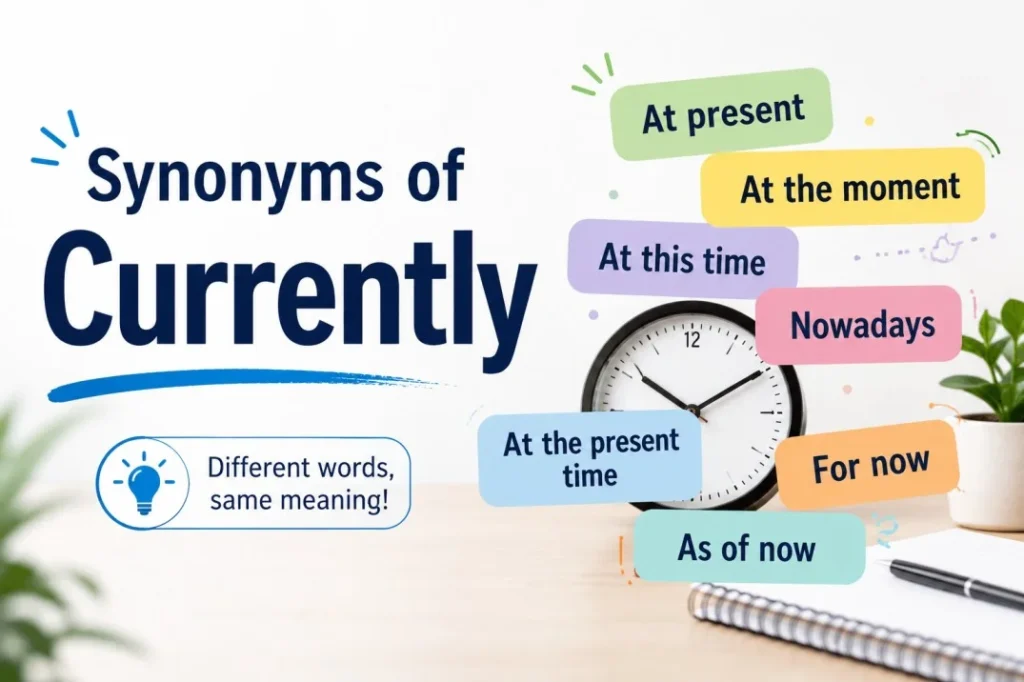
The word “currently” appears everywhere in everyday English. It means “at the present time” or “now.” For example, imagine you are talking to a friend on the phone. They ask, “What are you doing?” You reply, “I am currently eating dinner.” This small word helps you explain what is happening right now.
English learners and content writers often use “currently” too much. Repeating the same word makes writing boring and less professional. Learning new synonyms helps you express ideas more clearly and keeps your readers interested.
This article explains the meaning of “currently,” its history, pronunciation, and grammar. It also provides 30 powerful synonyms with example sentences. By the end, you will feel more confident using different words to talk about the present time.
Meaning of Currently
Definition
Currently (Adverb):
A simple, clear definition: At the present time or now.
Examples
- She is currently working on a new project at her job.
- The store is currently closed for renovations.
Connotative Meaning
The emotional tone of “currently” depends on the context:
- Positive tone: Suggests action, progress, or being up-to-date.
- Negative tone: Can imply something temporary or unfinished.
- Neutral tone: Most often used as a factual statement of time.
(Connotation is the emotional or cultural meaning attached to a word beyond its literal definition.)
Etymology
The origin of “currently” comes from:
- The Latin word “currere,” which means “to run.”
- The Old French word “curant,” meaning “running” or “flowing.”
- The English suffix “-ly,” which turns adjectives into adverbs.
Short History
- Old English (450–1100): The word did not exist in this form. People used words like “nu” (now).
- Middle English (1100–1500): The word “currant” appeared, meaning “running” or “in circulation.”
- Modern English (1500–Present): “Currently” became common in the 1800s to mean “at the present time.”
Pronunciation (US & UK – IPA)
- US: /ˈkɜːr.ənt.li/
- UK: /ˈkʌr.ənt.li/
Syllables
Cur-rent-ly
Affixation Pattern of Currently
- Root: Cur(r)- (from Latin “currere” meaning to run)
- Prefix: None
- Suffix: -ent (adjective-forming suffix) + -ly (adverb-forming suffix)
Word Formation of the Keyword
Several words are formed from the root “curr-“:
- Current (adjective/noun)
- Currently (adverb)
- Currency (noun)
- Currentness (noun)
Synonyms of Currently
1. Now (Adverb)
US: /naʊ/ | UK: /naʊ/
Meaning: At the present moment.
Examples:
- I am now ready to leave.
- The meeting is starting now.
2. At Present (Adverb)
US: /æt ˈprɛz.ənt/ | UK: /æt ˈprɛz.ənt/
Meaning: At this time.
Examples:
- At present, we have no plans to expand.
- She is at present living in London.
3. At the Moment (Adverb)
US: /æt ðə ˈmoʊ.mənt/ | UK: /æt ðə ˈməʊ.mənt/
Meaning: Right now.
Examples:
- He is busy at the moment.
- I am not feeling well at the moment.
4. Presently (Adverb)
US: /ˈprɛz.ənt.li/ | UK: /ˈprɛz.ənt.li/
Meaning: At this time or soon.
Examples:
- She is presently on vacation.
- The doctor will see you presently.
5. Today (Adverb)
US: /təˈdeɪ/ | UK: /təˈdeɪ/
Meaning: On this present day or in modern times.
Examples:
- Today, more people work from home.
- He is feeling better today.
6. Right Now (Adverb)
US: /raɪt naʊ/ | UK: /raɪt naʊ/
Meaning: Exactly at this moment.
Examples:
- I am right now cooking dinner.
- She needs help right now.
7. At This Time (Adverb)
US: /æt ðɪs taɪm/ | UK: /æt ðɪs taɪm/
Meaning: Now.
Examples:
- At this time, we are not hiring.
- The store is closed at this time.
8. Nowadays (Adverb)
US: /ˈnaʊ.ə.deɪz/ | UK: /ˈnaʊ.ə.deɪz/
Meaning: In modern times.
Examples:
- Nowadays, many people use smartphones.
- Children nowadays spend more time online.
9. These Days (Adverb)
US: /ðiːz deɪz/ | UK: /ðiːz deɪz/
Meaning: In the present period of time.
Examples:
- These days, I wake up early.
- People are more health-conscious these days.
10. For Now (Adverb)
US: /fɔːr naʊ/ | UK: /fɔː naʊ/
Meaning: For the present time.
Examples:
- We will stay here for now.
- That is enough for now.
11. At This Point (Adverb)
US: /æt ðɪs pɔɪnt/ | UK: /æt ðɪs pɔɪnt/
Meaning: At this stage or moment.
Examples:
- At this point, we cannot change the plan.
- She is happy at this point in her life.
12. For the Time Being (Adverb)
US: /fɔːr ðə taɪm ˈbiː.ɪŋ/ | UK: /fɔː ðə taɪm ˈbiː.ɪŋ/
Meaning: Temporarily.
Examples:
- We will use this office for the time being.
- She is staying with her parents for the time being.
13. In the Present (Adverb)
US: /ɪn ðə ˈprɛz.ənt/ | UK: /ɪn ðə ˈprɛz.ənt/
Meaning: Now.
Examples:
- He lives in the present and does not worry about the past.
- We must focus on the present.
14. At the Present Time (Adverb)
US: /æt ðə ˈprɛz.ənt taɪm/ | UK: /æt ðə ˈprɛz.ənt taɪm/
Meaning: Now.
Examples:
- At the present time, we have no comments.
- She is at the present time working abroad.
15. Just Now (Adverb)
US: /dʒʌst naʊ/ | UK: /dʒʌst naʊ/
Meaning: A short time ago or right now.
Examples:
- I saw him just now.
- She just now finished her homework.
16. This Day (Adverb)
US: /ðɪs deɪ/ | UK: /ðɪs deɪ/
Meaning: On this particular day.
Examples:
- This day is very special to us.
- We are celebrating this day together.
17. As of Now (Adverb)
US: /æz əv naʊ/ | UK: /æz əv naʊ/
Meaning: Starting from now.
Examples:
- As of now, the store is open.
- As of now, I am the manager.
18. At This Instant (Adverb)
US: /æt ðɪs ˈɪn.stənt/ | UK: /æt ðɪs ˈɪn.stənt/
Meaning: Exactly now.
Examples:
- She is walking in at this instant.
- The phone is ringing at this instant.
19. At This Very Moment (Adverb)
US: /æt ðɪs ˈver.i ˈmoʊ.mənt/ | UK: /æt ðɪs ˈver.i ˈməʊ.mənt/
Meaning: Right now with emphasis.
Examples:
- At this very moment, I am thinking of you.
- The decision is being made at this very moment.
20. Now Then (Adverb)
US: /naʊ ðɛn/ | UK: /naʊ ðɛn/
Meaning: At this time (often used to begin a statement).
Examples:
- Now then, let us begin the meeting.
- Now then, what is the next step?
21. Here and Now (Adverb)
US: /hɪr ænd naʊ/ | UK: /hɪər ænd naʊ/
Meaning: At this exact place and time.
Examples:
- We must solve the problem here and now.
- I want to talk about this here and now.
22. Immediately (Adverb)
US: /ɪˈmiː.di.ət.li/ | UK: /ɪˈmiː.di.ət.li/
Meaning: Without delay.
Examples:
- She responded immediately to my email.
- He left the room immediately.
23. In This Day and Age (Adverb)
US: /ɪn ðɪs deɪ ænd eɪdʒ/ | UK: /ɪn ðɪs deɪ ænd eɪdʒ/
Meaning: In modern times.
Examples:
- In this day and age, everyone uses the internet.
- Children grow up faster in this day and age.
24. Anymore (Adverb)
US: /ˌɛn.iˈmɔːr/ | UK: /ˌɛn.iˈmɔːr/
Meaning: Now (often used in negative statements).
Examples:
- I do not live there anymore.
- She does not work here anymore.
25. No Longer (Adverb)
US: /noʊ ˈlɔːŋ.ɡər/ | UK: /nəʊ ˈlɒŋ.ɡər/
Meaning: Not now.
Examples:
- He no longer works here.
- She is no longer my friend.
26. These Times (Adverb)
US: /ðiːz taɪmz/ | UK: /ðiːz taɪmz/
Meaning: The present period.
Examples:
- These times are difficult for everyone.
- We are living in strange times.
27. At This Stage (Adverb)
US: /æt ðɪs steɪdʒ/ | UK: /æt ðɪs steɪdʒ/
Meaning: At this point in a process.
Examples:
- At this stage, we cannot change anything.
- She is at this stage of her career.
28. In This Day (Adverb)
US: /ɪn ðɪs deɪ/ | UK: /ɪn ðɪs deɪ/
Meaning: In the present time.
Examples:
- In this day, technology changes fast.
- People travel more in this day.
29. For Now (Adverb)
US: /fɔːr naʊ/ | UK: /fɔː naʊ/
Meaning: Temporarily.
Examples:
- We will stop here for now.
- This is enough for now.
30. From Now On (Adverb)
US: /frʌm naʊ ɒn/ | UK: /frʌm naʊ ɒn/
Meaning: Starting now and continuing.
Examples:
- From now on, I will wake up early.
- From now on, we will work harder.
Prototype Meaning
The most typical meaning of “currently” is to indicate that something is happening or existing at the present time. People usually imagine a clear, factual statement about the present moment. For example, when someone says, “I am currently at work,” listeners understand that the person is in their workplace right now.
Prototype Categorization
Here are ways to group these synonyms:
- Simple Present Time Words: Now, at present, at the moment, presently, today.
- Emphasizing Exact Time: Right now, at this very moment, at this instant, just now.
- Broad Modern Era Words: Nowadays, these days, in this day and age, in the present.
- Temporary or Conditional Words: For now, for the time being, at this point, at this stage.
- Negative Present Words: Anymore, no longer.
Categorization helps writers choose the best synonym for each situation. For example, if you want to sound formal, use “at present.” If you are writing informally, “right now” works better. Knowing these groups improves your writing style and clarity.
Antonyms of Currently
- Soon (Adverb): In the near future.
- Later (Adverb): At a time in the future.
- Eventually (Adverb): At some future time.
- Never (Adverb): Not at any time.
- Formerly (Adverb): In the past.
- Previously (Adverb): Before now.
- Then (Adverb): At that time.
- Afterwards (Adverb): At a later time.
Short Questions and Answers
What does “currently” mean?
“Currently” means now or at the present time.
When should “currently” be used?
Use “currently” when you want to state facts about the present moment in a clear and formal way.
Is “currently” positive or negative?
“Currently” is neutral. Its tone depends on the context. For example, “I am currently happy” is positive, while “I am currently sick” is negative.
How is it different from similar words?
“Currently” is more formal than “now.” “Nowadays” refers to a broader time period, while “currently” focuses on the exact present.
Conclusion
Learning the word “currently” and its synonyms helps you express time more accurately. It makes your writing more interesting and professional. When you avoid repeating the same word, your readers stay engaged. Using different synonyms also builds your English confidence.
Try to practice these new words every day. Use them in your conversations and writing. You will soon notice how much better your English sounds. Vocabulary is the key to clear communication. Keep learning, and you will become a stronger writer and speaker.

I am a linguist with 17 years of experience in English language teaching, including postgraduate-level instruction. My expertise includes English grammar, and I contribute as a content and blog writer, producing scholarly and educational language resources.