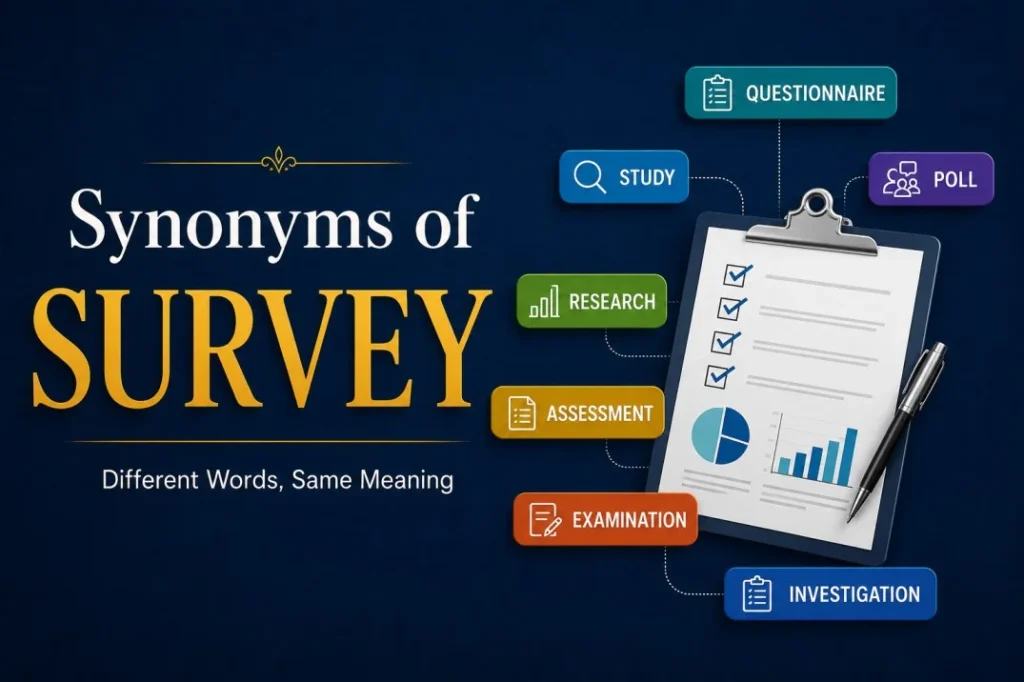
The word survey is a common English word that means looking at, examining, or collecting information about something. Imagine a teacher asking students questions about their favorite school subjects. The teacher is conducting a survey to gather information. We often use this word in education, business, research, government, and everyday conversations.
Learning synonyms of survey is important for English learners because it helps improve vocabulary and makes speaking and writing more interesting. Content writers also use synonyms to avoid repeating the same word many times.
In this article, you will learn the meaning of survey, its pronunciation, grammar, history, connotations, and 30 powerful synonyms with examples. You will also discover semantic categories, antonyms, and practical usage tips to strengthen your English skills.
Meaning of Survey
Definition
Survey (Noun / Verb):
A survey is a study, examination, or set of questions used to collect information from people. As a verb, it means to examine, inspect, or gather information about something.
Examples
- The company conducted a survey about customer satisfaction.
- Researchers surveyed hundreds of people for the project.
Connotative Meaning
(Connotation: the emotional or cultural feeling associated with a word beyond its dictionary meaning.)
- Positive tone: Careful study, informed decision-making, useful research.
- Negative tone: Can suggest questioning, checking, or monitoring people too closely.
- Neutral tone: Collecting information or examining something objectively.
Etymology
- Origin: From Anglo-French surveier.
- Original meaning: “To look over” or “to oversee.”
- Derived from: Old French sur (over) + veoir (to see).
Short History of the Keyword
- Old English (450–1100): The exact word was not used, but similar ideas existed through words meaning “look over” or “inspect.”
- Middle English (1100–1500): Forms influenced by Old French entered English.
- Modern English (1500–Present): The word became common for inspection, measurement, research, and questionnaires.
Pronunciation (US & UK – IPA)
US: /sərˈveɪ/ (verb), /ˈsɝː.veɪ/ (noun)
UK: /səˈveɪ/ (verb), /ˈsɜː.veɪ/ (noun)
Syllables
sur-vey
Affixation Pattern of Survey
Root: survey
Prefix: None
Suffix: None
Word Formation of the Keyword
- Survey (noun)
- Survey (verb)
- Surveyed (verb – past tense)
- Surveying (verb – present participle/gerund)
- Surveyor (noun)
- Surveys (noun plural / verb form)
Synonyms of Survey
1. Examination (Noun)
US: /ɪɡˌzæməˈneɪʃən/ | UK: /ɪɡˌzæmɪˈneɪʃən/
Meaning: A careful study or inspection of something.
Examples:
- The examination revealed several issues.
- A detailed examination was completed yesterday.
2. Inspection (Noun)
US: /ɪnˈspɛkʃən/ | UK: /ɪnˈspekʃən/
Meaning: A close and careful check.
Examples:
- The building passed inspection.
- Officials performed an inspection of the site.
3. Review (Noun/Verb)
US: /rɪˈvjuː/ | UK: /rɪˈvjuː/
Meaning: Looking at something again for evaluation.
Examples:
- The manager reviewed the report.
- A review showed positive results.
4. Assessment (Noun)
US: /əˈsɛsmənt/ | UK: /əˈsesmənt/
Meaning: Evaluation of quality, value, or condition.
Examples:
- The assessment took two days.
- Teachers completed student assessments.
5. Analysis (Noun)
US: /əˈnæləsɪs/ | UK: /əˈnæləsɪs/
Meaning: Detailed study of something.
Examples:
- The analysis explained the findings.
- Data analysis helped the researchers.
6. Study (Noun)
US: /ˈstʌdi/ | UK: /ˈstʌdi/
Meaning: Careful investigation of a subject.
Examples:
- The study involved many participants.
- Scientists published a new study.
7. Investigation (Noun)
US: /ɪnˌvɛstəˈɡeɪʃən/ | UK: /ɪnˌvestɪˈɡeɪʃən/
Meaning: Detailed inquiry into facts.
Examples:
- Police launched an investigation.
- The investigation lasted months.
8. Inquiry (Noun)
US: /ɪnˈkwaɪri/ | UK: /ɪnˈkwaɪəri/
Meaning: A search for information.
Examples:
- An inquiry was opened.
- The committee conducted an inquiry.
9. Research (Noun)
US: /rɪˈsɜːrtʃ/ | UK: /rɪˈsɜːtʃ/
Meaning: Systematic study to discover facts.
Examples:
- Research supports the theory.
- She works in medical research.
10. Audit (Noun)
US: /ˈɔːdɪt/ | UK: /ˈɔːdɪt/
Meaning: Official examination of records.
Examples:
- The company underwent an audit.
- Audits improve accountability.
11. Poll (Noun)
US: /poʊl/ | UK: /pəʊl/
Meaning: Collection of opinions from people.
Examples:
- The poll showed strong support.
- Many people answered the poll.
12. Questionnaire (Noun)
US: /ˌkwɛstʃəˈnɛr/ | UK: /ˌkwestʃəˈneə/
Meaning: A list of questions for gathering information.
Examples:
- Participants completed a questionnaire.
- The questionnaire was simple.
13. Census (Noun)
US: /ˈsɛnsəs/ | UK: /ˈsensəs/
Meaning: Official count of a population.
Examples:
- The census occurs regularly.
- Census data helps governments.
14. Appraisal (Noun)
US: /əˈpreɪzəl/ | UK: /əˈpreɪzəl/
Meaning: Evaluation of value or quality.
Examples:
- The property received an appraisal.
- Performance appraisals are important.
15. Evaluation (Noun)
US: /ɪˌvæljuˈeɪʃən/ | UK: /ɪˌvæljuˈeɪʃən/
Meaning: Judging quality or effectiveness.
Examples:
- An evaluation was completed.
- The evaluation showed progress.
16. Observation (Noun)
US: /ˌɑːbzərˈveɪʃən/ | UK: /ˌɒbzəˈveɪʃən/
Meaning: Careful watching of something.
Examples:
- Observation provided useful data.
- Scientists relied on observation.
17. Scrutiny (Noun)
US: /ˈskruːtəni/ | UK: /ˈskruːtɪni/
Meaning: Very close examination.
Examples:
- The report faced scrutiny.
- Public scrutiny increased.
18. Inspectional Review (Noun)
US: /ɪnˈspɛkʃənəl rɪˈvjuː/ | UK: /ɪnˈspekʃənəl rɪˈvjuː/
Meaning: A review involving detailed checking.
Examples:
- An inspectional review was ordered.
- The review found minor issues.
19. Reconnaissance (Noun)
US: /rɪˈkɑːnəsəns/ | UK: /rɪˈkɒnɪsəns/
Meaning: Preliminary exploration to gather information.
Examples:
- The team performed reconnaissance.
- Reconnaissance helped planning.
20. Scan (Noun/Verb)
US: /skæn/ | UK: /skæn/
Meaning: Quick examination.
Examples:
- The doctor ordered a scan.
- She scanned the document.
21. Check (Noun/Verb)
US: /tʃɛk/ | UK: /tʃek/
Meaning: Examination for accuracy or condition.
Examples:
- Please perform a safety check.
- He checked the equipment.
22. Overview (Noun)
US: /ˈoʊvərˌvjuː/ | UK: /ˈəʊvəvjuː/
Meaning: General summary or view.
Examples:
- The report gives an overview.
- We discussed an overview first.
23. Exploration (Noun)
US: /ˌɛkspləˈreɪʃən/ | UK: /ˌekspləˈreɪʃən/
Meaning: Investigation to learn more.
Examples:
- Exploration led to discoveries.
- The topic deserves further exploration.
24. Probe (Noun/Verb)
US: /proʊb/ | UK: /prəʊb/
Meaning: Deep investigation.
Examples:
- Officials launched a probe.
- Journalists probed the issue.
25. Field Study (Noun)
US: /fiːld ˈstʌdi/ | UK: /fiːld ˈstʌdi/
Meaning: Research conducted outside a laboratory.
Examples:
- Students completed a field study.
- The field study lasted weeks.
26. Sounding (Noun)
US: /ˈsaʊndɪŋ/ | UK: /ˈsaʊndɪŋ/
Meaning: An attempt to discover opinions.
Examples:
- The group took political soundings.
- Soundings showed public concerns.
27. Sampling (Noun)
US: /ˈsæmplɪŋ/ | UK: /ˈsɑːmplɪŋ/
Meaning: Selecting part of a group for study.
Examples:
- Sampling reduced costs.
- Random sampling improved accuracy.
28. Monitoring (Noun)
US: /ˈmɑːnɪtərɪŋ/ | UK: /ˈmɒnɪtərɪŋ/
Meaning: Continuous observation.
Examples:
- Monitoring continues daily.
- Environmental monitoring is important.
29. Inspection Tour (Noun)
US: /ɪnˈspɛkʃən tʊr/ | UK: /ɪnˈspekʃən tʊə/
Meaning: Visit made to examine places or conditions.
Examples:
- The mayor made an inspection tour.
- Officials completed an inspection tour.
30. Surveying (Verb/Noun)
US: /sərˈveɪɪŋ/ | UK: /səˈveɪɪŋ/
Meaning: The act of examining or measuring.
Examples:
- Surveying requires accuracy.
- Engineers were surveying the land.
Prototype Meaning
When people hear the word survey, they usually imagine a set of questions given to a group of people to collect opinions, facts, or feedback. This is the most common and typical meaning of the word in modern English. Businesses, schools, researchers, and governments often use surveys to understand what people think or need.
Prototype Categorization
Categorizing synonyms helps writers choose the most accurate word for a specific situation.
- Research and Data Collection: Survey, Research, Study, Sampling, Census, Questionnaire, Poll
- Examination and Checking: Inspection, Examination, Check, Scan, Scrutiny
- Evaluation and Judgment: Assessment, Evaluation, Appraisal, Audit, Review
- Investigation and Inquiry: Investigation, Inquiry, Probe, Exploration
- Observation and Monitoring: Observation, Monitoring, Reconnaissance
- General Understanding: Overview, Sounding, Field Study
Writers can improve precision by selecting a synonym that best matches the context.
Antonyms of Survey
- Ignore (Verb): To pay no attention to something.
- Neglect (Verb): To fail to care for or examine something.
- Overlook (Verb): To miss or fail to notice.
- Dismiss (Verb): To reject without investigation.
- Disregard (Verb): To ignore deliberately.
- Avoid (Verb): To stay away from examining something.
- Abandon (Verb): To leave something without review.
- Forget (Verb): To fail to remember or consider.
Short Questions and Answers
- What does survey mean?
A survey is a method of collecting information or examining something carefully. - When should survey be used?
Use it when gathering opinions, facts, measurements, or conducting an examination. - Is survey positive or negative?
It is usually neutral, but it can be positive when helping decision-making and negative when linked to excessive monitoring. - How is it different from similar words?
A survey often gathers information broadly, while an investigation or probe usually goes deeper into a specific issue.
Conclusion
The word survey is an important English word used for collecting information, examining situations, and understanding people’s opinions. Learning its synonyms helps expand vocabulary, improve communication, and make writing more engaging. Words such as assessment, research, inspection, and evaluation allow speakers and writers to express ideas with greater accuracy. Using a variety of synonyms also prevents repetition and makes content more professional. As your vocabulary grows, your confidence in English speaking and writing grows too. Practice using one or two new synonyms each day in sentences and conversations. Over time, these words will become a natural part of your everyday English

I am a linguist with 17 years of experience in English language teaching, including postgraduate-level instruction. My expertise includes English grammar, and I contribute as a content and blog writer, producing scholarly and educational language resources.