The word mosaic means a picture, pattern, or design made by joining many small pieces together. These pieces may be made of stone, glass, wood, tile, or other materials. We also use the word to describe a mix of different people, cultures, ideas, or experiences.
Imagine walking into an old building with a colorful floor made from tiny tiles. Each small piece looks simple, but together they create a beautiful picture. That is a perfect example of a mosaic.
The word mosaic is common in art, architecture, history, education, and everyday English. Learning its synonyms helps English learners, students, teachers, and content writers avoid repeating the same word. This article explains the meaning of mosaic, its pronunciation, history, grammar, semantic categories, and 30 useful synonyms with simple examples.
Meaning of Mosaic
Definition
Mosaic (Noun):
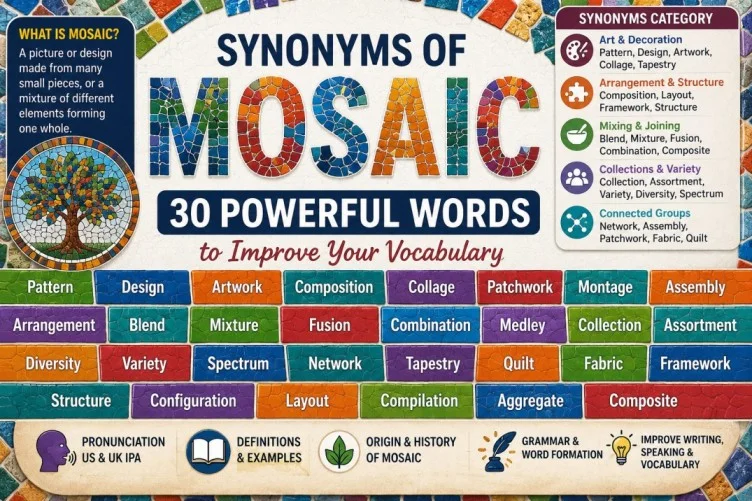
A picture, design, or pattern made by putting many small pieces together. It can also mean a collection of different parts that form one whole.
Examples
- The museum displayed a beautiful mosaic made from colorful glass.
- Our city is a mosaic of many cultures and traditions.
Connotative Meaning
(Connotation means the emotional feeling or idea that a word suggests beyond its dictionary meaning.)
- Positive tone: Beauty, creativity, diversity, unity.
- Negative tone: Rarely negative, but it may suggest something broken into many parts.
- Neutral tone: A design made from small pieces or a mixture of different elements.
Etymology
- Source Language: French and Latin, from Greek.
- Original Meaning: “Work dedicated to the Muses” or decorative artwork.
Short History
- Old English (450–1100): The word was not used in English.
- Middle English (1100–1500): The term entered English through French influence.
- Modern English (1500–Present): It became common for tile art and later for describing diversity and mixed collections.
Pronunciation (US & UK – IPA)
- US: /moʊˈzeɪ.ɪk/
- UK: /məʊˈzeɪ.ɪk/
Syllables
mo-sa-ic
Affixation Pattern of Mosaic
- Root: mosaic
- Prefix: None
- Suffix: None
Word Formation of Mosaic
- Mosaic (Noun)
- Mosaic (Adjective)
- Mosaics (Plural Noun)
- Mosaicist (Noun – a person who creates mosaics)
- Mosaicked (Adjective/Past Participle)
- Mosaicking (Verb Form)
A List of 30 Synonyms for Mosaic
1. Pattern (Noun)
US: /ˈpætərn/ | UK: /ˈpætən/
Meaning: A repeated decorative design.
Examples
- The floor has a colorful pattern.
- I noticed a floral pattern on the wall.
2. Design (Noun)
US: /dɪˈzaɪn/ | UK: /dɪˈzaɪn/
Meaning: A planned artistic arrangement.
Examples
- The design looks elegant.
- She created a new design.
3. Artwork (Noun)
US: /ˈɑrtˌwɜrk/ | UK: /ˈɑːtwɜːk/
Meaning: A piece of creative art.
Examples
- The artwork impressed everyone.
- His artwork won first prize.
4. Composition (Noun)
US: /ˌkɑmpəˈzɪʃən/ | UK: /ˌkɒmpəˈzɪʃən/
Meaning: The arrangement of different parts.
Examples
- The painting has a balanced composition.
- The composition is attractive.
5. Collage (Noun)
US: /kəˈlɑʒ/ | UK: /ˈkɒlɑːʒ/
Meaning: Artwork made by combining different materials.
Examples
- She made a collage from magazine pages.
- The collage covered the classroom wall.
6. Patchwork (Noun)
US: /ˈpætʃˌwɜrk/ | UK: /ˈpætʃwɜːk/
Meaning: A mixture of different pieces joined together.
Examples
- The quilt is patchwork.
- The law became a patchwork of rules.
7. Montage (Noun)
US: /mɑnˈtɑʒ/ | UK: /mɒnˈtɑːʒ/
Meaning: A collection of images arranged together.
Examples
- The film opened with a montage.
- The photo montage told a story.
8. Assembly (Noun)
US: /əˈsɛmbli/ | UK: /əˈsembli/
Meaning: A group of parts put together.
Examples
- The assembly took several hours.
- Every piece fits the assembly.
9. Arrangement (Noun)
US: /əˈreɪndʒmənt/ | UK: /əˈreɪndʒmənt/
Meaning: The way things are organized.
Examples
- I liked the flower arrangement.
- The arrangement looked neat.
10. Blend (Noun)
US: /blɛnd/ | UK: /blend/
Meaning: A mixture of different things.
Examples
- The soup is a blend of spices.
- The city is a blend of cultures.
11. Mixture (Noun)
US: /ˈmɪkstʃər/ | UK: /ˈmɪkstʃə/
Meaning: Different things combined.
Examples
- The recipe uses a mixture of herbs.
- It was a mixture of emotions.
12. Fusion (Noun)
US: /ˈfjuʒən/ | UK: /ˈfjuːʒən/
Meaning: The joining of different elements.
Examples
- Fusion music is popular.
- The restaurant serves fusion food.
13. Combination (Noun)
US: /ˌkɑmbəˈneɪʃən/ | UK: /ˌkɒmbɪˈneɪʃən/
Meaning: Two or more things joined together.
Examples
- Blue and gold make a nice combination.
- The combination worked well.
14. Medley (Noun)
US: /ˈmɛdli/ | UK: /ˈmedli/
Meaning: A mixture of different items.
Examples
- The band played a medley.
- We enjoyed a medley of songs.
15. Collection (Noun)
US: /kəˈlɛkʃən/ | UK: /kəˈlekʃən/
Meaning: A group of gathered items.
Examples
- The museum has a large collection.
- Her collection is valuable.
16. Assortment (Noun)
US: /əˈsɔrtmənt/ | UK: /əˈsɔːtmənt/
Meaning: A variety of different things.
Examples
- The shop sells an assortment of gifts.
- We sampled an assortment of fruits.
17. Diversity (Noun)
US: /daɪˈvɜrsəti/ | UK: /daɪˈvɜːsəti/
Meaning: The state of having many different kinds.
Examples
- The school celebrates diversity.
- Diversity strengthens society.
18. Variety (Noun)
US: /vəˈraɪəti/ | UK: /vəˈraɪəti/
Meaning: Many different types.
Examples
- The menu offers great variety.
- We planted a variety of flowers.
19. Spectrum (Noun)
US: /ˈspɛktrəm/ | UK: /ˈspektrəm/
Meaning: A wide range of things.
Examples
- The course covers a spectrum of topics.
- Opinions fell across the spectrum.
20. Network (Noun)
US: /ˈnɛtwɜrk/ | UK: /ˈnetwɜːk/
Meaning: A connected group.
Examples
- The roads form a network.
- We built a business network.
21. Tapestry (Noun)
US: /ˈtæpəstri/ | UK: /ˈtæpɪstri/
Meaning: A rich mixture or woven artwork.
Examples
- The castle displayed a tapestry.
- History is a tapestry of events.
22. Quilt (Noun)
US: /kwɪlt/ | UK: /kwɪlt/
Meaning: A covering made from joined fabric pieces.
Examples
- Grandma stitched a quilt.
- The quilt kept us warm.
23. Fabric (Noun)
US: /ˈfæbrɪk/ | UK: /ˈfæbrɪk/
Meaning: The basic structure of something.
Examples
- Trust is part of society’s fabric.
- The fabric felt soft.
24. Framework (Noun)
US: /ˈfreɪmˌwɜrk/ | UK: /ˈfreɪmwɜːk/
Meaning: A supporting structure.
Examples
- The framework is strong.
- We developed a learning framework.
25. Structure (Noun)
US: /ˈstrʌktʃər/ | UK: /ˈstrʌktʃə/
Meaning: The arrangement of parts.
Examples
- The building has a solid structure.
- Sentence structure matters.
26. Configuration (Noun)
US: /kənˌfɪɡjəˈreɪʃən/ | UK: /kənˌfɪɡəˈreɪʃən/
Meaning: The way parts are arranged.
Examples
- The computer configuration changed.
- The room has a new configuration.
27. Layout (Noun)
US: /ˈleɪˌaʊt/ | UK: /ˈleɪaʊt/
Meaning: The planned arrangement of objects.
Examples
- The office layout is practical.
- I like the garden layout.
28. Compilation (Noun)
US: /ˌkɑmpəˈleɪʃən/ | UK: /ˌkɒmpɪˈleɪʃən/
Meaning: A collection gathered into one work.
Examples
- The album is a compilation of songs.
- She published a compilation of poems.
29. Aggregate (Noun)
US: /ˈæɡrɪɡət/ | UK: /ˈæɡrɪɡət/
Meaning: A whole formed from many parts.
Examples
- The report shows the aggregate results.
- The aggregate value increased.
30. Composite (Noun/Adjective)
US: /kəmˈpɑzɪt/ | UK: /ˈkɒmpəzɪt/
Meaning: Made from several different parts.
Examples
- The image is a composite.
- The bridge uses composite materials.
Prototype Meaning
When people hear the word mosaic, they usually imagine a colorful picture made from many tiny pieces of glass, stone, or tile. Each small piece is different, but together they create one beautiful and complete image. In everyday English, the word also represents a rich mixture of people, cultures, ideas, or experiences that form a unified whole.
Prototype Categorization
Grouping synonyms into categories helps writers choose the most accurate word for different situations.
- Art and Decoration: mosaic, collage, pattern, design, artwork, tapestry.
- Arrangement and Structure: composition, arrangement, layout, framework, structure, configuration.
- Mixing and Joining: blend, mixture, fusion, combination, composite, aggregate.
- Collections and Variety: assortment, collection, medley, variety, diversity, spectrum.
- Connected Groups: network, assembly, compilation, patchwork, fabric, quilt.
Writers should choose the synonym that best matches the meaning and context instead of using the same word repeatedly.
Antonyms of Mosaic
- Uniformity (Noun): The state of being the same throughout.
- Sameness (Noun): Lack of variety.
- Unity (Noun): Complete oneness without visible differences.
- Monotony (Noun): Lack of variation.
- Consistency (Noun): The quality of remaining unchanged.
- Homogeneity (Noun): All parts are alike.
Short Questions and Answers
- What does mosaic mean?It means a picture made from small pieces or a mixture of different elements forming one whole.
- When should mosaic be used?Use it when describing decorative art, mixed cultures, diverse groups, or anything made from many connected parts.
- Is mosaic positive or negative?It is usually positive or neutral because it often suggests beauty, diversity, and creativity.
- How is it different from similar words?A mosaic emphasizes many small parts creating one complete whole, while words like pattern or design mainly describe appearance, and mixture focuses on combining things.
Conclusion
Learning the word mosaic and its synonyms helps you build a richer English vocabulary. It allows you to describe art, culture, people, ideas, and objects more accurately. Using different synonyms also makes your writing and speaking more interesting by avoiding repeated words. Understanding pronunciation, history, grammar, and connotations helps you choose the right word in every situation. Whether you are an English learner, student, teacher, or content writer, practicing these synonyms every day will improve your communication skills and increase your confidence. The more words you learn, the easier it becomes to express your thoughts clearly and naturally.

I am a linguist with 17 years of experience in English language teaching, including postgraduate-level instruction. My expertise includes English grammar, and I contribute as a content and blog writer, producing scholarly and educational language resources.